Gender-bender: is that a boy or a girl?

Do your children fit visual gender stereotypes―people’s expectations of what a girl, a boy should look like? Mine didn’t, especially when little, long-haired, and sporting Princess dresses and combat boots.

One of my most vivid memories about this mis-fit takes place at a swimming pool in March, 2007. Cinder is not-quite 5, Flora is 2.3. Ender’s just a speck of unclaimed cosmic dust.

Setting: swimming pool in Banff National Park. The story unfolds thus:

My long-haired boy and long-haired girl, wearing identical great white shark swim shorts and shirts (they insisted on identical ones–Flora tried to sell Cinder on pink mermaid bikinis, but he said mermaids weren’t real and sharks were, and that was that), had spent the last few days (in said swim outfits) being variously and randomly called boys, girls, boy and girl rightly and wrongly. None of us really reacted much, because, well, whatever, right? Finally, here and now, after a lifeguard told Cinder and me to “make sure she could touch the bottom when the waves came,” Cinder tossed his head, looked up at her, started to say, “I’m a bo…” then turned to me, and said,

“Mom? Shouldn’t there be a word that means both boy and girl? You know, like she and he, but one that’s both she and he, so that people can use it when they don’t know if someone’s a boy or a girl or when it doesn’t matter if someone’s a boy or a girl?”

There should.

But there isn’t.

2013: Flora, 8, is ultra-feminine now, hair to her waist, and almost always in a dress these days (with pants or leggings underneath, “In case I need to kick someone’s ass in a hurry, or run away from Aunt Josephine.”). No one’s taken her for a boy for a long time… Cinder, 10.5, has always been such a boy-boy in behaviour and choice of clothes (or weapons), but he’s got blond, curly hair that he keeps long (if never brushed and generally, frankly, dreaded) and eye-lashes to die for. He still gets called a girl on average once a week. One day, I will capture the resulting eye-roll in a video. Wonderfully, he still doesn’t care. And Ender, 3 and change, is just where Flora and Cinder were in the shark suit story: he’s got long hair, so it doesn’t matter how butch he looks or acts, he gets called a girl. Especially when Flora dresses him in some of her favourite “hand me down” clothes. Or the Princess dress.

There should be a word that means boy or girl (man or woman) that you can use when you don’t know the gender of a child―or when you just don’t care.

But there still isn’t.

More like this: The Return of the Princess dress.

You can still talk about play: What is play?

Waiting for the right time: why you should stop putting it off and have your babies now

English: Babies are always the same.

I spent a fabulous weekend recently partying with some fabulous people in their mid-to-late 30s who were all childless and waiting for the “right” moment to start their family. At the end of the fabulous weekend, I went back to my partner and our three squiggly kids, who covered me with sloppy kisses, and they went back to… waiting for the right time.

It’s a very popular notion among in Western society today—waiting to have children until the time is right: until you have your career at the right point, the right house, the right car, the right balance in your bank account… I personally believe there are few cultural fallacies that as potently contribute to people’s unhappiness. What point in your career is the right point? What amount of money is sufficient? You could always make more (and spend more)…

But then, we’re a family where the money comes from freelance writing and film-making, so really, waiting for financial stability as most people define it was never in the cards in the life plan. And if I were to do it all over again—if anything, I would have had the little bums sooner and closer together.

If you’re reading me, you’re probably not waiting to have children—you’ve got them. Do you think they came at the right time? Do you think they came too early? Or did you wait too long?

The adjustment to parenthood and familyhood is never easy. Is it easier if you go straight into it after a short period together as a couple… or after years or decades of “couplehood”?

Life happens as it does, and so many of our life choices aren’t really choices. Ya’ can’t have them babies until you find the right partner. Ya both need to want them… ya both need to be on the same page… ya both have to think it’s the “right” time.

But if your idea of the “right” time is the “perfect” time, the “ideal” time… well. There’s no such thing.

(Creative Commons photo with the tag: Babies are always the same. Ha ha.)

Hey, if you’re in your twenties and cringing at this, visit The Rambling Amazon and read why she doesn’t want to have kids right now for a counterpoint.

Defining family-centred, in pictures

If there is indeed a permissive-to-authoritarian parenting spectrum, I  fall, by conscious choice, closer to the P than the A. But, the phrases “child-centred” and “child-led” raise my hackles. I’ve  always liked “family-centred” or “whole-family focused” for those moments when absolutely pressed to slap a label on us. But those terms are pretty hard for me to define (although, in the past, I’ve tried to do so here, Finding Your Family’s Harmony, and here, 10 Habits From the House of Permissiveness).

Except on New Year’s Eve 2012. The way we sent off 2012 and brought in 2013 was, to me, the perfect illustration of a family-centred life… and a rockin’ party. The party was so good no one took the time to take pictures. But here are a few pictures of the aftermath.

First view of the kitchen in the morning:

Aftermath1

The Perplexus in the remnants of the cheeseplate:

Aftermath0

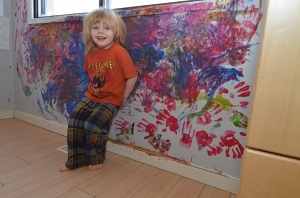
Ender posing in front of the “Kids’ Art Wall” in the kitchen:

Kids Wall 2

This was the little kids’ art wall: the toddlers went to town on it with tempera paint, and then the older kids came and added their handprints… they got a little over-enthusiastic and started to mark up our map, at which point I redirected…

Kids wall 1

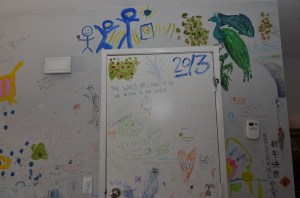
The older kids and adults put their marks here:

Whole Wall

This wall is the view that greets you when you walk up our entry way stairs into our main living area. It’s the wall that gets diritiest and most marked up in life. We were planning to repaint it at some point this year… in the interm, it’s our wall of awesomeness. Here are some close ups:

Wall Peacock

Wall 2

Wall Organs

Wall Classic Mark

And in the morning, we cleaned up the debris mostly together:

Child Labour

And that, from the kids-and-adults party through to everyone working together to clean up the mess–and everyone working together to create the art (and mess)–is family-centred living to me.

What is it to you? And how did you bring in 2013?

(By the way, if you didn’t visit Cloudy With a Chance of Wine’s Best of 2012 Blog Hop on New Year’s Eve–pop over there sometimes this week when you have a chance. People linked their best posts of the year, and there are some absolute gems to be discovered. I’m still working my way through the posts, because there are so many excellent ones to read one doesn’t want to just skim.)

Quote This: Pam Laricchia on expressing parents’ needs while affirming kids’ needs

English: A jar of coffee-covered chocolate beans

We can express our needs and choose to gift our kids with extra attention, extra supplies, extra anything. Expressing our needs helps them understand when we’re going above and beyond so it doesn’t become an expectation.

Pam Laricchia, Living Joyfully

This is an excerpt from Laricchia’s very thought-provoking post, The Unschooling Family: Considering Everyone’s Needs. You might also want to check out its sister post, Unschooling and the Power Paradigm. For non-homeschooling/unschooling readers, don’t let the label keep you from taking a gander: both of these posts are essentially about respectful parenting. Agree with her point of view, disagree, or fall somewhere in between–I bet her take on power within the family will make you think. And thinking’s always good, right?

Photo (A jar of coffee-covered chocolate beans) from Wikipedia… combining the two elements that are essential to fulfilling my own most critical personal needs… 🙂

English: Weighing scale, Galicia, Spain França...

More like this: It’s not about balance: creating your own family’s harmony.

Why so serious today? Sorry. Want to laugh? How about this one: Mom? Have you noticed I’ve stopped…

And if you want to read more about unschooling, pop over to our new Undogmatic Unschoolers blog. It’s very new and so very thin, but that means you can read everything on it really, really quickly.

Quote This: The universe’s random messages to you

Awards

From my fab friend and neighbour Crystal Moontree, who needed to hear this yesterday and thought someone else might too:

No heavenly being is waiting at the end of the line, giving out awards for sadomasochism. Give yourself a break.

Read In Praise of Calling It Quits at the Gala Darling Radical Self-Love Project for the full  context.

English: A Swingline-brand Stapler

From my “how could you move so far away from me” friend LD, via Unlawful Humour:

Whoever said nothing is impossible has obviously never tried to staple water to a tree.

I’d add… or clean a house with a three-year-old awake in it…

Agatha Christie

From Agatha Christie, via those annoying quotes WordPress chucks at you each time you post:

The best time for planning a book is while you’re doing the dishes.

No, Agatha, it’s not. But the kitchen sink’s not a bad place at which to rough draft blog posts.

Octobers of the past retrospective

Pumpkins, photographed in Canada.

Ender turned three this month, and when I started this blog in the Spring of 2012, I created a “fake” archive going back to October 2009–the point of his arrival. (I had to start somewhere, right? And where better than with a birth story?) So as October wraps up, I’m looking back at the highlights from three Octobers past:

Three years ago in October:

Any Way They Have to Come, October 21, 2009
The Last Three Minutes, October 15, 2009

Two years ago in October:

Why Ender’s Ender, October 14, 2010

One year ago in October:

Cinder and Flora Become Hellenic Pagans, October 25, 2011
Emergency Pig’s Ear, October 21, 2011
Don’t you know skin falls off? October 5, 2011

…and sending out belated Canadian Thanksgiving “thank you’s” to the universe for Ender, Flora, Cinder–Sean–and my entire, ridiculously privileged life.

Quote this: A.S. Neill on parents and the yearnings of childhood

Parents who have forgotten the yearnings of their childhood—forgotten how to play and how to fantasize—make poor parents.

A.S. Neill, Summerhill School: A New View of Childhood
(New York: St. Martin’s Press, 1993 [1960])

Paques01

Discuss. Do you think your recollections of childhood, of how you felt, what you thought, as a child (and a teen) are accurate? Do they help you be the parent you want to be? Or is Neill off base here? What do you think?

P.S. Happy third birthday, my sweet Ender. xoxo Mom

MOST POPULAR POSTS

My current favourite: The Authoritative New Parents’ Guide to Sex After Children (of course)

SeriousWhen toddlers attack (surviving “That Hitting Things”) • Searching for strategies for Sensitive Seven • Five is hard: can you attachment parent an older child • It’s not about balance: Creating your family’s harmony • 10 habits for a happy home from the house of chaos and permissiveness • The ultimate secret behind parenting: it’s evolution, baby

FunnyFloor peas • The rarest song of all • Sarcasm, lawn darts, and toilets  • What humanitarian really means  • The sacrifices mothers make for their children (Warning: grossness factor uber-high)  • It’s all about presentation  • Anatomy talk, now and forever  • Want to hear all the swear words I know?  • Of the apocalypse, euphemisms and (un)potty training  • Mom? Have you noticed I’ve stopped…  • Poisonous Volvo

Quote this: A Mother’s Prayer

I don’t pray… and I don’t really like reposting sappy “picture” quotes, but sometimes, one pops into an in-box or a feed at a time that you really, really need to hear it, and so it was with this one:

Oh give me patience when wee hands

Tug at me with their small demands.

Especially when I’m sitting at the computer desperately trying to meet yet another deadline… give me patience with those wee hands…

And give me gentle and smiling eyes.

Keep my lips from hasty replies.

I don’t want to ask for too much here: gentle and smiling eyes would be bonus, but let’s just focus on what comes out of the lips. Words are important. Words are important…

And let not weariness, confusion or noise

Obscure my vision of life’s fleeting joys.

Life’s full of weariness, confusion and noise. So be it. But yeah, let me keep half-an-eyelid and a quarter of an ear on the joy behind the noise and the weariness. Always.

So when, in years to come my house is still–

No bitter memories its room may fill.

If this were my poem, I’d end it differently. Because it’s not about what it will be like in the future, is it? It’s about how we want it to be now. And I want to be patient now, and talking-not-yelling now, and focused on joy now because… well, I’m living now. And this is my life now.

Via my friend Liz’s Facebook feed via Ask Dr. Sears via Mothering Magazine. Author unknown.

MOST POPULAR POSTS

SeriousWhen toddlers attack (surviving “That Hitting Things”) • Searching for strategies for Sensitive Seven • Five is hard: can you attachment parent an older child • It’s not about balance: Creating your family’s harmony • 10 habits for a happy home from the house of chaos and permissiveness • The ultimate secret behind parenting: it’s evolution, baby

A Quiet Moment

Photo (A Quiet Moment) by Glen Johannes Photography

FunnyFloor peas • The rarest song of all • Sarcasm, lawn darts, and toilets  • What humanitarian really means  • The sacrifices mothers make for their children (Warning: grossness factor uber-high)  • It’s all about presentation  • Anatomy talk, now and forever  • Want to hear all the swear words I know?  • Of the apocalypse, euphemisms and (un)potty training  • Mom? Have you noticed I’ve stopped…  • Poisonous Volvo

Sharing Allison Tate’s The Mom Stays in the Picture

Super quickly popping in to share Allison Tate’s The Mom Stays in the Picture, from HuffPost’s blog. Get the camera-shy, post-partum mother in your life to read this piece, and then take lots and lots of photos of her with her children.

The best quote from the post:

When I look at pictures of my own mother, I don’t look at cellulite or hair debacles. I just see her — her kind eyes, her open-mouthed, joyful smile, her familiar clothes. That’s the mother I remember. My mother’s body is the vessel that carries all the memories of my childhood. I always loved that her stomach was soft, her skin freckled, her fingers long. I didn’t care that she didn’t look like a model. She was my mama.

Now off to dress the toddler, clean the bathroom, feed the children, meet a deadline…

Quote this: Daniel Greenberg on patience

‎Of all the virtues required in the art of child-rearing, none is more important – – and none rarer — than patience, in parents, in family, in friends; patience to allow the miracle of human development to unfold according to its own internal laws.

Daniel Greenberg, Child Rearing (1987)

From my friend Swimming Through Stars.

Photo (Patience) by normalityrelief

Patience

“How to help 10-year-old boy with existential angst”

That’s the top search landing people on Nothing By The Book this week, but I’m not sure that you’re all finding the post that you’re seeking for. I think it’s this one: A love letter to the boy who’ll set the world on fire. I also think How I got deprogrammed and learned to love video games might contain some insight for some mothers of 10-year-old boys trying to understand what is going on inside their game-controller wielding sons.

I’m processing a bigger exposition on the changes my own 10–almost 10.5–year-old is going through, because it’s massive. The biggest one since five/five-and-a-half (I wrote about it here, Five is Hard: can you attachment parent the older child), and just as part of the solution at five was to make his world bigger, that certainly seems to be part of the key now.

But, that later. For now, I hope the love letter and the video game piece help you–spark off some ideas for what your little man is going through and how you can support him.

Jane

Game controller

MOST POPULAR POSTS

Serious: When toddlers attack (surviving “That Hitting Things”) • Searching for strategies for Sensitive Seven • Five is hard: can you attachment parent an older child • It’s not about balance: Creating your family’s harmony • 10 habits for a happy home from the house of chaos and permissiveness • The ultimate secret behind parenting: it’s evolution, baby

Funny: Floor peas • The rarest song of all • Sarcasm, lawn darts, and toilets  • What humanitarian really means  • The sacrifices mothers make for their children (Warning: grossness factor uber-high)  • It’s all about presentation  • Anatomy talk, now and forever  • Want to hear all the swear words I know?  • Of the apocalypse, euphemisms and (un)potty training  • Mom? Have you noticed I’ve stopped…  • Poisonous Volvo

Nature wins again

Party, party, I going to a party! My first party! I love parties!”

That is Ender, dancing in the bathroom while I try to de-grossify him. Four weeks short of his third birthday, he’s just been invited to his first official “tea” party. Flora’s friend Moxie is putting it on; Flora’s already there, and Ender can’t wait to go.

I’m struck, yet again, how different each of my children is from the others–the girl from the boys, the boys from each other. At age three, Cinder would never by his own choice go to anything that looked like a party of a crowd. I remember his analysis of his third–and for a long time, his last–birthday party:

It was ok. It would have been better if all those people hadn’t come.”

Cinder made his first friend when he was… 7. (And, oh, man, what a relief that was to me! Look! He does want to play with others!) He’s still very selective about who he spends time with. He’s got three close friends, and no room in his life or needs for more. Flora is “lonely” if she’s spent the day playing with just three friends. She just started a new music class–seven little girls, all new to her. She’s thrilled. “I wonder which of them I will like best, and which ones I will become good friends with?” she muses at the end of the first day. “Junie is really, really pretty. And Billie Joe is a little shy, but I think she’s really sweet.” In the same situation, Cinder would be … if not petrified, then immensely uncomfortable.

Ender is more on Flora’s end of the social spectrum. Everyone he meets is a friend. A new baby is crawling around at the back of our Tang Soo Do gym. Ender crawls with him. Tickles his tummy. (Thinks about pushing him over–fortunately, I catch that in time.) The baby’s not there next time:

Where my friend? I miss my friend!”

We walk home in the dark from the firepit, and a bike whizzes by. “Who that?” Ender asks. I’m not sure, I didn’t really see. But he saw enough to identify the person:

That my friend Mingo! He play ball and trampoline with me! I love him!”

“Was that Mingo, Cinder?” I ask my eldest. He looks at me. Shrugs. “Dunno. Some guy on a bike.” Mingo, incidentally, is closer in age to Cinder and more Cinder’s playmate than Ender’s. But, but–them two boys, they relate to the world in such different ways.

It’s at moments like this, when the contrast between these two boys–or all three of my children–is so pronounced, that I almost give up on investing anything in nurture. You know? Nature just seems to trump everything. Cinder is Cinder; Ender is Ender; Flora is Flora; and there’s nothing I can do to affect their essential nature.

Except, of course, that nature needs nurture. If nature is the raw material, the unalterable building block, nurture is the sculptor. Nature is the inclination and the impulse; nurture the habit and inner–first outer–“discipline.”* Nature makes Cinder an ever-moving ball of energy; nurture’s given him the tools to channel that energy. Nature’s given Flora the universe’s most tender heart; it will be nurture that will help her find ways to protect it when she must.

(I’m afraid to pontificate on what Nature’s determined for Ender. Let’s leave that one be for now, shall we?)

Party, party, party!”

Ender hollers. “Let’s go!”

I don’t have to come, right?”

Cinder checks in. Nope. Not this time. And off we go.

The Agile Gene, by Matt Ridley (book cover)

If Nature versus Nurture is an argument that keeps on popping up in your head, you might enjoy Matt Ridley’s The Agile Gene: How Nature Turns on Nurture (originally published as Nature via Nurture). It’s an interesting read–and here’s a video of a Ridley lecture at Princeton if you just want a sample, and here’s Matt Ridley’s blog.

From Ask Moxie: Free But Not Cheap

A very interesting post about motherhood as job versus relationship, Free but Not Cheap, at Ask Moxie. Moxie’s post in a nut-shell:

If we think it’s a job, then nothing makes sense about it. How is it possible that it’s so important but also so undervalued? How is it possible to be a good mother if you’re with your kids 24/7 but also be a good mother if you leave them to go work for a good part of the day? How can we take such satisfaction from being with our kids but be so bored by all the stuff we have to do for our kids?

But motherhood makes sense when you realize that it’s a relationship. Loving and nurturing your child is the relationship you have with your child. That’s why when you have a bad day as an adult, you still want your mom (if you have a good relationship with your mom) even though she isn’t making your meals, changing your clothes for you, driving you to work, or doing any of the stuff moms of kids do.

(Italics mine.)

My sister-in-law and I were talking yesterday, as our little Neanderthals threw rocks at each other at the playground, about the cost of childcare and the paradox that this thing we say is the most important thing in the world–raising children, creating the new generation of citizens etc. etc.–is hands-down the worst paid job in our society… and at the same time, “too expensive”–with a price tag that makes even high-earning people gag. We pay people more to clean our houses than to watch over our children.

What message does that send to any parent contemplating pausing career-building or bread-winning in favour of being the primary caregiver for their own children?

That thought threatens to take me into a digression, and I need to “be with” my children, as well as “do stuff for” ’em, so I’ll just end with this: Motherhood. A relationship. A state of being. Not a job.

Motherhood.

Sunshine of our lives, or, how toddlers survive

Sunshine, morning, so slow, so lazy… do we get out of bed or not? I guess we should. I tousle the toddler’s head.

Jane: Ready to get out of bed, little Ender?

Ender: Ready. Not ready. Ready. OK. Let’s go, Big Mama.

And we roll out, slowly, and fat sweaty hands wrap around my neck, and we gallop down the hallway. Everyone else is up already. I poke my head into the Lego/Computer Room/Sean’s office, where Cinder is already hard at work… er, play.

Jane: Good morning, little love.

Ender: Good morning, little love.

Cinder: Yo, Ender, how are you doing this morning?

Ender: Me happy, little love. But me need to pee.

And we gallop down the hallway the last two feet to the bathroom. Make it. Relief. We poke our heads in through another door. See the Sean.

Jane: Good morning…

Ender: Good morning, our big love.

And kisses and tousles and sunshine. And Ender is ready for a day of action and destruction. There are things to shove down sink drains and toys to put in toilets, there are pictures to scribble on and books to tear up, there are milk jugs in the fridge that need to be poured onto the floor, pots to bang and rearrange, boxes to squash, a dog to terrorize, a fish tank that desperately needs a bar of soap added to it, a sister’s hair to pull, a brother’s Lego creations to destroy, food to smear on walls and throw on the floor, bathwater to drink and pour down the stairs… Oh, it’s a full, full day for an Ender and he lives each minute as fully as possible, and at day’s end, everyone exhausted to bed goes, exhausted by the pace of life set by the Ender.

And Ender falls asleep, exhausted too and so happy and so fulfilled, and already, I can tell from the cast of his eyes and lips as they close, planning the next day’s mischief. And so we all fall asleep too, so we can keep pace with him.

We yell at him, you know. Snap. Complain. Sometimes, run away and hide (even me). But, boy oh boy, we love him. And when he wakes up the next morning, sunshine of our lives, we forget all the “I want to throttle Ender!” moments and just drown in his sunshiney love.

Ender: Good morning, Big Love Mama.

Jane: Good morning, love of my life.

Ender: No. I not love of your life.

Jane: No? What are you then?

Ender: I littlest love in the house.

Jane: Good morning, littlest love in the house.

Ender: Let’s go play. Outside?

Jane: Let’s pee and have breakfast first.

Ender: Let’s pee. Then me put something in toilet. Maybe Lego. Maybe car. Maybe… pee! Hee hee hee hee.

And the day begins anew.

Sun

The problem with environmental education

A trail at Jacobsburg Environmental Education ...

Wondering why your uber-environmentally aware kids don’t like to play in dirty. Read Look, Don’t Touch: The problem with environmental education, by David Sobel in Orion Magazine.

“FOR SPECIAL PLACES TO WORK their magic on kids,” wrote lepidopterist Robert Michael Pyle, “they need to be able to do some clamber and damage. They need to be free to climb trees, muck about, catch things, and get wet—above all, to leave the trail.”

…and then take your kids to some wild, wild spot where they can climb, run, catch things, get wet and dirty… and fall in love with our planet.

via my lovely friend Brooke and her awesome “leave the trail” family.

Photo: A trail at Jacobsburg Environmental Education Center (Photo credit: Wikipedia)

Between the carrot (cake) and the fork

The stream from the watergun catches me under my skirt and I holler. And then the little bum shoots again. “Cinder!” I yell, tossing my own empty water gun far, far away from me. “Look, no weapon! I’m out!” He blasts me again.

“Dude! Remember that carrot cake we’re planning to get when we go to Eau Claire? There are two distinct futures ahead of you. One of them involves eating a delicious carrot cake. The other has me poking you in the bohunkus with a fork. Which one are you going to choose?”

My friend Neela, skirting the edges of the water gun fight, laughs. “That’s an interesting parenting technique,” she says, half-serious. “You should blog about it.”

“And call it what, how to disguise threats, punishments and rewards with words?” I ask. I’m soaking wet. Cinder’s backed off; he’s chasing Flora and her friend Jenny now. They’re still fully armed and firing back.

Neela gives my flippant statement serious thought. “Words are powerful,” she says. “Syntax, semantics, all that matters. I’d never say, ‘If you get into your pajamas, girls, I’ll get you ice cream.’ But I do say…” she thinks for a moment… “Oh, ‘Girls in pajamas who report to the kitchen will get ice cream.’” She laughs. “Because, you know, ice cream before bed is a routine snack in my house.” (I leave it up to you to determine if she’s joking or not… or if it matters.)

Neela and I round up the combatants and take them to Eau Claire. The moms get coffee; the kids sweets. Cinder gets carrot cake, not a fork in the bohunkus. Flora gets a lecture about gratitude, and Neela and I talk about … gratitude, entitlement, and the too-easy-too-cross line between coercive discipline and … what? we’re not quite sure what to call it. Words, words, words. But as Neela said before, and says again, words are important.

Cinder’s running around, stealing Jenny’s shoes in order to lure her off the blanket where she’s chatting with Flora and get her to chase him. Then he plays Frisbee with Ender. Then returns to “annoying the girls.” Later, he’ll tell me, “Well, the trip wasn’t a total loss. I got to annoy the girls.” “D’you have to do that?” I’ll sigh. “It’s sort of my job,” he’ll retort.

And my job, as Cinder’s mother, is to… well, to make sure that the “annoying the girls” doesn’t cross a certain line. To encourage peace and harmony when possible, and to minimize the bloodshed (usually metaphorical) and help negotiate truces and separations when necessary.

And to muddle along that path the best way I can, on any given day, in any given moment. And yeah, sometimes it means waving the carrot (cake).

(You know I’d never really poke him in the bohunkus with a fork, right? He knows I’d never do it. I’m pretty sure he knows… hold on. “Cinder? Do you think I’d ever poke you in the butt with a fork?” Pause. “Probably not. Um… Well, you might.” “Really? You think I’d…” “I think if I poked you first, you might.” “But you’re not gonna, right?” “Well…” Fuck. Not exactly the reassurance I was looking for…)

The muddling continues.

English: Carrot cake Deutsch: Rüeblitorte, Kar...

For “Neela.” Based on events of August 1, 2012.

Quote this: Peggy O’Mara on “inner voice”

The way we talk to our children becomes their inner voice.

– Peggy O’Mara

via Facebook (what else) from The Silver Pen

My children’s inner voice has been short-tempered and prone to lectures lately. Just so you know.

Your Inner Voice is Wrong

Your Inner Voice is Wrong (Photo credit: Thomas Hawk)

Saying yes

Say Yes, a post by Catherine Arveseth from The Power of Moms, arrived in my in-box earlier this week via my good friend Crystal. As we prepared for our trip to the wilds of ‘Toba, it was a timely reminder for me… “Yes, you can take the waterguns.” “Yes, we’ll throw the scooters in.” “Yes, we’ll buy those Peak Freens cookies for the road.”

I dream of getting into the car with one suitcase. And sometimes, I get to, and sometimes, they have to leave their markers, stuffies, balls (“Ender, seriously? Three balls? Baby, one soccer ball in the car. One.” “Two?” “One.” “Two?” Damn you, Bambi eyes) and what-not behind. And I know that from that bag of toys, one will be played with. So be it. “Yes.”

We default to “No” so easily. Because we’re tried. Because we don’t want to go up (or down) the stairs one more time. Because we don’t want to clean up the mess. I like to think our house is a “yes if possible” environment, but… we all default to “No,” sometimes, often for a not very good reason.

From Arveseth’s post:

“Yes is air” writes Ann Voskamp. “In the rarefied oxygen of that one word, ‘yes!’, the dreams breathe deep and the body exhales joy. I embrace [the] mess and try to be done with the slow suffocation of ‘perhaps’ and ‘we’ll see’ and ‘maybe’ — the biding of time till the visions wither limp — and every day I try to remember that control smothers and fear asphyxiates.”

I’d add two points to this.

First, there are so many moments and days in a child’s–a person’s life–when the No is inevitable. When you as a parent have to say no, because the request is not feasible–dangerous–impossible. Or when the world says No, because, well, that’s just the way the cookie crumbles in 2012. Or when you’re doubled over the toilet vomiting and there isn’t an ounce of strength left in you to say “Yes” to anything… anything.

Second, when “No” is not the default mode, when it’s pulled out only when really necessary–it has way more power. It means… “No.” Rather than, “No, but if you whine and complain and argue enough I might change my mind. Or, “No. No. No… why are you doing it anyway?”

So. I’m writing this just before our trip–you’re reading this while I’m already on it. My task for myself: to be conscious of “Yes.” To default there. To really think hard before I say “No.”

I’ll report back on how it went when we come back. Including on how soccer balls I was conned into putting into the van…

A football (or soccer ball) icon.

Life lessons from large families

I (accidentally) zipped through Meagan Francis’ Table for Eight last week, a book about living as a large family in a small family world (irrelevant aside: ended up on my Kobo because I thought it was a “big cook” cookbook–you know, recipes up-sized for large groups?). We’re not really a large family–three kids, two adults, one small, but troublesome dog–but most of the time, I have an extra kid or two or three in tow or in the house–and many of the families we spend most of our time with are three or four or more kid families, so there were many parts of the book that resonated with me on some level. And some parts that I experienced purely as a voyeur, sometimes rather glad it wasn’t me having to figure out how to sort eight kids between three bedrooms… and sometimes regretful that Ender won’t have a sibling close in age to bunk with.

My favourite line from the book:

“Surrender to motherhood … but don’t give yourself up entirely.”

I found that quote, and Francis’ entire “Time for Mom” chapter quite in synch with my thinking around family time, self-actualization and family harmony.

Another tidbit that really resonated with me (and then had me pondering, “But what does this say about me, really?”) was this:

Part of the way I keep my life simple is by gravitating toward emotionally healthy, stable people who don’t pick fights with me or each other. … The way I look at it is this: I spend a lot of time with emotionally immature people: my children. They’re still growing and learning about social interaction, and it’s my job to help them. I just don’t have the time to deal with emotionally immature grown-ups, too!

Yup.

(Although, I have to confess, I sometimes see this as a character failing in myself. Am I just too selfish and intimacy-averse to enter into your latest drama? To offer you the support you crave? I don’t know. Perhaps. But as a result, I’m pretty balanced, stable and undrained myself, so if that’s what selfishness looks like, so be it.)

The best lesson from the book, which took me almost 10 years and three kids to figure out:

I was at a family party where the food was laid out buffet-style… I filled a plate for myself, sat down, and ate, and then called them to the tabe.

“What kind of a mother feeds herself before her children?” my grandmother asked.

“A full one,” I retorted.

I’m not extrapolating this one to anything other than food: read nothing else into it, but take the food lesson as it is. It took me almost 10 years of cold coffee, half-chewed food, food thrown into my mouth as it was leaving the table, after-thought meals that weren’t really meals, to learn to eat well, regularly–and often before feeding the children. Now I eat first whenever I can (with babies, nurslings and toddlers, it’s not always possible, but one must seize the moment). I eat well. And everyone’s happier. (Including the thinner and more energetic me.)

English: Come on Kids! I know where to get som...

Interest piqued about Table for Eight, but not sure if it’s for you? Here’s a review of the book from the website Lots Of Kids, and here’s Francis’ blog, The Happiest Mom.

The Myth of the Frazzled Modern Mother

Today’s mothers are frazzled. Falling apart. Utterly incompetent, overwhelmed and unable to cope with the demands of daily life. At least that’s the impression you’re going to get from pretty much any day’s sample blogs, “lifestyle” newspaper articles, or just about any column in the ever-proliferating parenting magazines and advice sites.

I disagree. Vehemently. I’m surrounded by extremely competent and on-top-of-it mothers. Heck, 9 out of 10 days, 9 out of 10 hours, I’m that extremely competent mother myself. And you know what? So are you. And that whiney blogger over there? And that friend of yours who posts nothing but negative status updates on Facebook? She’s a competent mother and human being too. Really.

She’s just making herself look bad—frazzled—incompetent—by putting what used to be private moments of despair and downtime out there in the public sphere, for everyone to see… everyone to comment on.

For everyone to remember. Hyper-focus on. But that’s one moment. One hour. One crappy day. OK, maybe a string of crappy days—in what’s actually a pretty good life.

I live a pretty good life. And yeah, I have moments of panic, frustration and utter madness. At times stretches of arduous tough days: those first weeks (months) post-partum. Never-ending flus. Life-altering illness and events. Confluxes of life events when everything piles on top of me and I want to throw myself a big pity party or crawl under my comforter and never come out.

But those are exceptions in a full, fulfilling, fun life. Exceptions (on topic: my friend Marie had a great post recently about her mantra “There are no bad days, just bad moments” and how it works on “one of those days”; have a peek). Most of the time, I’m pretty on top of it. Damn-right competent. And baby, so are you.

 So here’s the big question of the day for you: is it good to broadcast those moments of despair? To post “So tired!” “If only they would sleep!” “Could anything else go wrong on this shitty, shitty day?” as your Facebook status? To blog about “the worst day ever?”

I’m not sure. I can see how you can build a cogent argument for each side. Sharing them crappy moments is the first step to getting support, a “I’ve been there too!” from a friend—which is sometimes all you need to shake off the blues and move on—or an offer of child care or food delivery—which you desperately need to get through that day or moment. But because you’ve shared them in the public space… well, they’re there, reminding all and sundry, including yourself, of that bad moment, bad day. Contributing to the Myth of the Frazzled Modern Mother.

Long after you’ve moved on.

What do you think? Are you a frazzled mother? Is it a myth? Do you inadvertently contribute to it? What can we do to combat it? Or, is it real?

A few days after I wrote the first draft of this post, I stumbled across this lovely post by Amy at Small World at Home, “What I don’t show you,” which isn’t precisely on this topic–but fits into the larger discussion of presenting in public space. More food for thought…

B0007445 Postnatal blues

Postnatal blues (Photo credit: wellcome images)