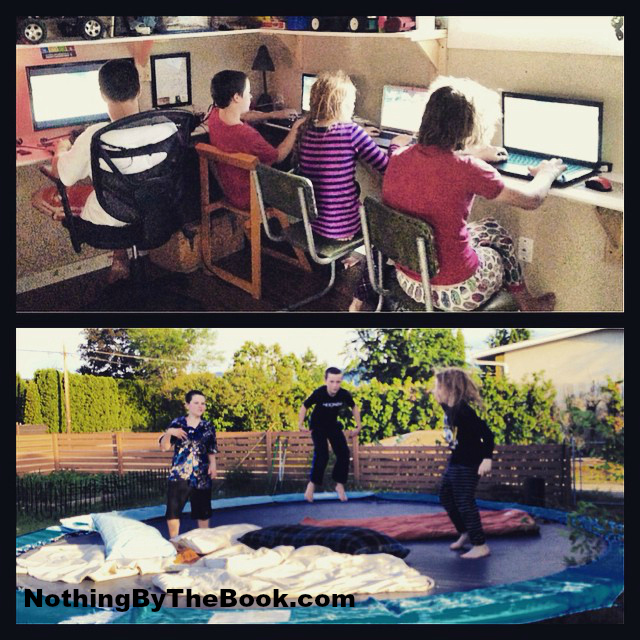
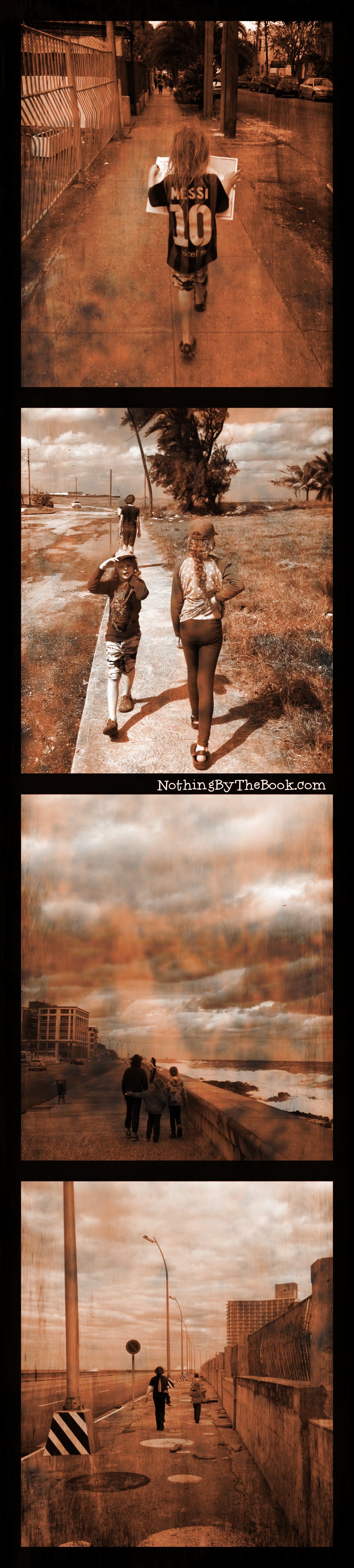
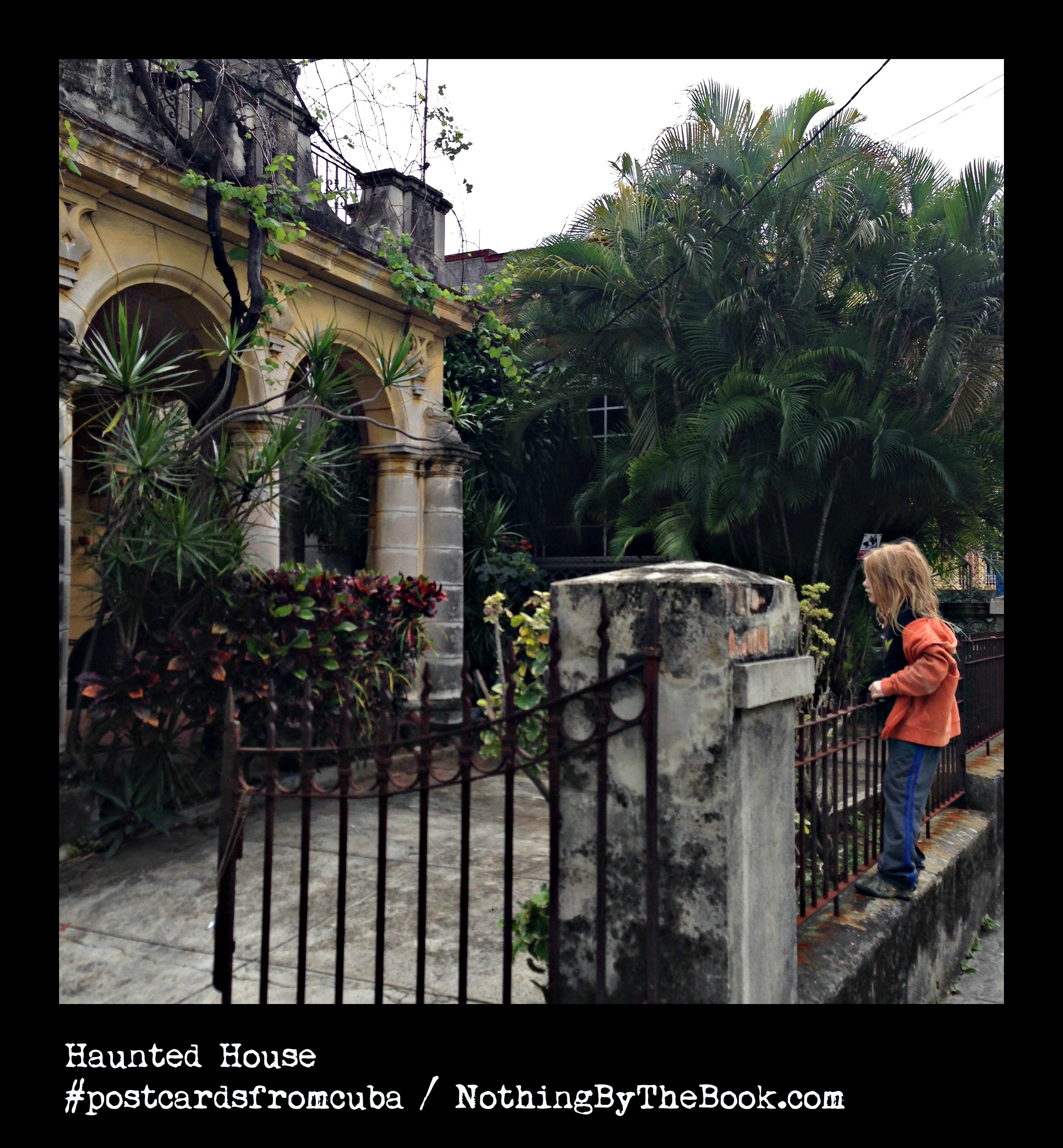
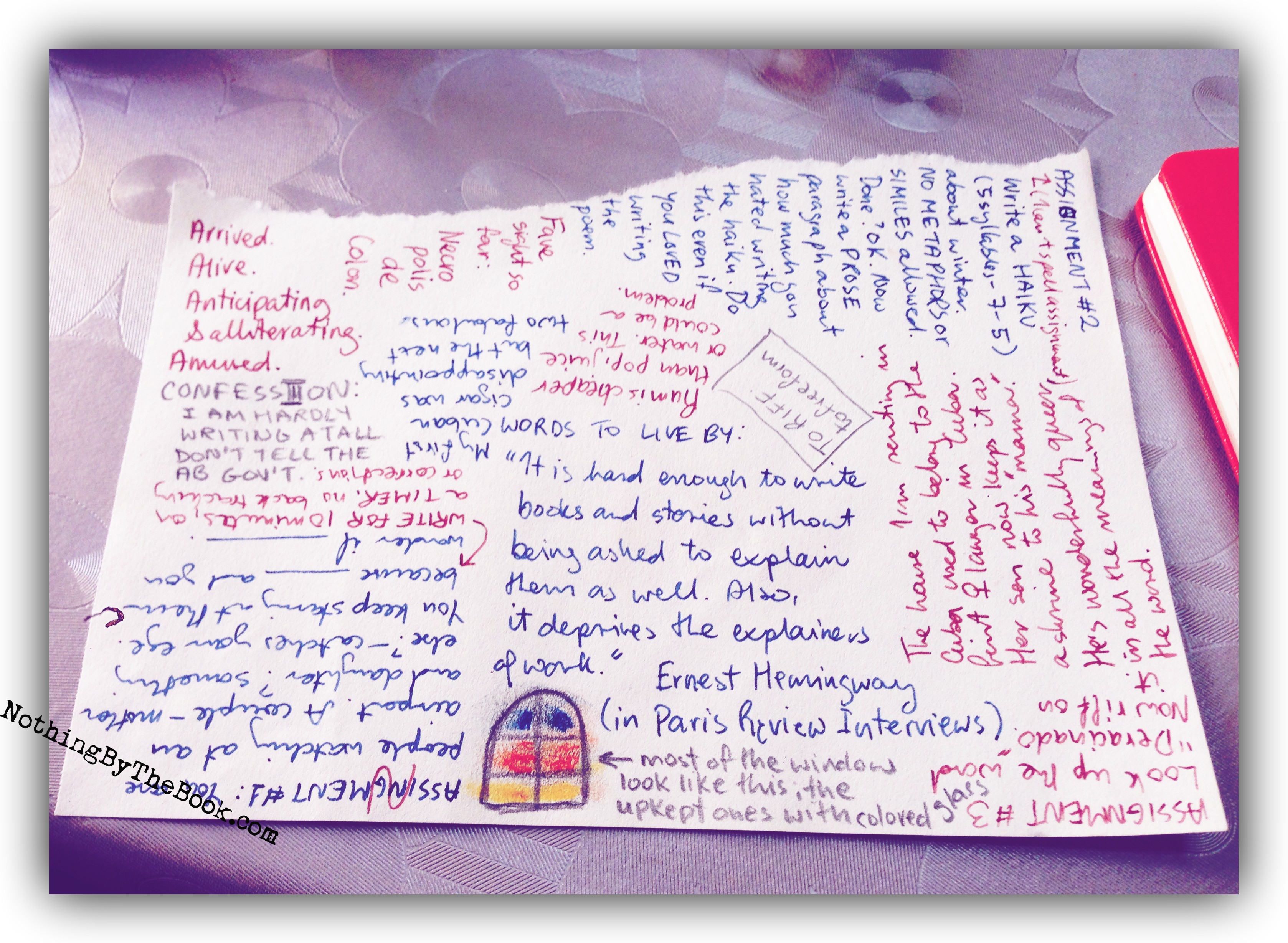
in-between the essays, there are messy journal entries. Such as this one:
listen:
& read:
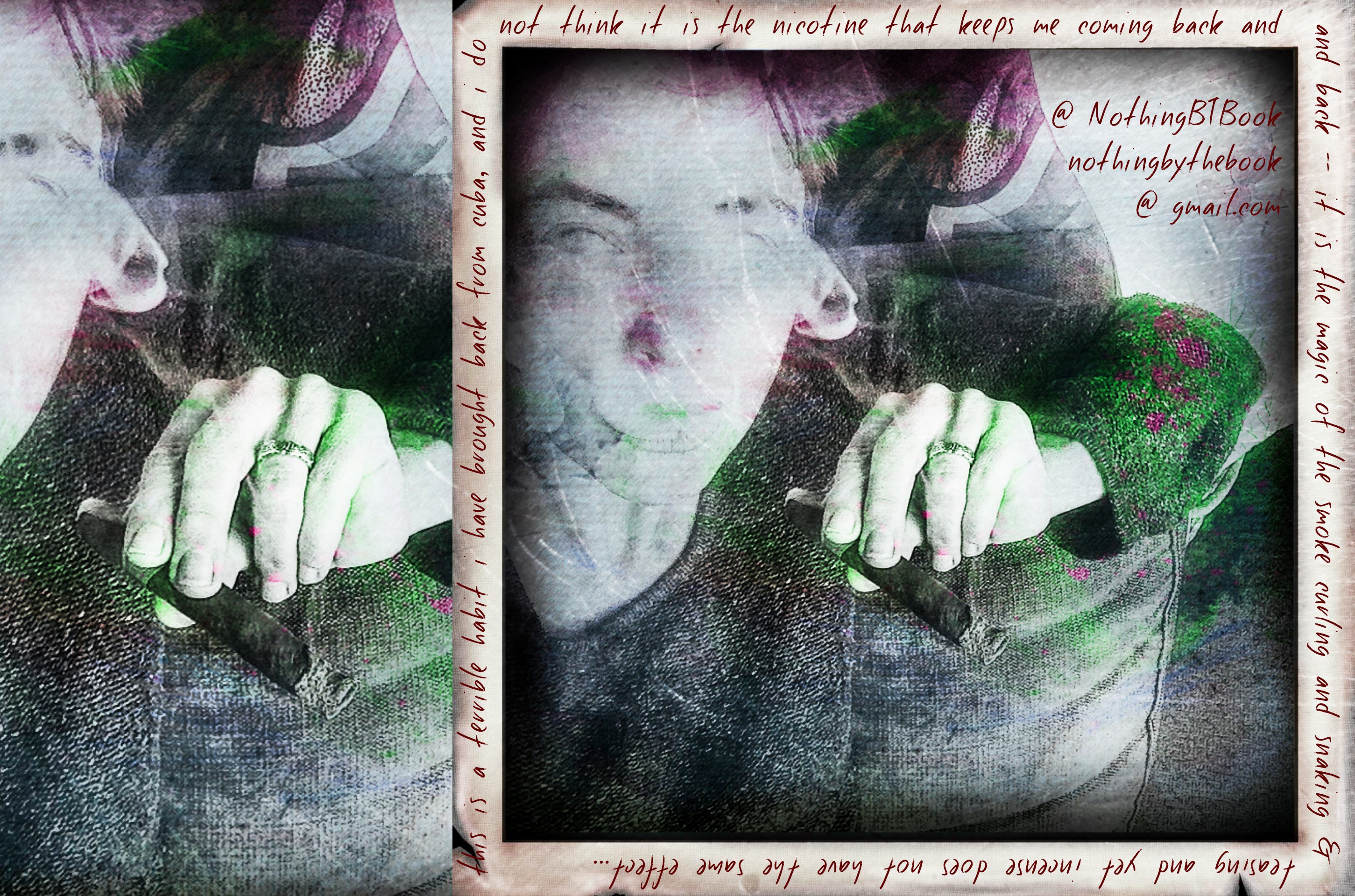
Today, the tar from the cigar sits heavy in my lungs. The night is heavy—the air has been heavy all day, and my body feels heavy too—leaden—my mind, my heart as well.
I am suddenly aware of the weight of my… toes—the weight of the life the old man from whom I bought the cigar leads. The weight of the cigar, grasped between two fingers seems immense, and so does the weight of every word I write.
28.i.2016
*
This month’s Postcards from Cuba are brought to you by my creative and illogical approach to finance. You can help! Be my patron, won’t you? Support Postcards from Cuba and Nothing By The Book. Buy me a coffee? A $5 donation is delicious:
& no, you don’t have to have a PayPal account to use the button. Thank you!
For every farmer and back-to-lander there ever was, especially the Sunnyside Community Garden folk.
Listen (a seven minute commitment):
& read:
prologue
Hi, Mom.
We’re all well and things are good. We have eggs! Long story—I’ll tell you about it when I get back.
I am not starving your grandchildren, but meat protein continues to be a bit of a challenge. We bought some inedible sausage the other day—I felt so bad about wasting it, but I had to throw it out. But the dumpster cats enjoyed it.
I found a butcher who’d sell to me—in most of the butcher shops near here, the meat is only available on the ration card, to Cubans—but it was pork hanging out in the full sun for god-knows how long, and it made me think about Islamic and Jewish prohibitions against eating pork… and you know what? There’s probably something in them. So we’re mostly eating chicken.
No first world whine—the chicken’s just fine.
Last Sunday, the supermarket was mobbed by a crowd before opening time, so I joined the line in case they were delivering something good—and it turned out to be chicken breasts—that kept us going for a full week. This week, there were chicken legs and thighs—imported from Brazil, and, judging by the Arabic writing on the packaging, destined for Algeria.
Still, between the eggs and the ice cream, we’re doing pretty good. J
M.
I.
Cinder: “We’re not eating a lot of vegetables while we’re here, are we?”
Dammit. If he—who tries to convince me that ketchup and salsa are vegetables back home—is noticing this, we really must be vegetable deficient.
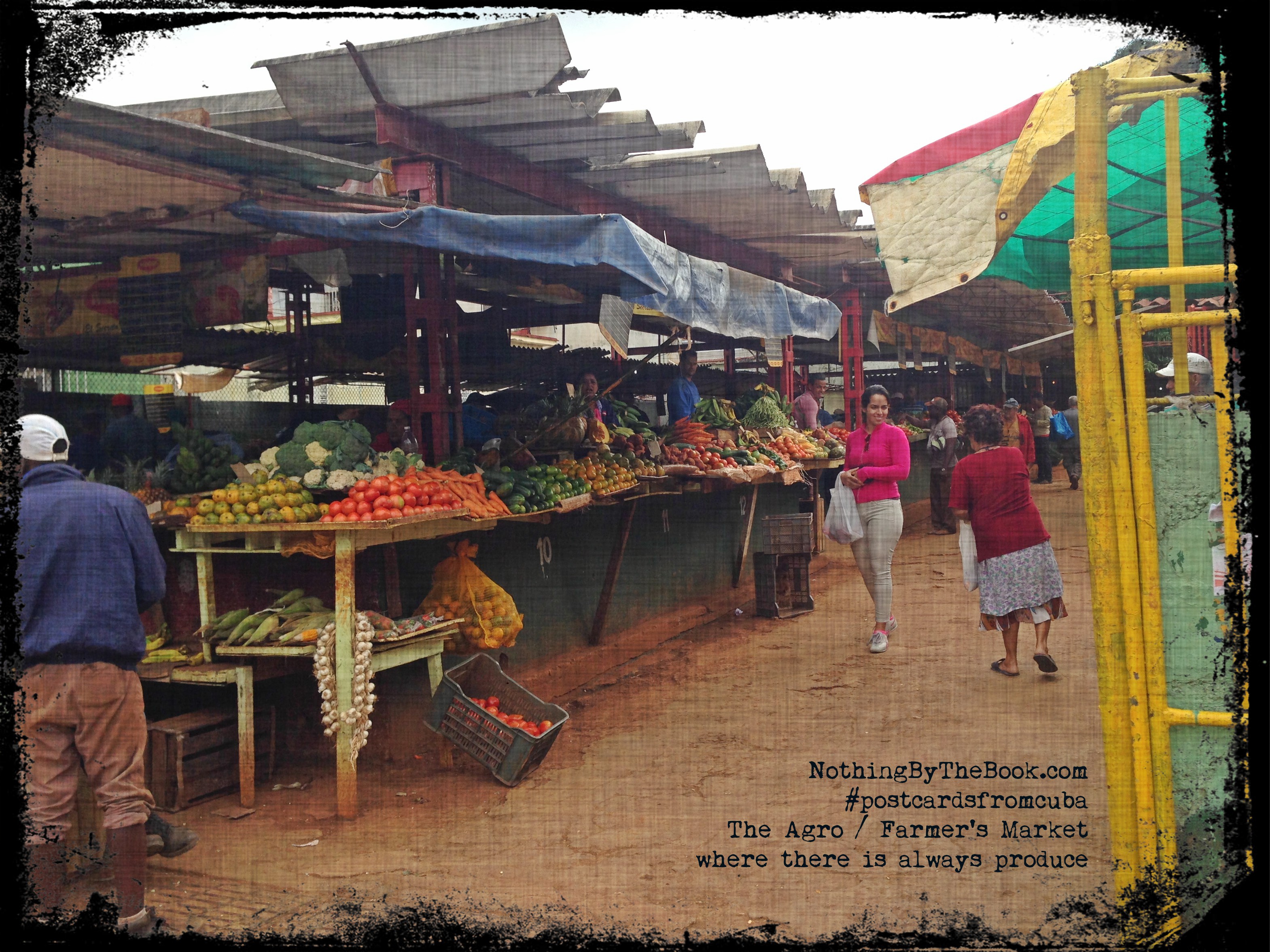
Jane: “I’ll go to the Agro when I go to pick up the matches. Anyone want to come with me?”
Cinder: “Nope.”
Flora: “Not really.”
Jane: “Really? No one? I’m pretty sure I get better prices when you guys are with me.”
Ender: “I’ll go with you. But only if you buy me ice cream after.”
Blackmailer.
Jane: “Deal.”
II.
I pay $2 pesos (CUP, or moneda nacional) for a box of matches—which seems to be excessive, because a street cigar also costs $2 local pesos, and a cone of ice cream $3, so, $2 pesos? Really? The unshaven man wearing unmatched shoes is insistent, and I need matches, so I fork over another coin—but don’t buy cigars from him.
$2 CUP, as far as I figure it, is $0.08 CUC (but don’t take my word for it, my Cuban math sucks), which is a perfectly reasonable price to pay for a box of matches… it’s just that shouldn’t a box of matches—especially of matches that don’t work that well—cost significantly less than a cigar?
(I find out later that $2 pesos is the standard street price for matches. Who knew?)
Matches in one hand and Ender’s sticky hand in the other, I hike over to the Agro… which is empty. Closed. Fuck. It’s Monday. Of course.
Vendor: “Hey, woman who hates my tomatoes—you want to buy some fruit?”
It’s one of the vendors from whom I’ve bought beans, bananas and carrots—from whom I refused to buy tomatoes—and whose brother asked me if I wanted to buy lobster. Which he was lugging around in a backpack.
I didn’t buy it.
Jane: “Yes… but I see you’re closed.”
Vendor: “That’s not a problem. Come in.”
I follow him through the gate—his father (genes, they be powerful things) blows me a kiss and makes a face at Ender—into a back room full of crates and agro workers, who are allegedly sorting… but mostly chilling and smoking.
Vendor: “We have everything, everything. What do you want? We have bananas, mangoes, guava, papaya…”
Jane: “Tomatoes?”
Vendor: “I remember you hate my tomatoes, but today we have beautiful tomatoes.”
He’s right. They’re gorgeous—by which I mean neither rotting nor green. The bananas, alas, are falling apart, and so are the mangoes. I’m regretful—I’ve been dying to try one of the giant Cuban mangoes, but it’s between seasons, so they’re all rotten.
He finds me a bunch of bananas that are still more yellow than brown—ripe, lusciously sweet, but not yet liquid. Another bunch that he says I must eat today. I don’t want to take it but it’s too late—it’s in my bag.
Vendor: “What else?”
What else? I look around.
Jane: “Cucumbers. Not limp ones like last time.”
Jesus. I can’t believe I said that. Everyone in the room starts howling while I turn red, and I pretend I don’t understand what he says next.
Vendor: “Casava?”
Jane: “No.”
Vendor: “Still haven’t learned how to cook it?”
Yeah. Not a clue what to do with it. Cut it? Bake it? Shred it?
Jane: “Carrots?”
Vendor: “Um… no carrots. Oranges?”
Jane: “No, I don’t like the oranges.”
Vendor 2: “These are incredible, delicious, oranges.”
Jane: “I haven’t had good oranges in Cuba yet. They’re all sour.”
Vendor 2: “No, no, these are delicious, so sweet. Hold on, I’ll peel one for you.”
Ender starts dancing—he’s my orange-loving Orange Boy—and he’s missed oranges, and resented my refusal to buy them (after the first few purchases of inedible green balls of sour juice-less-ness). To my surprise, the orange is actually orange inside and juicy and delicious.
Vendor: 2: “Yeah?”
Jane: “Yeah.”
Vendor 3: “How about guava? Do you like guava?”
Jane: “I love guava, but this is too…”
I can’t remember the word for rotten—that would be rude anyway—and I’m afraid to say soft.
Vendor 4: “Here, this one is perfect. No charge.”
I hand over $5CUC for a pound or two of tomatoes, two cucumbers, three pounds of bananas, and a bag of oranges I can barely lift. “Oh, I see limes, give me a lime,” I add. They give me a lime. And change. I give it back. “For the service.” “No, no.” They shake their heads.
Put more limes in my bag.
Jane: “Enough, enough!”
III.
Flora: “Did you get any meat?”
Jane: “Um. No.”
Flora: “What did you get?”
I empty the bags onto the kitchen counter.
Cinder: “Wow, are you worried we’re going to get scurvy?”
Jane: “Maybe a little.”
Cinder: “You shouldn’t be. What about all that orange pop we’re drinking?”
Right. Fortified with Vitamin C?
Maybe?
*
This month’s Postcards from Cuba are brought to you by my creative and illogical approach to finance. You can help! Be my patron, won’t you? Support Postcards from Cuba and Nothing By The Book. Buy me a coffee? A $5 donation is delicious:
& no, you don’t have to have a PayPal account to use the button. Thank you!
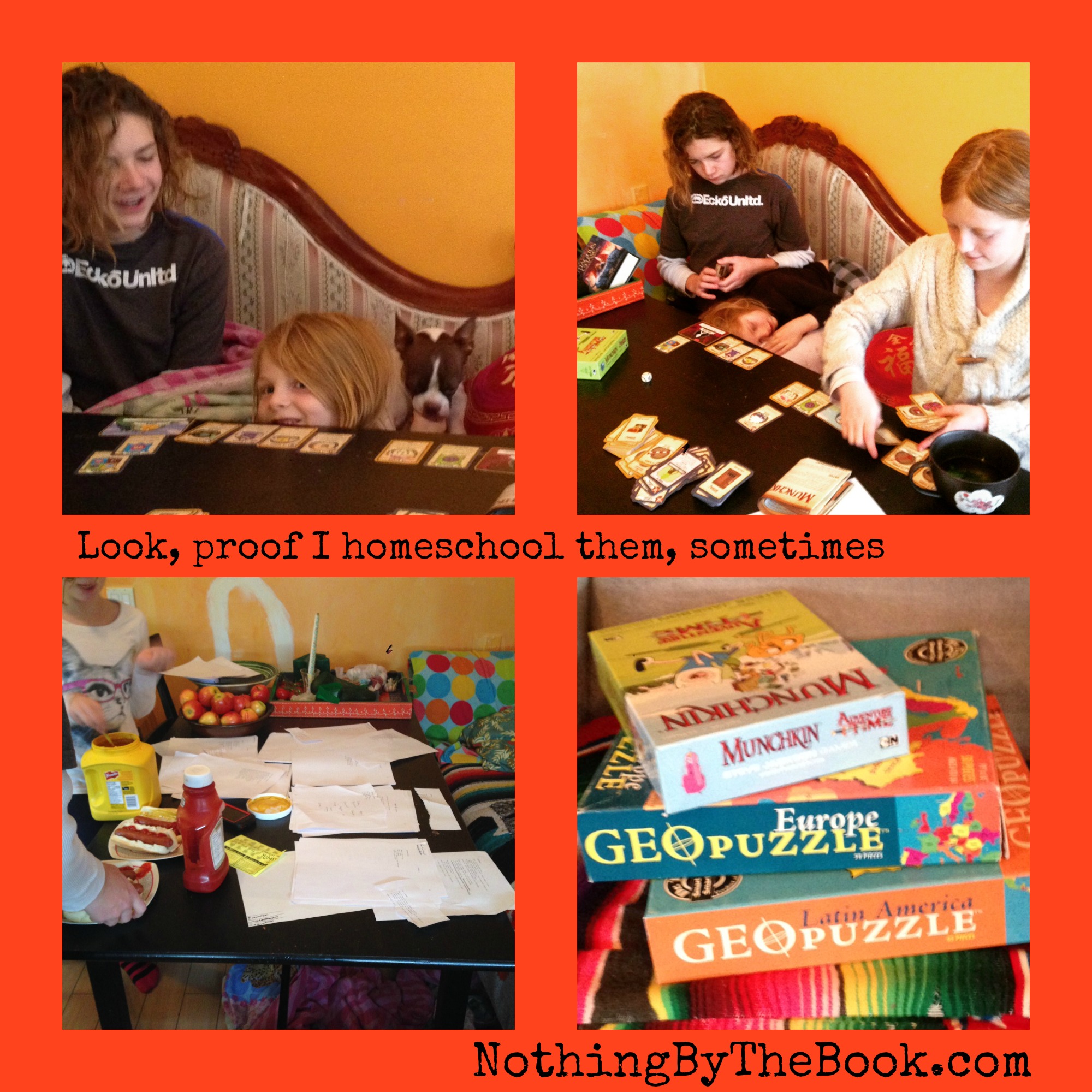
For everyone whose kids aren’t heading back to school today, in appreciation of the path you’ve chosen to walk. Never a dull moment, is there?
And, for everyone whose kids are heading back to school today, who, 10 years later, are still asking me, “But how do you do it? And what is it, exactly, that you do all day?”
And an extra-special thank you for Sean Lindsay to capturing the event on video so that those of you who weren’t there can see me call Yo-Yo Ma a violin player.
(I was very nervous.)
The transcript of the speech I was supposed to give follows the video. Obviously, I departed from the script just a little…
Prepared speech
All right. Unschooling. Let’s have a quick poll. Who here is familiar with the concept, philosophy, whatever you wanna call it? Who thinks it’s the best idea ever and that’s what they’re going to do with their kids? Awesome. I love preaching to the choir… Who thinks it’s totally kooky and only crazy people would do it? Who equates it with unlearning and unparenting?
Don’t be shy to tell me so—when I first heard of unschooling, I was kind of appalled. And, here I am, 10 years later, its fourth biggest advocate.
Its first, second and third biggest advocates are my three children.
Unschooling, as most of you know, was the term coined by homeschool advocate John Holt—and I’m sure you’re all reading all of his books and Growing Without Schooling articles—they’re all archived on the web—if you’re not devouring them, do, they are absolutely inspirational.
John Holt used the term unschooling to refer to homeschooling in general. Holt thought that the best and most important thing about homeschooling was that it not duplicate school in the home environment.
Since then, the idea of unschooling, and the term itself, has acquired all sorts of definitions and sister terms, including delight-driven learning, free range learning, child-led learning, interest-led learning. There are as many ways, today, of defining unschooling as there are families who call themselves unschoolers.
The thing most people think we have in common is that we are curriculum-free—or at least curriculum-light. The actual, much more important thing that I believe all unschoolers have in common is that we love learning and we believe our kids love learning and we believe our kids will learn whatever they need to learn as they need to learn it.
This is both unbelievably easy and unbelievably hard.
It also starts, not with believing in your child, but with believing in yourself. To be an effective unschooling parent, you need to love, crave, delight in learning new things. All the time. And be confident that… you can do it. That when you need to learn Japanese—you will sit down, grit your teeth, do the work, and learn Japanese.
If you don’t have that trust and confidence in yourself, you will not have it in your children.
So I actually have an assignment for all of you who are thinking about unschooling. I want you to think about something you’ve always wanted to know how to do—and, starting tomorrow, I want you to start working on it. Japanese? Knitting? Car maintenance? Worm composting? It doesn’t matter what. Something.
It’s possible that you’re a little out of practice at chasing your passions and your interests. Before you start helping your children on their unschooling journey, launch yourself. Be passionate about your life, your interests, your learning.
I think that’s a critical prerequisite for being an unschooling family. The parents have to be committed life learners too.
My second assignment for you, if you are thinking about unschooling, is to commit a month to—are you ready for this?—doing nothing to actively shape your children’s education. Just… watch them. When you’re not setting the agenda—what do they do? When left to their own devices, when they are not interrupted, when they are not shuttled from activity to activity, playdate to playdate, what do they do?
Pay attention. Do it alongside them—or at least watch them. What do they love to do?
Then offer them a little more of it. But not too much. Make it findable, reachable, available—but don’t shove it down their throats.
So this is the point in the conversation when someone usually starts to hyperventilate a little and say,
“But if they want to be a world class violin player and I don’t get them in early child hood music education by three and practicing an hour a day by five, they’ll never get there!”
Or “But if they’re not reading by six they’ll be behind.”
Or “But suppose all they want to do is play video games?”
Here’s the thing: a child raised to love learning will never be behind. A child brought up in a family that values learning and who learns how to learn continuously, constantly—not to pass a test, not to get a certificate but to acquire a skill or knowledge they need and want to have—that child has an incredible leg up on kids who are forced to learn things they don’t care about.
How many of you had to take French as a second language in school? I did, through to grade 12. Languages are incredibly easy for me. I spoke five or six before I was 10. I learned Japanese and Korean in university. Spanish when I decided I wanted to travel in Latin America. I’m learning Farsi now. French? After being made to learn it when I didn’t care about it?
I think I can say Please and thank you in a horrible Western Canadian accent, and that’s about it.
Here’s another thing, though—if you can’t make yourself believe this—if you think your children will never want to learn to read unless you make them—if you think your children will never want to learn math unless you make them—unschooling is not for you. I’m not sure homeschooling is for you, either, but that’s a highly controversial statement and if you like, we can argue about that on Twitter sometime, but not here.
If all your kids want to do is play video games—awesome. There are so many studies coming out now about the advantages of video game playing on learners, that Sweden has made Minecraft mandatory in its schools. What you, as a parent, need to do in that case is—hang out beside your children while they’re playing their games. What are they doing, really? There’s more happening than just swiping at the screen in most of the games children gravitate to.
Talk to them about what they enjoy. And why. If you think the game they’re playing is idiotic—it’s okay to think that—try not to say it. Watch. Angry Birds is all about geometry. Minecraft is fabulous. Fruit Ninja, I’m not so sure about, but, you know, the lame games, kids burn out on—they binge for a while, and then move on to something more stimulating. Hate the game they’re playing? Do some research and offer a more interesting one.
As for that world class violin player who’ll never fulfill her dreams unless you get her in lessons by age three…
One in a million three year olds has the kind of talent that will turn her into a violinist like Itzhak Perlman or a cellist like Yo-Yo Ma.
(Also, yes, I’m totally making up this statistic. I’m not actually a 100 per cent sure what instrument Yo-Yo Ma plays. Call me on it.)
And if she has that talent, there is very little you can do to extinguish it. Fail to sign her up for violin lessons—she will find a ukulele in a neighbour’s house and start strumming it. She will demand lessons. She will practice without you telling her to.
I feel a cynic in the audience, who says no child will practice violin—guitar—piano—unless you make her. Not even a talented child. Again, I say—if you unschool, you have to have that faith.
I agree with you that plenty of children can be turned into competent musicians if you force them to practice.
What I’m saying is that the children who truly love music—art—science—math—for whom it is the interest and the passion—they will discover it and chase it and master it without you forcing them to sit down for an hour of practice every afternoon.
If you don’t believe me, you shouldn’t unschool. You will be miserable, and you will make your children miserable with your inconsistency and lack of confidence in themselves.
OK. Enough philosophy. What you all want to know is, what does unschooling look like on a daily basis? And I’ll give you a few examples from my family, but before I do I want to talk about scheduling, routines and rhythms.
For me, unschooling does not equal unscheduling. It does not mean not knowing what the hell we’re going to do tomorrow or next week or next month in all aspects of our lives. It does not mean waking up Monday morning, rolling out of bed at 11 a.m.—that’s only in my fantasies, sigh—and saying, “Gee, I wonder what we’re going to do today?”
I work, my kids’ daddy works, our work demands introduce a fair bit of deadline-driven chaos into our lives, and all of my children do better in the context of some sort of predictable schedule. One of the things that worries me most when people first discover unschooling is that they turn it into this Religion of Freedom in which nothing is planned, all is chaos… and everyone is miserable. Some people do great when everything in their lives is unplanned and unpredictable.
I am not one of them, and neither are any of my children.
And so—no unscheduling in my life. Our life, and our unschooling practice, has a definite rhythm. It’s a responsive rhythm rather than a rigid one, but there’s a definite routine.
The main anchors of our daily routine are, frankly, about me, and not the kids. When I get up in the morning, the first thing I do is write for 30 minutes. This is my meditation, my religious practice, my work, my everything—no matter what else happens in my day, this is what I must do. Then, I check in with the kids to make sure they’ve eaten—keep in mind my kids are 14, 11 and almost 7 now—and I make sure they’re settled into doing something—it’s summer still in our world so that something generally involves being outside with their friends—and then I go back and try to wring at least another hour of time, sometimes two for my work.
Then I turn my attention back to the kids. Feed them second breakfast or first lunch—anyone else’s kids just never stop eating—and be available to them if they need me for something. This would be the time that I do math with 11 year old, or she’ll show me her latest modeling clay project or something, or my seven year old will want to show me his Lego project. Or we might read. Or we’ve made plans, or make plans to go somewhere interesting in the city, alone or with friends.
I have a teenager now, and he sleeps until late, and when he wakes up, I try to be present and not distracted to just hang with him for a bit. He and I are trying to get into the habit of doing math each afternoon for 15-30 minutes—he’s very math/science/engineering focused, and he’ll probably want to do some on-line math courses soon, so we’re working on establishing those habits. How does this fit into an unschooling philosophy? See, this is something he wants to do—this awareness and desire came at an age at which it made sense to him that certain building blocks had to be in place first—and so, we’re doing it.
By the way, after not doing any math, at all, until my eldest was 11 or 12, we breezed through grade 2, 3 and 4 level math in 17 days—I kept track—and then grade 5 took a little longer, 21 days. And then we took a break for almost year, reviewed everything in a week, and he keeps on plugging away at it. And he’s the one who reminds me we’ve skipped too many days.
When he’s not doing that, by the way, all he does is play video games. And run. And listen to audiobooks. And watch Youtube vloggers. And run. And play video games. And Skype with friends. And make cookies from scratch. And run to the Y to go for a swim. And look up tutorials on how to set up servers, hack mods or optimize his computer to better play video games.
All he does is play video games… and I think he’s doing ok.
(But did you notice that… he doesn’t just play video games? I know this—because I watch and pay attention…)
The 11 year old is an artist, and she spends big chunks of her day drawing or making jewelery. Also writing stories about unicorns. Yesterday, she came to me and said she wanted to ramp up her math. So that might happen.
The not quite 7 year old mostly plays in dirt and with Lego.
So my afternoons focus on what the kids need and want, and might include going swimming, going to a thing—there are so many things happening in Calgary all the time! It’s awesome! An unschooler’s tip: I put all the things in my calendar as I hear about them. So, Beakerhead is coming up—if you don’t know what Beakerhead is, google it, and I’ve just taken care of all your science planning for the year, you’re welcome—as soon as the program guide came into my hands, I ran through it, marked all the stuff that looked cool, put it in my calendar, and so, when on that Wednesday in September, I’m not on deadline and we want to go do a thing—look! There’s a cool thing happening! Let’s go!
When we get back from a thing—or when I finish a bout of doing something with them at home—by late afternoon, we all take a break from each other. The kids either go to hang with friends—we live in a great neighbourhood for that—or chill with audiobooks or the little guy builds Lego—and I go to my writing space or to the balcony to be alone. I might work or inflict myself on social media… or I might just stare off into space for a while.
As an aside—self-care and taking time for yourself and to be alone is so critical as a homeschooling parent. Teachers have regular breaks. So do day care workers. Make sure you give them to yourself.
Then, supper. After supper, the kids can go on screens—so when I said my eldest plays video games all the time, I just meant all night. Except on binge days—that’s another part of our routine—I need two days a week when I can really hyper-focus on my work, and on those days, they have unlimited screen time.
Ironically, those days don’t look that much different for them than the other days, except that I’m not really available to them in any meaningful way.
A couple of nights a week, my daughter has martial arts class—the boys don’t do classes of any sort, it’s against their religion, my eldest informed me once—and a couple of nights a week, I take to myself and head out of the house almost as soon as my partner comes home.
Once or twice a month, I get us out of the city for most of the day—into the mountains, or to Drumheller or to a place like that.
And that’s sort of what unschooling looks like.
It looks like… life.
I’m going to give worldschooling just a few minutes before I close, because worldschooling is not complicated. You travel, you learn. You experience, you learn. That’s really not much else to it. And you will worldschool just the way you homeschool. So, as an unschooler talking about worldschooling, the perspective I offer is for goodness’ sake do not turn every museum-temple-whatever visit into a forced educational experience with pre-experience reading and post-experience worksheets! But, you know, if that kind of thing is a critical part of your personality, you will bring that to homeschooling and to worldschooling. And that’s okay. We have to be the people we are.
I think almost all of us dream about the possibility of worldschooling, right? Travel, exotic locales—it’s exciting. I’ve just spent three months with my kids witnessing a Cuba in a transition as intensive as the Communist revolution of 1959 and it was exhilarating.
I’ve taken my kids to Poland, France, London. To all-inclusive resorts in Mexico, and to fishing villages in Mexico too.
This is a fabulous experience, and if you can afford to travel the world with your children, do it. It will be exhausting, and at times you will wonder why you ever bothered to leave—but in the end it will be worth it.
If you can’t afford to—and I think this is a really important thing to keep in mind as you go along on your homeschooling journey—everything is possible in theory, right, but practical considerations trump our dreams. Travel is expensive, even when you do it cheaply—especially if you are a family of five, six or eight, right? Your job, your partner’s job—and input into you taking your children off to Asia for six months, come on honey, you won’t miss us that much—your own level of comfort—these are all important considerations.
If they keep you close to home—worldschool in your city and your community.
There are two ways of doing this. The first is to look at your city and your province the way a tourist would. If I were a stranger here, where would I go? What would I see? Make a list of all of this area’s museums and tourist attractions—even the crappy ones. And explore them, even the crappy ones. The Torrington Gopher Hole Museum is a one of a kind experience, and it’s only an hour away.
Walk the streets of your city—or the one that’s an hour’s drive away—with no agenda other than to experience it—learn it. Obviously—take your children along.
The second—we live in a multicultural city, and we live in the time of the Internet! Take advantage of both. Go to the city’s various cultural festivals. Go to ethnic markets. Take your kids out for some out-of-your-comfort-zone food—or get a cook book out of the library and prepare an Indonesian or Moroccan or whatever feast at home.
One of our favourite things to do is to go to the Asian supermarket and look at all the foods we don’t eat. And, sometimes, buy them and eat them. Often they’re delicious. Occasionally, they’re gross. Both experiences are fabulous.
I don’t have to tell you how the Internet brings the world to you—I’m just going to remind you not to forget it. A vicarious experience of the world is right there, at your fingertips. One of my kids favorite things that they’ve found on the Internet on their own and brought home to me is Universal Yums. Every month, a box of candies and snacks from a different country arrives in our mailbox, complete with a little booklet of facts and trivia about the region of the month, sometimes with links to music or movies—what a spring board for further exploration!
If I’ve changed your life–I aim high ;)–consider buying me a cup of coffee ($5), a bottle of cheap wine ($20), or, you know, a week’s worth of groceries ($350).*
(Seriously. Those damn kids WILL. NOT. STOP. EATING.)
Jane: Goddammit, it was really funny. I know, I’ll write about…
Ender: No!
Consent. It’s a thing.
This is why I now write fiction. For adults.
(But I’m still keeping notes for a bestselling memoir called The Secret Lives of Children.)
II.
This is not a non sequitur. You will see.
k d lang on creativity:
“if you just celebrate the fact
that you get to be creative
it’s a totally different ball game
than if you look at it
as a means to an end
as a vehicle to success”
(You can check out the interview that’s excerpted from here).
III.
While everyone was having a final moment with The Hip, I couldn’t bear to look and instead, feeling maudlin, I was binging on kd lang, and wondering… if I had learned I had an immediate expiration date—three months, three years, three days—what would I do NOW?
OK, we don’t. We only ever did it once… but I think it mildly traumatized them.
Jane: Um… yeah?
Flora: So should I die before you—I want to be cremated and have my ashes turned into glitter.
Jane: Glitter?
Flora: Yeah, you know. Like glitter glue, glitter paint, all sparkly?
Jane: I’m not sure if ashes…
Flora: You probably won’t have to do anything. After all, I am an evolved unicorn. I’ll probably just turn to glitter naturally.
Naturally.
IV.
We all have an expiration date—an end date—don’t we? What’s yours? What’s mine? Suppose it were tomorrow?
Fingers hover over the keyboard. Where the fuck am I going with this?
Ender climbs into my lap and knocks the laptop screen over. I tuck him into my left armpit and kiss his crazy dreadlocked hair. We shift and reposition—I try to reach other his squirming body to reach the keyboard with my left hand…
Ender: You’re squeezing me to death, Mom!
Jane: That’s because it’s rather hard to type while hugging you.
Ender: You can’t stop.
Hugging him? Or the other?
I wrap my left hand around his head. Type only with my right.
Where am I going with this?
If I had an expiration date.. what would I do? What would I change?
“How we spend our days is, of course, how we spend our lives.”
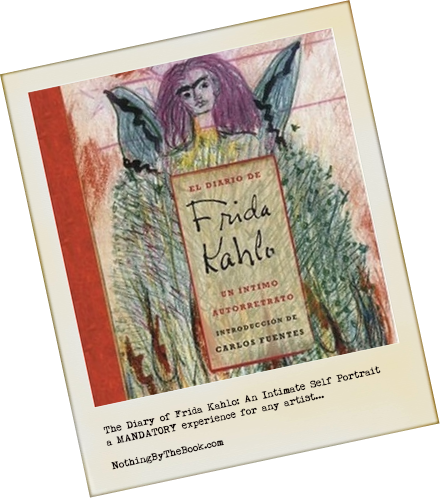
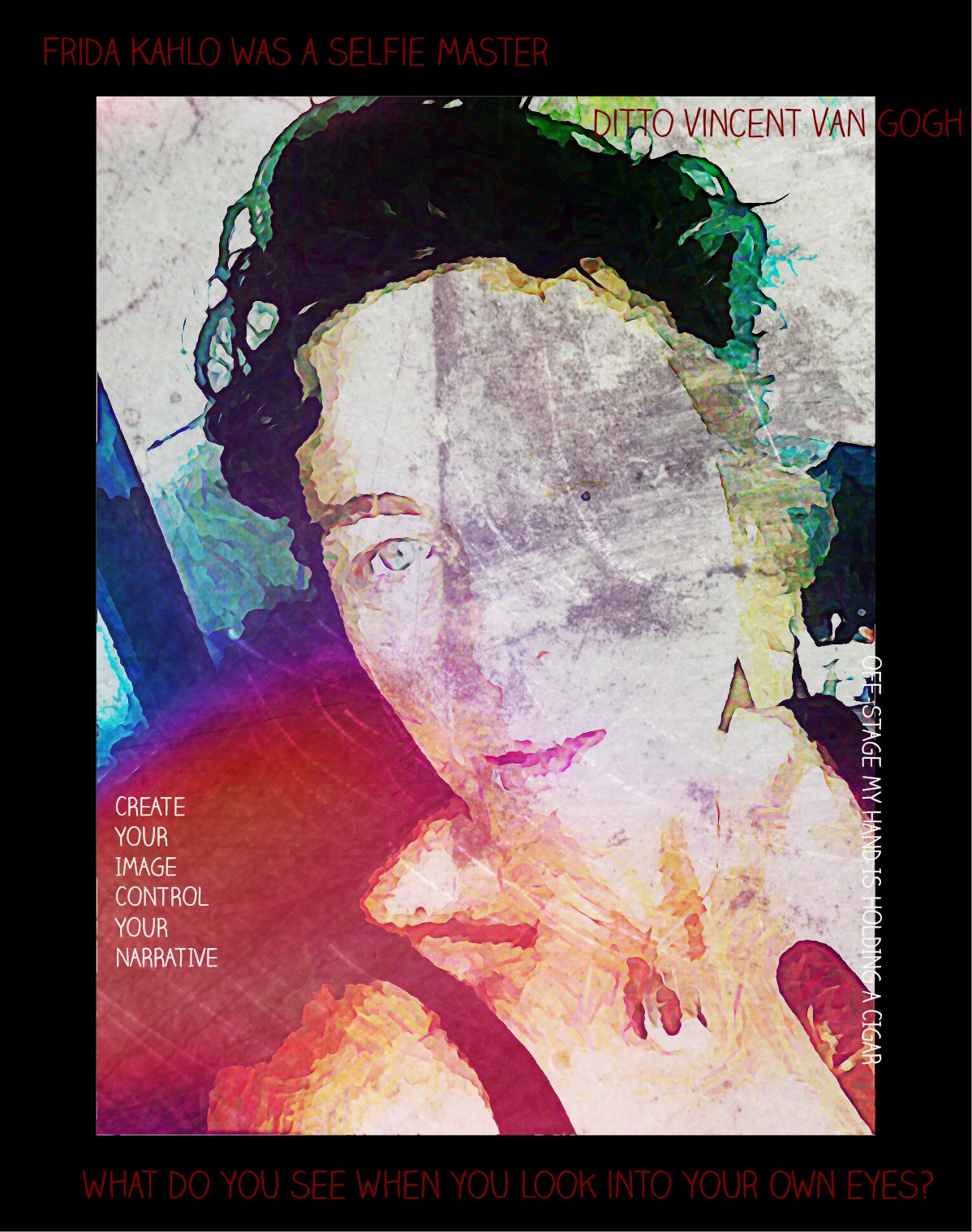
I write a piece called Frida Kahlo was a selfie master, and you find The Diary of Frida Kahlo: An Intimate Self Portrait for me, and it is in my hands the next day, OMFG, perfection, adoration, love. Thank you, my love.
Why I hate the Internet:
It’s ALWAYS there.
Why I love the Internet:
It’s ALWAYS there.
Except… when we hit pause. And we can do that, you know.
Idea:
Suppose… suppose that instead of feeding the insatiable beast of social media… we focused on both making and consuming less content… but of higher quality?
I think I’m gonna do that. You?
Confession:
I homeschool at least in part because the idea of dragging my kids (and myself) out of bed on time every morning fills me with horror. Plus—making lunches… ugh.
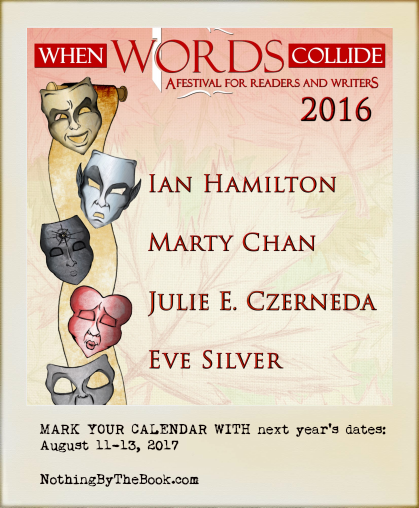
Put August 11-13, 2017 in your calendars now. Those are the dates for the next When Words Collide writers’ conference and fest in Calgary. I’m still digesting #wwcyyc2016—my first one—but in brief: I can’t remember the last time I’ve felt so energized and full of possibilities… it was an absolutely amazing experience.
This is the last week to catch Hamlet at Shakespeare by the Bow on Prince’s Island. Hamlet is played by a chick, man, and there’s all sorts of awesome gender bending going on. Last shows through til this Sunday.
Take your kids. If they’re bored, you can send them to the nearby playground.
Cinder: You know, Mom, I don’t know if you’ve heard, but before there selfie, there was this thing called the someone-elsie, and it was this crazy thing–get this–someone else would take your photo. Bizarre, eh? It was invented in the Victorian times by…
PS3 What? I’m busy. And you’re on holiday. And I know you’re not doing the homework anyway.
PS4 Fine. Across the street (or hallway) from you lives a 72 year old woman who always wears a blue wig and carries her pet cat in a bird cage. This drives you crazy. And… go… 500 words minimum–the story ends with her dying and bequeathing you the cat and the wig.
You: “So, no post last week, eh Jane? Slacking off?”
Jane: “Twenty-five thousand words in five days, baby, and a first-final draft of a third novel finished. What did you do? Play Pokemon Go?”
I’m totally bragging.
I’ve never, ever had flow like that before.
But, in case envy is devouring you right now, let me assure you: the post-output bliss lasts exactly 24 minutes, and I’m currently convinced that if it came that easily and that quickly, it must be shit.
II.
Assignment: Fingers on keyboard—I won’t make you write this by hand—fingers on keyboard, ready? And… “Why I no longer take selfies” or “In praise of the selfie phenomenon.” 25 minutes.
Don’t stop. 25 minutes. Fingers dancing.
Now—stop.
You should have 500 words.
Now cut it down to 250…
Stop whining.
The final piece is going to 150, including your headline.
You’re welcome.
III.
A first-final draft, by the way, is the first draft that you think is a final draft (in reality it’s the fourth, fifth, seventh), until you start to show it to people and…
Him: “So… Chapter 17… have you considered that it should actually be Chapter 3? And, um, half its current size?”
Her: “Actually, a paragraph. Maybe even just two sentences. It fleshes out a character that only exists to illustrate… Get rid of her, and, instead…”
Jane: “You don’t understand my vision at all. You’re stupid. Fat. And those shoes are UGLY.”
Ah, fuck. That was supposed to be just communicated to you through the squinting of my eyes. It wasn’t supposed to come out of my mouth.
Sorry. Are we still friends?
IV.
The children subsist on stale bread softened with margarine for breakfast, lunch and dinner, except for the days when Cinder breaks down and makes everyone hot dogs.
When he does, our industrial-size container of mustard leaps out of the fridge and tries to kill him.
He swears. A good mother would ask him if he needs help cleaning up the mess.
Jane: “I’m writing. See if the dog will eat some of it?”
He cleans up the best he can. Puts the mustard back in. Reaches in for the ketchup.
Cinder: “Fuuuuuuuuuuuuuck!”
Jane: “Again?”
Cinder: “This time, it was more of a suicide attempt than homicide.”
We clean up the mess together. Look at the offending container.
Jane: “When that thing is empty, I am never, ever, ever buying mustard again.”
Cinder: “We could just throw it out now.”
Flora: “No! I love mustard.”
So. We suffer.
Because we love her.
That be life…
V.
Sean goes to Costco—home of the industrial size mustard—on Saturday, after he sees Ender spreading mustard on a stale tortilla.
Ender: “There’s nothing else to eat!”
Sean: “Oh, come on. There’s also…”
A pickle.
Ender eats it.
Sean goes to Costco. Comes back with all the things. Also, an industrial size bag of sugar.
It’s a sweet, sweet gesture—because Flora’s in baking camp right now, and she’s planning to make her entire family fat and diabetic before the end of the summer.
It’s too big to fit into any of our cupboards.
Jane: “Where should we put this?”
Sean: “Um…”
It’s currently the centerpiece of our kitchen table.
I think—I’m not sure—Sean and I are engaged in a Cold War of apathy to see who will break down first and take it down to the basement… as an offering to the mice or ants.
VI.
I’m thinking about selfies today, I think, because the lines around my eyes, lips seem more pronounced—it’s the sleep deprivation—but also beautiful—that’s the post-output elation—and also, about how you told me you don’t think you’re beautiful, and this just blows my mind, how is this possible, have you never looked in a mirror?
You: “When I look in the mirror, I don’t see what you see.”
Jane: “Then look in my eyes instead.”
VII.
Flora makes cupcakes. Macaroons. Banana bread. Cinder bakes chocolate chip cookies. Sean roasts two chickens.
Me, I cut two thousand words, and write seven hundred for money. In my sleep.
VIII.
Cinder takes a steak knife and pokes a hole in the industrial size bag of sugar.
Jane: “Why. The. Fuck. Did. You. Do. That?”
Cinder: “I think… I think this is one of those times when the answer is obvious, Mom.”
Jane: “Because it was there?”
Cinder: “And it’s been there for a really long time. We really should put it in the pantry.”
Jane: “Mice. Ants.”
He finds an industrial size plastic ice cream bucket and brings it up to the kitchen.
I transfer the sugar into it.
He borrows a Sharpie from Flora. Labels the top of the container:
Cinder’s Crystal Meth.
Flora: “Nice. Let’s make sure that’s out when people come to visit.”
IX.
What needs to happen next is I need to not think about words, in words for a few days. At least hours.
This is achievable.
Right?
Right.
Wrong.
I don’t know.
Help.
X.
Flora brings macaroons from baking camp.
Oh, yes.
Jane: “Like something is telling me ‘I love you’ inside my mouth.”
Flora: “That good?”
Jane: “That good.”
The best part: Cinder doesn’t like them, and Sean and Ender are allergic.
Mine! All mine!
XI.
I guess I could clean house. It’s filthier than…
…but I can’t rouse myself to do so. I text you instead.
Jane: “Coffee?”
You: “Champagne?”
Cinder: “Mom! The fucking mustard fell out of the fridge again!”
Life.
xoxo,
“Jane”
PS.
You: “That made very little sense.”
Jane: “Twenty five thousand words that made sense in five days. I. Am. Fried.”
PS2 Don’t forget your assignment. Selfies. Love them? Hate them? Tell me.
Jane: Home in 5 min to start planning the funeral.
Flora: Where are you?
Jane: Walking. By Sammie’s Park.
Flora. Yay… CAR!
Confession: it took me a while to get it. But I got it.
Jane: Fuck, it hit me and now I’m dead too.
Flora: Yay, party in purgatory. Is that the right word?
Jane: Pretty sure we’re all going straight to hell.
Flora: Yup.
II.
When I was 21, I had a friend—then 28—who used to say that doing the things you didn’t want to do that had to be done when they had to be done—and not putting them off until tomorrow—was the sign of a grown up.
She was a grown up. I was working on it.
The world is sadly devoid of grown ups these days, don’t you think?
III.
So, I went and I did the things. Some of them anyway. Sigh. Being a grown up is so utterly unrewarding sometimes. So. Now, it’s time to play.
Your assignment for this week: Every time you want to check Facebook or text someone—including me—you’re going to pull out your notebook or laptop, and write for 10 minutes. It doesn’t matter what. Feel free to write, “I really want to check Facebook, and that bitch said I couldn’t. Who died and made her God? Why am I doing this? I’m so going to check Facebook.” (And you can, love. After you write for 10 minutes first.)
You: “That sounded more like practice than play.”
Jane: “It’s both. You can’t play the game until you’ve practiced the basic moves a few times.”
IV.
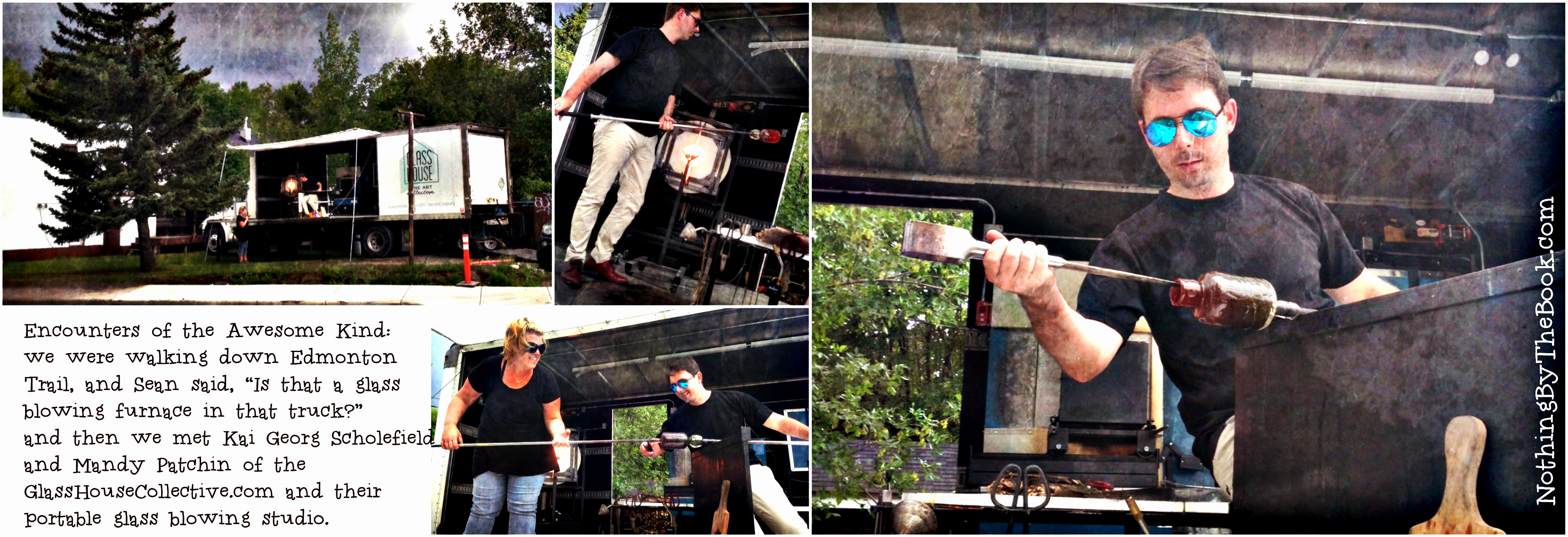
Coolest thing I saw/experienced this week:
It’s a PORTABLE glass blowing studio. I know, right? Check out GlassHouseCollective for more info… and play with fire this summer, will you?
xoxo
“Jane”
PS If you’re in yyc, check this out:
Sofar Sounds Show / July 16, 2016, 6:00pm Location to be announced to attendees Free, donations accepted, register for your invitation
“Are you familiar with Sofar? No? Well you should be! Its goal is to find local artists and host private, acoustic sessions in intimate, alternative settings. Think a curated house, gallery or museum concert. Each one is hosted by volunteers who welcome 50 to 100 music lovers into their space, along with three to five local music acts. Those who have signed up and are chosen will be given the address day before the event but the lineup will remain a mystery.” sofarsounds.com
PS2 If you’re looking for POSTCARDS FROM CUBA, start here or jump to the table of contents… and, please consider supporting the project with a $5 contribution:
… and the rest of the postcards will start flowing your way in September.
Jane: “What? Can you give more? Oh, baby, as many zeros after that five as your affluence permits! But a $5 contribution DOES make a difference.”
I am in Cuba, and I am in bed with Jane Austen, reading Sense and Sensibility, a book I have read perhaps a thousand times over the years. No. Wait. Ridiculous exaggeration. And I can do the math, quickly. I first read it 20 years ago, precisely. This month, in fact, exactly. And I’ve re-read it, the entire Austen oeuvre, at least three times a year, sometimes five or six, since. Let’s keep it to three. So. I’ve read each Austen book at least 60 times.
I’m in bed with Jane Austen’s Sense and Sensibility for the sixty first time, and she’s still surprising me.
Today, what catches my attention is this brutal portrait of John Dashwood, the older step-brother of the book’s heroines, and the inheritor of all the family wealth (because, patriarchy):
“He was not an ill-disposed young man, unless to be rather cold hearted and rather selfish is to be ill-disposed: but he was, in general, well respected; for he conducted himself with propriety in the discharge of his ordinary duties.”
But wait. There was hope for John. In his wife:
“Had he married a more amiable woman, he might have been made still more respectable than he was:–he might even have been amiable himself. …
But, alas, it was not to be. His wife:
“…was a strong caricature of himself;–more narrow-minded and selfish.”
God, I love me my Jane.
I am struggling—have been for the past two years, almost three, more, possibly—with the discharge of some of my ordinary duties. You know what I mean. Christmas cards, birthday presents, polite conversation… those social niceties that the Dashwoods, cold, selfish, unfeeling but oh-so-proper excel at and use as the yardstick to measure the quality of others.
II.
I’m in Cuba. In bed with Jane Austen. I’ve been binging on Hemingway—because, Cuba—but I am overdosed on maleness and testosterone and terse sentences. Give me semicolons, em-dashes and affairs of the heart told from the point of a view of the women to whom they are everything.
III.
Cuba. Jane Austen. Affairs of the heart. Writing.
What I love about Sense and Sensibility is… well, everything, actually. All the men—especially the libertine Willoughby. I could love every one of them, although Edward Ferrars would bore me after six weeks, Willoughby and I would make each other miserable within two years, and I’d break Colonel Brandon’s heart. The one I’d really like to take on, though, is Mr. Palmer. Charlotte Palmer’s rude husband? Yeah. He has potential.
I love the women too. I love Mrs. Dashwood as a mother—the vulgarity of Mrs. Jennings. Lucy Steele is an absolutely brilliant creation. And Elinor and Marianne are me. And you. Don’t you think? Each so exaggerated, each of us carries both within ourselves. I am both. I love Marianne more—I know it’s safer to be Elinor—but Elinor will only lead a half-life.
Do you ever wonder what Jane Austen would have written like if she’d had children? I do, by the time I get to the end of each of her novels—especially Pride and Prejudice and Persuasion. I think, holy fuck, what insight, what wit, what perception, what talent.
And yet. So much she doesn’t know, suspect—cannot imagine because it cannot be imagined.
You: “Or she wouldn’t have written at all because she had children.”
No. Impossible. You know she would have. And it all would have been better.
V.
Duties. Children. Excuses.
Cuba.
Alone in Cuba with three children, 24/7.
Writing.
Status report, five weeks in: 16,000 words on major pet project. 30-odd essays, vignettes, sketches. Six experiments no one will ever see, but oh, I’m so happy I wrote them.
She wouldn’t have written because she had children?
Ha.
Not my Jane. Nor yours.
And baby—you know I’m writing this for you, right? In bed, with Jane Austen, I am, as always, thinking of you. Dearest. No excuses. No half-life. And if you need to ditch “propriety in the discharge of [your] ordinary duties” … do it.
*
It’s almost time to leave Havana, and Postcards from Cuba is taking a break for the summer while I scour for the funding I need to bring you the second and third parts of the project. You are invited to help any way you can:
… and the rest of the postcards will start flowing your way in September.
If today’s your first time here, and you want to catch up on the Postcards from Cuba project, visit the ANNOTATED table of contents.
*
Although #postcardsfromcuba is taking a break, Nothing By The Book is not. The theme for the summer is “practice and play.”
Expect a new post most Wednesdays.
You: “Practice and play?”
Jane: “Practice and play. You’ll see. And maybe join. Because—no half-life, no excuses, love. Ordinary duties be damned.”
For Sara, Valli, Lilia, Charlotte, Lachlan, Meredith, Nova, Faeryn, Indigo et al. Who would have fun there anyway.
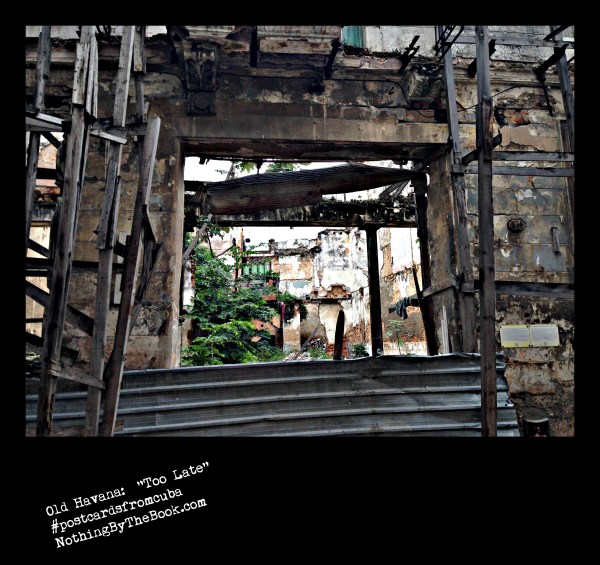
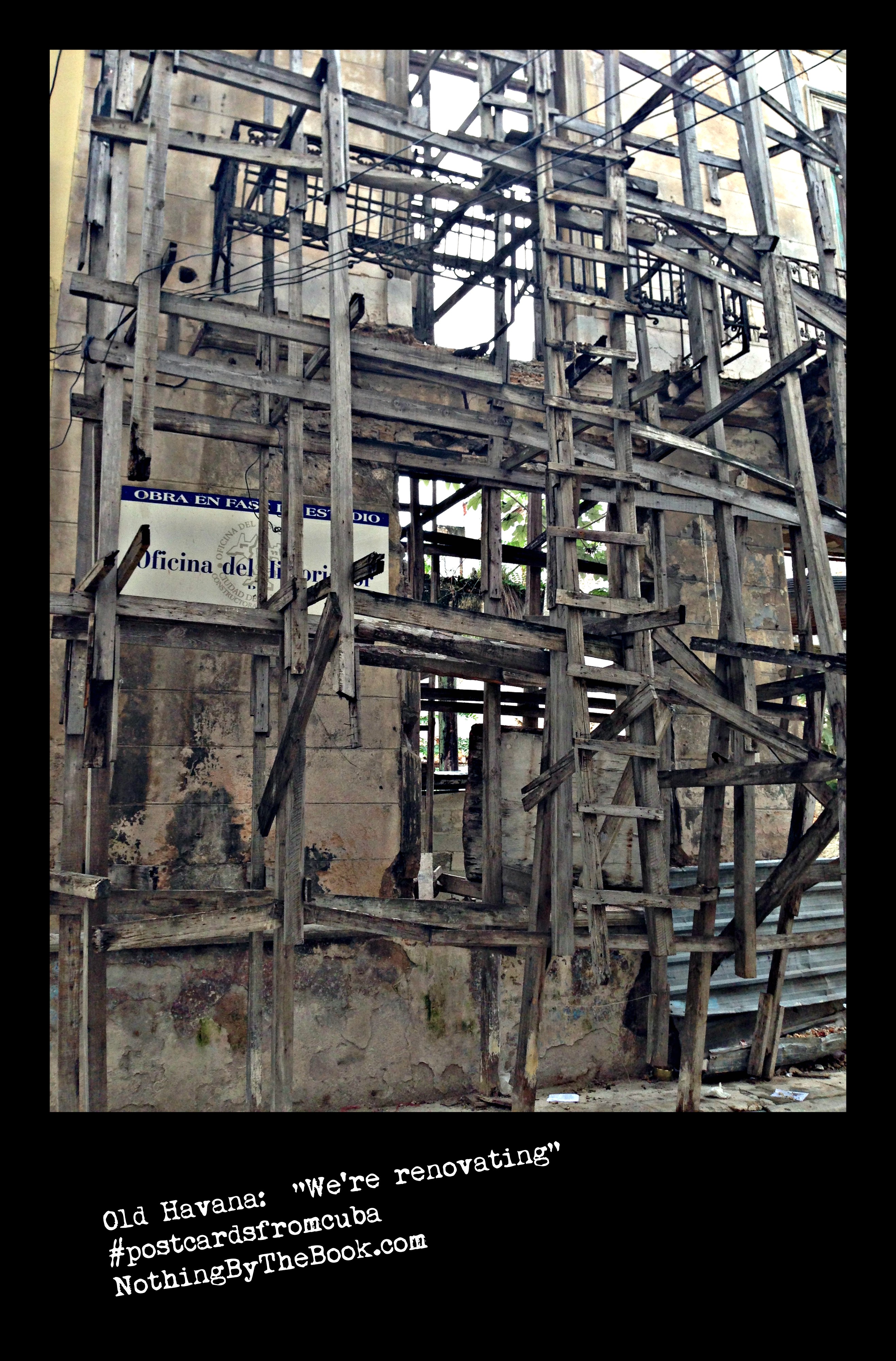
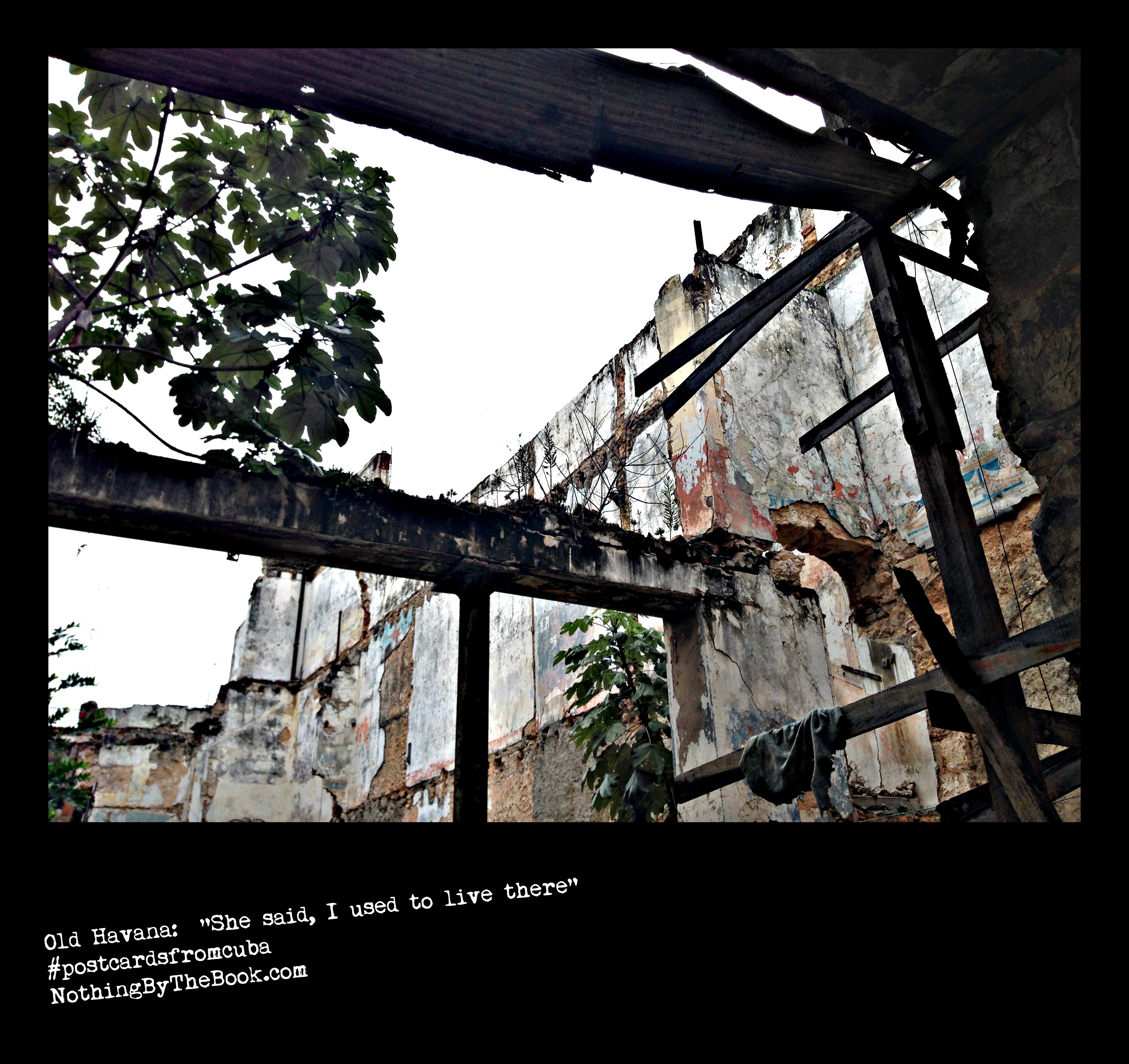
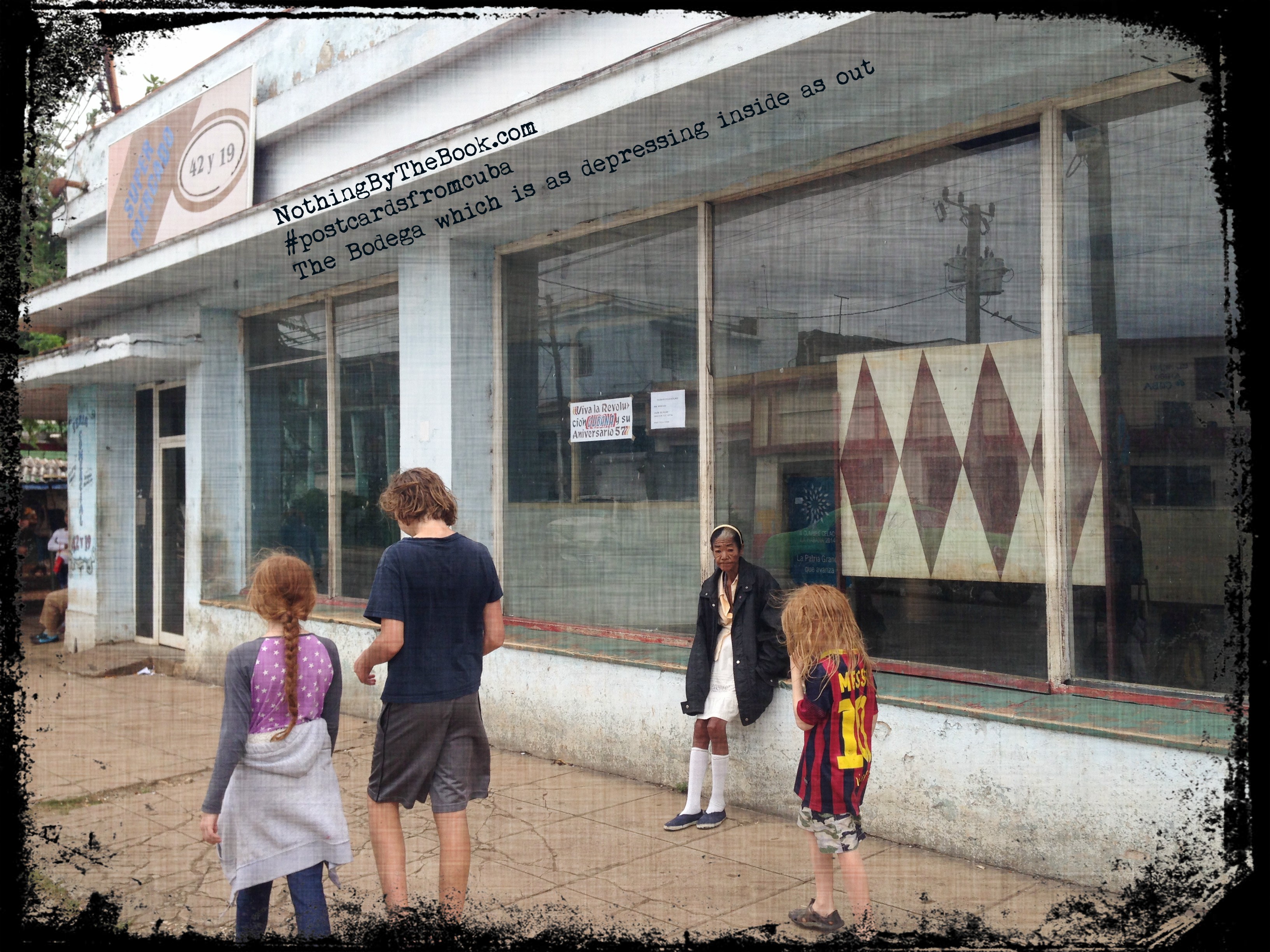
The playgrounds kill me. Each time I see one, rusted through, abandoned, virtually destroyed, I am hit by a wave of suffering so intense, I almost vomit. I do not feel this badly when I walk past the shoeless drunk curled into the doorway of a building owned by the government that’s supposed to provide for him. Nor when I walk past a mansion that was a thing of beauty in 1858, 1959, and is now a heap of rubble.
But the playgrounds—empty, rusting, so fucking unsafe… they kill me.
Do you understand why?
My children don’t mind. They find the places that work, and have so much fun:
Yes, my children don’t mind at all…
Do Cuban children?
So many of the playgrounds are… empty. So empty. Because they are—well, not just depressing but dangerous.
And sometimes… they are put to different, more practical use:
I try to see beauty and purpose in that.
I see it as the most powerful indictment of Castro’s revolution.
This slideshow requires JavaScript.
…and wait until I show you what the schools look like…
*
LANDED here for the first time? Let me catch you up:
And if you like what you read/hear/see, please consider expressing your delight by becoming a patron of this project via PayPal:
You: Why?
Jane: Because you’ve always wanted to be a patron of the arts, and you know that artists can’t pay for groceries with exposure.
You: How much?
Jane: Buy me a cup of coffee, a Cuba Libre, or a counterfeit Cuban cigar.
You: That’s all?
Jane: My avarice is happy to match your affluence. But I get $1 in royalties for each copy my other self sells of a traditionally published book. It is impossible to disappoint me.
If you would like to make a contribution, but have PayPal issues (I get it), please email me at nothingbythebook at gmail.com, and we’ll work something out.
For Saeed. Who understands “homesick” … and the trouble with defining “home” when one is in motion.
Listen:
and read:
I.
I am exploring Havana at the pace of three children, and for this, I am very grateful. Left to myself, I would binge and get drunk on this city, make myself sick with too much experience crammed into (always) too little time. The children force me to move slower—to pace myself and so to look carefully, to reflect… to digest.
They also force me to pay attention to the mundane. I could not eat—today, tomorrow—or eat badly. They must be fed and fed well, every day, and so in the act of feeding them, I experience the Havana a Cuban mother would, at least a little. Imperfectly, I know. After all, I can waltz into any of the tiendas panmericanas and buy anything—pay with credit card at Mercado 70—and even as I say, “Holy fuck that’s expensive”—expensive for me does not hold the same meaning as expensive does to the woman who lives next door, the woman who cleans the house where I live or the woman—her face so beautiful and so tired—jostling next to me on the overcrowded bus.
“Are they all yours, all three?” she asks. I nod.
“A big family,” she says. “We don’t have big families here, now.”
I nod…
I think I understand.
I probably don’t—I can’t, can I? But, on the bus to and from the market, an exhausted six-year-old asleep in my arms, an equally exhausted eleven-year-old who refuses the proffered seat (“I think that old lady needed it more than I did”), and a claustrophobic/probably ochlophobic thirteen-year-old agitating to get off now and walk the rest of the way home, I come closer than I would if I were moving through Havana alone.
II.
Home.
What is “home,” when you’re travelling?
III.
Cinder is unhappy, homesick.
I knew, always, this adventure would be most difficult for him. He is, always has been, my most “stay at home” child. His perfect day consists of… nothing much. His familiar routine—what I know is his immensely rich inner life, best experienced in the safety, tranquility, predictability of home.
He and I are both consciously trying to create routine, stability, tranquility here—but Havana exhausts him. And when we are out, not matter how cool the experience, he most looks forward to getting back “home,” to our casa, our home base here—and this eagerness, if anything, is my proof that I’ve done something right, that I’ve managed to create “home” for him here, a little.
Today, mid-day, he crashes hard. We’ve planned to be out—we know we need to be out until 2 p.m. because today’s the mega-cleaning day for Jorge and his housekeeper—and we have been. We’ve taken a new bus, walked a new part of the Malecon, ended up at Coppellia Park for ice cream—and still ended up “home” too early. She wasn’t done—I grabbed towels and swim suits, and shepherded us over to a nearby hotel’s swimming pool.
We planned to do that anyway, later. But in the meantime, Cinder planned to be home—to recharge.
So.
Crash.
I miss its onset, and only see the result—his siblings jump in the pool and he refuses, goes off into the hotel’s garden courtyard, walks a lap, and when he comes back, it takes me one look to see, feel that he is unwell. Sick? Sunstroke? As I start to form the words, “Are you all right?” he snarls-growls at me and storms off.
I give him a minute or two. Follow.
He evades me in the courtyard, changing directions.
Jane: “Cinder, my love, you don’t have to tell me anything, but I need to hold you and hug you.”
He lets me.
Cinder: “I want to go home, I want to go home.”
We both know he doesn’t mean our casa particular.
Jane: “I know.”
I stand there, holding him, saying nothing.
This is the hardest thing I can do.
I am holding him, loving him, and reminding myself: he does not want to be here. I am not having this experience for him. I am having it for me, and I am dragging him along. When I started planning this trip, his position, from the outset, was that he wanted to stay at home with Sean. (My position, of course, was that thirteen was way too young to spend 10+ hours a day in total solitude while his daddy was at work. Cinder’s position—and my thirteen year old self peeks over my shoulder, empathizes, agrees—was that that would be kind of heaven…)
Holding him, I tell him this—that I know. That I know he doesn’t want to be here, didn’t choose to be here. That I understand, accept his feelings.
Cinder: “I really, really want to go home.”
Jane: “I know.”
IV.
After he shows me his home, Lazaro asks me, “Are you homesick? Do you miss your home?” And is shocked when I say, I don’t. Doesn’t believe me. “You must miss home,” he says, and the children pipe up, “We do!” And it’s true. It’s worst for Cinder, but it hits the other two as well. They’re homesick. For their dad, their dog, their friends, their beds and their routines—in roughly that order.
Me? I’ll be happy to get back to toilets that flush and grocery stores stacked to the ceiling with everything I might want and more than anyone should ever need, but right now…
“I’m so interested in, stimulated by everything here,” I try to put it into words for Lazaro. “And I have such a short time here…” And, of course, my children are here with me, and they’re what I would most miss about home, and so…
Do I miss home?
As you’re reading that, are you thinking, “Do you miss me?” Because frankly, love… yes, at those moments at night, and in the morning, sometimes, and every once in a while when I see something beautiful or think something so strange that won’t feel real until I tell you about it—yes, at those moments, I miss you. Madly. But most of the time? Not so much. I’m here, you see, and I know I’ll be back, and I’m here for such a short time, and I need to be here so fucking completely and fully, and I can barely manage it, being here, being present in the intensity of here is exhausting, and it would be so easy to retreat to missing and longing—so no.
I don’t miss home.
I will be glad to be back, of course. And I will be so glad to see you again.
But I am so happy to be here, right now.
Cinder isn’t.
V.
When we finally get “home” that day, I make everyone—especially Cinder—comfort food. I fry up the cheese balls we bought from a newly discovered merchant, and make grilled tuna sandwiches. We watch Horrible Histories together, and as I watch Cinder regroup, I change the week’s plans. Tomorrow’s Sunday, and the plan, all week, was to go to Old Havana and into Salvador’s Alley, and listen to music and experience the chaos and intensity of Havana on a Sunday.
Jane: “Stay at home chill day tomorrow, what do you think, dudes?”
The little ones don’t care. Cinder knows this is for him.
Cinder: “But you really want to go to Salvador’s Alley.”
Jane: “We’ll go next week. Tomorrow, we stay home.”
He nods. A few minutes later, hugs me from behind, suddenly. “Thank you, Mom,” he whispers in my ear. I kiss his. “I’d like to wash my clothes tomorrow, too.”
Sounds like a plan.
VI.
“You really don’t miss home?” Lazaro asks again, and I’m starting to feel a really defensive. I know my sense of “home” is not… He lives in the house his wife’s great-grandfather built. I had, what, seven, eight different “homes” before I was 10, and then three within the first year of coming to Canada, and then…
“Home” was people, my family.
My kids are here. Their daddy will be here in a few days. Suddenly, I miss him, you, her so badly my belly hurts.
“I miss my people,” I tell Lazaro.
And for a few minutes, I do… And then…
Jane: “What the hell is that?”
I’m looking at something strange-beautiful-amazing, I’m in Havana, at a key historical moment in Cuba’s continuing Revolution-Evolution, and I’m just here, and I’m not thinking about you at all.
VII.
But in the evening, at “home,” on the verandah that is my writing room, in the quiet of a noisy Havana night–I’m thinking about you. Yes, now, right now, I’m thinking about you. There are so many things I want to tell you about. I’m worried that when I get back home, though, the intensity of what I thought, felt will be gone, replaced by the record of iPhone photos and a fading memory. Will I be able to really tell you what effect this city, this country had on me?
Probably not.
So. I write it down. Messily. Urgently. Before the intensity of “here, now” is diluted, habituated.
I write:
“I am exploring Havana at the pace of three children, and for this, I am very grateful. Left to myself, I would binge and get drunk on this city, make myself sick with too much experience crammed into (always) too little time. The children force me to move more slowly—to pace myself and so to look carefully, to reflect… to digest.”
Admit it–you’ve always wanted to be a patron of the arts. If you enjoy the Postcards project, please express your delight and support by making a donation via PayPal:
You: “But how much should I give?”
Jane: “I get $1 each time a sell a traditionally published book, so my bar’s set really low, love. Want to buy me a cup of coffee? That’s $4.75 if you’ll spring for a mocha or latte. If you’re feeling extra-generous–let’s split a bottle of $25 wine, shall we?”
If you’d like to make a contribution but have PayPal issues, email me at nothingbythebook@ gmail.com and we’ll work something out.
Or, ya know. Just hang out with us and enjoy. That be cool too.
It was a Monday, and I want to tell you about that Monday on this Monday, because there was absolutely nothing special about it.
And it was marvelous.
I.
I woke up squeezed, the cement between Ender’s sticky stinky back—Christ, that child needs a bath and a reminder to change his shirt—and his father’s cool front, his hot breath on my neck. Stretched, opened eyes, closed them. It was a Monday, I knew, and I could wake up now, go make coffee, start writing… or wait, wait, stay tucked in-between the sheets and my loves, and Sean’s alarm would go off, and he’d get up, sigh, stretch—then meander up the stairs, make the coffee before heading up to the shower.
What do you think I did?
interlude-within-interlude
I love waking up to made coffee. I love making coffee too—my relationship with the black drug is both dysfunctional and erotic—but I love having it made for me more.
II.
The coffee was just ready to be pressed when I walked into the kitchen. I kissed Sean’s neck, then cheek. Poured that first cup, body taut with anticipation. Oh, yes. The smell.
Then—cinnamon. Cardamom. Liquid whipped cream—never, ever, love, offer me skim milk or diary substitute for my coffee. No, nor half-and-half—if we are to sin, let us sin fully, never in tepid, dietary half-measures.
Then I wrote.
Three pages of shit. Really. There were, in those three pages, two, three good sentences and one decent phrase—and three or four paragraphs that, down the line, may become a good chapter. But, generally… shit.
Three pages of it.
It happens like that sometimes.
III.
Sean needed me to drive him to work, but that’s not why he brought me a second cup of coffee—cinnamon, cardamom, whipped cream added, but of course—and when I drank it—pen scratching paper, one dull sentence after another—I felt so loved I think I managed to write a phrase that didn’t suck.
We left the house at 8:40, leaving the younger two eating cereal and chips and salsa in the living room while watching age inappropriate Netflix programming.
We drove in silence. I don’t like to talk in the morning—there are too many thoughts to speak. I was back at 9:04. Flora and Ender were still eating and consuming How I Met Your Mother. “Today’s our binge day, right?” Ender checked in. I nodded. Poured a third cup of coffee. Cardamom. Cinnamon.
Fuck, out of whipped cream.
life hack
Time is perhaps my most precious commodity—and it is not that I do not have enough time—I have as much of it as you, as everyone: twenty-four precious hours in every precious day, seven days in every week, and 30 to 31 days a month, except in February…
And I work very diligently at not being overscheduled or rushed, at not overscheduling or rushing my family.
I work, quite creatively, I think, at finding ways to make my time work for me, for them.
“Binge days” are one of my tools. On Mondays and Thursdays, I outsource parenting to the iPads and laptops. The kids can watch, play anything all day (the rest of the week, we are screen-free until after supper). I don’t make breakfast, lunch, snacks—I am effectively unavailable to the children until 4, 4:30 when I will make them supper… although it will probably be hot dogs or ramen noodles. Those are the days that I sink into my work… or leave the house, meet friends, occasionally roam the streets aimlessly for hours—that too is part of the process.
III.
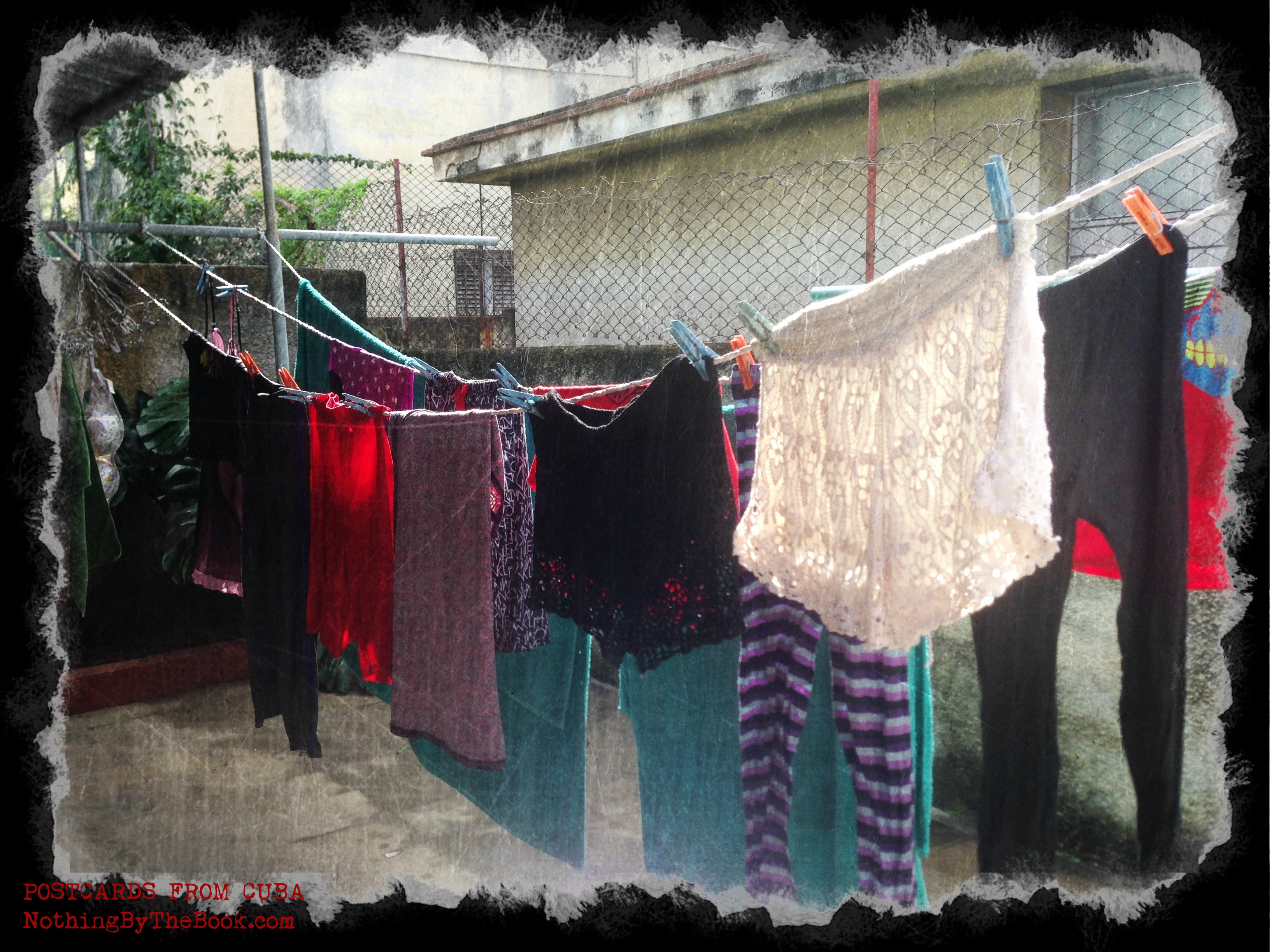
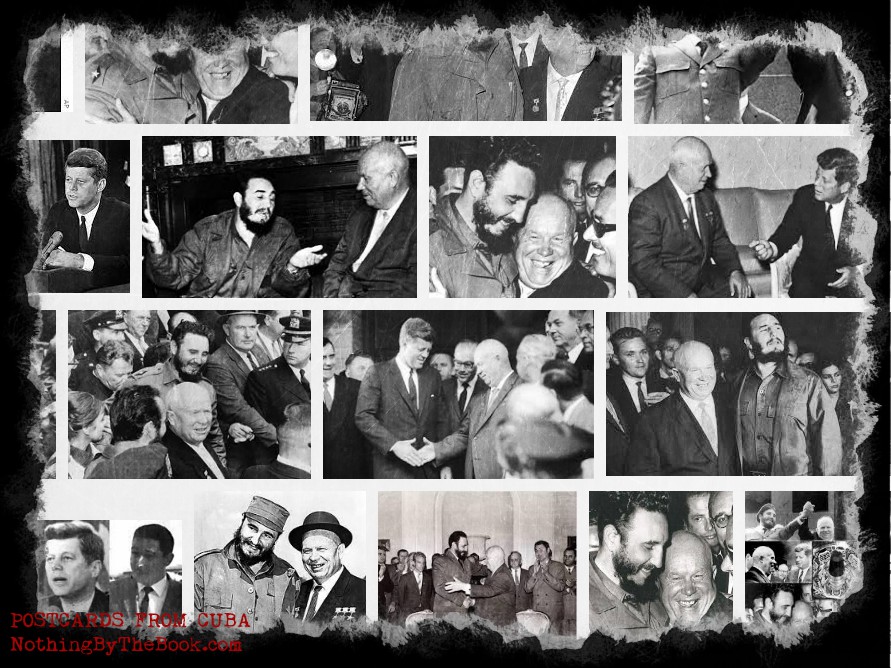
I drank the coffee black while revising and rehearsing “If Nikita Krushchev had to wash a bra in Cuba.” The children were quiet so I thought I’d record it—but Sean had taken the laptop with Adobe Audition to work, so no, that wouldn’t work… what next? Another postcard, “Homesick,” yes, this one needed more work, a lot more work, and there was a piece missing—did I not write down a conversation I had with Lazaro—he asked me, “Do you miss home,” and I said… where is it?
Found it. Yes.
I don’t usually clean on binge days but on this Monday, the house looked the way Eastern Europe did when the Mongols rode through it on a thirteenth century Sunday, so on the way upstairs to pee, I swept the living room and asked the kids to pick up those things from the dust pile they did not want to end up in the garbage. After peeing, I cleaned the bathroom—because I was there, and because the Mongols had been there too.
explanation
Marie’s elder two boys were visiting Cinder the week prior (and the week that would follow). There was much joy. And really, comparatively controlled destruction. But having four boys (I absolve the man from blame) pee in one bathroom for however many days straight… no way was I going to have a shower or bath until I cleaned it thoroughly.
And also, lit some incense…
IV.
I read “Homesick” again, revised it a little, saw that you texted, decided to ignore you while I thought about what was wrong with “Homesick,” got hungry.
Made fava beans for myself and helped Ender make a cheese tortilla with salsa—washed dishes while the beans cooked—thought about a woman named Molly Jones and someone currently represented in the manuscript as [S.C./X]—asked the kids if they needed anything—chopped parsley and cilantro, got it all over the floor but did not clean it up.
Texted you, then got a great idea for how to illustrate “Homesick,” and that entailed taking a photograph of… did I know where it was, I did, found it, did it.
Ate one more spoonful of my fava bean mush.
Remembered that while I was writing my shitty morning pages I was thinking that I was running out of clothes and that if I wanted to have socks to wear for tomorrow, I ought to put in a load of laundry, so I went upstairs to start the water running for my bath, and then ran downstairs to put in a load of my clothes.
Made it upstairs before the tub overflowed, and that made me so happy.
Bath, in the dark, incense. No candles today.
True story: no one interrupted me while I bathed. Not a single one of the children needed to pee, vomit or brush their teeth.
It was glorious.
I had an idea.
I didn’t write it down. But it stayed.
insight
I’ve been reading a little, again, about writers and writing—journaling and writing practice in particular, because, I don’t know, I’m stuck, bored? Something’s coming—I feel restless and unsettled, and I have these two, three projects in hand right now, but I think something else is coming, and I’m not sure I have the tools… where was I?
I’ve been reading a little, again, about writers and writing—which is procrastination disguised as professional development—and among the things the gurus are in agreement about is that you must write things down, have notebooks, pencils (phones with notepad apps) about you at all times to jot down ideas, inspiration. I don’t know, I guess it doesn’t hurt…
But the good ideas, they stay. In fact, they refuse to leave, the invasive, demanding, clamorous bastards.
Clamorous is a nice word. Try to use it today in a casual conversation; better yet, at a board room table.
V.
Took the neglected dog for a walk. Flora came with. The weather was blustery; we were happy.
I had a lot of thoughts.
The dog found some disgusting garbage to eat—a piece of meat tied around a string, what the fuck—and I had to ram my hand down her throat to pull it out, yuck, yuck, gross—so grateful Flora was with me so that she could open doors for me as I ran into the house to wash my disgusting hand.
“Don’t say you hate the dog,” Flora forestalled me.
“OK,” I agreed. But I thought it.
unsolicited advice
Dogs and children do not go together. This is a horrible myth perpetuated by Hollywood? 1950s children’s books? Something. I don’t know. Please, for the love of the dog you are going to neglect, listen to me: if you are pregnant, if you are planning to have children soon—if you have small children: DO NOT GET A DOG.
It’s fine. I know you’re not going to listen. When you do get your dog, and neglect it, and don’t particularly love it, come back and let me say, “I told you so.”
Marie, by the way, I totally blame you. You should have stopped me.
VI.
Sat down and wrote for 75 minutes straight. Fucking gold. Every word worth keeping.
Well. Ok, 25 per cent of them would be cut later. In the moment, though—I was 100 per cent satisfied.
As a result, I decided to make the children mashed potatoes and breaded chicken cutlets for dinner, instead of the Mr. Noodles Ramen they were probably expecting.
Thought about you, a little. Of course I did. Listened to Amanda Palmer’s The Art of Asking while peeling the potatoes and seasoning the chicken.
Finally cleaned the muffin in which I had made Eggs A La Janine last weekend, and ugh, it was disgusting.
a recipe: eggs a la Janine
If you ever want to feed six to twelve people piping hot bacon and eggs that are all ready at the same time, you will need a dozen (or two eggs), as many slices of bacon as you have eggs, and a muffin tin (or two).
Cut a bit off each bacon slice—just enough to fit in the bottom of each muffin hole. Put that bit in the bottom, then take the rest of the slice and put it inside the hole: yes, you’ve just made a muffin cup out of bacon. Repeat with all your bacon slices… and now break an egg into each cup.
Bake for 12-20 minutes (depending on how set you like your eggs) at 350 degrees. Yum.
VII.
When Sean came home, we ate very quickly, did a half-ass job of cleaning the kitchen, and ran to listen to some people talk about art.
When we came home, we talked about art some more. Read books to the still-awake kids—dammit, sometimes, when we go out at night, they put themselves to bed, but no, that Monday they waited for us.
Scratch that dammit. It was lovely.
Then, sex.
Sleep.
*
Epilogue
Later that week—it was on a Saturday—I would meet a woman named Karen Pheasant who came into my life solely to tell me that she lived a creative non-fiction life.
Me too, sister. Me too.
The artists talking about art didn’t talk about this, but another artist—also a zoologist—calls art making the extra-ordinary out of the ordinary.*
I like that definition. Mostly.
Except… if you really pay attention to things… is anything ever ordinary?
So then… is everything art?
So then, I thought about you and all the things I hadn’t told you since the last time I saw you.
Here you go. They are all contained in the story of this one monday.
And if you like what you read/hear/see, please consider expressing your delight by becoming a patron of this project via PayPal:
You: Why?
Jane: Because you’ve always wanted to be a patron of the arts, and you know that artists can’t pay for groceries with exposure.
You: How much?
Jane: Buy me a cup of coffee, a Cuba Libre, or a counterfeit Cuban cigar.
You: That’s all?
Jane: My avarice is happy to match your affluence. But I get $1 in royalties for each copy my other self sells of a traditionally published book. It is impossible to disappoint me.
If you would like to make a contribution, but have PayPal issues (I get it), please email me at nothingbythebook at gmail.com, and we’ll work something out.
His work is all over Havana, and I think I found him in an art gallery once–and one day, someone told me his name AND his address, and I wrote it down on a sunscreened forearm, and then lost it…
Did you listen to that Amanda Palmer Ted Talk? Yeah?
If you enjoy the Postcards project, please express your delight and support by making a donation via PayPal:
You: “But how much should I give?”
Jane: “I get $1 each time a sell a traditionally published book, so my bar’s set really low, love. Want to buy me a cup of coffee? That’s $4.75 if you’ll spring for a mocha or latte.”
If you’d like to make a contribution but have PayPal issues, email me at nothingbythebook@ gmail.com and we’ll work something out.
Or, ya know. Just hang out with us and enjoy. That be cool too.
For Janine. Who understands how important it is to care for one’s delicates.
Today’s post is brought to you by the wifi on the Red Arrow bus that traverses Highway 2 between Calgary and Edmonton and Sean Lindsay‘s ability to edit audio while moving at 120 km an hour.
Listen:
and, of course, read:
I.
Jorge now refers to the villa’s front salon as “my writing room,” and every time he says it, I feel at home… even though I haven’t written a word there.
II.
The kids want me to make jello.
Jane: “Ok, ok. But first I have to go to the store and buy yoghurt.”
You might be mystified. They understand. I’ve been making them jello in the plastic cups we’ve saved from the extortionate, imported-from-Spain single-serving yoghurt I bought them a couple of weeks ago. ($0.90CUC, so more than a Canadian dollar, per miniscule single serving). But yesterday, I used one of the cups as a candle holder. Not because there was a black out, by the way, but because I was running out of matches—I’ve already told you that story, right? Point: we only have two yoghurt containers, and there are three children, and so… I need to buy more yoghurt.
Cinder: “Can you buy more cream cheese while you’re there?”
Jane: “Sure.”
Except, I can’t. The tubs of cream cheese have been replaced by slabs of white cheese. Mozarellish? Maybe? “Queso blanco,” Yaskiel, the clerk behind the cheese-and-butter counter, says. I as him when there might be cream cheese again. He shrugs.
I buy some queso blanco, made locally, and the second last chunk of gouda, imported from Europe via Brazil.
The elderly woman behind me taps me on the shoulder. Would I mind taking the bigger chunk so she can have the little one? It’s a difference of $0.75CUC in price. A dollar and change to me. Significant to her.
“Of course.”
The strawberry yoghurt I bought here last time has been replaced by plain yoghurt, which will not be celebrated by the children, and no-fat peach, aspartame-sweetened yoghurt, which I will not let them eat. But—oh—chocolate pudding in absolutely perfect jello-making cups—much better than the yoghurt cups, which are, really, too thin and tall to house jello properly.
Bonus: the pudding is $0.50CUC a cup, making it almost half the price of the yoghurt.
Vanya, the clerk who’s been on check-out most often when I’ve been at the store, is manning the meat station.
“Hey, amor, you were asking about chicken—there are still chicken breasts,” he calls to me, and points, and sure enough, there they are, behind him, rapidly defrosting in the freezer bin. Delivered Sunday, yesterday, he says. They do their best to keep them cold, but the freezer bins have no tops, you see, so you’ve really got to buy them Sunday if you want them to be fully frozen. But it’s Monday morning. They’re still pretty solid.
I grab a pack. Chicken juice (don’t think about it) drips down my hands. Vanya gives me a damp rag to dry off. “They’re still pretty frozen,” he says. I decide to believe him.
(On the way home, I decide I should, in fact, run back for another pack, because there is no guarantee they will deliver them again next Sunday, or, ever again, is there?)
Vanya’s name, of course, is a legacy of Cuba’s relationship with Soviet Russia. There are quite a few Vanyas, Vladimirs, Yuris, Olgas, Valentinas, and Yevgenies around. Most of them are in their 50s—born in the first years after the revolution.
I haven’t met any Josephs, though… Nor a Nikita.
III.
“No matter how much imperialist reaction, headed by the United States, tries to stop or check the great revolutionary process of liberation of mankind, it is powerless to do so. People fighting for their freedom and independence are strong enough to defend their gains with the backing of all the forces of peace and socialism. This was convincingly demonstrated by what took place in the Caribbean towards the end of last year.”
That’s Nikita Khrushchev addressing a mixed audience of Cubans and Russians on May 23, 1963, speaking about the Cuban missile crisis that brought the world to the brink of a nuclear war in October 1962, when Khrushchev headed the Soviet Union and JFK was the President of the United States of America.
“The Caribbean crisis was one of the sharpest clashes between the forces of socialism and imperialism, the forces of peace and war in the entire post-war period. When they prepared their invasion of Cuba, the American belligerents thought that the Soviet Union and other socialist countries would not be able to render effective aid to the Cuban Republic.
The imperialists reckoned on the geographical remoteness of Cuba from the socialist countries allowing them to utilise their overwhelming military superiority in this area and attack the Cuban people and wipe out their revolutionary gains. As everyone is aware the American imperialists are no greenhorns when it comes to suppressing the liberation struggle in Latin America and other areas of the world.”
…
“The imperialists’ plans to strangle the Cuban revolution came to grief thanks to the firm stand of the Cuban Government headed by Comrade Fidel Castro, the fighting solidarity of the Cubans, the military might of the Soviet Union and the powerful political and moral support of the socialist countries and all the peace-loving forces which joined the united front to defend the heroic Island of Freedom.”
Go on. Gag. I am…
…but if I quoted you the propaganda the Americans were spewing at the same time—even now— you’d gag too. Or you ought to, anyway.
(You can download the whole speech here, courtesy of the Luxembourg-based Centre Virtuel de la Connaissance sur l’Europe.)
IV.
Cinder: “Did you get yoghurt?
Jane: “No, chocolate pudding. But look: chicken breasts!”
The kids do a little dance of joy.
Ender: “Will you make jello now?”
Jane: “Right away. You have to eat the pudding, and I just have to finish washing my bras.”
Um. Yeah. So, between the tub, bathroom sink, kitchen sink, and two laundry tubs, I have five places where I could do laundry. Not one of them comes with a plug. I try to solve this issue the First World Way by, you know, trying to buy a plug.
This is not possible.
There is apparently a nation-wide plug shortage in Cuba.
OK.
I create make-shift plugs out of plastic wrap and rocks, and they do ok, but they’re none of them a perfect fit, and the water keeps on draining, and I can’t give anything a proper soak.
So. I use our pots.
Cinder: “Rinse it really well. Because when we washed my socks and then you made pasta, it kind of tasted like detergent.”
Flora: “What are you going to do when Daddy comes to visit? Are you going to tell him what you use the pots for when you’re not using them for cooking?”
This is also a true story: November 18, 1956. Three years after the death of Stalin, and two years and forty-three days before Fidel Castro and co. unseated the US-backed and profoundly undemocratic government of Fulgencio Battista, Khrushchev is talking to Western ambassadors at the Polish Embassy in Moscow—I’m telling you the story at least in part because it happened at the Polish Embassy, of course—so he’s talking to Western ambassadors, and he says:
“About the capitalist states, it doesn’t depend on you whether or not we exist. If you don’t like us, don’t accept our invitations, and don’t invite us to come to see you. Whether you like it or not, history is on our side. We will bury you!”*
Nikita died in 1971; the Soviet Union itself… well, the mortal wound was delivered on November 9, 1989, when the Berlin Wall fell. The patient was declared legally dead on December 26, 1991.
VI.
Cuba lives.
Cuba lives.
It is so… very, very much alive.
VII.
Ender: “Is the jello ready?”
Jane: “Let’s go check.”
We do. It’s ready. It’s orange. It tastes mostly like sugar and artificial colouring, and only a little bit like harsh detergent.
The children are ecstatic. After they eat, they carefully wash the pudding cups-cum-jello cups so that we can use them again.
I walk into “my writing room,” then past it, onto the verandah, meditating on the meaning of the word “freedom.” Also, “independent.” And… when he was dying… did Nikita have an inkling of what the future would hold?
Does Castro?
Down below me, the street—Cuba—lives, and I wish I had a crystal ball that would assure me… you know? I just don’t want to think…
But I know nothing, nothing. Except for this—Fidel will die, as Nikita did. So will Raoul.
And if you like what you read/hear/see, please consider expressing your delight by becoming a patron of this project via PayPal:
You: Why?
Jane: Because you’ve always wanted to be a patron of the arts, and you know that artists can’t pay for groceries with exposure.
You: How much?
Jane: Buy me a cup of coffee, a Cuba Libre, or a counterfeit Cuban cigar.
You: That’s all?
Jane: My avarice is happy to match your affluence. But I get $1 in royalties for each copy my other self sells of a traditionally published book. It is impossible to disappoint me.
If you would like to make a contribution, but have PayPal issues (I get it), please email me at nothingbythebook at gmail.com, and we’ll work something out.
For Carey. Look, there be skating in Cuba, even without ice and ice rinks…
Caption: Actually, you know what? I’m not going to give you more words. I trust you to figure it out…
*
The best things in life and on the Internet are free, but content creators need to pay for groceries with money. If you enjoy the Postcards project, please express your delight and support by making a donation via PayPal:
You: “But how much should I give?”
Jane: “I get $1 each time a sell a traditionally published book, so my bar’s set really low, love. Want to buy me a cup of coffee? That’s $4.75 if you’ll spring for a mocha or latte. Bottle of wine? My palate’s unsophisticated: $19.95 will more than cover it.”
If you’d like to make a contribution but have PayPal issues, email me at nothingbythebook@ gmail.com and we’ll work something out.
Or, ya know. Just hang out with us and enjoy. That be cool too.
For Valerie, who knows where to buy happy pigs and who understands the joy of having half a cow in the freezer.
Caption: the meat would be here. I think?
Caption: The pig is always here.
Caption: But we don’t starve.
*
riff
MERCADO 70
The best stocked supermarket in Havana.
There are always olives; twice, jam.
Nobody ever buys the pig; frostbitten,
I think it is only there for show.
Coming next: I don’t want to spoil it, but there might be skating involved.
*
like what you see?
The best things in life and on the Internet are free, but that frost-bitten pig costs money! If you enjoy the Postcards project, please express your delight and support by making a donation via PayPal:
You: “But how much should I give?”
Jane: “I get $1 each time a sell a traditionally published book, so my bar’s set really low, love. This week, I think you should buy me … a pork chop. No? $4.99 a pound, reports the local Safeway flyer.”
If you’d like to make a contribution but have PayPal issues, email me at nothingbythebook@ gmail.com and we’ll work something out.
Or, ya know. Just hang out with us and enjoy. That be cool too.