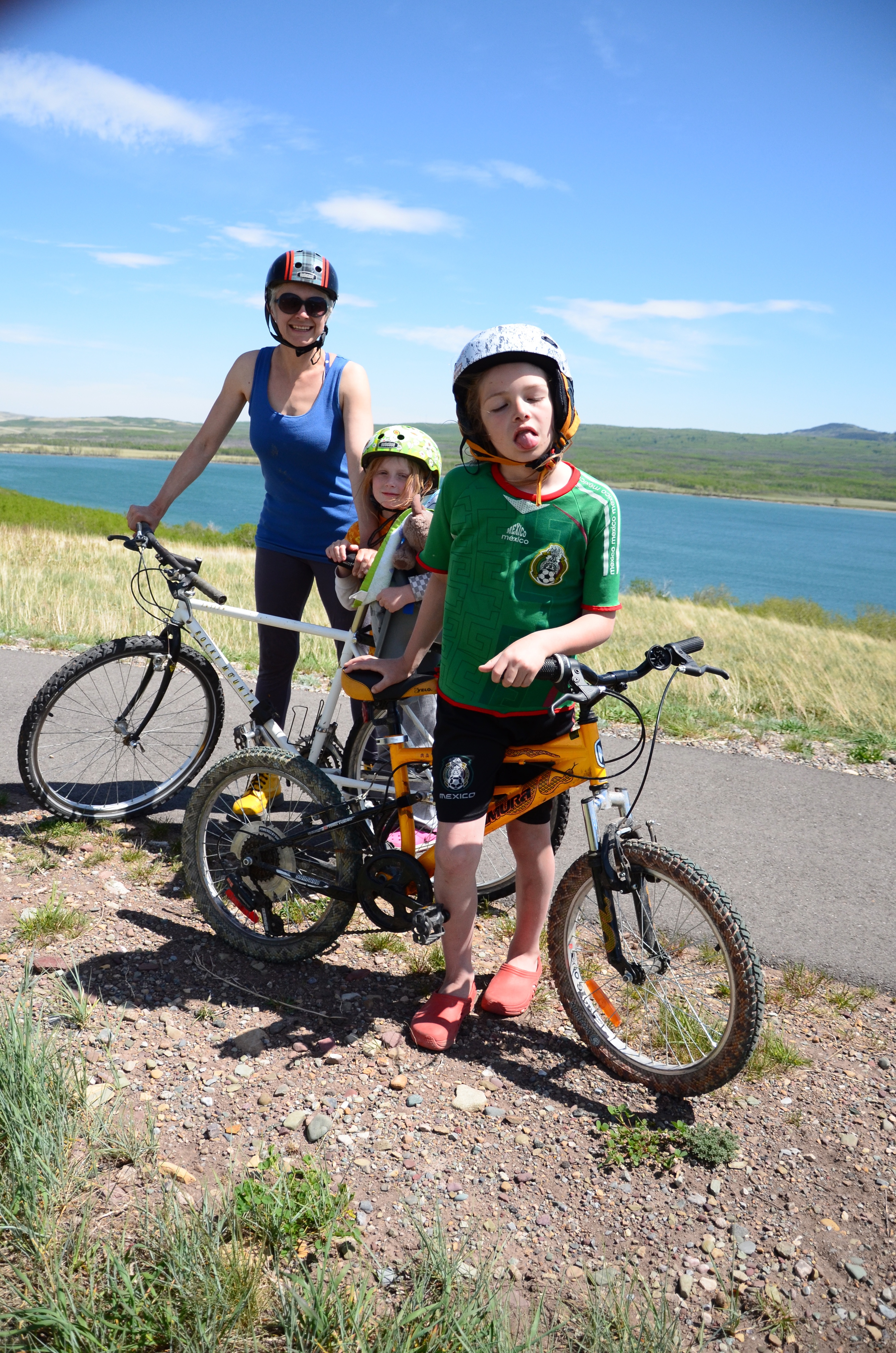
The Myth of the Frazzled Modern Mother

Today’s mothers are frazzled. Falling apart. Utterly incompetent, overwhelmed and unable to cope with the demands of daily life. At least that’s the impression you’re going to get from pretty much any day’s sample blogs, “lifestyle” newspaper articles, or just about any column in the ever-proliferating parenting magazines and advice sites.

I disagree. Vehemently. I’m surrounded by extremely competent and on-top-of-it mothers. Heck, 9 out of 10 days, 9 out of 10 hours, I’m that extremely competent mother myself. And you know what? So are you. And that whiney blogger over there? And that friend of yours who posts nothing but negative status updates on Facebook? She’s a competent mother and human being too. Really.

She’s just making herself look bad—frazzled—incompetent—by putting what used to be private moments of despair and downtime out there in the public sphere, for everyone to see… everyone to comment on.

For everyone to remember. Hyper-focus on. But that’s one moment. One hour. One crappy day. OK, maybe a string of crappy days—in what’s actually a pretty good life.

I live a pretty good life. And yeah, I have moments of panic, frustration and utter madness. At times stretches of arduous tough days: those first weeks (months) post-partum. Never-ending flus. Life-altering illness and events. Confluxes of life events when everything piles on top of me and I want to throw myself a big pity party or crawl under my comforter and never come out.

But those are exceptions in a full, fulfilling, fun life. Exceptions (on topic: my friend Marie had a great post recently about her mantra “There are no bad days, just bad moments” and how it works on “one of those days”; have a peek). Most of the time, I’m pretty on top of it. Damn-right competent. And baby, so are you.

 So here’s the big question of the day for you: is it good to broadcast those moments of despair? To post “So tired!” “If only they would sleep!” “Could anything else go wrong on this shitty, shitty day?” as your Facebook status? To blog about “the worst day ever?”

I’m not sure. I can see how you can build a cogent argument for each side. Sharing them crappy moments is the first step to getting support, a “I’ve been there too!” from a friend—which is sometimes all you need to shake off the blues and move on—or an offer of child care or food delivery—which you desperately need to get through that day or moment. But because you’ve shared them in the public space… well, they’re there, reminding all and sundry, including yourself, of that bad moment, bad day. Contributing to the Myth of the Frazzled Modern Mother.

Long after you’ve moved on.

What do you think? Are you a frazzled mother? Is it a myth? Do you inadvertently contribute to it? What can we do to combat it? Or, is it real?

A few days after I wrote the first draft of this post, I stumbled across this lovely post by Amy at Small World at Home, “What I don’t show you,” which isn’t precisely on this topic–but fits into the larger discussion of presenting in public space. More food for thought…

B0007445 Postnatal blues

Postnatal blues (Photo credit: wellcome images)

“It’s impossible–it’s theoretically impossible to make a video game as bad as the Grateful Dead.”

Pen Jillette on video games:

…There is this tremendous amount of arrogance and hubris, where somebody can look at something for five minutes and dismiss it. …

…That kind of obsession is going to lead to a sophisticated 30-year-old who has a background in that artform. It just seems so simple, and yet I’m constantly in these big arguments with people on the computer who are talking about, “I would never let my kid do this and this in a video game.” And these are adults who when they were children were dropping acid and going to see the Grateful Dead.

I mean, the Grateful Dead is provably s***ty music. It’s impossible – it’s theoretically impossible to make a video game as bad as the Grateful Dead. I throw that out there as a challenge.”

From Erik Kain’s blog ar Forbes.com … which he got from an interview with Gameinformer back in November 2009 … but it just made its way into my life via a share on Facebook from a friend who’s the founding partner of a kick-ass Vancouver-based video game company.

Cinder, by the way, had his first programming lesson yesterday. Or his teacher had his first Minecraft lesson yesterday. Another adventure is beginning.

For my own video game awakening: How I got deprogrammed and learned to love video games.

Deutsch: Minecraft is a video game which allow...

(Photo credit: Wikipedia)


Cinder Recommends: Horrible Science

Cover of "Bulging Brains (Horrible Scienc...

What is it: A series of more than 30 disgusting, gross, yucky, bloody and nefarious books about science, with titles such as Angry Animals, Bulging Brains, Evolve or Die, Fatal Forces, Nasty Nature and Wasted World, most written by Nick Arnold and illustrated by Tony de Saulles. Also 82 issues of fabulously full-colour magazine re-issues of the books.

Why Cinder loves it: Cause it’s really gross. Informative, yes, chokful of scientific facts and all that—but there’s blood, vomit and fart jokes on just about every page.

Why Jane loves it: Cause it’s pretty funny and chokful of science in a way a non-scientist like me can really get into. And cause Cinder loves it. And I can read it for hours without getting bored.

Why Flora barely tolerates it: Cause sometimes “they’re mean to animals. And why is that supposed to be funny? It’s just mean.” And also, “that’s just so gross. Why did they have to show that?” There are some issues that she enjoys… but she skips over a lot of stuff.

Recommended ages: We started reading Horrible Science with Cinder when he was five or six. And Flora not quite three. So we’ve probably scarred her for life. Cinder’s 10… and we’re still reading Horrible Science together.

Best way to test drive it: Buy or borrow the full-colour, hard cover The Stunning Science of Everything (here’s the BBC review of it  and here’s the more critical Popular Science review). It’s a good test drive.

Need to know more? You can check out the Horrible Science UK site, or visit author Nick Arnold’s gross (not really) site  and illustrator Tony de Saulles site.

Lucky Americans can buy Horrible Science books AND the colour magazines at reasonable prices at Ray’s Horrible Books in San Diego. North American editions of most of the books are now available for overlooked Canadians too, who can order individual book titles from Book Depository, Chapters or Amazon. (Ray will ship to Canada, but says, truthfully, the price ends up being extortionate. But if you’re planning a trip to the States…)

The best deal on the books, however, is through Scholastic Book clubs, which will often have box sets available at discounted prices.  (If they’re not being offered locally currently, try the World Scholastic Book Clubs. Even with the pound prices and the 25% shipping, the box set prices through the international clubs are often much lower.)

Buyers’ Tip: If your kids love Horrible Science books the way Cinder did, you probably want to plonk down the coin for what’s left of the magazines. You can get them from Ray’s Horrible books at $3 an issue. They’re full-colour and even more visual than the books (which are b&w paperbacks). And at 24 pages, they’re the perfect, “OK, I’ll read you one before bedtime” length (“Two?” “One.” “Two?” “One and a half.”) They are full of typos and oversimplify concepts… but whatever. They’re cool.

And then you might want to look into Horrible Geography. And Horrible Histories. And Horribly Famous. And Murderous Maths. We have them all. We want more.

Tony de Saulles at Epsom library

Tony de Saulles at Epsom library (Photo credit: Surrey County Council)

Don’t preach–HELP me get outside

I missed Nature Play Day.

If you missed it too—mark your calendars for 2013: June 15, 2013. It’s an event sponsored by Child & Nature Alliance of Canada,  a network of organizations and individuals who are working to connect children to nature through education, advocacy, programming, policy, research, and the built environment, and part of the “get thy child back into nature” movement inspired by, among others, Richard Louv’s Last Child in the Woods.  The idea behind it is to raise the awareness around outdoor play and the need to get our children outside to play. From the CNAC website: “Make Nature Play Day a day to invite someone out with you who may have forgotten how wonderful it is to play outside — help them reconnect with nature by planning a great day outside!”

It’s a good goal, right? There’s a… typical… post here  by Jill Sturdy from the Canadian Parks and Wilderness Society about why Nature Play Day is important and how one can celebrate it.

So why does reading about Nature Play Day… and the goals of organizations such as Child & Nature Alliance of Canada leave me so… uncomfortable?

Same two reasons that had me cringing through parts of Louv’s book. First, it’s just kinda sad that we need this. Right? That we, as parents, in a pretty affluent, aware society, need to be reminded that it’s a good thing to take our kids outside. That we need Nature Play Day. And organizations dedicated to promoting this idea. Shouldn’t we just know? Should we just do it?

The thing is—of course we know. But here’s the second reason for my heebee-jeebies when we start talking about this topic. Of course we know our children need to—want to, until we unlearn them of the habit—to be outside.

But it’s frackin’ hard, in 2013, to give them as much outdoor time as they ought to have.

Of my three children, all love to play outside, at manicured playgrounds and in wild spaces. They love to climb trees, throw rocks in rivers, build dams, dig pits, hunt for bugs, build forts… and just run, run, run. The two boys, moreover, need to be outside. We cracked the code with Cinder when he was two—requirements for a happy, stable Cinder included a minimum of four—count them, four—hours of outdoor play. Could be substituted for with some intense physical indoor activity in part… but outdoors was better. His little brother apparently read the same baby manual.

So we’re outside a lot.

And it costs us.

It’s a price I’m willing and able to pay—I freelance, my husband works from home, we homeschool, and we live in an area around a safe, large “Common” space, complete with playground, wild spaces, and lots of families and adults trading off active and passive child watching duties. But I’m hyper-aware that our lifestyle offers flexibilities most people do not have. My kids are outside every day; most days, they play outside almost as much as they need to (if not necessarily as much as they want to).

But it costs us. For every hour that my kids are outside is an hour that their parents don’t—the list is long—don’t earn money. Don’t clean house. Can’t prepare supper. Don’t do laundry. Don’t run errands.

Because we can’t just let them outside, right?

Even with the gift that is our Common, I sit at the playground watching my two-year-old climb the ladder and go down the slide—again and again and again. An hour rolls by, maybe two. He needs to do this. And I need to watch him.

Paid work doesn’t get done during this time. Supper doesn’t get prepped. The dishes don’t get done.

My elder two are, at 7.5 and 10, able to fill some of this need on their own. They can play on the Common, and venture within a certain boundary of the neighbourhood on their own. But they need me to take them to the wilds, to the rivers—or even to the outdoor spaces that a generation ago they could have run off to alone.

They need my supervision not because they’re less competent than children of an earlier generation. Nor because their world is a less safe place. I need to be there because it’s an emptier place. That’s the real danger of our streets and neighbourhoods: not lurking criminals, but the lack of benign adult presences. The grandmas peeking out the windows, the neighbours hanging out on the porch, watching the kids scooter or run by between playgrounds and parks. Available to help if needed—and helping just by being, just by having eyes.

Even in our inner-city neighbourhood, considered one of the most vibrant in our city, the residential streets are empty, and most of the time, our parks and playgrounds are very, very quiet.

It’s easy to tell parents to get themselves and their children outside. It’s easy to make parents feel guilty about not being outside enough.

It’s darn hard to create neighbourhoods, communities and societies in which it’s easy for parents to let their kids have as much outdoor time as they need—without the parents needing to be present in the outdoor time with them all the time.

A water-based playground in Germany

A water-based playground in Germany (Photo credit: Wikipedia)

Do your children play outside as much as they need to? And what’s the cost to you?

Here is a great source of inspiration for getting outside in small doses (and what to do once you get here): The Outdoor Hour Challenges.

“Want to hear all the swear words I know?”

My own personal goal for this month… next month… any month, really: to swear less. At least in front of the children. At the children. I mean, in front of the children. I don’t swear at them. At least not out loud. Much. Hey, it’s been a stressful month, ok? Anyway. My goal. Swear less. So it’s eerily appropriate that I revisit today the time Cinder regaled me with all the swear words he knew.

We picked up some books at the library yesterday, including a stack of “Phonics Comix” for Cinder by request. He’s flipping through one on the way to the car. “Fuck! The only word in this book I can read is “moo!” Well, I guess this one here is probably cow…”

A few hours later that night, as we are getting ready for bed, said child comes up to be with a sneaky look on his face. “Hey, mom–do you want to hear me say all the swear words I know?”

(What, by the way, would be the proper response to this request?)

I say, “Um, not particularly.”

“Are you sure?”

“Have you a burning desire to regale me with all the swear words you know?”

“Yes.”

“OK, go.”

So he starts to list off—an amazingly modest list, actually that starts with “darn”—not “a real one, but apparently it used to be, did you know that?”—gives top billing to “Jesus Christ!” (which is what Catholic-raised I holler when I explode a pyrex baking dish and what not)—proceeds through shoot, shit and fuck, adds for reasons I do not understand “shoulder” and then, after a dramatic pause, finishes with hell.

Silence.

“So, do you want to know how I learned these?”

“Unfortunately, I think we can trace pretty much every single one of those to either me or Daddy.”

“Um… I guess. But actually, the other day, at the potluck party, we played this game, Truth or Dare, and one of the kids was dared to say all the swear words he knew, and he did, and I was taking notes.”

“Notes?”

“You know, mental notes. And KH said swear words were useful things to use if you wanted to offend your enemies, did you know that?”

“Um…”

“But if I want to offend my enemies, I know something better! Know what?”

“What?”

“I will bend over and fart at them!”

Boys.

From Life’s Archives, Swearing, February 3, 2009

If you liked this, you’ll love this: Why Parents Swear

swearing in cartoon Suomi: Kiroileva sarjakuva...


It’s not about balance: creating your family’s harmony

Ever since Cinder arrived and completely changed our universe, I envisioned life post-children as… family life. Not adult-centred. Not child-centred.

Family-centred.

I was lucky here, as I had had a pretty good model. My parents lived full lives, with us in them, part of them, along for the entire exhilarating ride. Among the legacies they’ve left me that I cherish is the belief that “parenting” isn’t a part of life, isn’t a job, isn’t a stage—it’s, simply, life.

Just life. Life with children, life as a family. We all struggle through this in the early days of the journey. We talk about the need for balance. Balance. I don’t really like that word in the context of family life. Because it’s not about balance, it’s not about give and take. It’s about… what? Harmony? Fulfillment?

It’s about every member of the family getting the nourishment he or she needs.

I want my children to be happy, fulfilled, loved, and respected—and me too, I want those things for myself as well. Both my children and I—and my partner, their father—deserve to be happy, fulfilled, loved, and respected. And we are happy, fulfilled, love, and respected… most of the time. (There are always bad days or, more precisely, bad moments. I think that’s another secret we learn on the journey: that bad moments can be just that, moments. Well, unless they become patterns. But that, again, is another story.)

In a family, when one member of the family isn’t feeling happy, fulfilled, loved, and respected—there are repercussions on everyone. It’s a situation that must be addressed.

Parents’ needs and children’s needs are often talked about in combative language, and words like compromise, sacrifice, trade-off etc. often make an appearance. It’s unfortunate—very Western—very unnecessary. Because it’s all just, well, life. Figuring out how to best get along, live, thrive—sometimes just barely survive!—as a family, in whatever the universe is throwing at you at the moment.

What does this mean for me as a mother of young children, for me as a person? Simply this: I did not stop being a person—with needs, wants, ideas, passions, biological rhythms and all that—when I had children. I added another layer of complexity—amazing complexity—loving complexity—complexity and experience I wouldn’t trade for anything else in the world. I am pursuing my life path, my life journey still.

My children are part of my journey, and they have their own, and I’m part of theirs… but their journey is not mine, just as my journey is not theirs. I am not putting my life on hold while I give them a dream childhood. I am still living my life, time is still flowing, stuff is happening. I’m just living it with my children. Different pace, different priorities than before, of course.

Balance? Life with young children is inevitably unbalanced. So I don’t seek balance. I seek harmony.

Sometimes I even find it.

In the end, this is the biggest secret power of women, of mothers–and of fathers, of parents–in the middle of the utmost chaos, conflicting pressures, we find a solution, we create our harmony. And it’s our harmony, our unique blend, formula, solution, to address the unique needs and challenges of the quirky individuals that make up our individual quirky families. No one else can create it for us; no one else can copy ours.

What do you aim for? Balance? Harmony? Something else altogether?

From Life’s Archives, Feb 21, 2008, Harmony, not Balance. It’s not often I pull out something I wrote about the parenting journey in the first years that still fully resounds with me… but this is one of those pieces. If I were writing it today, it would still be essentially the same. Well, more polished and more cohesive. I’m getting much more sleep these days.

Every Cathedral Should Have Stained Glass

“Is it a long and boring story?”

I.

Ender: Ma-ma! Ma-ma! Come to the tub!

Jane: Sweetness, in a few minutes, I’m finishing cleaning the sink… What is this gunk?

Ender: No! Mama come in tub now!

Jane: Dude, what’s the rush?

Ender: I need to pee… and I want to pee on YOU!

Sale fail. 

II.

Flora: Mom? Why is the oregano in the tin that’s labeled red lentils?

Jane: It’s a long and boring story. The important thing is you found it.

Flora: Where are the red lentils?

Jane: In the ziploc bag labeled brown rice.

Flora: Is that a long and boring story too?

Jane: No, that one’s actually pretty exciting. Want to hear it?

Flora: No, not really.

Thwarted.

III.

Flora: Mom? Why is there a flat poop floating in the toilet?

Jane: Um… I guess I forgot to flush the toilet when I last changed Ender.

Flora: But why is the poop flat?

Jane: It’s a long and boring story.

Flora: Oh, I’m not in a rush. Why don’t you tell it to me while I poop?

Jane: Seriously? That’s the story you want to hear?

Flora: You can tell me the rice and lentil tin stories too if you really want to.

Why is she humouring me? What is she plotting?

To discourage seed predators, pulses contain t...

I love them bums terribly.

Cinder & Flora agree: Get thee to Boneville

What is it: Only the best graphic novel of all time. Jeff Smith’s Bone is… well. It just is. It’s so good. On every level. The art. The story. The jokes. The serious bits. The balance of the serious with the funny, the profound with the irreverent. Even the subplot lines that peter out or come out of nowhere work.

How good is it, really: We read and reread the entire series for months, and no one ever got bored of it–not even the mother reading it for the seventieth time. Flora counts these as the first books she’s read on her own. She sleeps with the entire stack beside her bed. When she wakes up in the night to pee or grab a drink, she sometimes reads a page or two by flashlight. When we go on trips, I have to negotiate with her to only take one or two of them with her (I know I’m eventually going to break down and get the whole collection in e-form so they can always be with her on the iPad).

Why is it so good: God, if I knew that, I’d produce something with all the same ingredients. It just is. It’s brilliant. I think perhaps it’s so brilliant because it wasn’t intended for children: it was simply the story Jeff Smith wanted to tell. And so did. It works for both Flora and Cinder because it’s both visual and an incredibly story, it’s got great girl characters and great boy characters, it’s got young people and old people, it’s got fighting and a touch of romance, it’s got Phone Bone, and Smiley and Bartleby…

Recommended ages: Flora and Cinder were 7 and 9 when we started reading it. Sean and I were 37. In our circle of friends, we’ve got five and six year olds devouring it, and teenagers. I expect this will be Ender’s first reader.

Need more? Think I’m overstating my case? Just Google Jeff Smith’s Bone. Or go, to Jeff’s site at www. boneville.com.

Look, Scholastic says it’s educational to boot.

The 621-and-counting reviews of  the first volume of Bone on Good Reads are here.

Now, get thee to your bookseller of choice. (Test drive them at the library if you like, but if your family loves them as much as ours did, you will need to own them.)

Burned Buyers’ Tip:Do get the colour versions, not the original black and whites. Triple-check that you’re getting the colour versions. It’s worth it. Don’t get the “entire massive series in one book” version. It’s too bulky. Plus, only one family member can read it at a time. Do get the Tall Tales extra book.  Give The Handbook a skip, though, unless you absolutely must appease a fanatic.

English: Jeff mimicking himself sitting in fro...

English: Jeff mimicking himself sitting in front of the poster in Barcelona. 2010 (Photo credit: Wikipedia)

Of the apocalypse, euphemisms and (un)potty training

I.

Jane: I don’t understand. I don’t understand how two people who love each other as much as I know you two do can fight so much!

Flora: Oh, Mom. Don’t worry. We’re just like Sadie and Carter. (Sadie and Carter Kane, from The Kane Chronicles.)

Cinder: Yeah, we fight all the time…

Flora: … but we cooperate when it matters.

Cinder: Yeah, we’d totally work together to save the world. Right, Flora?

Flora: Right… Ouch! Why’d you punch me?

Cinder: The world is not in peril right now.

The Revelation of St John: 4. The Four Riders ...

II.

Cinder: Mom! I taught Ender a new word!

Jane: Oh, dear God. Do I want to hear this?

Cinder: Ender! What do you say?

Ender: Butt sack! Butt sack!

Jane: Butt sack?

Cinder: It’s a euphemism. Do you want to know for what?

Jane: No.

III.

Jane: Ender, beloved, the potty is right there. Why did you pee on the floor? Again?

Ender: I hate potty. I never pee in potty again.

Jane: Why?

Ender: Potty evil.

Jane: Cinder!

Cinder: What? Why are you assuming I told him the potty was evil?

Silence.

Cinder: Well, it’s not like he was using it much anyway.

IV.

Flora: Moooom! Maggie’s drinking pee!

Jane: What? Oh… no, that’s okay, that’s water.

Flora: You… gave… Maggie… water… in… Ender’s POTTY?

Jane: Well… it’s not like he’s using it these days.

Honouring the private lives of children

The insight comes at this moment: My children, 5.95 and 3.4 at the time, are on the floor in my living room/office, playing a rather odd game that involves some plastic dinosaur figures, a couple of Lego Exoforce structures, and a plot line that combines some kind of intergalatic battle with a game of hide and seek and a trip to Banff. They’ve just come down from upstairs, where they were hanging out in Sean’s “workshop,” which has numerous breakable things in it. I was not in there, hovering over them, to ensure they didn’t break the printer, put magnets on the hard drives, or brought the pile of intricately arranged video tapes on top
of the bureau crashing down on their heads.

I didn’t have to hover―not because they are “better” or more “obedient” children than the child who would do all that, but because they’re in a different developmental cycle. I have Sharpie marker traces on our (trashed) leather couch, basement floor and several stuffed toys from a different phase, after the onset of which the Sharpies were put away in a high, unreachable, unseeable place. There was a DVD destroying incident, after which Sean’s workshop was off limits for a long while.

The Sharpies are still away. The door to the workshop is once again perpetually open.

 That’s by the way (another by the way: the game on the floor below me, by the way, now includes a ghost haunting, and I’m trying to figure out how this fits into the previous going to Banff via intergalatic battle bit, but that’s probably just as irrelevant). We all figure out how to deal with the “in the moment” issues thrown at us by our children with ways that address the “in the moment” needs and fit into our big picture philosophy of life, more or less adequately.

Today, I want to put another issue on the table, the issue of 
privacy and the inner life of the child.

Now, my partner and I spend a lot of time with our children. Oodles. We both work from home. We homeschool. We could be together 24/7. And one of the breakthroughs for me on the parenting journey―it happened, as always, later than it should have–was that as they’ve gotten older, my children need more space, more privacy, more alone time. Not to the exclusion of time with each other and time with their parents and time with other people in their lives–but alone time, uninterrupted time to just be by themselves, to do their own thing without being watched (however unobtrusively), without being questioned about it, without having to account for that time.


Sometimes, when Cinder has a crazy day(s), one of the things that’s been missing from his rhythm is this alone time. He’s been with me and his sister 24/7 and frankly, he just wants us to go away, but that’s a hard thing to say to people you love, so he acts like a bum instead to make us go away. I’m working on giving him the words to say it, and helping him recognize that it’s ok
to say, “I just want to be by myself for a while.”

His sister recognizes this about herself much more intuitively. She will take a basket of toys into the bathroom and close the door on herself, announcing that she “needs some privacy.” And she’ll stay there for a long stretch of time, 30 minutes, an hour–until someone desperately has to pee because we only have one bathroom–playing by herself, being by herself, enjoying her privacy.

Children need a private inner life. This need manifests in different ways and is fulfilled in different ways, but I do think it’s pretty much universal–everyone needs some space in which to just be themselves, by themselves, without an audience, however loving or unobtrusive.

Filling this need, safely, as a parent, involves a whole lot of judgement calls. Cinder just wandered past my desk carrying a pair of scissors. I followed him onto the balcony, saw that he had a pile of construction paper on the table there, and retreated. Had he been three, instead of almost six, and heading towards his sister’s precious dolls (or head!), I probably would have stayed. Had be been heading somewhere with a box of matches―or for a box of matches―I would have offered rather obtrusive supervision. Judgement calls.

Cinder and Flora wrap up their focused (unsupervised) together time. They call me away from my own alone, private time and time of reflection, and we all three embark on a very complicated craft that requires my participation and very active supervision (“No! Melted wax is hot! Gah!”). And then they’re tired of each other, and of me. Flora takes a basket of toys to the bathroom. Cinder heads outside to run laps around the Common. When they come back to me, I resolve not to ask them what they were doing, what they were thinking.

Maybe they’ll tell me. Maybe they won’t. Either outcome’s okay.

Children have private lives and they need privacy. (Based on an April 2008 day and previously published list post).

What are your thoughts on the private lives of children? How do your children take their private time? How did you come to recognize this need?

sharpies!

Cinder & Flora agree: Rick Riordan’s Percy Jackson rocks

What is it: A series of fabulous books about the children of Greek (and later Roman) gods and mortals living in modern America, fighting monsters, going on quests, and saving the world for their godly parents and mere mortals. The books are available everywhere, including your local library (they’ve got multiple copies of all at ours). They’re also available as audio books at iTunes, which is one of Flora’s favourite ways of experiencing the stories. There’s also the Percy Jackson and the Lightning Thief movie, available at Netflix (in Canada at least) as well as our local library and iTunes. And a graphic novel version of The Lightning Thief.

Why we love it: strong male and female characters. Epic plot line. Best immersion in Greek (and later Roman) mythology ever. (To see how far Cinder and Flora took their Percy Jackson obsession, read Cinder and Flora become Hellenic Pagans.)

Recommended ages: Percy is 12 in the first book and 16 at the end of the first series. Flora and Cinder were 6.5 and 9 when we discovered Percy.

To learn more: Visit author Rick Riordan website, at www.rickriordan.com. Read reviews of the first Percy Jackson book, The Lightning Thief, at GoodReads.com.

Rick Riordan at the 2007 Texas Book Festival, ...

Rick Riordan at the 2007 Texas Book Festival, Austin, Texas, United States. (Photo credit: Wikipedia)

The 2 a.m. phone call: why sleeping through the night is irrelevant

It’s 2 a.m. The telephone rings. It’s dark and I’m groggy as I race through the house for the telephone. I don’t get there in a time and I’m in a brief moment of panic as I crouch beside it and wait for it to ring again. My Flora’s sleeping out of the house this night and this phone call can only be about her.

The phone rings again; I pick up; the panic subsides. Yes, it’s Flora. Sleep over fail. She woke up in a strange place, a strange bed and is frightened. Wants to come home.

Sean runs over to get her—and we’re both briefly grateful about the place we live, where sleepovers take place a couple of doors down instead of across the city—and a short two minutes later, she’s in my arms, face pressed against my chest. She’s whispering “the whole story”: how it was so fun, and they had a great time, and she had no trouble at all falling asleep, and then she woke up, and it was dark and strange and she didn’t want to stay…

I listen and then shush her, tell her to go back to sleep. She presses tight against me. Now that she feels perfectly safe and secure, she also feels embarrassed that she bailed. I reassure her in a sleepy voice… and shush her again. “Now sleep, Flora, sleep.”

She presses against me. On the other side of me, Ender flips over, rolls. But doesn’t wake. It’s doesn’t happen very often these days that I find myself squished between two little bodies and I take a sleepy minute to savour the moment.

And I think about how much parenting takes place in these dark hours—when, really, we’re at our worst. Exhausted. Unconscious. Still on duty, but too tired to perform.

None of that ends when the baby (toddler, preschooler, kindergartener!) “sleeps through the night.” Our Cinder actually reached that milestone relatively quickly—sometime around two years. And so what? A few weeks of blissfully uninterrupted sleep followed. Then came the night terrors. When the first wave of those subsided, he got out of diapers—and had to get up to pee in the night. Six times a night, it seemed (probably just once or twice). Then Flora arrived and being awake for Cinder became irrelevant because I was waking up for Flora. When she nightweaned, she started waking up at 3 a.m., raring to go for the day. When she’d sleep late (aka, until 5 a.m.), Cinder would have night terrors. Inevitably, on the nights both kids slept soundly, the dog would have diarrhea… Or, naturally, I would have insomnia.

As I’m cataloging the different stages of post-child sleep deprivation, Flora presses her closer against me. “I’m going to roll over; you can hug my back,” I whisper. “Can’t I roll over with you?” she whimpers. “No, stay there—Ender’s on the other side.” I readjust, so does she. “I like your soft side better,” she sighs. Her head is between my shoulder blades. But her breathing is winding down—sleep is almost there.

“Mom?”

“Sleep, Flora.”

“Does Monday come after Sunday?”

“Yes. Sleep, Flora.”

“Is tomorrow Sunday?”

“Yes. Sleep, baby.”

“And then Monday?”

“Mmmm.”

“Good. I have plans on Monday.”

And she’s asleep. Ender does another flip. But doesn’t wake up. I send a prayer to Morpheus—or should I be petitioning Ra?–that neither of them wakes up with the sunrise. It’ll probably be a four pot, not four cup, coffee day, tomorrow, I think as I feel my breathing reach the sleep rhythm. And I’m out.

I don’t  belittle or dismiss sleep deprivation. It’s tough. There’s a reason sleep deprivation is a form of torture. And each family needs to find its own unique solution to ensuring all members—especially the primary caretaker—gets enough sleep. But “sleeping through the night”? That’s irrelevant. Because kids keep on needing their parents at night, long after they wean. Sometimes just for a minute, for a quick squeeze and reassurance. Sometimes for longer. But if not exactly forever—for a long, long time.

Ender wakes up that morning, by the way, at 5:30 a.m. I curse Morpheus and tell off Ra. Then we tiptoe downstairs. I make coffee. Pull the electronic babysitter—aka Backyardiggans on Netflix—onto duty. Cuddle the Ender. Write most of this post.

Flora streaks downstairs at 7 a.m. “Hi, Mom, I’m going to Meghan’s!” she calls. “Hug? Kiss?” I holler. She backtracks. Hug. Kiss. And for Ender. And for Maggie the runt terrier. And she’s off.

I look at Ender. Hug. Kiss. Soon, I’ll roll off the couch and make the second pot of coffee. By the third pot, I’ll be ready to face the day.

Pot number four, I decide to save for the inevitable afternoon crash.

Koala sleeping on a tree top

 (N.B. For those concerned about my caffeine intake, I should clarify they’re pretty small coffee pots. It was a purchasing mistake. We thought the small press would make us drink less coffee. Nope. It just makes coffee drinking a more labour-intensive process. Live and learn. On the plus side, the cafe is always fresh.)

“Mom? Have you noticed I’ve stopped…”

Flora: Mom? Have you noticed I’ve stopped sliding down the banister?

Jane: You’ve been sliding down the banister? You mean the railing? You mean this railing? This incredibly dangerous, sliver-infested railing?

Flora: Mom! I said, have you noticed I’ve stopped sliding down the banister?

Jane: Um, no, I guess I didn’t.

Flora: Well, I have. … Aren’t you going to ask me why?

Jane: Um… why have you stopped sliding down the banister?

Flora: Remember that day Ender got a sliver from the banister?

Jane: Yeah?

Flora: Well, that’s when I decided to stop. Because a sliver in your vulva could really ruin your day.

Full stop.

English: Staircase banister in Antoine Cartier...

Biking as a metaphor for life

We’re out on our bikes all the time again, and we’re a bit of a gong-show―Ender, Maggie the rat, er, runt Terrier in the biggest bicycle ever (this one), Cinder on his snake bike, Flora on a bike she can barely lift―but needs to ride instead of the little one she can handle because that’s the only way she can keep up with her big brother. Cinder’s usually up ahead, Flora chases him for a while then falls back to ride with me. Ender squeals with delight and Maggie squeals with terror. And I get all sappy, watching them ride, and remembering that it wasn’t that long ago that I had both Cinder and Flora in a trailer behind me… and then Cinder on training wheels… and then Cinder on a little bike…

When Cinder dropped his training wheels and we started going for longer bike rides, I noticed one day how we were usually riding–he in front, setting the pace, going like a madman at first, then slower and slower, and me behind, pulling his sister in the trailer, keeping an eye on the path and possible obstacles, the two of us occasionally stopping to talk, then moving on…

And I was earnestly, sappily, struck with how we biked was so reflective of how I saw parenting and learning and living and all of that.

 And I got so in love with this metaphor, and started writing it out in more detail in my head and developing it into a huge life-changing thesis that I was going to write up for one of my yahoo groups or an article or maybe an entire book … that I stopped paying attention to the path and the real universe around me and I rode right into a post.

Lesson learned?

Nope. I’m cycling hard, chasing Cinder, keeping an eye on Flora, restraining Maggie, chatting to Ender, but my mind again turns the moment into a metaphor and a story―and bam!

It might even have been the same lightpost.

Biking in Waterton Lakes National Park

Here we are after conquering a hill in Waterton Lakes National Park. Ender’s napping in the baby seat and missing the view.

“But I don’t want to marry a handsome prince!”

Setting: Playground.

The Players: Ursa, 3.5, as the Princess. Flora, 7.5 and “in charge” of Ursa, as the Mother. Ender, 2.5, as Everyone Else.

Ursa: Save me, Mother, save me!

Flora: Mama to the rescue! Where is that fiendish dragon?

Ursa: Is Ender the dragon?

Flora: Yes. Ender! Come and guard Ursa!

Ursa: He’s not coming.

Flora: Well, toddlers are like that. Not very obedient. Ender! Come attack Ursa!

Ender: OK!

Ursa: Aaah!

Flora: It’s okay! I’ll save you, darling!

Ursa: Now that you’ve saved me, you have to marry me.

Flora: I can’t marry you! I’m your mother!

Ursa: But you saved me.

Flora: You’re supposed to marry a handsome prince, my darling.

Ursa: But I don’t want to marry a handsome prince.

Flora: Oh. Do you want to marry a handsome princess?

Ursa: No, I want to marry you. Because you saved me.

Flora: How about we replay the game, and Ender saves you? He can be the handsome prince.

Ursa: Who will be the dragon?

Flora: That rock over.

Ursa: Save me, save me!

Flora: Ender! Go save the princess!

Ender: Attack!

Ursa: He’s attacking me!

Flora: Just pretending he’s attacking the dragon. Now, Ender, kiss her and save her.

Ursa: I don’t want him to kiss me. I just want him to save me and marry me.

… For “Ursa,” and her mom, who didn’t get to hear it. Thanks for visiting with us. We love you.

English: Ursa Major, Astronomical chart showin...

Love letter discipline

Love Letter Discipline

When my kids are having “one of those days”—you know which ones I mean, the ones where nothing works right, and you’re wondering how wrong is it, really, to post your child on Kijiji… or Freecycle—I have two fool-proof strategies.

Strategy 1: I take them out for ice cream. (That’s yesterday’s post).

Strategy 2: I write them love letters.

Seriously. Sometimes in my head, sometimes—on the really, really “those” days—physically. Here is an example of Flora’s:

To My Flora,

You are my most beautiful, brilliant little daughter. And you will grow and grow into my most beautiful, brilliant big daughter. And I will love you every minute and every second and every nano-second of your amazing life. I will love you when you laugh and when you cry, when you’re angry and when you’re happy, when you’re celebrating the world and when you’re fighting it, when you need me to hold you and when you need to be alone. I will love you, every part of you, forever and ever and for always. Because you are Flora, because you are you.

And here is one for Cinder:

To My Cinder,

You are my most beautiful, brilliant not-so-little son. And you will grow and grown into my ever-bigger beautiful, brilliant son. And I will love you every minute and every second and every nano-second of your amazing life. I will love you when you’re full of joy and when you’re full of sadness. I will love you when you do what I ask you to do and when you march off listening to the beat of your own drummer. I will love you when you’re strong and when you’re weak, when you’re creating and when you’re deconstructing, when you’re wild and when you’re calm. I will love you when we are together and understand each other, and I will love you when we are apart and don’t. I will love you, every part of you, every thought of you and every moment of you, for ever and ever and for always. Because you are Cinder, because you are you.

By the time I finish writing or thinking one of these—or simply re-reading one I wrote during a previous crisis—I’m usually regrounded and recharged. Able to put the current moment’s craziness in perspective. Reminded of how much I love the little beasts, no matter how beastly they seem in this particular moment.

Got a moment? Write your own love letters to the munchkins. Don’t wait until you want to freecycle the little dudes. Do it now—and then when one of those days come, pull them out and read them.

And then take the kids out for ice cream.

I’ve recently shared a very long love letter to Cinder with you on occasion of his birthday, and you’ll find a very long love letter to Flora here. These longer letters were not written or composed in the heat of an “everyone’s evil!” moment, but I do refer to them in the heat of the moment quite often.

If you’ve written a love letter to your beasts… er, I mean beloved munchkins, please share it.

Love heart

Ice cream discipline

“Without ice cream, there would be darkness and chaos.”
― Don Kardong

When I want to throttle my kids, I take them out for ice cream. They’re screaming, beating on each other, whining, complaining―you name the most undesired behaviour, the thing that makes you understand why parents batter their children―and I’m about to turn into evil monster mommy who’ll out-scream and out-whine them―when they’re so bad―and I use that weighty word advisedly, because they’re so bad not even the most Pollyanist attachment parent guru could put a positive spin on what they are doing―when they’re so bad I want to freecycle all three of them, and maybe throw in my partner for good measure cause, you know, he contributed half the genetic material that gave rise to those monsters―when I’m completely at the end of my rope and about to start screaming, my absolutely full-proof, never-fail strategy is to take the kids out for ice cream.

The nearest ice cream place near our house is a 15-20 minute walk away, over a couple of bridges and through a lovely park. It gets us out of the house and into the outdoors, which is often enough to reset the entire day, to give us a clean start.

The weather where we live sucks much of the time, so we’re not always up for the walk. ‘s okay. The nearest drive-through ice cream place is a 15-20 minute drive away. “Ice cream” as a rallying call makes getting three kids into the car a piece of cake (especially if the alternative is staying in the house with Psycho Mom). They’re restrained in car seats. I pop in a book on tape. And there is 20 minutes of silence and looking forward to ice cream―followed by devouring of ice cream, and thank yous, and appreciation of each other.

To make ice cream, we need to walk to the grocery store―about a 25 minute walk at kid pace, or 5 minutes in the car or by bike. Gets us out too. Then back. Then working together to create a treat. (We make lazy Vitamix ice cream that’s ready in 1 minute. Yum.)

Ice cream discipline works―without fail―because it creates a disruption in the negative behaviour pattern we’ve all gotten into. It’s the reset button. And it’s, you know, ice cream.

Worried that it rewards bad behaviour? It doesn’t. It stops it. On my part, as well as theirs. And lets enjoy each other again―and have a pretty good rest of the day.

“Have you ever spent days and days and days making up flavors of ice cream that no one’s ever eaten before? Like chicken and telepone ice cream? Green mouse ice cream was the worst. I didn’t like that at all.” 
― Neil Gaiman , The Sandman, Vol. 7: Brief Lives

For more ice cream quotes, go visit this page of Good Reads.

Now, I know you can’t always get out for ice cream in the middle of a disaster of a day. Ice Cream Discipline’s sister strategy is coming tomorrow.

It's the picture of Italian ice-cream in a sho...

What’s your fool-proof “the kids get to live!”/”reset” strategy?

Why they don’t ask for permission…

I walk into the living room to see Ender and Cinder sitting around my old non-functioning Mac Book, its keyboard in pieces, and Cinder wedging one of the panels on the body open.

Cinder: Hi Mom.
Jane: What are you doing?
Cinder: Ender and I wanted to see what the inside of a computer looked like. Don’t worry–this is the broken old one. … Um… was this one of those things I should have asked permission for?
Jane: Um… yeah, probably.
Cinder: Would you have said yes?
Jane: Um… well…
Cinder: See, when I think you might say no, I don’t want to ask permission.

White MacBook laptop

From Life’s Archives, May 5, 2010. Cinder was a couple of weeks short of nine years old, and Ender not quite two. As far as this type of event goes, not much has changed in the intervening year!

A love letter to the boy who’ll set the world on fire

Cinder turns 10 today. 10. Double digits. Join me in celebrating the boy by re-reading the love letter I wrote him when he was still nine… and in a very liminal phase.

August, 2011. Yesterday, I accidentally slipped my feet into my 9-year-old son’s shoes. And they fit well enough that I took a few steps in them before realizing my mistake. This first-born baby of mine, seven pounds eleven ounces nine years ago―the size of a grain of rice ten years ago, just part of cosmic dust before then―is now so long, so tall, so strong. Stronger than me. No longer in a sling, no longer kept safe and satisfied only in my arms―the journey has been gradual, but this year, this day, this moment, it strikes me, smacks me in the face.

I love him. When he was that babe in arms and I looked at him and fell in love with him for the first time―and then every day, every hour, all over again―I didn’t think it was possible to love anything, any creature, any person this much. And then I loved him more and more every single day, and today, when I look at his tousled, tangled head, his lanky, long legs, the eyelashes that half-cover those sometimes mischievous, sometimes sad eyes, I fall in love all over again and again, and I can’t believe it is possible to love anything, any person this much. But now I know that tomorrow, and the day after and the year after, I will love him even more.

He isn’t bliss everyday. Being a nine year old boy in 2011’s North America isn’t easy. Sure, you can dismiss this as a First World Whine―hey, he isn’t toting guns in Sierra Leone, living in a shanty town in Rio de Janeiro, starving in East Africa. Over-privileged middle class white boy of over-educated parents, what are your woes? Lusting after an X-box game, having to eat roast asparagus for dinner again? Our world dismisses his … heck, call it was it is, existential angst. But it’s there, and it’s real.

My nine year old boy, my love, is searching for his purpose in life. A little child no longer, yet a long way from man, he is on a journey. He wants to be useful. He wants to work. To grow. To contribute. And it is so hard, in 2011. Were he growing up in any other historical era―1000 years ago, 500, even 50 years ago―this angst would not exist. He would help on the farm, in the fields. Chop wood. Practice hunting. Fighting.

Don’t misunderstand me: I don’t romanticize. We live longer, healthier, safer now than ever before in human history, for all our fears and complaints. But with this life comes the existential angst of our children. Especially such children as my son. See, he is the boy that you’d take on the hunt with you as soon as he could keep up with the men, because he’s got a strong arm and a good eye, and never gets tired. He’s the son who’d chop a cord of wood for you, then tame a colt or two, all before breakfast. He’d see the enemy coming before anyone else because he’d be up in the highest tree. You’d never lack for food―or protection―with him in your tribe.

What do you expect of this boy wonder in 2011? Well, you’d like him to sit quietly at a table and colour a pretty picture. Then cut up some cardboard and glue it, and maybe some dried up pasta too―look, we’ve got googly eyes, isn’t that cool?―to a piece of paper. Sit and listen to a story. Sit and read a book. Walk, don’t run. Write about this. Tell us about your feelings. Don’t be too noisy, don’t be too active, don’t be too disruptive.

But for goodness’ sake, don’t play too many video games, because that’s just not good for your brain. (Stop. I must digress. Video games invade my love letter, but ever wonder why today’s eight year old, nine year old, 12 year old boys love video games so much? Can you see it? Can you see the hunt, the fight, the chase? Those little buttons, those dudes on the screen―they’re speaking to their genes. They’re channeling the Caveman inside. Come full circle, video games back to love letter. I love my son. My son loves video games. I know why.)

My little love, growing so tall, so lanky, so strong. Searching. He wants to become a man, a useful, productive, important part of his tribe. What tribe? Where is it? When he was four, he decided he knew what he wanted to be when he grew up: the man who starts the fire at his community’s firepit. That’s who he’s going to be. But the path is long, and it’s tough, and not very obvious. So he’s struggling, searching, misstepping. And there I am, watching―he is my heart outside of me, exposed, and I want to protect him, help him, ease things for him, but there is so little I can do. So much of this he must struggle through alone, my love, and all I can do is be there―present, supportive, unconditional. There when he needs me, in the background when he thinks he doesn’t. Loving him, celebrating him, feeling blessed and grateful that he is my son… making sure he knows that I love him, celebrate him, and feel blessed and grateful that I am his mother.

It is another day, another night, and he is silent, falling asleep. He talked a lot today, about his game, the smell of rain, the trajectory of a roundhouse kick, the peskiness of little sisters. Then silent, perturbed. The eyes close, I see the brain, spirit, soul still working. Searching. What will he be? Fully himself, fully wonderful.

I write this to remind myself―to hold myself steady during the moments when he is not bliss. To remind myself of what matters and what doesn’t. To remind myself that the work we started, the bonds we weaved when he was a babe at breast, a toddler on hip, that work isn’t over. It continues, every day. Every choice, every word, said and unsaid, builds that bond and builds that relationship. Or harms it.

I don’t like to think of parenthood, motherhood as work. It’s not. It’s life, part of life, a definition of my life, as much a part of it as eating, sleeping, breathing. But the work metaphor creeps in, because in 2011 North America, everything that requires any effort at all is work. So―this love letter is my work. Put explicit into words, to exist outside of me as affirmation and expression and reminder. I love you, my beautiful son, unconditionally, perfectly, fully, in all your moods and moments. What will you be? What you are. Fully yourself, fully full of wonder. Cosmic dust transformed into a gift, to me, to the world.

The cinder path

The cinder path (Photo credit: Wikipedia)

Poisonous Volvo

I just really need to laugh today, and I bet you do too.

Unedited and uncensored; anatomy talk warning. Flora’s a month short of two, and Cinder’s four and a half.

Setting: our bathroom.

Cinder: Flora, stop trying to grab my penis. Flora! No! Stop!

Flora: hee hee hee

Cinder: It’s poisonous. Poisonous! Like the giant red milipedes in the
South American rainforest!

Flora: hee hee hee

Cinder: It will bite you!

Flora: hee hee hee

Cinder: OK, Flora, I know you want to play with it. But you can’t. Only I can play with it. Play with your own.

Flora: Oh… no pee pee!! Brother! No pee pee?

Cinder: Oh, I forgot, you don’t have one. Well, maybe one day, if you are very good, I’ll let you borrow mine. If I can. Mom! (I’m in the next room) Can I borrow my penis to Flora for a while?

Jane: Um… no. It doesn’t work like that.

Cinder: I didn’t think so. Well, sorry, Flora.

Flora: No pee pee? Why?

Cinder: Don’t worry, Flora. I’m sure we can think of something fun to do with your… Mom! What’s Flora’s not-a-penis called?

Jane: Um… (Still haven’t decided if Flora should have a Volvo or a Gavina… OK, I know she has BOTH, but you know what I mean. Go for the Volvo today) A vulva.

Cinder: We can think of something fun to do with your vulva. Hmm. Let me think. Maybe we could attach something to it?

Flora: Yeaah!

Cinder: Or… we could stick something in it.

Flora: Nooooo.

Next day. 
Setting: post-bath time. Sean and I hanging out downstairs chatting, Cinder and Flora are playing upstairs. Suddenly:

Cinder: Flora! I will smite you with my poisonous penis!

Flora: Aaaaah! Run! Run!

Sean: Well, if Flora turns out to be gay, we’ll know why.

Jane: Sean!

Sean: What? I think it would make the teen years a lot easier, don’t you?

Jane: Sean!

Sean: What? All I’m saying is, if she ends up a lesbian, being chased by her brother’s poisonous penis may be one of the reasons. And don’t you think you’d worry less about boys and teen pregnancy and all that?

Jane: What are you…

Cinder: Ok, Flora. Now it’s your turn to smite me with your poisonous volvo.

Flora: Aaaaah! Run! Run!

The genitalia of the Callosobruchus analis bee...

The genitalia of the Callosobruchus analis beetle. It is covered in spines from base to tip. Referenced in Rönn, J., Katvala, M. & Arnqvist, G. 2007. Coevolution between harmful male genitalia and female resistance in seed beetles. Proceedings of the National Academy of Sciences 104, 10921-1092. and Hotzy, C. & Arnqvist, G. 2009. Sperm competition favors harmful males in seed beetles. Current Biology 19, 404-407. (Photo credit: Wikipedia)

From Life’s Archives, December 9, 2006.