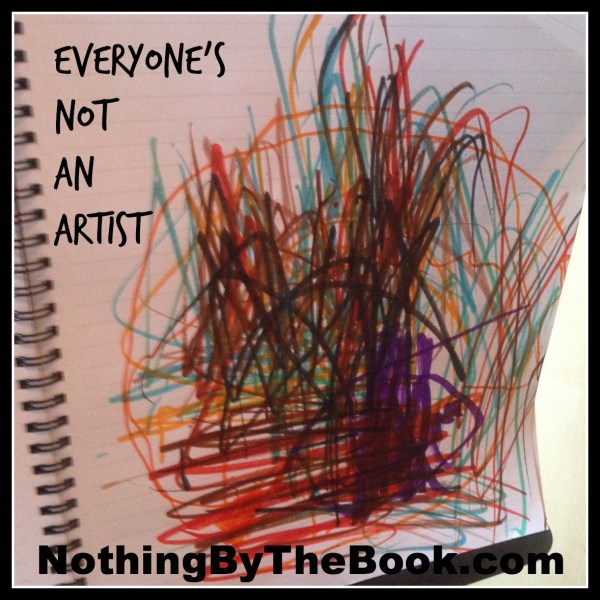
Summer rerun2: Everyone is NOT an artist

This post was originally published on March 25, 2012, after a children’s play called For Art’s Sake riled me, a little. It seems appropriate to revisit it right now, as I’m immersed myself in the art and life of Calgary artist Amy Dryer (FragmentsOfSoul), struggling to reduce her immense talent into a too-much, too-shallow profile for a magazine client. 

Why the rerun: Nothing By The Book is taking a page from old school un-social media and doing a re-run summer, while I spend the hot days getting a tan, running through sprinkles, selling one book, writing another, reading two dozen more, neglecting my garden, falling in love, jumping off cliffs—you know. Everything but blogging. But, you get reruns of my favourite stuff, so everyone wins. Likely keeping up with Instagram—NothingByTheBook—connect there, if you like? Or Twitter—  or/and .”

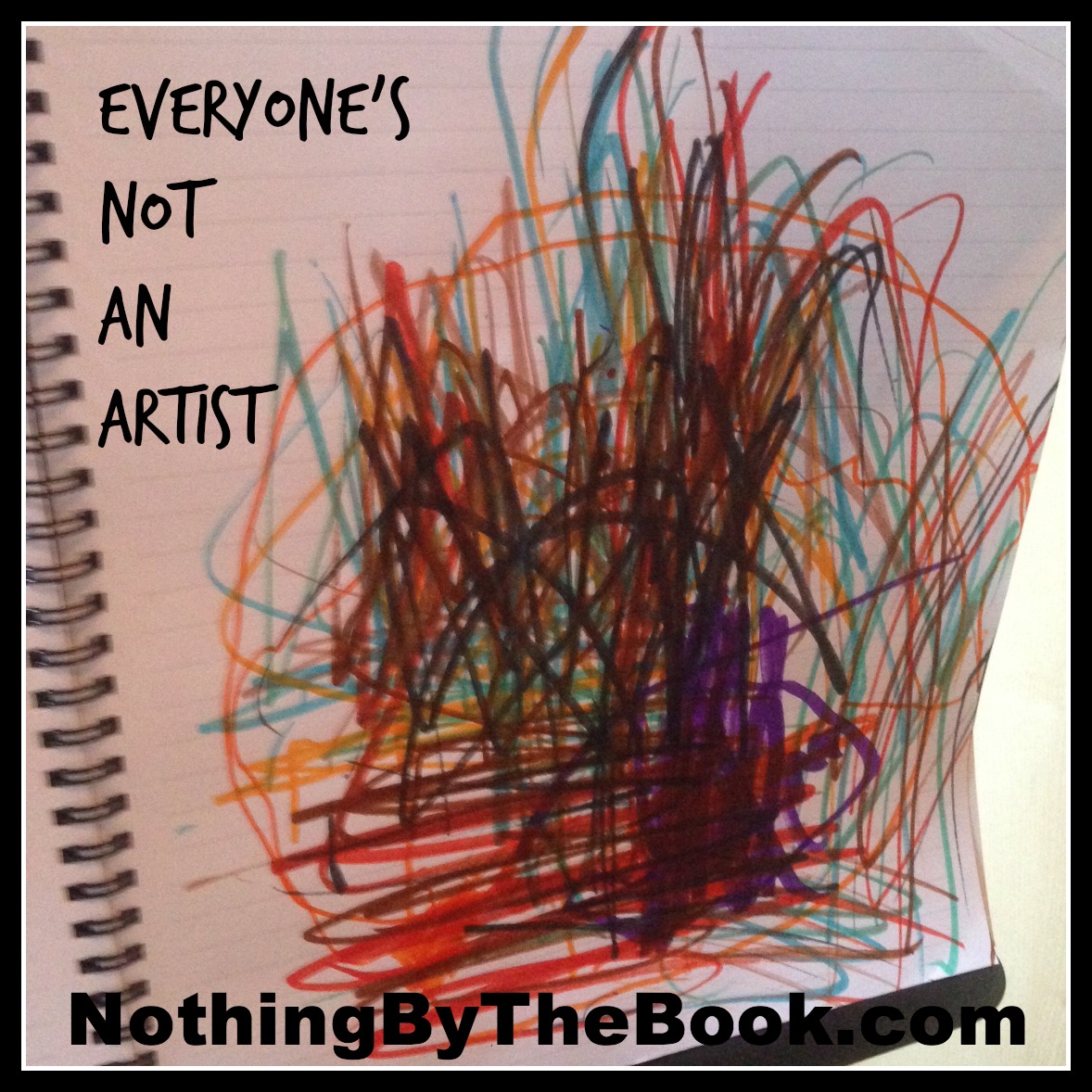
NBTB-Not An Artist

There is a lovely quote attributed to Pablo Picasso along the lines that, “ “All children are artists. The problem is how to remain an artist once he grows up.” In Quest Theatre’s production of For Art’s Sake, the lovely children’s play that played last weekend at Y-Stage in Calgary, the playwright and authors draw attention a couple of times to another Picasso soundbyte on art: that the great master spend most of his adult life trying to paint (think?) like a child. The message of the play, delivered repeatedly by one of the characters and proudly parroted back at the actors at the end of the play by my own Flora? “Everyone is an artist.”

Except they’re not.

A caveat before I go any further: I enjoyed the play—the actors were terrific, the setting and its use of multi-media inspired, and the little people loved it. I love Quest Theatre. I support Y-Stage unreservedly and will be back for their offering next month (here’s a link to details about the show at FamilyFunCalgary).

But I disagree with its fundamental tenant. Everyone is not an artist… and I’m not sure why these days, artists are so darn determined to convince the rest of us that a) they’re not that special and b) if only we opened our minds / cleaned our chakras / freed our inner elves, we could do what they do.

I am a writer. I don’t think everyone is a writer. Nor that everyone should exert themselves to be a writer, to express themselves, fulfill themselves—earn a livelihood for themselves—in this particular way. If everyone is an artist, is everyone an engineer? A plumber? A mathematician?

My artist child is shining under the influence of the play. She’s an artist. And she loves the message that everyone is an artist. It’s reassuring to her fledgling confidence.

Her older brother? He laughed in all the funny spots. Clearly enjoyed himself. As we leave the theatre, however, he’s unforgiving. “It was kind of crappy,” he says. “Art this art that. I don’t like art. I don’t like drawing or painting very much. Or even looking at pictures. That’s just not my thing.”

He’s not an artist. Nor a thwarted artist—not an artist denied. Surrounded by paints, crayons, markers, pencils, chalks, in a house in which walls were prepped for painting and drawing on, he abandoned all that as soon as he grew into consciousness of choice. That is not how he expresses himself, fulfills himself, processes information, relaxes.

But it is what his sister turns to do all that. She draws when she’s overflowing with happiness. And when she’s sad. When she’s at a loss. It’s what she does when she listens to books on tape. Her handwriting practice sheets are works of art—an interplay of colour, patterns, creation. Will this love stay her lifelong passion, lead her to her livelihood, or remain a steadfast companion/form of release and expression throughout her life?

Maybe. And will she try to convince her brother that he’s an artist too? That everyone is an artist?

Frankly, I hope not. It’s a gift, a talent, a passion that not everyone shares or aspires to. And claiming that they do denigrates its meaning. Its value.

Everyone’s not an artist.

What do you think?

xoxo

“Jane”

PS Looking for me? Awesome. Click here.

Summer Rerun: They tell you, “It gets easier.” They lie

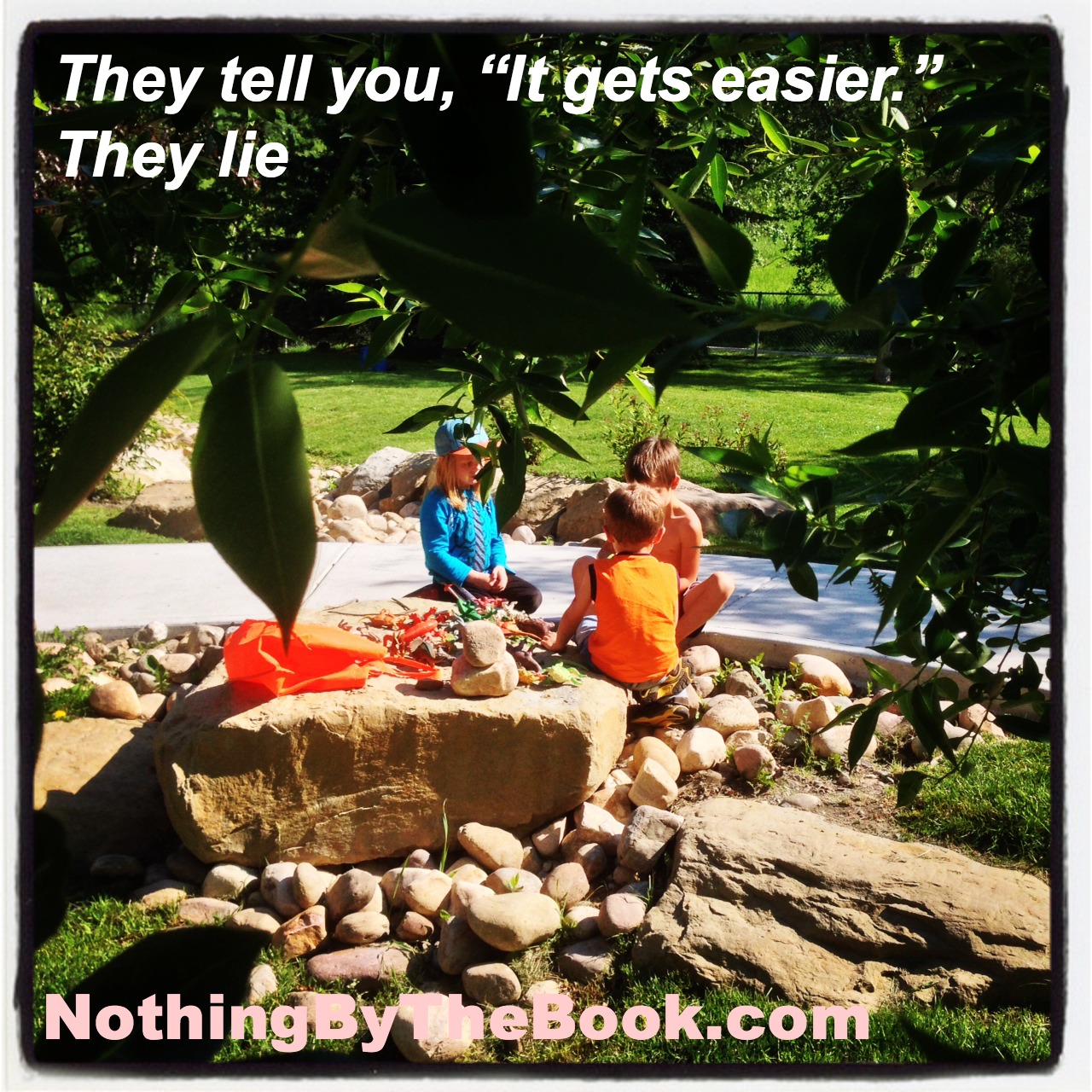
NBTB They tell you it gets easier

So there she is, stumbling down the block—walking circles around the playground—sleepwalking through the mall. The mewling baby inside a sling—a car seat—stroller. Glassy eyes, cause she hasn’t slept more than 45 minutes—no wait, two days ago, she got three hours in a row, score!—in four months. Wearing ratty pants—because they fit. And her husband’s sweater—because all her tops have been puked on and laundry, she was going to do laundry yesterday, but then the baby had a fever and…

“Holy deja vu. I know I’ve read this before. What’s up?”

“So observant, you are. This post was originally published on May 28, 2013, and briefly broke the Internets. Or at least my website. Nothing By The Book is taking a page from old school un-social media and doing a re-run summer, while I spend the hot days getting a tan, running through sprinkles, selling one book, writing another, reading two dozen more, neglecting my garden, falling in love, jumping off cliffs—you know. Everything but blogging. But, you get reruns of my favourite stuff, so everyone wins. Likely keeping up with Instagram—NothingByTheBook—will you? Or Twitter—  or/and .”

So there she is. The new mom, the first-time mom, and she’s so exhausted and she so clearly needs—what? A hug, help, empathy, reassurance. And you—you’re a good person, and so you want to give it to her. So there you go. Run up to her. Smile. And you want to say, you’re going to say:

“It gets easier.”

Don’t. Just fucking don’t. Because, fast-forward two years, three, and there she is. Running down the block. Maybe another baby in sling. Toddler in stroller or running away. And maybe she’s getting more sleep—but maybe not. Maybe the toddler has night terrors, and wakes up screaming for hours on end in the night. Or maybe, even if Morpheus has been kind to her and the children sleep—she doesn’t sleep nearly was much as she should, because when they sleep, that’s the only time she can be free. To… think. To read. To be… alone.

The toddler makes a break for it and tries to run into the street, and she nabs him, just in time, and pulls him back, and starts explaining how streets are dangerous and he must hold Mommy’s hand, but he really, really, really wants to be on the other side, and he’s two, so self-will is emerging with a vengeance and soon he’s screaming and tantruming, and you, you can see she’s on the edge, about to lose it, because maybe this is the seventh time today—this hour—she’s had to deal with this, and you want to help. You want to give her a hug, help, empathy, reassurance. And you want, you’re going to run over to her and you’re going to say:

“It gets easier.”

Don’t. Don’t. Because a year later, there she is, with her three-and-a-half year-old. Before they left the house this morning, he put her iPhone in the toilet, cut his dad’s headphone cord into shreds, and threw $30 worth of grass-fed beef off the balcony in the compost pile. And now, his pants around his ankles, he’s chasing a flock of pigeons, penis in hand, yelling, “I’m going to pee on you, pigeons!” at the top of his lungs. And she’s trying to decide—should she catch him? Or should she take advantage of the fact that he’s distracted for five minutes, so she can change the new baby’s diaper? Because she hasn’t had a chance to even check it for the last five hours… And I swear on any of the gods that you may or may not believe in, if, at that moment, you come up to her, and you say—because you’re an empathetic, loving person who wants to help—if you come to her at that moment and say,

“It gets easier.”

she’s going to rip that diaper off the baby and throw it in your face. Followed by the tepid remains of her coffee (you’re lucky that she hasn’t had a hot, scalding hot, deliciously hot cup of coffee in three and a half years). And then she’s going to sob. And she’s going to say…

“When? When the fuck does it get easier? Because I’ve been waiting for it to get easier for two three five six years.”

I’m sitting in the middle of my living room—11 years into motherhood—and I’m in a brief picture-perfect postcard (Instagram for those of you born post-1995) moment. I’m stretched out on the couch, coffee cup beside me, laptop on my lap—and, for a few minutes at least, I’m chilling. Three feet away from me, my 11 year-old is building worlds in Minecraft, and Skyping with a friend. My eight-year-old is running with a pack of her friends just outside—I hear their voices, hers most distinct among them to my ears, through the balcony. Tucked under my arm is the three-and-a-half year old, taking a break from wrecking havoc and destruction on the world to play a game on the iPad.

I’m messaging with a friend a few years behind me on the parenting path. And she asks me, and I can hear the tears in her words even though she’s typing them (people who think texting lacks nuance do not text enough; she is weeping through the keyboard),

“When does it get easier? People keep on saying, ‘It gets easier.’ When? When?”

So, I wonder, is she ready to hear this? Is she ready to hear: It doesn’t get easier. All the people who say this? They’re all liars, every last one.

But I won’t say that. First, because I do not wish to make her despair. Second, because it’s not true. It does get easier. It really does. But when people say it, what you, first-time mother, hear it is not ‘It gets easier,” but this:

“Things will get back to the way they were before, soon.”

And that, my lovely friend, will never happen. Things will never be the way they were before. Never. Things have changed forever. Things will never get back to “normal”—as you defined normal when you were single—when you were childless. Never.

And so I tell her this, and again I hear tears in-between the words she types to me.

And now I have to deconstruct the lie to her. I have to explain. That they don’t mean to lie. It really does get easier—sort of. The stuff that’s killing you now—be it the lack of sleep, the aching nipples, the endless diapers-laundry-is-she-sick-is-he-teething or be it the toddler tantrums, potty training regressions, “She won’t leave the house!” “Getting him in and out of the car seat is hell”–all of that, it will get easier—and, in fact, end. They all wean. Toilet train. Stop drawing on walls (unless they live in this house). But see, then, other stuff happens that’s really hard too. Ferocious FiveSensitive Seven. Bullies on the playground—social issues with friends and ‘frenemies.’ Broken hearts. Explosive anger at things and issues much, much bigger than all those daily rubs that cause toddlers angst.

“It gets easier”: yeah, I suppose it does, because you figure it out, and adapt, and get coping strategies. But every time you “master” a phase—they change. Grow. Face new challenges. And you’ve got to change, grow and adapt with them. If only you could do so ahead of them…

But you can’t. And so, you see, “it gets easier” … it’s a lie.

And it’s the most destructive lie, the most life-damaging myth you can buy into. See, because if you keep on waiting for things to get easier—if you put living, changing, adapting, figuring out how to dance this dance, walk this path as it is now, with all of its bumps and rubs—if you put all that on hold until it gets easier…

Well. You’ll be fucked. Totally. And completely.

So. My dearest. It doesn’t get easier. It changes. You get better. You grow. Learn. And that little squealer—that awesome toddler—that slightly evil three-year-old—he grows. Learns. Changes. It gets better. When you learn and change and grow and all that—it all gets better.

But. Easier? No.

So. There she is. Frazzled. Exhausted. So fucking tired. And she sees you coming, and you have empathy poring out of your pores. And you want to help her. Offer her empathy. Support.

What are you going to tell her?

xoxo

“Jane”

P.S. Here’s the original post, with its bazillion comments.


She loves Sherlock but David Tennant will never love me—and no one is doing the dishes…

I.

Well. That was how many weeks in a row of making-you-cry-and-angst serious? Change of pace. And go:

Flora: Do you know why I love Sherlock so much, Mom?

Jane: Well, he’s a timeless character, a hero-anti-hero figure rolled into one, a dragon slayer, yes, but also a so-bad-boy, on-the-side-of-right and yet essentially amoral, brilliant-yet-obtuse—he’s really the perfect archetype of…

Flora: It’s because he looks just like Daddy and talks just like you.

Oh. From which you may deduce a) that the father of my children is h-h-h-o-t and b) that I’m a high-functioning sociopath.

II.

Jane: Keerist. Would someone please command, order, TELL ME to go do the dishes? Or better yet, go in the kitchen and do them for me?

Cinder: Meh. Just go read a book. We’ll just eat the chicken from the baking tray.

Flora: With our fingers.

Ender: I! Want! A! Fork!

There’s always a demanding one, isn’t there?

I can wash one fork.

I. Will. Wash. One. Fork.

III.

Flora: And another thing! Don’t you dare blog about this!

Jane: But…

Flora: No!

Jane: But…

Flora: Absolutely, never, ever, NO!

Sorry. You don’t get to find out. But man. It was brilliant.

But she says I can tell you this one:

IV.

Flora: Mom? What do adults talk about?

What a question. What do adults talk about? My friend Marie and I look at each other. Laugh.

Jane: Kids?

Marie: Books?

Jane: Oh, homeschooling.

Marie: Boys.

Jane: Girls.

Flora: You can’t talk about boys and girls! You’re married!

Marie: Well, your dad’s a boy, you know.

Flora: OMG. Do married people get crushes?

Jane: Well…

Marie: Um…

Flora: OMG. You do. Like Daddy has a crush on Felicia Day? And you think David Tennant is hot?

Jane: Well…

Marie: Um…

Flora: Mom? There’s something you need to know.

Jane: What’s that?

Flora: David Tennant will never love you!

Meh. I’ll live.

V.

So, Nothing By The Book is taking a page from old school un-social media and doing a re-run summer, while I spend the hot days (please, weather gods, grant this piece of flood plain some scalding hot days, will you?) getting a tan, running through sprinkles, selling one book, writing another, reading two dozen more, neglecting my garden, falling in love, jumping off cliffs—you know. Everything but blogging. Stay in touch via Instagram—NothingByTheBook—will you? Or Twitter—  or/and . Or, just come back in September.

I will.

xoxo

“Jane”

NBTB-Rafting in the wading pool.jpg

Post-script:

Jane: And then she says, “David Tennant will never love you!”

Flora: It’s true.

Sean: I don’t know about that. I mean, just look at your mom, and she’s really smart too. And David Tennant’s pretty intelligent and dresses like he’s got great taste. I bet he’d be totally into her. And then, you know how we had to stand in line for hours to get that Matt Smith photo? We’d get to hang out with David Tennant all the time and take pictures of him all the time and then sell them on e-Bay for a fortune and…

Flora: I didn’t think of it like that. OK. What do we have to do to hook them up?

My family. They deserve a high-functioning sociopath.

Post-script 2:

“Sunny days, long weekends, flood anniversary trauma. I’ve missed so much!”

“Oh, let me catch you up, ma’ darling. June posts you might have missed below.”

I’m going to do everything I can to convince my daughter NOT to be a stay-at-home mom. Want to know why?

There are a lot of posts in my quiver, in my mind that I don’t write. Because… hard. You know the kind? A story you long to tell, a panegyric you need to scream out… but you don’t, because half, more, the people in your life will be grievously offended?

This is one such post.

I write it for Flora. And for your daughter, too.

We’re sitting in a coffee shop—on a park bench—on my beloved Common—in my kitchen. And you’re in agony.

Your marriage is ending—really, it’s over, it’s just a question of how, when—and you’re terrified.

You’re terrified of—well, everything, really, because all change, especially that kind of change, is terrifying—but you’re, particularly, specifically, terrified of…

What? I ask. Again. You always wait for me to ask, before you say, you say…

… you say money, you say economic consequences, you say financial vulnerability…

… you say if you took that out of the equation, you’d be able to think clearer, plan better, but you can’t. Of course you can’t. How can you take that out of the equation? It’s everything.

You say if you could be sure, if you knew, you’d be financially ok, your kids would be ok—you’d walk. You’d have left a long time ago. Or: you wouldn’t be so terrified at the thought of being left. You would be more rational about him leaving…

And I say… nothing. I make supportive friend noises, and tell you you’ll be all right. Say words like lawyers, child support payment guidelines, protection, blah-blah-blah. Meaningless, meaningless words, because I know, you know, how it will all play out.

We know that as you disentangle-separate-end, you will fight, bitterly, over his money.

It doesn’t matter that it was our money before.

Now it’s his. And it affects everything, 21st century pro-woman, pro-child laws be damned. The person who signs the cheques holds the power. Defines the rules of engagement. Has the most power.

That’s just the way it is.

I know this. You know this. We’ve seen this play out, in our lives, how many times? The circles we move in, dominated by attachment parenting-homeschooling-radical-homemaker-yes-I’m-a-stay-at-home-parent-and-proud-of-it people, however self-proclaimed in their lifestyle radicality, end up being so predictably hetero-conventional. He earns money. She “stays” home. It’s their—our!—money. We’re a team! A family! Everything is ours.

Until there’s no love, friendship, affection, respect, and only anger, resentment, betrayal, emptiness. Fury. Bitterness.

And then—ours? Ha. It’s mine.

You don’t understand. But I do. Because it’s not a male-female thing. Not a greedy-bad-selfish husband versus giving-good-selfless wife. It’s a breadwinner versus dependent dynamic. And it sucks that in our most intimate relationships who makes the money matters so much. But it does. Oh, it does.

In my family, it’s usually me—and it’s our money when things are good. But when I get angry? It’s mine and could you fucking stop wasting it?

(Sean pauses at this moment and looks at me. You sure you want to be writing this? he asks. I need to, I say. Can you take it? His eyes return to the screen.)

You’re listening, but she, she’s appalled. Do you see her? She’s there on the periphery, right there… And she screams: It’s ours, ours. We’re a team. Forever. He appreciates everything I do, everything I sacrifice.

Sure. For now. While things are good.

And now, you’re angry. Because you’re not stupid or naïve. And the decision to stop earning, to stop building a career, to become financially dependent on someone you love-trust-are-building-a-forever-life-with… you didn’t make it lightly. Or alone. You made it together. And so, for five, 10, 15, 20 years, that’s what you did… and now?

I want to tell you… I want to tell you that staying out of fear, financial or otherwise, is worse than leaving in uncertainty. I want to tell you to make your decision on the assumption that everything will be ok… but will it? I don’t know. I can’t tell you. The financial and emotional consequences of the dissolution of the worst and most dysfunctional of marriages are vast.

And really… yours isn’t so bad.

Still. I’ll tell you none of that. I’ll make my supportive friend noises. Give you contact details for lawyers and links to the child support guideline tables*** and mediators’ addresses.

And heave a great, grateful sigh of relief… that it’s my money.

That my decisions to stay and love and work and build and negotiate and change and continue and grow together—complicated though they are—they never include financial fear. Dependence on someone else writing a cheque. Paying the bills.

(Buying my compliance in the decisions he makes for our (his!) children.)

(This is really difficult to read, Sean says. I nod. I know. And yet… why? “I don’t need you. But I want you.” It shouldn’t be difficult. It should, actually, be glorious. I am free and independent, and I choose to be here, with you—when I could be, would be just fine without you. But I want you. I want this, us. But. Need? No. Not financially, anyway. And that’s all we’re talking about here, my beloved. Money.)

She —that woman over there, who is convinced that her partnership-lovership-marriage is forever? — is so angry with me. I don’t understand her, she says. Her partner. Their love. Their trust. How they’re rewriting the rules of conventional marriage… by living what looks like a conventional marriage (he at work, she at home) but what is actually radical homemaking** and how they’re going to save the world and raise a new generation of children who…

It’s a beautiful story. And why argue? She won’t listen to me anyway. And maybe, who knows? Maybe she will be one of the lucky one-in-two. After all, 57 per cent of the American women married between 1985 and 1989 were still married 15 years later. Only (only!) 43 per cent were divorced.* Maybe her guy is completely exempt from and unaffected by dominant social habits and mores. Maybe he really will believe it’s our money, and that the work she does in the house and garden, with the children and all those quotidian tasks that make his career possible is just as valuable as the work he does that brings in the money that pays the bills and buys all the things.

I haven’t seen a man—or woman, for that matter—for whom that holds true come end-game. But they could exist. They could be evolving.

But… “maybe” is not good enough for my Flora. Nor are those odds. I want her, whether she loves one partner forever or walks any other path, free. Loving and staying because she wants to. Not because she feels she has to. Staying and being in the relationship without giving up her power—her economic clout—because we live in a world in which money matters. And who makes the money matters.

Now you’re really angry with me, because… well. Because. I understand. Be angry. It’s fine. I deserve it. Your agony and fear terrify me, even though they don’t play out in the path I walk… because my Flora, my Flora, suppose my Flora walks your path? Suppose she chases a fairy tale… and wakes up in a cage?

I want her free. Independent. Making choices out of love, commitment, reflection, and yeah, reason, sure, reason. But, not fear. Never fear.

“Jane”

nbtb-NOT-SAHM

* “Marital Status & Living Arrangements: Most People Make Only One Trip Down the Aisle, But First Marriages Shorter, Census Bureau Reports.” Census.gov. Retrieved 2012-03-27. via Wikipedia

**Radical Homemakers is the title of a rather fascinating book by Shannon Hayes  … which is worth reading regardless of whether you hated every word I’ve written above or nodded furiously at each paragraph.

***Canadian Child Support Table Guidelines


A “lost” year: on standing still, moving forward, stepping back

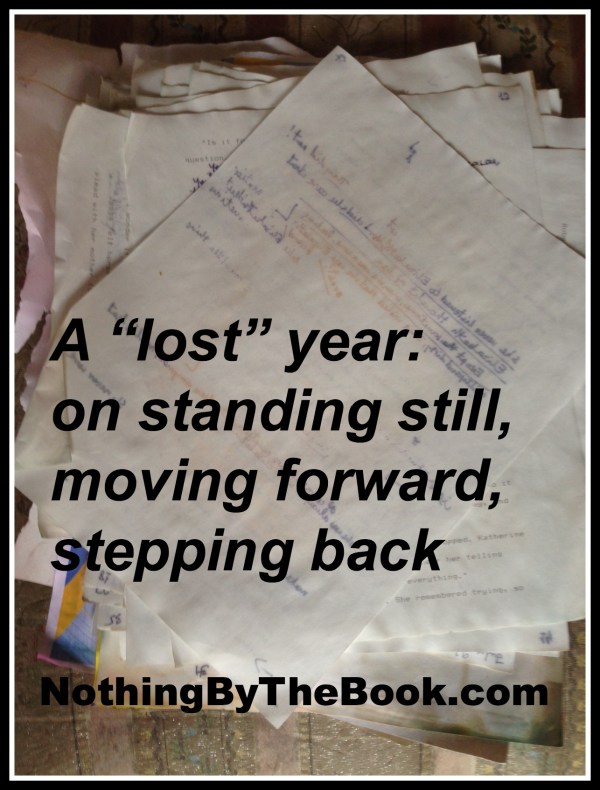
Come. Come in. I have something I want to show you. Here, over here: this box. That one. And that pile over there. Remember, I told you about them? My papers, my manuscripts, my letters. The record of my early creative life.

They’re all terribly, terribly bad. I mean—not just a little bad. God-awful. It’s hard to say what’s worse—the novel I wrote when I was 13 and the sheafs of heavy metal music-inspired poetry I churned out when I was 15 are probably absolutely the worst, although the novel I wrote when I was 16, and the one I started when I was 18 are pretty bad too.

There is no reason to save them, to hold on to them. They make me cringe, you know, when I look at them? They are so very, so very terribly, wonderfully bad.

They stink.

photo (1)

Flora: What are you doing, Mom?

Jane: I’m trying to write something that’s simultaneously truthful and not asshat pretentious, and failing miserably.

Flora: Oh. Are you going to be much longer? Because I need you to take me to the craft store to buy me more clay.

Jane: Yeah, ok. In a bit. Hold on. I’m trying to explain why I’ve spent an entire year tripping over boxes of molding, unreadable papers.

They actually do stink. I’m pretty sure they’re actively molding. Maybe, if I procrastinate long enough, the mold will finish what the flood started. Maybe, I’m waiting for a force of nature to take agency away from me again…

Cinder: Mom? What are you doing?

Flora: Ssssh. She’s writing about how she can’t throw out those stinky papers.

Cinder: Isn’t it because she’s lazy?

Jane: Silence, progeny. I’m wallowing in artistic existential angst here.

photo

There must be, I think, a part of me that enjoys the wallowing. That wants to stay here, looking at those boxes, looking at the curling edges, the black splotches, red splotches that used to be ink. There’s clearly a part of me that’s getting off on the drama of the destruction…

There’s also a part of me that’s really pleased that this early work is so fucking bad. You know? Wouldn’t it be terrible—it must be so terrible—to look at what you did 20, 30 years ago and say—that was my best work! Why can’t I write like that any more? What’s happened to me? Definitely not the issue here. Those boxes are not full of my best work.

But, but… they are this titillating record of potential. You know? That poem, the one you tried so hard not to read when separating the wet pages, but you did, and you laughed out loud at its pathos? It’s awful-bad, I know. But there’s that one phrase… you know? That one phrase… I like it still, and looking at it, I see the places it’s gone in the intervening 25 years, and I like that. And while I’m embarrassed by the overall badness of the piece… those four words in a row… they please me.

And I’m reluctant to let them go.

Ender: Moooooooooom! What are you doing? I need you!

Jane: I’m trying to explain why I’ve been stuck, unmoving, unproductive… why I’ve felt tethered, trapped by the past, unable to move into the future, paralyzed by what was, torn between denying it and embracing, obsessed with the idea and yet working really hard at not thinking about it, not dealing with it…

Ender: I’m hungry. And I need you to get my bike out of the shed. And I can’t find my shoes. And also, I think I pooped my pants.

Jane: Right. I should do something about all of those things. Just give me a few more minutes here…

Do I need to let them go? An impossible question. What would I have done, had the flood not rampaged through them? The most likely answer: nothing. They would have stayed in their boxes. Existing. Unexamined. For years, decades, a lifetime.

I don’t like being forced to examine them. Examine myself: who I was, what I thought, how I dreamed.

Flora: Mom? Are you still angsting?

Jane: Yes!

Cinder: Seriously? Do you want me to just go chuck them for you?

Jane: No!

Ender: Somebody! Needs! To! Clean! My! Bum!

I had this not-so-secret plan, after I failed to be able to deal with the remnants of the papers right after the flood (I burned my destroyed letters; I couldn’t touch the manuscripts), that I would mark the anniversary of the loss with a big, cleansing bonfire. I’d invite my writer friends, and we’d be all very solemn and supportive, and then get rip-roaring drunk, and we’d burn my past, and a new stage of uber-creativity would rise from the ashes…

photo 1

I know. Cliché. But, why not?

So here I am, a year later. And there they are, my boxes, my papers, my past. Still unexamined, unsalvaged. Neither discarded nor saved.

In limbo.

Me? I look back at this past year as, in many ways, a lost year. A year in which I both failed to move forward and didn’t have the ability to look back: a year in which I stood still. But maybe I had to. Maybe, for possibly the first time in my life, I just had to stand in place for a while…

Cinder: OMG, Mom, are you still writing about those stinky papers?

Flora: Hey! She’s a writer! That’s what she does! But could you please hurry up? We have things to do! Places to go!

Ender: I’m! Still! Poopy! And! Hungry!

Jane: Almost done. Almost done…

So. I’m not quite sure I’m done standing still. Maybe that’s what it is. Maybe I need to stand still a little longer. Digest-marinate-process all that I was a little longer.

Cinder: Moooom!

But not for too much longer. Not forever. Because I have things to do. Places to go. Stories to write. A life to live.

My terrible-no-good poems and novels—and hey, here’s a short story I wrote in my 20s, and this one actually doesn’t totally suck… it’s not good, but it’s not god-awful either—my papers, I think, will stay in their purgatory for a little longer. Just a little longer. And when I’m ready to get moving again, I will let them go.

But not today.

No bonfire this year.

But, there will be a hell of a party…

xoxo

“Jane”

NBTB-A lost year

P.S. An invitation: If you’re in Calgary, you should spend some part of your weekend celebrating the one-year anniversary of the flood and Neighbour Day in one of the communities you helped to save. If you worked in Sunnyhill, our big celebration is on Saturday, June 21, from 5 p.m. on; the greater Sunnyside celebration is on Sunday, June 22, 4 p.m. to 7 p.m. at the site of the Crisis Café.

If you have no idea what I’m blathering on about, YYC Flood 101:

Where have you been, Jane?” June 27, 2013

“Everything back to normal, Jane?” July 4, 2013

unLessons from the flood: we are amazing  July 9, 2013

Running on empty: why “so are things back to normal?” is not the right question October 29, 2013

A love letter to my flood plain, June 11, 2014

A love letter to my flood plain

NBTB Love Letter to flood plain.jpg

This love letter begins, as every good love letter should, while I’m naked in bed…

No. Stop. Sorry. Not like this. First, this:

Prologue

There was this flood last year, and it changed us. So very profoundly. And we know it, feel it, breathe it. Tell it, to each other, to anyone who wants to listen (to many who do not).

But do we tell it, really? Our kids are collecting flood stories from the ‘hood to turn into an archive and into an anniversary performance piece. I tell mine… and it is not until I come back home that I realize that of all the stories I could have told, I chose the least important, least personal.

The safest.

“Makes sense,” my neighbour-the-poet says. “Of course it makes sense.”

Does it?

“What story did you tell?” I ask him, and he tells me. And I am shocked. “That one? Really? You could tell… you could share… that one? That part of you?”

He could, he did. Me? My eyes swell with tears. My most intimate story swims within me. I can tell, spin so many other stories. That one? I’m not even sure I want to hear it.

But there’s one part of my story that’s everyone’s story. It belongs to you, as much, more, as it does to me. Ready?

F-front door2

I.

I’m naked in bed, languorous, lazy, loved, and the psychic-who-lives next door delivers a hot breakfast to me and my love.

This is the magic of the place where I live, this place that I love so ardently that life elsewhere, life without it is hard to imagine.

This act of kindness-nourishment-knowing—it is not extra-ordinary. Not here. On this piece of flood plain where I live, this sort of thing just happens.

All the time.

This happens too: a book placed into my hand. “I just read it. You will love it.”

Always, an embrace when you need. Always, someone to help you move a couch.

Always, someone from whom I can borrow eggs, sugar, salt, a bottle of wine.

And this: emergency, panic. I need to leave my tiniest, who has never, ever been detached from my arms and my breast. And I leave him—with you, without thinking twice about it, I know you will love my precious and keep him safe for me.

“Potluck tonight?” “Gah, I have nothing to bring.” “Don’t worry. We have plenty.”

New Year’s. Summer Solstice (even last year’s one). Halloween. Impromptu sleep-overs all over; in the morning, a kid head-count. Six kids traipse down my stairs. There are five clambering up yours. “Does your mother know you’re here?” “I think so… oh, isn’t that her, at your door?” It is. “Coffee delivery!” Oh, yes.

Someone else’s mother sneaks into my house while I have a doctor’s appointment and washes my kitchen floor. Because.

This place where I live binds people, builds people.

The idea of losing it is unbearable. Unacceptable.

F-The Boat

II.

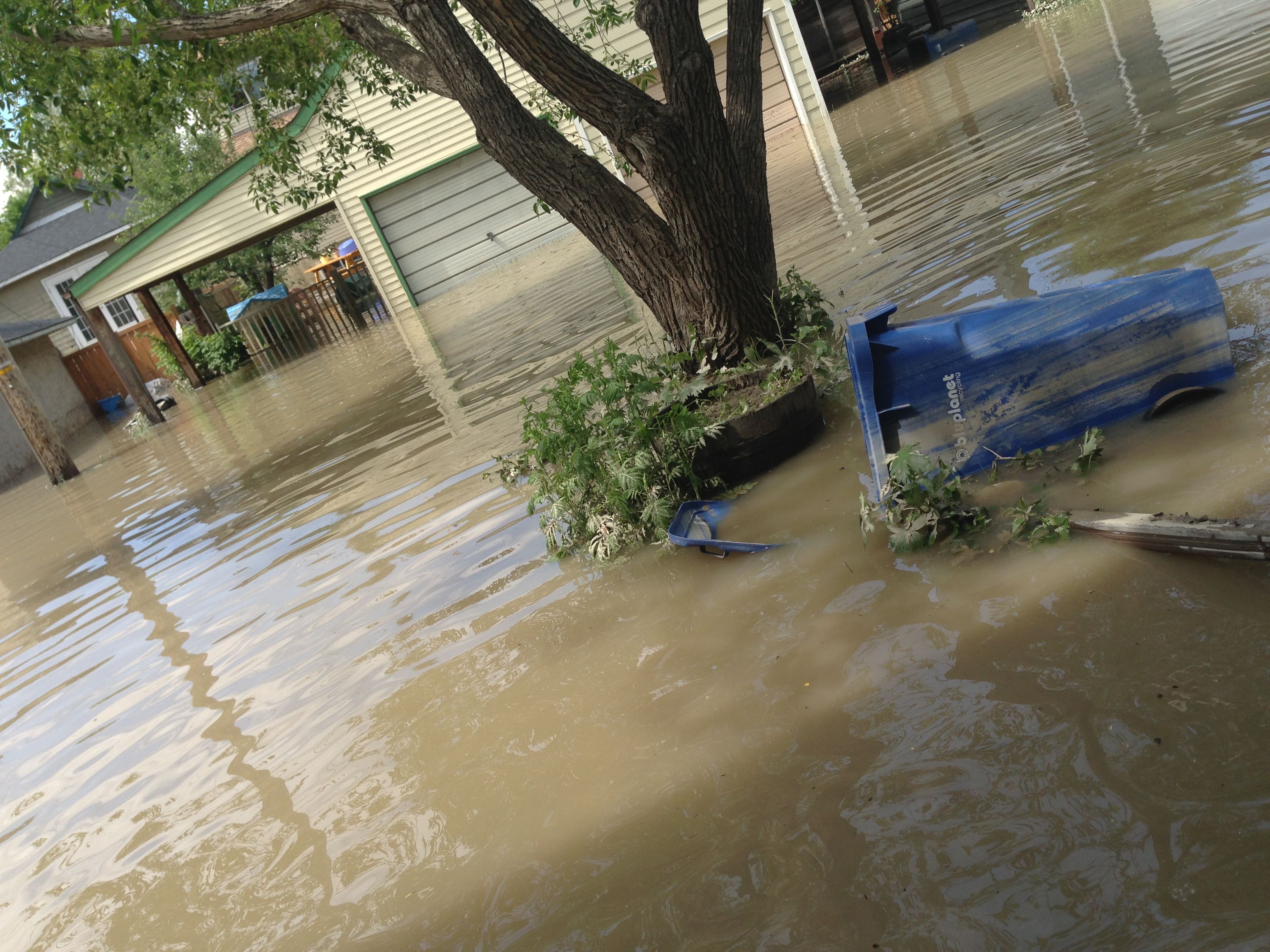
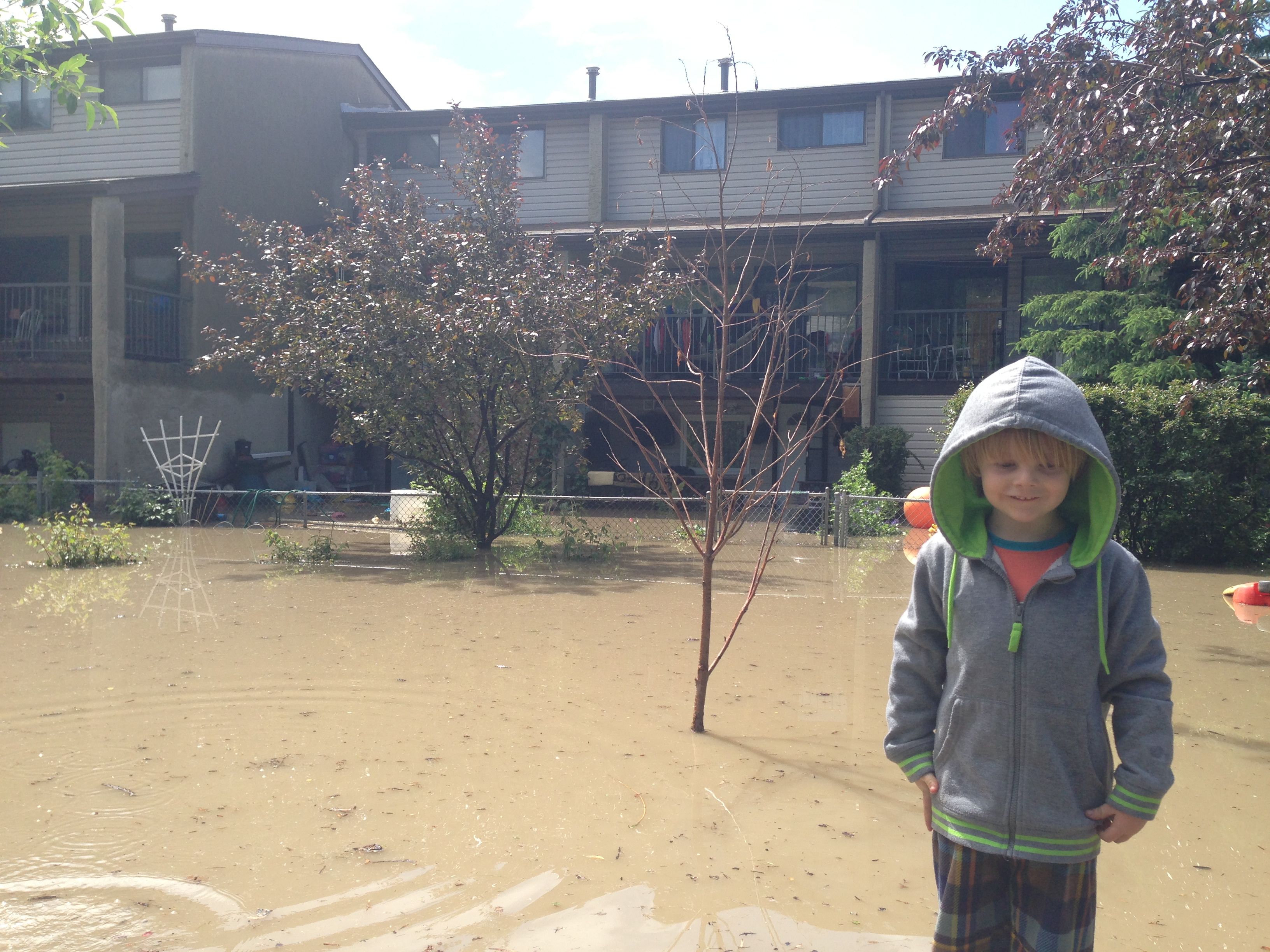
We were never in real danger of losing it. Our streets were not ripped to shreds. The water was out of our houses in a few days—it did not linger for weeks. We are rebuilt. But. In those first days, when the water came—before it receded—before we got back home—we did not know. And we were not rational. And I was terrified.

I could not, would not lose you.

F-Rubber boots

III.

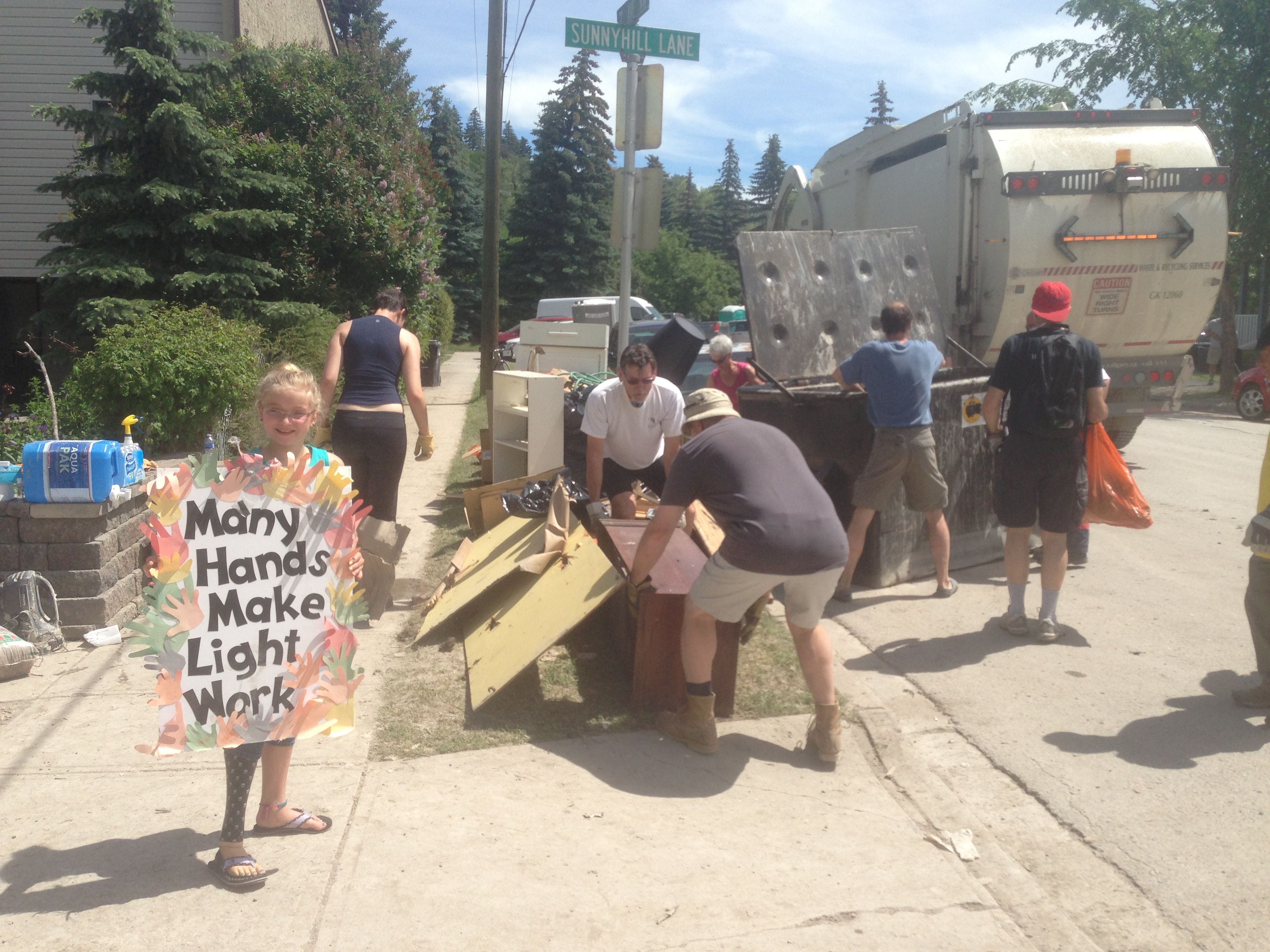
I must have loved you before, of course I must have. But this is when I really fall in love with you: when you are at your ugliest. When there is still knee-deep (wait, over here it’s higher, people are wearing hip-waders and getting soaked) water in Sunnyhill Lane. When there are army trucks rolling down Seventh Avenue. When the air smells of diesel and the vibrations of pumps and generators drown out voices. You are covered with mud and silt and fuck-is-that-sewage? and your streets are lined with the debris of a hundred, thousand lives and you look destroyed and ugly and I love you so desperately nothing but saving you matters.

F-Garbage2

IV.

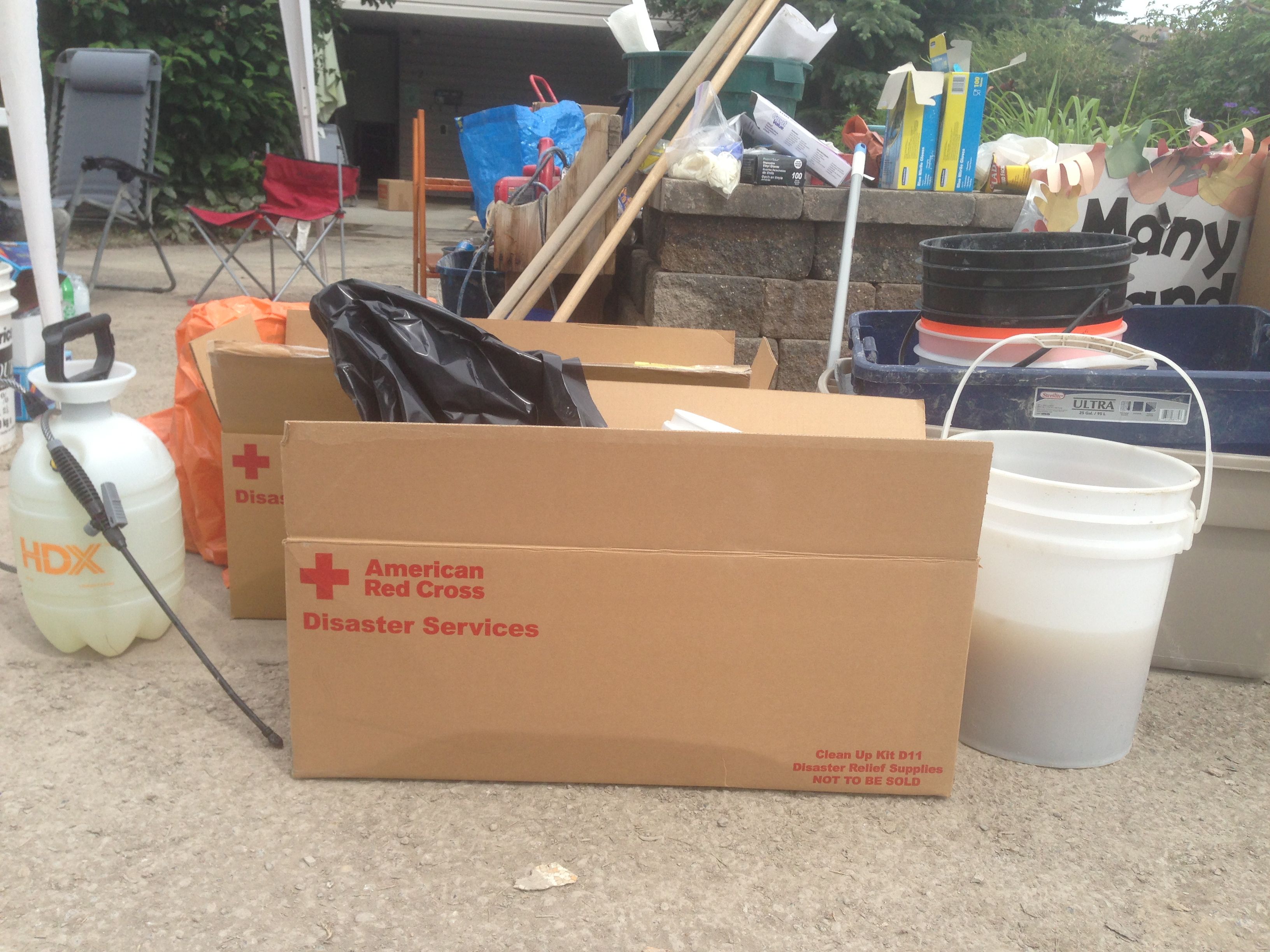
“Christ. It looks like Kandahar,” you say. I look at you, unseeing. I would say, stupid exaggeration, get some perspective, come on, except I’m covered foot-to-toe in mud and so is everyone around me, and there are mountains and mountains of walls-doors-furniture-it’s-not-garbage-it’s-our-lives piled up between the apple trees, and the Red Cross has just delivered a stack of disaster relief kits. We tear through them scavenging for facemasks. Hoping for crowbars. Ha. A mop and a bucket? What the fuck?

F-ARC Disaster Services Kit

V.

You have been, to me, a sanctuary that consisted of a lane, a garden, a Common. A handful of neighbours. You become my everything. As I struggle to save you and you come to save me, you grow. You transcend what you were. You become…

You become a million beating hearts. An army of citizens covered in mud. I love you as I have never loved anything before. And I love them, desperately, passionately, fully, because they are saving you. You are them, they are you.

There are no boundaries.

F-Many Hands Make Light Work

VI.

Then, we all go home.

We come back to our gutted homes; you go back to your unscarred ones. Or go on to help other communities. To High River (which still rends my insides).

We go/come home. But we are all changed.

See, we all love you now in a way we could not even imagine before. You are not just our homes and our communities. You are not just our paths and our riverbanks and our parks and our buildings, our bridges, our streets, our landmarks. You are, of course you are, all of those things. But most of all, you are us. We are you. And we know you—ourselves—so fully and so intimately. There is no theory-to-be-tested, no promises-to-be-fulfilled. There is no uncertainty over what we will-can-could do when asked: we have done it. Everything that had to be done? We did it.

We saved you. You saved us.

F-Battling the mud

VII.

We are changed. But not all of us know this as fully-intimately-undeniably as those of us who lost and saved know this.

“I lost nothing. I did not help. I was unaffected.”

I walk with him on the river paths—because I hardly ever walk anywhere else—and he claims to be unaffected. And thus… unchanged. And I see, suddenly, how damaged he is. He had no personal loss, he says. He was not covered with mud. Your tears.

I cover him with mine.

He claims to be unaffected… but as he watches me cry into the river… unaffected?

No such thing.

We are all affected.

F-Our house debris

VIII.

This place where I live, this place that I love beyond the pall of all reason, this place that builds and binds, this place of jerrybuilt-during-a-past-boom townhouses, this place where dandelions bloom and little children grow up and old people grow older, this place is mine, and it is me.

This place is precious because it is loved, so loved, all the more so because it was threatened, almost-lost, saved. And as I love it, caress it, press it into me—each walk on its streets, each rediscovery of each of its crevices, curvatures, indentations an act of gratitude, acceptance, surrender—it grows. It becomes your place, our place, you, us.

This place is us, a million beating hearts.

F-Evening shift at SHL

IX.

“If it floods again, will we leave? Will we move?”

“I can’t. I can’t. I can’t even think that.”

F-O on Flooded Common

X.

I have loved and was loved and have eaten and felt loved again, and now I must get out of bed, find clothes, do things. But for the moment, for one more moment, I remain naked, languorous, wrapped up in you. And I need to tell you: I have loved you before this, for so long. But I did not really know how much until you were wrecked, destroyed, broken. And I did not truly value you, see the truth of you until you saved me/I saved you.

My most beloved: thank you.

F-Reunited

un-Epilogue

So. I tell the part of my flood story that’s our flood story, I write it as an imperfect love letter to my imperfect piece of flood plain, which I love, passionately, in all its faults, with all its warts, frustrations.

I am so very, very grateful. Love, gratitude, vulnerability, appreciation, surrender swim inside me, fill me, leak out through my tears.

And my own, innermost flood story, the one that I’m not sure even I want to hear? It is so very simple, really. And it is this: a year ago, I could not feel like this. I would not write like this.

I would not cry like this.

I could not love like this.

NBTB-I love you


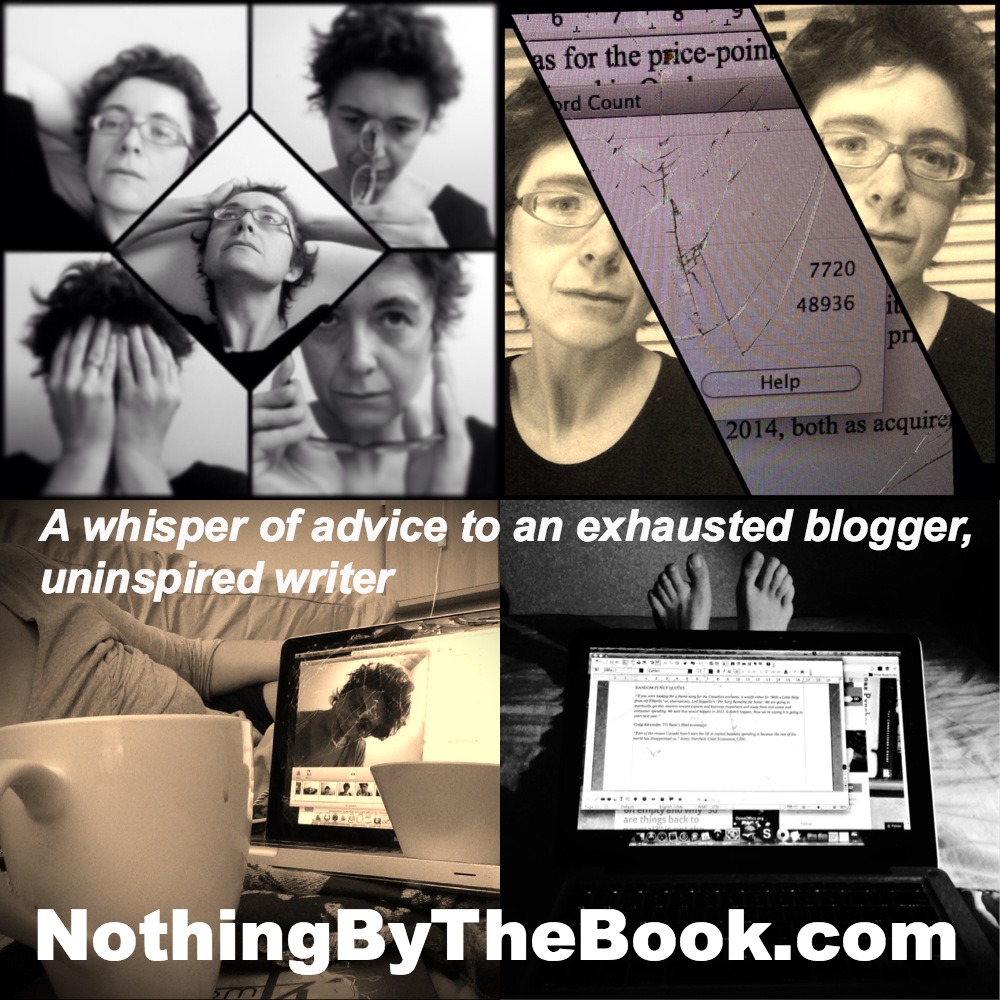
A whisper of advice to an exhausted blogger, uninspired writer

Play.

That’s all.

Forget about niching, target audience, stats.

Play.

Write three sentences about one of your kids’ curls. A pea smashed into the carpet.

Or: walk away from motherhood, parenthood, cooking, IT–whatever it is that your “niche” is. Write about something beautiful. Irrelevant. Important. Or not. Take a picture: and make a list of the adjectives it inspires in you.

Pull a quote from a book you’re reading. Do things to it. Let it do things to you.

Spend some time on Brain Pickings. Maybe start with Famous Advice on Writing. Or, no, no, read this, Susan Sontag on Sex:

“If only I could feel about sex as I do about writing! That I’m the vehicle, the medium, the instrument of some force beyond myself.”

… and see where that takes you.

Read Stephen King’s On Writing.

Here, in this space, your space, there are no rules but the ones you make.

Play.

Watch the Words, words, words playlist from Ted Talks: a collection of 12 fabulous talks for people who love words.

Write.

NBTB-Exhausted Blogger

xoxo

“Jane”

PS Unless you’re getting paid for it and you’re on deadline. Then suck it up, grit your teeth and get it done (hopefully not while crying). But here? Writing for you?

Play.

You’re welcome.

Would Edgar Allan Poe by any other name smell so sweet? (And wear a fez?)

I.

First, this:

Flora: Was Edgar Allan Poe a real person?

Jane: What? Yes, of course.

Flora: And he really wrote The Raven?

Jane: Yes.

Flora: And his real name really was Edgar Allan Poe?

Jane: Yes. Well, he was born Edgar Poe, but then he was sort-of-adopted by a family called Allan, and so he became Edgar Allan Poe…

Flora: That’s just brilliant. He’s so lucky. Because suppose he had been named Edgar Steve Poe? Or Edgar Smith Poe? He’d never have written The Raven then. No way.

Jane: Really?

Flora: Yes. Only someone with a cool name like Edgar Allan Poe could have written The Raven. Edgar Steve Smith Poe would have written… The Pigeon.

With apologies to Steve Smiths… everywhere…

II.

Then this:

Flora: Was Charles Dickens a real person?

Jane: What?

Flora: Was Charles Dickens a real person? A real writer?

Jane: Yes. He wrote… David Copperfield, which is so good. And of course, A Christmas Carol. And The Bleak House, and Nicholas Nickleby, and…

Flora: OK, so Charles Dickens is like Sir Arthur Conan Doyle. Not like Sherlock Holmes.

Jane: Yes. Sherlock Holmes was not a real person—he was a character created by Sir Arthur Conan Doyle.

Flora: It’s important to get these things straight.

Jane: Absolutely.

Gods, I love her.

III.

And finally:

Flora: So Agatha Christie was a real person.

Jane: Yes.

Flora: But The Doctor is not a real person.

Jane: No. I mean, yes, he is not a real person.

Flora: But Matt Smith is a real person. And so is David Tennant.

Jane: Yes.

Flora: Two different real people, playing the same character.

Jane: Yes. Well, actually—what, 12? 13 different people playing the same character over 50 years…

Flora: Why is all of this so confusing?

Because… life. Art. Authors. Characters. Creators. Creations.

Yes, she’s watching The Wasp and The Unicorn, and The Day of the Doctor. Simultaneously. Reading Sherlock Holmes (graphic novel version, adapted by Ian Edginton, and illustrated by I.N.J. Culbard—brilliant). I’m not quite sure from where Charles Dickens makes an appearance. I ask. “Horrible Histories.” Of course.

NBTB-Fez Medley for Edgar Allan Poe post

xoxo

“Jane”

PS  “Well, this is all very nice interesting, but I’m here looking for that interview tips for kids video that’s part of the Sunnyside YYC Flood Scrap Book Project.”

“Are you? Thrilled. That’s this here: Filing, flooding, interviewing—or, ‘Confluence.’ Our kids and the film crew will be at the Hillhurst-Sunnyhill Farmers’ Market today interviewing. If you’re a YYC reader: come tell your story.”

40 is… self-absorbed. Criminally so. But that’s probably not just ok, but inevitable, necessary…

I.

Today, I am 40.

Thank you.

It’s kind of fabulous.

Frightening, too, because… promise not to tell anyone under 40? OK. Frightening, because… well, I thought that by 40, at 40, I’d have things more figured out. You know? I’d be… all grown up.

Oh, don’t press me; don’t make me be specific. I know I’ve done a bunch of all the things… children, marriage, career (sort of). I have no complaints and no regrets, very, very few “I wish I had” U-turns…

I just thought—when I was 10, 20, and even 30—that by the time I reached this particular number, four decades on this earth, I would be more… enlightened. More “done” this whole growing up thing.

That’s all.

Instead… here I am. So very, very flawed. And unfinished. And uncertain. And not sure what next, where next, how next…

And you draw me into yourself and hold me and ask me… do I know anyone who’s “done”? All grown-up, you mean? I ask… Yes, you say. Do I know anyone who’s… got it all figured out—or at least says/presents as if they do?

(Always, you and I, with the qualifiers.)

I think.

Yes. Yes, I do.

And what do you think of them, you ask…

And there is only one thing to say, isn’t there? They are either boring or insufferable, these rare people who’ve got it all figured out, who are “done.” More often: both.

There, you whisper into my self. And you’re neither. So. What next, where next, how next—that’s what’s so very exciting, yes?

Yes.

II.

Today, I am 40 and I am feeling very reflective, pensive and utterly, utterly self-absorbed. Perhaps even more so than in adolescence when SELF was emerging from CHILD. And now, SELF is emerging from/fighting with/playing with/contradicting/stretching/breaking/building SELF, and wow. What next, where next, how next?

I think… let’s go this way. This way—yeah, there, that-a way. For a while, anyway…

III.

And, because, 40 is so very, very self-absorbed—criminally so, ridiculously so, in a most frustrating “needs a hard slap upside the head and yo-princess-you-are-utterly-insignificant-in-the-grand-plan-of-the-universe-so-why-all-the-angst” kind of way—here is what my 40 looks like, is. In pictures and words. Because. Writer with an iPhone.* Lethal combination for the self-absorbed year. And, go:


This slideshow requires JavaScript.

xoxo

“Jane”

PS “Jane,  so… self-absorbed?”

“Utterly. Pretty sure, my love, temporarily. But here, in my play-space, where I can do whatever I want.”

PS2 This, here? Naked? Not so much. It’s always, always a performance. Even when it’s an utterly self-absorbed one…

*Most of the “self” images are from the #365feministselfie project. Because. Power.

Filing, flooding, interviewing—or, “Confluence”

I.

“Filed!” You’re talking about your taxes; when I scream, “Filed!”—or, to be more accurate, type it as a Facebook status update, I’m talking about stories. Meeting deadlines. It’s a verb that determines timelines in my house: “I file on Thursday, so we can go to Banff on Friday”; “I need to file by Monday morning, so no, we can’t do that on the weekend”; “Mom? Have you filed yet? Because we really need to go grocery shopping?”

I filed this morning. Glory, relief, joy.

II.

Flora: I know my Mom’s a writer, but sometimes it seems like what she really does for work is talk on the telephone.

Cinder: Ha. Sometimes, I think what she does for work is swear at the computer.

Ender: Penis?

Sean: Would you guys get the hell out of the house now, so your Mom can do her interview in peace?

III.

photo (18)

Soon, so very soon, I will have a space-place of my own again. But these days, sometimes, too often, my car is my office.

IV.

So. There was this flood. And we are coming up on its one year anniversary… it’s one month and one week away. It’s going to be a hard, stressful June.

“Have you been by the river today?”

“The Bow is low… the Elbow is really running hard, already.”

“And the snow… there is so much snow in the mountains.”

I walk across a bridge with a friend and see, out of the corner of my eye, a piece of unreclaimed bank, still ravaged. I bend over the railing. Throw up.

I’m supposed to be “reclaiming” my lost living space. Instead, I’m anticipating losing it again.

And that’s all of us right now. So. What do we do? So many things… but the one I want to tell you about is the Sunnyside YYC Flood Scrapbook and Theatre Project,  a collaboration of Trickster Theatre, Sunnyside School, and the Hillhurst-Sunnyside Community Association. Community kids will be working together to capture the shared community experiences from the June 2013 Flood. It’s a massive project: the kids will be working with community volunteers to gather photos and video footage from residents and to capture stories of the flood and the recovery that followed. Their goal is to create a digital scrapbook and archive of the community’s flood experience, which will serve, in addition to its obvious and overt purpose, as inspiration for the creation of public performance pieces. These will be performed on June 20th and 21st, 2014… our anniversary.

Artistic guidance for the project comes from Trickster Theatre, and  support from the Sunnyside School Society and The Calgary Foundation, for which we are all so very grateful.

Sean and Falstaff Productions are providing video support for the project. To help get our kids rolling on the story-gathering task, he filmed me giving Flora interview tips—and Flora’s first interview with one of our neighbours.

Flora is brilliant, and I’m terribly earnest and long-winded. If you have 10 minutes to kill:


Link to FP video on Youtube: Tell Me Your Story: Interview Tips for Kids

V.

And… if you have a floodster or a dozen in your life… this is going to be a really hard month. Bear with us.

xoxo

“Jane”

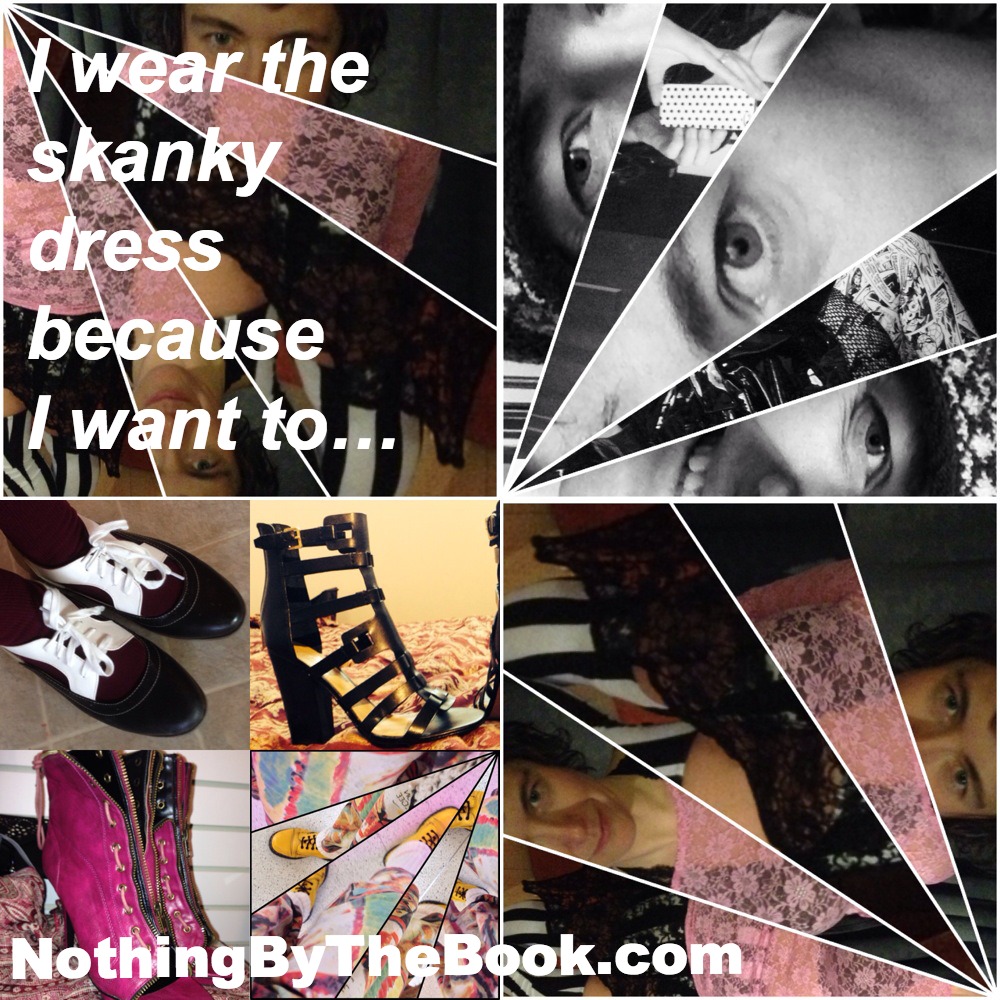
I wear the skanky dress because I want to…

This story begins when someone I don’t know confides in someone I love that she’d like to wear dresses more, but… she doesn’t… because… well… and…

(I’m not there, I don’t know her at all, but I can see this moment, I can see her pause, ponder, scrunch up her forehead and wonder why it is that she, a successful-powerful-intelligent-confident-adult! woman, why is she even thinking about this? Why is wearing-a-dress/not-wearing-a-dress even a thing? Why is this taking up brain power?)

I come into the story when a new dress comes into my life. And I pull it over my head to parade in it in front of someone I love, but I get distracted by a mirror, and I look at myself, from this angle and from that, and I-love-this-dress-so-much-and-me-in-it-and-I-have-a-thousand-thoughts-racing-through-my-head-and-I-freeze-and…

…and he walks by and sees me, and says,

“Admiring how hot you look in your new dress?”

…and I look at him and say…

“Well… that, yeah… but mostly, I’m pondering why is it that it took me three children, four decades and a brush-with-life-in-a-wheel chair to feel comfortable wearing a dress like this?”

Not just a dress that looks like this, you know (although, wow, how it looks, how it looks!)—it’s more complicated than that. Wearing a dress like this. As if it’s my second skin, a part of me that’s just… a part of me…

And he scrunches up his face, and tells me of his conversation about dresses and wearing-not-wearing with a successful-powerful-intelligent-confident-adult woman who wasn’t sure why this even was an issue for her… but it was…

And in that moment, I know. I know exactly why it was an issue. It gets done to us, to our daughters, to all girls—and to some boys, too—the first time we get a pink onesie… but you know all about that, so I won’t bore you with it. Instead, I’ll tell you this story:

I’m 24, and a little brilliant, and in my first (it will be my last) corporate job. It’s my first performance review. I kick ass. They love my work. I’m perfect. Except, there’s this: “She should dress more professionally.”

I go home, cry, and the next day, buy an ugly navy blue suit. I hate it. It pinches, rubs, feels awkward when I sit. Walk. It makes me look like a fucking corporate drone. A woman-pretending-to-be-a-man, badly.

It does the job.

It hides the fact that I have a beautiful body.

Because, apparently, that distracts from my overall competence?

At my next performance review, the addition of the ugly blue suit to my wardrobe is duly noted as a professional achievement. I quit that job for many, many reasons—but the fact that what I wear is commented on, negatively and positively, in a review of my work, is absolutely a contributing factor.

But the damage is done. It started before, of course. In elementary school, when boys snapped girls’ bra straps, just because, and made our growing breasts a cause of embarrassment and something to hide instead of a glorious, glorious developmental leap to enjoy. In junior high school, when… fuck, you know, I’m almost 40, and I don’t want to go there again. If you were a girl in junior high school, you know. If you have a daughter that age, you’re going through it again, and it hurts even more, because it’s her, and nothing’s changed, and what-the-hell-is-wrong-with-this-world?

Fast-forward to university, and feminism and women’s studies and sociobiology, relativist (or is it?) anthropology, cultural studies, post-modernist English lit, Queer cinema studies, and ow-my-head-hurts-who-am-I-how-am-I-why-do-you-keep-on-telling-me-I-can’t-be-this-if-I-am-that? Rational or sexual, intelligent or beautiful, strong-and-in-control or an eroticized-victim?

Some of these things I analyze, process, struggle with… so many more of them just infiltrate me, affect me, attack me, without me really becoming aware of them.

And then, what happens? I would like to say that pregnancy-child birth-lactation changes me. That would be a great story, wouldn’t it? Four times, the belly grows and stretches and stretches, three times, I am Goddess-Life-Birth-Beginning, for a decade, my body-and-breasts are a source of nourishment-love-comfort… and also, not my own, really, they belong to them, and first I can’t get used to that, and then I love it, and then I resent it, and I’m done, and I want ME back…

…and so, changed, and not my own for so long, and then reclaimed… surely, all that’s part of what happens to me?

But while that’s part of the story—because everything is part of the story—it’s not the whole story, nor even it’s most important part. And it’s not an archetypal, inevitable part, either. But we can argue about that another time…

The reclaiming-reinventing my body from the injury that made me contemplate the-rest-of-my-life-in-a-wheelchair is part of the story too, I suppose. But I like to think it just accelerated—brought into stark relief—a process that was already underway…

(Did you forget what I was writing about? This is a story about a dress. Dresses. Femininity, sexuality, self. On we go: …)

I meet her when I’m… 27? 28? She’s a decade my senior. Gorgeous. You’d know who she is if I told you. She kicks ass, and has since she was 22. Actually, probably since she was 12. And I’m interviewing her about how brilliant and amazing she is. And I also know—I’ve heard them slur her beauty, her sexuality—use the existence of those aspects of her as a negation of her professional achievements, an attempt to refute the fact that on her bad day, she can outthink most of them on their best.

So… I see her brilliance-and-sexuality, fully before me, and I am so in love with it—with her confidence and with how… how in her skin she is. But I wonder… I want to know.

I ask her.

“Do they take you seriously?”

I don’t have to explain who they are. She knows. And she laughs. “Hold on,” she says. And she reaches into a drawer.

Hair pulled back in a rubber band. Big, ugly glasses. Earrings and scarf off. Stark, unflattering jacket on.

“I’m like a fucking quick-change artist when I need to be,” she says. “But I bother to do this less and less. Because, you know what? Fuck them. And I know what they say about me, and they say it whether I’m dressed like a frump or a slut. They’ll say it about any woman who’s like us.”

She doesn’t need to operationalize that. Does she for you? “Like us”—powerful. That’s it. Her own, your own… Powerful.

The jacket, glasses come off. The hair comes loose. She looks at me and unsnaps a button on her shirt. “Fuck them,” she repeats. “If this throws them off their game, I’m all for it.”

I watch her career progress, at breakneck speed, in adulation.

I never see those ugly glasses on her face again…

(Interlude: years later, an editor asks me… “How the hell did you get that quote?” And I’m embarrassed. But I tell him, and it was like this: “I waited until he was looking at my tits to ask the question.” On the other end of the line… silence. And then, “And once again, a tip I can never use myself or pass on to other writers.” Sorry. When the playing field is unfair, and they write all the rules… we will play dirty. Because—fuck them.)

I meet him (not my editor; him, Master of the Universe; read on…) when I’m… 30. I’m mired in babies. I don’t think of what I wear as clothes so much as… rags covered with baby puke, urine, and pureed potatoes. When I get the interview, I cry, because I have nothing to wear—the ugly blue suits I bought to fake it in Corporate Canada don’t fit my “popped out two babies in three years” shape. I go “shopping” in my mother’s closet. Go to the interview in something tasteful, elegant, professional. Thoroughly not mine.

So uncomfortable.

I’m off my game, totally.

The jacket chafes me, the white shirt’s buttons are bursting against my milk-full breasts.

He’s wearing jeans and a flannel shirt, and I won’t even tell you what’s on his feet. (Cowboy boots would be an upgrade.) We’re going to see the Premier. And other, more important people.

Himself, he’s one of the most powerful people in the industry, in the province… He’s fully in his skin.

Does he know that I’m not in mine? Does he care?

Do I care if he cares?

Should I?

I’m not sure if my thinking around this event is conscious—or even if it happens in the moment. I do know this: that’s the last time I wear a suit. The last time I go to an interview—an event—anywhere—not in my skin.

What defines, makes up my skin changes over the next decade. At first, there are all those puking and nursing babies, and so what I wear must make my breasts accessible to them and be easily washable and hide stains too. And my shape is changing, fluctuating—what does it want? What do I need to wrap myself in to feel good at this moment, as belly grows/shrinks/flaps/can’t-find-its-waist? And then, I am broken, so broken, and frankly, nothing fits, works, nothing I put on me makes me feel anything but anger at this fragile biological construction’s total and utter betrayal of me…

At this time, in this fog of pain, I think I have no skin. But, I do, I do. Because this happens: I meet him for the first time, and he’s all excited and anxious to meet me. And dressed up. In his skin? In a uniform? I don’t know. He looks at me as we shake hands, and he says…

“Christ, they told me you don’t look like a legal affairs writer. And ah… I mean. I don’t know what I thought a legal affairs writer would look like. But… yeah. Not like this.”

And I laugh. And look down at… my skirt (unprofessionally short) and top (unprofessionally minimalist) and my thoroughly-impractical-because-you-can-bike-in-heels shoes… I ask:

“What do I look like? Who do I look like?”

There are so many possible answers to that question. Only one right one, though. And it is this, and he gives it:

“Yourself.”

My new dress has been rumpled, enjoyed, taken off. He who loves me helps me put it back on. Watches me return to examining myself in it, from various angles.

I am not sure if I can fully articulate, truthfully articulate what brought me to this place of loving this dress, loving myself in this dress, and finding nothing but power-joy-comfort-oh-yes-this-is-me  in this second skin. If I wore this dress 20 years ago, 10 years ago, I would not wear it like this—I would be aware of its effect on them, and even if I chose to flaunt their opinion… I’d still care. Oh, I’d still care.

And I would still be in the chaos of all those dichotomies—this-but-not-that-no-you-can’t-be-both-all. Some examined; most, subconscious infiltrators.

But now, today, at this juncture…

Brilliant-and-sexual. Rational-and-hot. Powerful-and-emotional. Erotic-and-strong. Articulate-and-beautiful. Vulnerable-and-feminist. Professional-and-wearing-whatever-the-fuck-I-want.

xoxo

“Jane”

More like this, but not really: Naked face politics • “Who are you wearing?” clothes as message, value, consciousness

NBTB-I wear the skanky dress

PS “Hi, Jane, first-time reader, and, um… I thought this was a parenting blog. You know? A mommy blog? About kids and snot and stuff?”

“It is, sometimes. And even when it isn’t, it is. Because mothers—parents—are, you know… people? Parenthood adds a dimension to your life, a new (oh-so-important) role. But it doesn’t replace who you are, erase everything you are. Or at least, it shouldn’t… We’ll talk about that in a couple of weeks. In the meantime, if you need a parenting reading fix, edify thyself at Soapbox.”

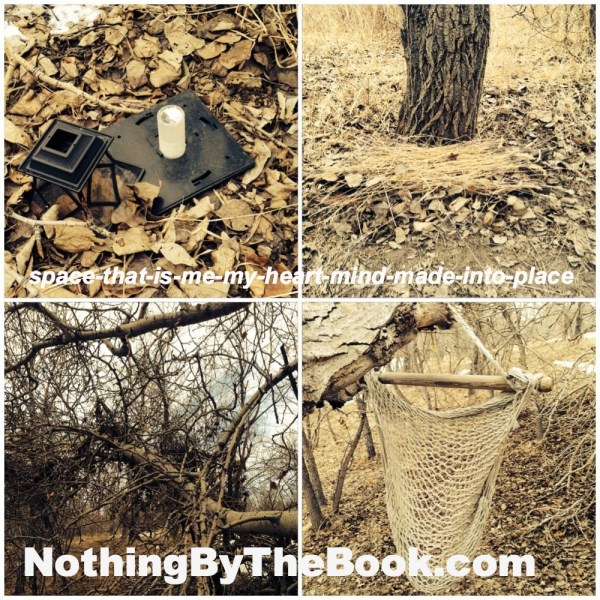
space-that-is-me-my-heart-mind-made-into-place

I.

You come into my house, and I am twirling, spiraling, dancing: half-delirious with joy and excitement. There are things I want to show you, share with you… Are you ready? I take your hand and dance with you through the hallway—walls, floors, baseboards!* —and into the place-space I really want to show you, the space most precious to me, my space.

I stand at its threshold, and beam. Spread my arms open and spin around: it’s tiny, but it’s mine, all mine, and it’s real-rebuilt-unspoilt. As I spin, I point to my little desk, and the couch-I-can-lounge-on-or-invite-friends-to-crash-on, and the rug no-child-or-dog-has-peed-on-yet, and the old, dusty Tiffany lamp Sean got me for a birthday way back when, and the little shelf of beloved-books that are there, within hand’s reach of me when I sit on the couch, and the window through which speckles of sunlight-and-outdoor-fairy-dust come in, and…

Mine, all mine, precious to me, and I am so happy, so happy to share it with you. Because I love you.

And you…

You look around, at this space-that-is-me, that is my heart-mind-made-into-place, and you say…

“Sort of a sloppy paint job, eh? I can see the spots you missed on the ceiling.”
And you say…

“Is that an Ikea sofa bed? I can’t stand Ikea furniture. And that colour… grey? What were you thinking?”

And you say…

“That Mexican blanket is so frayed and worn. Plus–taaacky! You should just throw it out.”

And you say…

“That secretary desk just doesn’t belong there at all.”

And you say…

“Why did you put a white rug there? You know it’s only going to get filthy, and you know you’ll never clean it.”

And you say…

“Is that the picture that was in your bedroom before? I’ve never liked it.”

You are in this space-that-is-me, my heart-mind-made-into-place, and you are violating me with every word.

I collapse into my grey—cheap, unfashionable, whatever, MINE, and it does what I need it to do—Ikea couch, wrap the frayed blanket (I LOVE IT) around me and turn away from you (I HATE YOU right now) and look at my shelf of beloved-books-that-always-make-me-happy and I reach out for one of them.

And you say…

“Jesus, are you still obsessed with Jane Austen? I don’t get how you can re-read those books over and over and over again. They’re so boring. Can’t you find something more interesting, more productive to do with your time?”

And our relationship is over. You never get to come into space-that-is-me, my-heart-mind ever again.

II.

You’ve never done this to me. You would never do this to me. As you read the story above—you were appalled, were you not? You thought, I know you did—what sort of terrible, terrible person would ever do that to a friend?

And yet… the average well-meaning, loving parent… does something like this… ALL THE TIME… to children.

ALL THE TIME.

III.

You come into their world, their moment, their space, their joy—and there they are, twirling, spiraling, dancing: half-delirious with joy and excitement. There are things they want to show you, share with you… Are you ready? They want to show you/tell you about their space-place-passion-joy, and it doesn’t matter what it is: an arrangement of sticks, a new graphic novel, a Youtube video that’s touched off something inside them, this cool thing they’ve built in Minecraft, a new Barbie doll outfit, what Sophia said at the playground. The way they’ve stacked their cars, rearranged their stuffies. Reorganized your kitchen cupboards.

It is a thing that is precious to them, and they are so happy, so happy to share it with you. Because they love you.

And you…

You look at what they are baring to you, and you say…

“What a mess!”

And you say…

“Did you spend the whole day watching Youtube videos again?”

And you say…

“I don’t get why you keep on reading crap like this.”

And you say…

“What a waste of time.”

And you say…

“Can’t you ever put your things away?”

And you say…

“I don’t understand why you hang out with her.”

And you say…

“Can’t you find something more interesting, more productive to do with your time?”

You are violating them with your every word.

And your relationship is over.

It won’t die the first time you do this. No. It will take a while.

But eventually… you will never get to come into space-that-is-them, their-heart-mind-space ever again.

IV.

Children give their heart-mind-space-place-come-within-me-be-inside-me-and-see-what-I-love… so freely. Don’t take it for granted.

Don’t wreck it.

Honour it.

You wouldn’t tell me—would you? —all those terrible things? (And if you would, baby—therapy. Now. Today; don’t wait for tomorrow.) You wouldn’t, of course you wouldn’t. Because you know you would violate me. With every word. And our relationship would be over, and my space-place-heart-mind closed to you forever.

Don’t do it to your children.

This soapbox moment brought to you by my own need for eternal vigilance over the tendency to treat our children worse than we would treat friends or strangers.

xoxo

“Jane”

NBTB-space-that-is-me

*If you’re new here, you might need to know… there was this flood: unLessons from the flood: we are amazing and After the flood: Running on empty, and why “are things back to normal” is not the right question. And now, 10.5 months later, I have my space back (well, almost, almost, any day now…), and am reimagining it. And it is quite, quite wonderful.

And when I get a cheap grey IKEA couch in there, and my frayed Mexican blanket, and a rug no-child-or-dog-has-peed-on-yet, and my most-beloved-books… it will be even better. And when I invite you into it, invite you in because I love you–you will look at it through MY eyes before you say anything. Because… you love me. And want to understand how I feel about this space-that-is-me, understand me–not hear yourself talk.

Of course you will.

Now. Go do the same thing when your child invites you in…

On big egos, scared-scarred-little-boys, and what to do when one of them tells you, my girl, that you have a big ego

I look at her and she takes my breath away. She is just so perfectly… herself. And I am envious. And in such love, my lungs, heart, stomach ache…

Jane: Do you know how utterly amazing you are? You are just awesome.

Flora: Aw. Thank you.

And she smiles her incredible smile at me. She’s at that lovely, unwrecked age when she still knows how to take a compliment, you know? When you tell her she’s beautiful, she just smiles a lovely smile that says, “I know.” When you tell her she’s clever, she looks at you, a little surprised—“Isn’t it obvious? Why must you say so?”

But the world-around-us is making inroads, attempting all sorts of assaults at her sense of self. And while she accepted the compliment as her natural due… she’s self-reflective enough to ponder whether that was ok. And so, she scrunches up her lovely, brilliant face, and looks at me…

Flora: Mom? Is it bad to have a big ego?

Oh, my beloved. The questions you ask. And would not your life be easier if I could just give you pap, pat answers? I hold her look and ponder my answer.

Jane: I suppose it depends on what you do with that ego…

But that’s no answer at all, is it? And it’s actually the wrong question, too. So I try again, to come closer to truth:

Jane: I think it’s probably worse to have no ego at all that to have a big one

She thinks on that for a while. Is not sure she understands. Asks for clarification. And so I ask her… what’s her perception? What does she think—is it good or bad to have a big ego? What does she understand by ego? What does she mean by “big ego”? Is she thinking of someone specific?

Flora: Someone with a big ego is someone who thinks they are oh-so-great.

And, oh-yes, she’s thinking of someone specific…

But is someone with a big ego really someone who thinks they are oh-so-great? I want to see where she takes this, so I ask her—how do you know that they think they are oh-so-great?

Flora: Well, they tell you how great they are. All the time.

Right. So listen to this, my Flora: in my experience—and in my line of work, I’ve become something of an expert on big egos, and egos-that-want-to-be-big-but-are-actually-egos-of-scarred-and-scared-little-boys—the people who tell you how great they are (all the time) don’t actually have big egos. They are scarred-and-scared-insecure-and-easily-threatened-little-boys-and-girls who need to talk big to feel big…

Flora: So… they tell you they’re oh-so-great… because they’re actually worried they aren’t?

Exactly, my love. The people with big-secure-confident-I’m-your-Mona-Lisa-and-I-know-it-down-to-my-toes egos… they don’t need to tell you how great they are. (You do it for them, to them, all the time, unprompted…)

My Flora is fascinated, and slightly perturbed. She stoops down, sits down. Thinks and thinks. Finally:

Flora: Do I have a big ego?

Ah, THE question. And so how do we answer that, within the parameters we have set? And with some consideration for the inroads the world-around-us is making into her mind?

Jane: Well… do you think you’re oh-so-great?

And what she says, beloved, what she says… well, this is what she says:

Flora: Well, I don’t know if I’m oh-so-great… but I’m pretty good. And pretty cool. Most of the time. Except sometimes, when I’m an obnoxious jerk. Sometimes on purpose, sometimes by accident… but generally, I’m just… I’m pretty good.

I’m me.

My blogging colleague Jen Rose at Something Clever 2.0 once commented here, “Flora for President!” Let me up that, today, to “Flora, Ultimate Ruler of the Universe!” Cause what a wonderful universe that would be…

Jane: So I think you have a perfectly healthy, solid ego that doesn’t need to tell others how great it is, because it is confident that it’s just awesome, and that’s pretty awesome.

She glows with… Floraness. And… did I tell you already? I look at her and she takes my breath away. She is just so perfectly… herself. I love her so much, my lungs, heart, stomach ache…

She smiles and me. And slants her eyes … and smiles again…

Flora: So if someone tells me I have a big ego… should I just kick him in the balls as hard as I can?

Well… um.

So…

What would you say?

xoxo

“Jane”

NBTB-On big egos

P.S. Somewhere, out there, I’m sure there is an article–course–workshop on how to write short, pithy, search engine friendly post headlines. Don’t tell me about it. I don’t care.

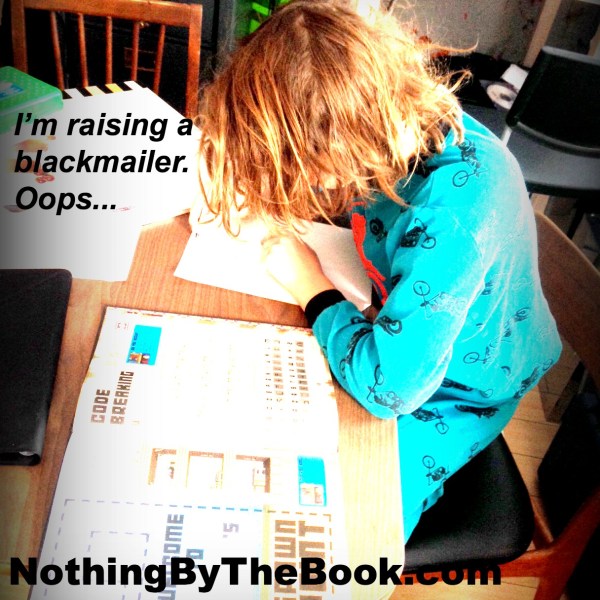
I’m raising a blackmailer. Oops

This one is for “Narf,” from The Road to Serenity, who asked for something funny. And for  B., who thinks he needs to review all my future NDAs, because… well, read on…

***

First, this: the children find out how utterly broke I am:

Flora: Mom? How much money do you have in your bank account?

I scrunch up my forehead, pull up the date, calculate the total number of bills deducted from my not-very-impressive balance as of today, and respond…

Jane: About $50.

Flora: OMFG! I have more than that in my Three Jars!

(Three Jars, by the way, is a very brilliant way of managing your children’s money without actually giving them real money. What I mean is—Aunt August sends a check for $16.66* for their birthday, and it’s in your name… you deposit it, of course, in your bank account, and then do you transfer it to their bank account? Of course not. At least I never do. I spend it, on, you know—food. Visa bills. Until Three Jars. Now, I “deposit” that amount into their account. It’s virtual money: I don’t put any real money in there. It’s just a record. Then, when we’re at a store, and Flora wants another Rainbow Loom, and wants to pay for it with her money—I pay for it with my visa… and deduct the money from her Three Jars account. Brilliant. Check it out.)**

Flora is very, very clever—I may have mentioned this before, how clever my girl is?—and my apparent indigence is causing her some concern. She’s following the matter to the obvious conclusion.

Flora: Mom? So I have more than $300 in my Three Jars. If I ask you for that money, where is it going to come from?

Here’s the part where I teach my children a terrible life lesson.

Jane: I would write you a cheque on my Line of Credit.

… and here’s the part where they learn the paradox of a freelance writer’s life:

Flora: Mom? Why do you have so little money when you’ve just worked so much?

Jane: Because I haven’t been paid yet.

… and here comes the part where I realize my children learn all sorts of financial lessons I don’t realize I teach them…

Cinder: Because Mom’s a freelance, Flora, and that means clients don’t pay her for weeks and weeks and sometimes months after she does the work.

Flora is outraged.

Flora: Well, that really sucks!

Me, you know, I haven’t had a biweekly, predictable paycheque since Y2K, so I rather take it in stride. Most of them pay. Eventually. In the meantime, there’s my treasured line of credit…

And here comes the part where… well, just listen:

Cinder: Hey, Mom? That client you wouldn’t tell us anything about, the one that you did that top secret project for—you know, the one that you said if you told us about, they’d send ninja assassins to Calgary to kill us and also everyone we talked to about it?

(Sometimes, I get REALLY interesting jobs. They come with these NDAs…)

Jane: Um, yeah?

Cinder: Have they paid you yet?

Jane: Um, no.

Cinder: So… why don’t you call them and say, “Pay me now, or I’m going to put your top secret project on Facebook?”

I crane around in the front seat of the car—these conversations almost often take place in the car—and stare at my son-the-future-blackmailer. Who 1) totally understands the power of social media and 2) knows that privacy in our current world is only a delusion…

… and I wonder exactly where I went wrong on the path of shaping his moral make-up…

… and then Flora—have I mentioned how very, very clever she is?—sets him straight:

Flora: But Cinder. Maybe they’d pay her this time—but then, she’d never, ever get another top-secret-don’t-tell-anyone-about-this-or-we-will-send-ninja-assasins-to-kill-you-and-everyone-you-might-have-talked-to job.

Cinder: But she’d get paid.

Flora: But she’d never get hired to do anything top secret again.

Silence falls. I do some mental arithmetic on how much room there is left on my line of credit, and decide plenty enough that I don’t need to panic. Yet. Flora, I suspect, is wondering if she should call in all her Three Jars savings now, before the line of credit is maxed. Cinder, I’m a little worried, might be thinking whether he should take the financial health of the family into his own blackmailing hands—and I make a mental note to change all my laptop and file passwords again. Just in case. Not that I doubt his integrity… just his, you know… judgement.  I turn again to look at him. His look is pensive rather than cunning—more like he’s feeling pity for my lack of ruthlessness rather than planning the demise of my professional reputation by threatening my client in my name.

I relax. Peek over at Ender, who was listening to but not following the conversation, but now has his brow furrowed in concentration. I love to watch him think: I see him chasing a thought… wrestling it… figuring out how to articulate it. What did he take away from all that? What did he glean, process?

And, here it comes.

Ender: Mom?

Jane: Yes, my darling?

Ender: Penis!

The four-year-old has spoken.

xoxo

“Jane”

Raising a blackmailer

*You remember Aunt Augusta? She’s not real—she’s a metaphor for every relative-aquaintance-friend-of-the-family-well-meaning-stranger-at-the-bus-stop-nosy-neighbour who has an opinion about how I live my life/raise my children and misses no opportunity to tell me I’m doing it wrong. I hope you have an Aunt Augusta or two in your life: there is no better barometer by which to measure your parenting. Aunt Augusta thinks you suck? Awesome. You’re doing something right.

**Not a sponsored post. I don’t do that. I’m a real user of the service and a real fan.

Photo: My blackmailer-in-training practicing breaking secret codes…

WILD THING: 7 ways to “attachment parent” the older child

This is for you. You know who you are. Originally published as “Five is hard, or can you attachment parent the older child?” xoxo

Wild Thing 7 ways to AP the older child.jpg

***

It happens to the most attached parents among us. We’ve breastfed, co-slept, and slung our babes happily. It was easy—or, it became easy, once we got into the groove and shook off Aunt Augusta’s disapproving glare. We saw our children grown and flourish, loved, connected, happy. But then, at some point, the demons of self-doubt return. Our child goes through a phase we see as difficult and challenging. Almost inevitably, this happens when we’re not at our best—pregnant, tired, stressed. And we wonder—is it possible to attachment parent the older child?

Five seems to be the milestone when these demons attack most ferociously. Makes sense: it’s such a milestone age in our culture. The preschooler becomes a kindergartener. The stroller’s abandoned; the first loose teeth come. The search for self becomes super-pronounced, and our five-year-old is frighteningly selfish. (I write about that aspect of five in Ferocious Five.)

It hit one of my friends very hard when her eldest daughter turned five. She asked our playgroup community for help, and she framed her struggles under this big question: “Is it possible the attachment parent the older child? This five year-old who’s driving me utterly, completely crazy every moment of every single day? Is it time to bring out the conventional discipline–punishment–toolbox?”

This was my response to my friend. I had seen Cinder through five pretty successfully. Not yet Flora. Bear that in mind as you read (also bear in mind that I had a very specific audience-of-one in mind for this piece. And I do again…). Check out Ferocious Five for the lessons Flora taught me.

(2008). Five is hard. But so is two, three, four, six, sixteen–all in their different ways. Part of the trouble is that our children move onward and forward through the different ages and stages, while we, their imperfect parents, have just figured out how to cope with the preceding one.

Is it possible to attachment parent the older child? Possible, necessary, critical. And here is where the difference between AP “things we do”–co-sleeping, breastfeeding, babywearing–and the AP “things we are” plays large. We don’t carry our five year olds, the majority of us don’t breastfeed them any more, we’re not necessarily co-sleeping with them. The “do” stuff is gone.

The “be” stuff is all that remains.

And how do we “be” with the older children? I think this is one of the points at which our paths can diverge quite dramatically. And I don’t know that there is one *right* answer. For what it is worth, based on my sample of one five-year-old shepherded through some challenging stuff to date, these are the principles that helped us:

1. Make their world larger.

At five, Cinder’s world got larger. We’re homeschooling, so the massive change that is five day a week kindergarten wasn’t part of it–but think of what a huge change that is for the average five-year-old, and how hard it must be sort out, everything so new. Still, even minus kindergarten, it was so clear to us that a five-year-old was very different from a four-year-old. And absolutely, we butted heads because while he had moved on, I was still mothering a four-year-old.

A huge breakthrough for me was to make his world larger–ride his bike on (safe!) streets, cross the street on his own, go into stores on his own, play a bigger role in everything. I can’t quite remember all the different changes we did, but they’re pretty much irrelevant–they wouldn’t necessarily work for your child. Talk with her. What would she like to do now that she couldn’t (or wasn’t interested) in doing a year or six months ago?

2. The only person whose behaviour I can control is myself.

The other thing I always come back when we run into “downs”: the only person whose behaviour I can control is myself. And if I am unhappy with how my child is acting, the first step is not to look for a way to change my child, but to look at myself, within myself, and ask myself what can I do to change how I am reacting and communicating with my children? What am I doing–reflexively, thoughtlessly–that I can change. Start with me. When I’m okay, when I’m balanced, when I’m grounded–well, very often, the problem goes away, because it was in me in the first place. My children mirror me.

And, if the problem really is in the other–if it is all my Cinder being crazy or my Flora being whiney–when I’m taking care of myself, reflecting on my behaviour, and acting from a place within me that’s grounded, well, then I can cope and talk and help them sort through whatever craziness they are going through at the time without losing it.

3. Re-connect, re-attach.

I strongly, strongly believe that any punishment–be it a time out, a withdrawal of privileges, or the most innocuous manufactured consequence–does not help these situations but serves to drive a tiny, but ever growing, wedge between the attached parent and child. The absolutely best thing I’ve ever read about discipline was in Gordon Neufeld’s Hold On To Your Kids–absolutely aimed at parents of older children, through to teens. We’ve talked about this before, you and I, but this is the essence of what I take away from Neufeld’s chapter on “Discipline that Does Not Divide”: “Is [whatever action you were going to take] going to further your connection to your child? Or is it going to estrange you?”

So what do I do when I kind of want to throttle Cinder? I work at re-connecting. I call them re-attachment days. Have a bath together. Wrestle (I’m not advising it for pregnant mamas). Go for coffee (for me) and cookie (for him) at Heartland Cafe, just the two of us (see Ice Cream Discipline). Really focus on him and try to enjoy him. So often, that’s what he’s asking for by being obnoxious–really focused attention from me.

Now if I could only ensure I always give it to him so that we wouldn’t go through the head-butting phase in the first place!

4. Remind myself of what I want to say and how I want to act.

What do I do in the moment? That’s way harder in practice, no question. When I’m really frazzled, I leave notes to myself in conspicuous places with “when Cinder does x–do not say/do this–say/do this instead.” (Fridge and front door best places. Also, bathroom door. See Surviving 3.5 and 5.5–a cheat sheet.) And I tell my children what they are–“Those are reminders to me of how I want to treat you and talk to you, even when what you are doing makes me very, very angry.”

5. Sing.

Sometimes, I sing, “I want to holler really loud, but I’m trying really hard not to, someone help me figure something else to do, I think I’m going to stand on my head to distract myself…” (This works really, really well with two and three year olds too, by the way.)

6. Forgive. Move on.

Sometimes, I don’t catch myself in time and do all the things I don’t want to do: yell, threaten (if there is an “if” and a “then” in a sentence, it’s almost always a threat)… and then I apologize, try to rewind, move forward.

7. Put it all in perspective.

And always, always, I remind myself that 1) the worst behaviours usually occur just before huge developmental/emotional milestones, changes and breakthroughs, 2) my child is acting in the best way he knows at this moment, and if that way is not acceptable to me, I need to help him find another one, and 3) I love the little bugger more than life or the universe, no matter how obnoxious he is. (This is a good exercise too: after a hard, hard day, sit down and make a list of all the things you love about your little one. From the shadow her eyelash make on her cheeks when she sleeps to the way she kisses you goodnight… everything you can think of.)

And, finally, if I want my children to treat me–and others–with respect, I must treat them with respect. No matter how angry or tired I am.

Lots of love and support,

“Jane”

2014. Gods, that’s long-winded and self-important and painfully sincere. But then, I was so. Still. There’s this: “If I want my children to treat me–and others–with respect, I must treat them with respect.” I don’t know that I needed to write 1400 more words, do you? Is it easy to do that when I’m exhausted, empty? Fuck, no. But then, most worthwhile things are hard, at least some of the time…


I become a Timelord, and tell you why when you say “I’m too busy,” I think you’re handing me a lame excuse

It happens like this: Sean buys me a Dalek dress and…

…actually, no, it happens like this: I’m trying to get together with a friend, and we’re comparing schedules, and arrive at a date 18 days out.

“Seriously?” I say. “This is the first time that works for both of us?”

She shrugs. “We’re amazing people with full, busy lives. You’re in deadline hell until the 8th. I’ve got this, that and the other until the 13th. Then you’re on a new story. Then…”

Then… I become a Timelord. I bend the laws of time and space, and we get together the next day. I’m still in deadline hell. She’s still got this, that and the other. We take a break for a slushy walk and a glass of wine.

Deadline hell is there when I come back. So is laundry, and a living room that looks like it’s been ransacked by very unskilled terrorists. And an eternal construction zone on the bottom floor of my house. And… oh, so many tasks, duties, obligations that can contribute to making me feel “too busy.”

And, ok. I’m busy. Stuff to do, always. But I’m not “too busy.” I’m not too busy to do the important, fulfilling. Or just the… fun. I’m not too busy to live. And neither should you be.

Want to know the secret to being a Timelord? It’s three-fold.

First, to steal shamelessly from United States Brigadier General Rhonda Cornum: “Prioritize A, B and C. Discard C.”

You know this. You probably do this. But you know what? You’re probably discarding the wrong C. See, getting together with my friend for a glass of wine—that’s an A. Right up there with reading to my kids at bedtime, meeting my deadlines, and NOT skipping a single work-out session.

Second—ready? This is the big one—realize that amidst your “I’m too busy,” you’re going to piss away a lot of time. OK, let’s not make it about you: in the middle of my “I’m so busy! Waaah!” I’m going to piss away a lot of time. I’m going to feel burnt out and spent, and will need to recharge and get refreshed before I can slog through another 12-hour “must produce” day. I can spend that inevitable piss away time unproductively, feeling like I should be working-doing-something, wallowing in guilt and ick… or I can plan to spend it in a re-energizing way: taking two hours away from deadline hell to go sledding with my kids. Recognizing that by Wednesday night, there is no way I will be capable of working into the night, and so, that’s a really good night to go to the theatre, yes, babe, let me arrange for a babysitter.

Third—and this is what separates the Companions from the Timelords, beloveds—I say yes to 20 minute commitments. It goes like this:

“Mom? Can we go sledding?”

And I look at the clock, and it’s 11:20, and Sean and I are doing a kid-and-car switch off in 30 minutes; his workday over and mine beginning. And my “too busy” instinct is to say “No.” Right? By the time the snowsuits are on… You know what? Screw it. I say yes.

We’re out the door in 5 minutes, on the hill in 10. Sean meets us there; I effect a snowpants- into-“suitable for client clothes” change in the truck. I make my meeting, cheeks frostbitten, a little sweaty—but happy. I spent 20 minutes outside engaged with my kids doing something, instead of inside, marking time until the switch-off, listening to bored kids whine.

It also goes like this:

“Hey, I’m five minutes away from your office and with a 35 minute gap until my next interview. Time for a coffee?”

And like this:

“I’m heading down south to Costco this afternoon with all three kids. Meet at the River for a sanity walk before or after?”

That’s all:

1. Prioritize—but make sure “A” includes the things you really need to do. Yoga, if that’s your thing. Poker night if that feeds your soul. Chocolate. Wine. Sex.

2. Plan for piss away time—and turn it into time for stuff you want to do that feeds your mind-soul-body.

3. Say yes to doing something for a very short time—use your “in-between” and “waiting” time instead of just filling it. A walk can be a 20-minute commitment. Less. As can getting naked with your lover. Or writing a blog post, pitch or long-overdue email letter (remember those?) to a forever friend—or at least the first draft of one.

So… Timelord with me, will you? And don’t tell me you’re too busy. I know you’re busy. Me too. Kids, family, money-tied work and love-tied work. Volunteer commitments. Dishes that won’t do themselves, and a bathroom that refuses to self-clean (is there a warranty for that?). And also: books I want to read, plays I want to see, events I want to experience. Friends I need to see. Places I need to  be.

And yeah, sometimes, deadline hell, work hell, this-that-or-the-other (the newborn, the un-potty-training toddler, the sick parent, the near-death experience, the divorce, the massive natural disaster, the nothing-else-matters event) takes over everything. Of course. Sometimes, you can’t bend the laws of time and space.

But most of the time… I can.

xoxo,

Jane

NBTB Timelord

P.S. In a totally coincidental unplanned, event, my Strategy Session column this month is about Sweating The Big Stuff:  stop putting out the fires and start strategizing. And it opens with Brigadier General Rhonda Cornum, whom I met in Martin Seligman’s Flourish.

P.P.S. For the bloggers in the audience: When I am in deadline hell, blogging—in particular, that aspect of blogging that involves interacting within the blogosphere and doing all those social media things, becomes “C.” And gets discarded, without a second thought, without guilt. Writing for the blog(s)* becomes “B” (when I’m truly a Timelord, it is “A”).

*If you can’t get enough of me, and having out-of-box ideas about education, I also write about unschooling and my kids’ learning journey at Undogmatic Unschoolers. My real self’s business writing portfolio is hangs out at Calgary Business Writer. Looking to connect in the SM (social media, get yer mind out of the gutter) universe? Go to Find “Jane” … or just follow @nothingbtbook on Twitter. Easiest, lowest effort, highest ROI act.

Interlude for a splash of colour

No words. Just this:

Next week: Words. (I’m on deadline. Shhhh. Don’t tell the client I popped in here to play.)

How my four-year-old receptionist defies the uterus-less CEO… and why that’s going to change the world

The landline rings, but I don’t care. There was a time when I would leap out of the shower and race to the telephone naked, but these days, only telemarketers and wanna-be-politicians ever call on it. I’m in the kitchen (fully clothed) doing battle with the sink and a frozen chicken, and pondering whether I should say yes or no to a new project—and whether my tepid disinclination to say yes is rational and should perhaps be off-set by the disturbing state of the family bank account—and…

“Mom! Are you going to get the telephone?”

“No!”

My elder two children are ignoring it too: they were reared in the pre-cell phone era when clients and editors called me on the landline, and answering the phone in the wrong way brought the Wrath of Psychotic-Bitch-Mom. The four-year-old lacks the training and the trauma. The phone is beguiling him. Plus, the ringtone is annoying.

“Mom! Please! Can I get it?”

Oh, why not? It’s probably a telemarketer, and it’s good practice for them to experience a four-year-old, isn’t it? I turn my head from the chicken for a minute, holler:

“OK!”

So… back to the inside of my head… will I say yes? Will I say no? I think I will say no, I’m pretty sure—I really don’t want to do it, and the part of it that’s intriguing isn’t sufficiently intriguing to make up for the part of it that a lobotomized chimpanzee could do, but, on the other hand, we need to eat. And go on exotic vacations…

From the other room, I hear,

“Hello?”

…and then…

“That is not how you say my mom’s name. Are you sure you know her?”

(There are so many, many different ways of mispronouncing “Jane.”)

“I’m Ender.”

“I’m not in school, ever! I’m four.”

“Mom! This guy really wants to talk to you!”

“Ma-baby—I’m busy killing a chicken. Hang up or tell him to call back.”

“My mom is killing a chicken. Well, not really. It’s already dead. But frozen. Also, I don’t think she finished her second cup of coffee this morning. And the dog peed in the basement, and I spilled cereal all over the couch, and the plumber hasn’t come so there’s no sink in the bathroom and she won’t play cars with me. She’s a big grouch, actually. Are you sure you really want to talk to her?”

“Mom? He says to tell you his name is… and it’s important.”

Oh, fuck.

Editor.

New editor.

Who has clearly not inherited the rolodex sticky-note that said “Do not call at home; communicate by email; in emergencies, email or text to schedule a time for a phone call.” (Digression: do people have rolodexes anymore? And do those of you under-28 know what that exotic word means?)

Goddammit.I wipe my icky hands on my clothes, and make my way to the phone…

“Hello, Jane here. … Hi. … So I’m not sure that I’ve had a chance to tell you this—but never, ever spontaneously call me at home. Now… give me five minutes to anaesthetize the children, and I’ll call you back on my cell from a locked, padded room…”

My real self has this column out right now, officially titled “Changing the status quo in the Canadian workplace”—more poetically self-titled “The CEO has a uterus—wait, the problem is that he doesn’t but half of his workforce does.” Here’s its key theme:

This is a story about why I don’t work for you.

Don’t roll your eyes. You should care, because I’m brilliant. …And it’s not just me. See her, over there? She’s even smarter than I am: she can see connections in trends, economic forecasts and people’s spending patterns that would make you rich beyond the dreams of avarice if you deployed her talents on the behalf of your corporation. And that one over there? You know that hole in your talent pipeline you’re looking to fill? She’d be perfect for it. …

We all left, because—hey, here’s something you’re not gonna hear a woman tell you very often, pay attention, darling—we all left because—eyes lower, lower, love, away from my face, lower, keep on going down… see this? We’ve all got this thing there called a uterus. Your wife’s got one, your daughter too. Your mother—that’s how you came to be, you know that, right? We’ve got these things, and that’s where new people incubate. And after they’re born, well, we’re kind of attached to them.

And even if we weren’t—the survival of the whole entire species depends on us, you know, taking care of them. Feeding them. Taking days off work when they’re sick or in high need… What? Nannies, day care? Not enough, dude, not enough—and you don’t get it, because, let me be politically incorrect here and blunt, you don’t get it, because you have a penis and a wife.

(Full unedited text of the Strategy Session, Alberta Venture column here)

It’s garnering fascinating responses from readers, varying from “Yes! Thank you for articulating this!” from many women readers-leaders to the ever-so-insightful “I wouldn’t have hired you anyway, bitch” from an alleged oil patch exec.* I end it with a call to arms—asking you to change the dominant culture of most workplaces by… well, by changing it. By acting like it’s already changed. Not by seeking accommodation—but by taking what you need. Whatever that means in your family-life reality.

And—and this, perhaps is even more important—by supporting those of your colleagues who are taking what they need. Not trying to pull them down to suffering through the unworkable status quo—just because you suffered through it. Just because you… weren’t able… didn’t have the courage… or weren’t sufficiently secure-privileged-arrogant-stubborn—I know I am all those things—to demand the change you needed.

A tentative knocking on my closed door. A whisper.

“Mom?”

Louder.

“Moooom? Are you done on the phone?”

“Yes, my baby. What do you need?”

“I just need you.”**

I let him in. Wrestle him on the bed for a while. Ponder if I’m going to say yes or no… where does the money-challenge-time-fulfillment-life matrix tell me to go right now? Remember there’s a raw chicken carcass waiting for me in the kitchen, and a client-of-a-client who needs some handholding. And, of course, the project that I really want and need to focus on that always get the short-shift… Skooch the four-year-old receptionist off the bed. Bribe his siblings to look after him.

And then—go do all the things that need to be done. My way.***

xoxo
“Jane”

Four-year-old receptionist.jpg

She likes footnotes:

* I generally don’t engage. I did that time. “You couldn’t afford my left foot, asswipe.”

** They need us so much, don’t they? Lest you think I advocate motherhood-martyrhood, please also read this: On the delicate art of running away… and always coming back.

*** It’s not supposed to be like that. The real secret to working at home with children is to get the children—or yourself—out of the house. More here: The naked truth about working from home, the real post. For more of my children’s encounters with clients and sources on the landline, see The naked truth about working from home, the teaser.

Next week… a surprise.

Looking for me?  Find “Jane”

Math, penises, impaired visual memory and existential angst

I.

Somewhere, in the math word problem instructions, was the phrase “be as creative as you like.” Oops. Here comes Flora:

Question: There are five elephants at the zoo. How many big elephant ears are there in the zoo herd?

Answer: There are nine ears, because Bill the male elephant only has one ear. He lost the other one when the zookeepers were rescuing him during the flood. This is a terrible tragedy, especially as all the other elephants make fun of him. You might think elephants are all cute and kind, but some of them are evil bastards.

And, here comes Cinder:

Question: Farmer Jones’ field is 167 m long and 4 m wide. Calculate the perimeter ( P ) and area ( A ).

Answer: P = ENIS A = SS.

II.

Speaking of penises (and when don’t I?), we’re renovating our bathroom. Because we’re insane and the reconstruction in the basement isn’t enough (actually, truly: it was a sanity-saving move: this one small thing, we can do and get done NOW). We’re en route to one of those horrid stores full of home renovation crap* and Sean asks me what kind of faucet I want. I stare at him blankly.

Sean: You know there are different kinds of faucets.

Jane: Um… sure. Yeah.

Sean: Do you want one that’s like the one we have now, or do you want something different?

I spare you the long technical and thoroughly incomprehensible to me description of European versus North American faucet styles and why this matters that follows, and jump to this: I am trying, very hard, to visualize our current sink and faucet, the place where I wash my hands and brush my teeth several times a day and have done so for eight, nine years? What does our sink look like? I’m fairly sure it’s white… possibly that colour they call ecru or ivory… round? Aren’t most sinks round? And the faucet? Christ. It’s just a faucet. Water comes out of it. I gather that one of the things my considerate beloved is trying to determine is whether I want a faucet with two separate hot-and-cold taps or one swivel tap. I close my eyes. Concentrate. I have no fucking clue what our faucet looks like. He reads my mind…

Sean: You have no idea what our faucet looks like?

The kids howl.

Jane: Fine, laugh. What do you think our faucet looks like?

Flora: It’s this dark shade of silver, with a beautiful curve. A line of green just around its base.** It’s just high enough that it reflects in the mirror, and when the taps are turned off, the cold one points at Ender’s collection of orange tooth brushes and the hot one at that weird splotch of red that you say is not blood on the wall beside the toilet.***

Cinder: That is not what Mom wants to know. The faucet has three holes, and they’re less than an inch way from the back splash… and probably eight inches apart from each other―I mean the outside two. And the sink is just over three feet high, and not quite two feet deep and 30 inches―no, actually, probably only 26 inches long.

Ender, paying intense attention to the conversation, shakes his head. And jumps in…

Ender: Our faucet looks like a penis.

Cinder: Actually, I’d like to change my answer to Ender’s.

Flora: I hate to ever agree with the boys, Mom, but yeah, Ender’s right. Our faucet looks like a penis.

Apparently, so does the new one.

Or so they tell me. When I close my eyes and try to see it… all I see is flowing water…

III.

Flora: Mom? What do adults talk about when there are no kids around?

Jane: Existential angst.

Flora: What’s that?

Jane: I think… it’s like trying to figure out who the heck you want to be when you grow up. Except that you’re already grown up, and so you feel like you should have figured this out already. But you haven’t. But you think you should…

Flora: But aren’t you just you?

Jane: What?

Flora: Well, I’m a kid. But I’m me. And when I grow up, maybe I’ll be a veterinarian. Or a painter. Or something. But I’ll still be me, right?

Right. And so… is that what existential angst is? Thinking that being you―being me―just isn’t enough?

xoxo
“Jane”

PS For those of you who’ve been unfortunate enough to witness me hitting my head against a brick wall last week: I’m not quite ready for the sledge hammer, but I’ve found me a rope ladder… Don’t get the reference? Then you’ve missed “I just want my kids to be happy.” Really? I don’t, and here’s why.

Next week: why I think “The CEO has a uterus―no, wait, he doesn’t but half his workforce does” is the most important thing I’ve ever written (as my real self), and why you―yes, you―need to go change the work world.****

Math-penises-staircase-to-everywhere.jpg

Footnotes galore

*I know you love those stores. I don’t. They smell. They’re too full of stuff. Worse, it’s all―well, a lot of it―stuff I need, because a third of my house is still a skeleton of its former self. Now what have you done? I’m all post-flood weepy again… OK. Moving on…

**The green is a deposit of limestone, because… crappy housekeeper. I know you think you are―I really am.

***It’s not blood. I promise. You don’t want to know what it is… but it’s not blood.

****Having a split on-line/writing personality is getting incredibly onerous. If you’re thinking of doing it: don’t. It leads to mild on-line schizophrenia, has bizarre implications on your real life, and reintegration is a bitch.

Looking for me?  Go to the for-stalkers-and-bloggers-and-no-I’m-a-real-sane-fan! section: Find “Jane”

“I just want my kids to be happy!” Really? I don’t. Here’s why…

Flora is bent over her loom, all concentration. Fingers sore, forehead creased. Snap! Something goes wrong—it’s all undone, all that work for nothing! She sobs in frustration. Starts again. Forehead creased. So focused. Happy? No, not so much.

Cinder is building worlds in Minecraft. He’s changing—hacking—a map or mod. Nothing’s going right. And finally, when it does—the Internet crashes. Then his computer freezes. “Fuck!” he screams. Restarts the router, the computer. Runs around the block a few times. Returns to his project. “This sucks! I’m so angry and frustrated!” he tells me as he sits back down at the desk. Swears some more as he waits for his applications to boot up.

Ender is trying to make a perfect “O.” No, he’s building a car ramp. Wait, he’s fiddling with his brother’s Lego. Now he’s reorganizing the kitchen pantry. “Mom? Is there anything I can cut?” I give him the tray of mushrooms, an aging cucumber, a cutting board, a knife. He massacres the vegetables. Focused. Determined. Happy? I don’t know… certainly not when he nicks his finger, bleeds, and needs a bandaid…

I’m bent over my laptop, salty water leaking out the corners of my eyes. I’ve just finished and sent out another assiduously, arduously tailored pitch and in the time I’ve been working on it, four new rejections pop into my in-box. Four. One of them back so quickly I know the recipient didn’t even bother reading the covering email, never mind the requested 50-page pitch package. I am deflated, battered, rejected, exhausted, angry, discouraged, oh, and in tears. Happy? Ha! I want to curl up into the fetal position on the filthy floor of the public washroom of the cafe in which I’m working* and wail at the universe.

I splash water at my face, wail to a friend via text, accept comfort and almost believe it, eat a chocolate croissant. Get back to work. Happy? No. But… moving on. In pursuit.

In pursuit, but not of happiness. I think the “just do what makes you happy,” “I just want my kids to be happy,” “Surely I deserve to be happy!” way of thinking—this cult of happiness North Americans pursue and sell to the rest of the world via their movies, ads and products—contributes to the First World epidemics of depression, entitlement, overconsumption, constant dissatisfaction. If we are taught—inculcated—with the idea that we are supposed to be happy and in pursuit of happiness—if not at always, at least most of the time, we are doomed to be disappointed and dissatisfied—if not always, at least most of the time.

I don’t want my kids to be doomed, disappointed or constantly dissatisfied.

And so, I don’t want them to “just be happy.”

Because happiness is a mood. A transient mood at that. A symptom, a byproduct, a reflection. A feeling.

It is not a goal, an achievement.

Now, beloved, listen to this: I’m not at all depressive or negative. I feel bliss frequently, and when I don’t experience it for a while, I will chase hits of dopamine as often, with as much abandon, maybe more, as you do. I think it’s wonderful to feel happy. And I absolutely want my children to feel happy, often, frequently, sustainably.

But I don’t “just want them to be happy.”

I want them to be… fulfilled. To know how to get full. And how to fill others. I want them to be purposeful, to have purpose, and live lives of meaning. I want them to be resilient. And grateful. To contribute, build, create, change. Help. Love. Be loved.

I want them to pursue difficult things. To glow with success and satisfaction when they succeed—to cry and mourn and to learn and find a way to move forward when they fail. I want them to know how to think… how to persevere… and you know, also, how to give up. Because that’s a skill too, and sometimes, you’ve got to stop beating your head against the wall, step away, and look around for a rope ladder with which to climb over that wall… or maybe a sledgehammer with which to demolish it…

I want them to be… human. Alive. Fully alive, aware. And that means: they will be sad. So sad. Angry. Thwarted. Frustrated. Discouraged. Disappointed. Battered. Rejected. Full of suffering, angst.

And then, later, or even at the same time, they will be in the flow, productive, thrilled, ecstatic, stoked, oh-so-happy.

But in the pursuit of something other, grander, more important, more meaningful, bigger than “just being happy.”

Flora walks out of her martial arts class head held high, but on the brink of tears, and they come when she’s safe in the car. “I think I did well,” she gets out between sobs. “I don’t think I screwed anything up. But, oh, I’m so upset! So anxious and unhappy right now!” When she gets her new belt… she will be ecstatic, walking in air. So-happy.

Cinder calls me to come see what he’s build. It’s taken hours. It’s beautifully complex. He’s spent. But so satisfied. He barely remembers how much swearing he was thrusting at the computer screen earlier in the day.

Ender crawls into my lap in tears. He wants to see his cousin, he wants to go to Legoland, he wants to have Ikea meatballs for lunch, he is so-so-unhappy, life is terrible, awful, he is exhausted. I read him books; he falls asleep. I am exhausted too. Happy? In this moment? No. But… fulfilled. Determined. Purposeful. Conscious. Aware.

I kiss his forehead, cheek as I tuck him in. Feel a shot of bliss and happiness. Enjoy it for a moment… then traipse down to the laptop. Stare at my cracked-spiderweb screen. Take a deep breath. Start writing. Seek flow, creation, accomplishment…

Happy? No.

Better.

xoxo

“Jane”

I just want my kids to be happy-not.jpg

*Cafes, my office away from home. Because a) flood and b) reconstruction and c) the secret to working at home with kids is to run away from them.

Looking for me? I’ve revamped the for-stalkers-and-bloggers-and-no-I’m-a-real-sane-fan! section: Find “Jane”

Next week on Nothing By The Book: The return of Cinder and Ender penis stories, Flora’s interpretative dance of the new math, and Jane’s surrender to existential angst (also possibly in interpretative dance).

This week in my real life: My real self wrote this column The CEO has a uterus: no, wait, the problem is that he doesn’t. It’s sort of going to change the world and you should check it out.