Summer rerun2: Everyone is NOT an artist

This post was originally published on March 25, 2012, after a children’s play called For Art’s Sake riled me, a little. It seems appropriate to revisit it right now, as I’m immersed myself in the art and life of Calgary artist Amy Dryer (FragmentsOfSoul), struggling to reduce her immense talent into a too-much, too-shallow profile for a magazine client. 

Why the rerun: Nothing By The Book is taking a page from old school un-social media and doing a re-run summer, while I spend the hot days getting a tan, running through sprinkles, selling one book, writing another, reading two dozen more, neglecting my garden, falling in love, jumping off cliffs—you know. Everything but blogging. But, you get reruns of my favourite stuff, so everyone wins. Likely keeping up with Instagram—NothingByTheBook—connect there, if you like? Or Twitter—  or/and .”

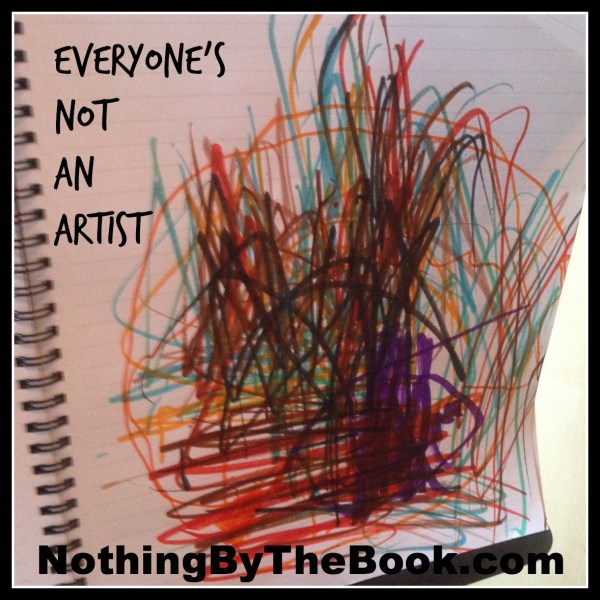
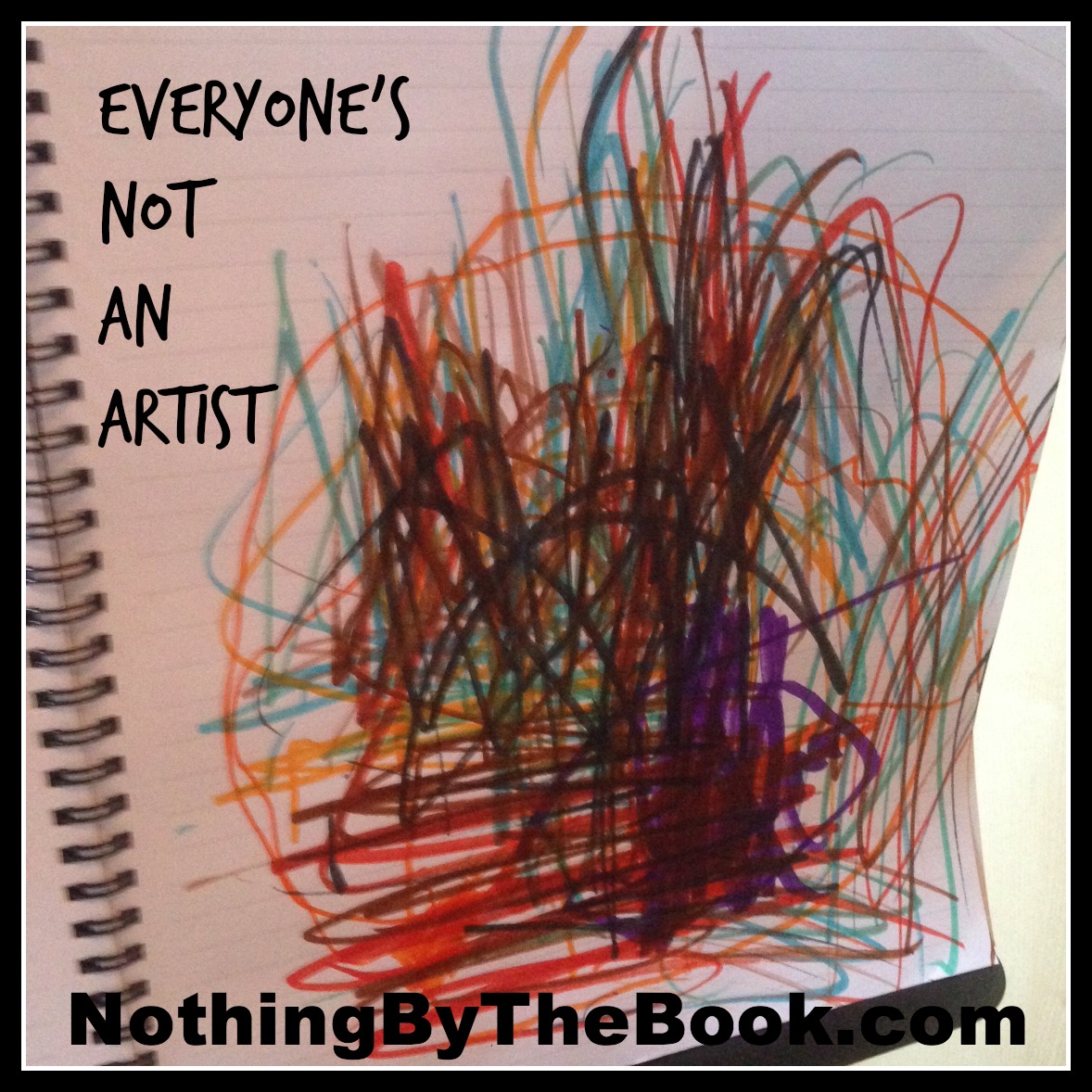
NBTB-Not An Artist

There is a lovely quote attributed to Pablo Picasso along the lines that, “ “All children are artists. The problem is how to remain an artist once he grows up.” In Quest Theatre’s production of For Art’s Sake, the lovely children’s play that played last weekend at Y-Stage in Calgary, the playwright and authors draw attention a couple of times to another Picasso soundbyte on art: that the great master spend most of his adult life trying to paint (think?) like a child. The message of the play, delivered repeatedly by one of the characters and proudly parroted back at the actors at the end of the play by my own Flora? “Everyone is an artist.”

Except they’re not.

A caveat before I go any further: I enjoyed the play—the actors were terrific, the setting and its use of multi-media inspired, and the little people loved it. I love Quest Theatre. I support Y-Stage unreservedly and will be back for their offering next month (here’s a link to details about the show at FamilyFunCalgary).

But I disagree with its fundamental tenant. Everyone is not an artist… and I’m not sure why these days, artists are so darn determined to convince the rest of us that a) they’re not that special and b) if only we opened our minds / cleaned our chakras / freed our inner elves, we could do what they do.

I am a writer. I don’t think everyone is a writer. Nor that everyone should exert themselves to be a writer, to express themselves, fulfill themselves—earn a livelihood for themselves—in this particular way. If everyone is an artist, is everyone an engineer? A plumber? A mathematician?

My artist child is shining under the influence of the play. She’s an artist. And she loves the message that everyone is an artist. It’s reassuring to her fledgling confidence.

Her older brother? He laughed in all the funny spots. Clearly enjoyed himself. As we leave the theatre, however, he’s unforgiving. “It was kind of crappy,” he says. “Art this art that. I don’t like art. I don’t like drawing or painting very much. Or even looking at pictures. That’s just not my thing.”

He’s not an artist. Nor a thwarted artist—not an artist denied. Surrounded by paints, crayons, markers, pencils, chalks, in a house in which walls were prepped for painting and drawing on, he abandoned all that as soon as he grew into consciousness of choice. That is not how he expresses himself, fulfills himself, processes information, relaxes.

But it is what his sister turns to do all that. She draws when she’s overflowing with happiness. And when she’s sad. When she’s at a loss. It’s what she does when she listens to books on tape. Her handwriting practice sheets are works of art—an interplay of colour, patterns, creation. Will this love stay her lifelong passion, lead her to her livelihood, or remain a steadfast companion/form of release and expression throughout her life?

Maybe. And will she try to convince her brother that he’s an artist too? That everyone is an artist?

Frankly, I hope not. It’s a gift, a talent, a passion that not everyone shares or aspires to. And claiming that they do denigrates its meaning. Its value.

Everyone’s not an artist.

What do you think?

xoxo

“Jane”

PS Looking for me? Awesome. Click here.

Summer Rerun: They tell you, “It gets easier.” They lie

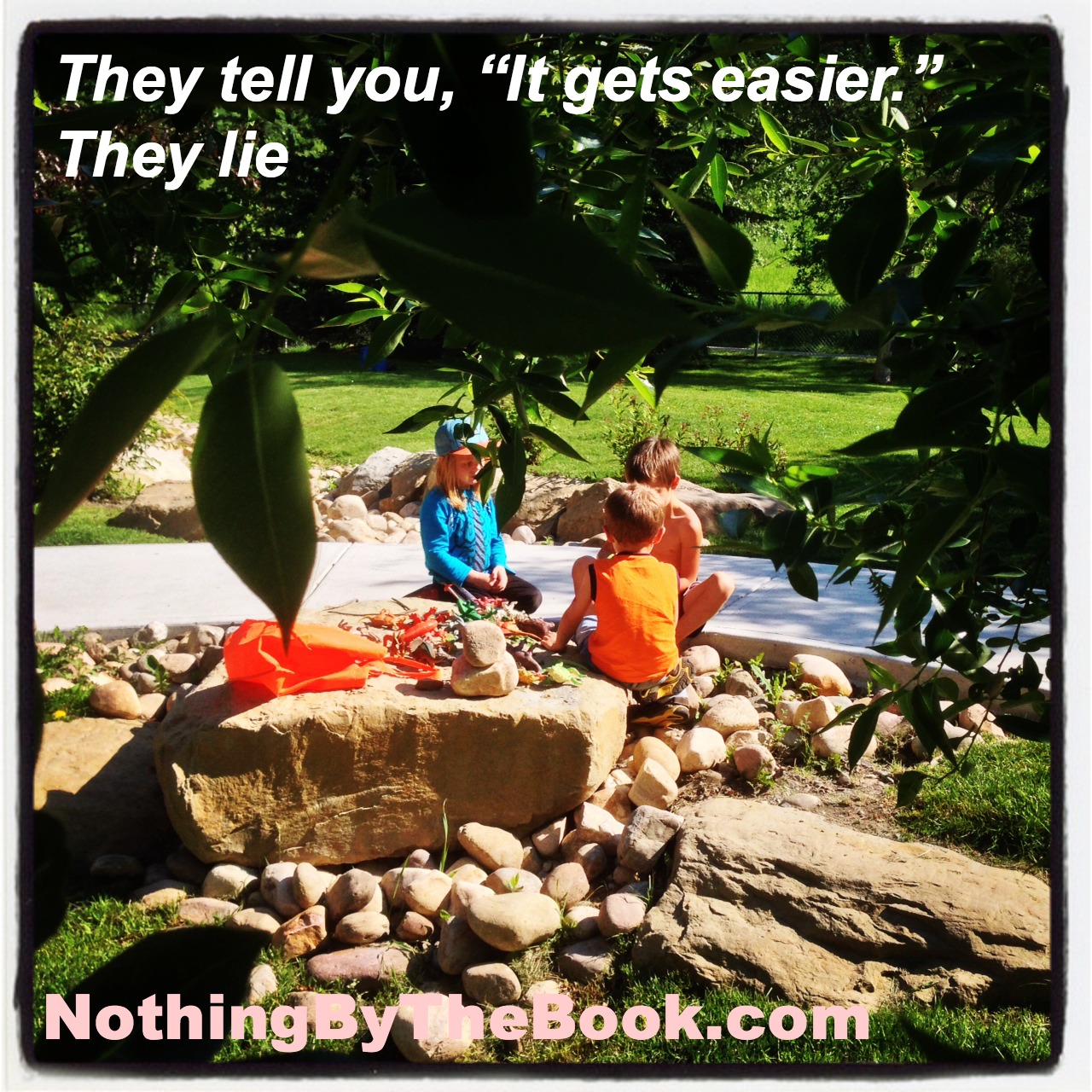
NBTB They tell you it gets easier

So there she is, stumbling down the block—walking circles around the playground—sleepwalking through the mall. The mewling baby inside a sling—a car seat—stroller. Glassy eyes, cause she hasn’t slept more than 45 minutes—no wait, two days ago, she got three hours in a row, score!—in four months. Wearing ratty pants—because they fit. And her husband’s sweater—because all her tops have been puked on and laundry, she was going to do laundry yesterday, but then the baby had a fever and…

“Holy deja vu. I know I’ve read this before. What’s up?”

“So observant, you are. This post was originally published on May 28, 2013, and briefly broke the Internets. Or at least my website. Nothing By The Book is taking a page from old school un-social media and doing a re-run summer, while I spend the hot days getting a tan, running through sprinkles, selling one book, writing another, reading two dozen more, neglecting my garden, falling in love, jumping off cliffs—you know. Everything but blogging. But, you get reruns of my favourite stuff, so everyone wins. Likely keeping up with Instagram—NothingByTheBook—will you? Or Twitter—  or/and .”

So there she is. The new mom, the first-time mom, and she’s so exhausted and she so clearly needs—what? A hug, help, empathy, reassurance. And you—you’re a good person, and so you want to give it to her. So there you go. Run up to her. Smile. And you want to say, you’re going to say:

“It gets easier.”

Don’t. Just fucking don’t. Because, fast-forward two years, three, and there she is. Running down the block. Maybe another baby in sling. Toddler in stroller or running away. And maybe she’s getting more sleep—but maybe not. Maybe the toddler has night terrors, and wakes up screaming for hours on end in the night. Or maybe, even if Morpheus has been kind to her and the children sleep—she doesn’t sleep nearly was much as she should, because when they sleep, that’s the only time she can be free. To… think. To read. To be… alone.

The toddler makes a break for it and tries to run into the street, and she nabs him, just in time, and pulls him back, and starts explaining how streets are dangerous and he must hold Mommy’s hand, but he really, really, really wants to be on the other side, and he’s two, so self-will is emerging with a vengeance and soon he’s screaming and tantruming, and you, you can see she’s on the edge, about to lose it, because maybe this is the seventh time today—this hour—she’s had to deal with this, and you want to help. You want to give her a hug, help, empathy, reassurance. And you want, you’re going to run over to her and you’re going to say:

“It gets easier.”

Don’t. Don’t. Because a year later, there she is, with her three-and-a-half year-old. Before they left the house this morning, he put her iPhone in the toilet, cut his dad’s headphone cord into shreds, and threw $30 worth of grass-fed beef off the balcony in the compost pile. And now, his pants around his ankles, he’s chasing a flock of pigeons, penis in hand, yelling, “I’m going to pee on you, pigeons!” at the top of his lungs. And she’s trying to decide—should she catch him? Or should she take advantage of the fact that he’s distracted for five minutes, so she can change the new baby’s diaper? Because she hasn’t had a chance to even check it for the last five hours… And I swear on any of the gods that you may or may not believe in, if, at that moment, you come up to her, and you say—because you’re an empathetic, loving person who wants to help—if you come to her at that moment and say,

“It gets easier.”

she’s going to rip that diaper off the baby and throw it in your face. Followed by the tepid remains of her coffee (you’re lucky that she hasn’t had a hot, scalding hot, deliciously hot cup of coffee in three and a half years). And then she’s going to sob. And she’s going to say…

“When? When the fuck does it get easier? Because I’ve been waiting for it to get easier for two three five six years.”

I’m sitting in the middle of my living room—11 years into motherhood—and I’m in a brief picture-perfect postcard (Instagram for those of you born post-1995) moment. I’m stretched out on the couch, coffee cup beside me, laptop on my lap—and, for a few minutes at least, I’m chilling. Three feet away from me, my 11 year-old is building worlds in Minecraft, and Skyping with a friend. My eight-year-old is running with a pack of her friends just outside—I hear their voices, hers most distinct among them to my ears, through the balcony. Tucked under my arm is the three-and-a-half year old, taking a break from wrecking havoc and destruction on the world to play a game on the iPad.

I’m messaging with a friend a few years behind me on the parenting path. And she asks me, and I can hear the tears in her words even though she’s typing them (people who think texting lacks nuance do not text enough; she is weeping through the keyboard),

“When does it get easier? People keep on saying, ‘It gets easier.’ When? When?”

So, I wonder, is she ready to hear this? Is she ready to hear: It doesn’t get easier. All the people who say this? They’re all liars, every last one.

But I won’t say that. First, because I do not wish to make her despair. Second, because it’s not true. It does get easier. It really does. But when people say it, what you, first-time mother, hear it is not ‘It gets easier,” but this:

“Things will get back to the way they were before, soon.”

And that, my lovely friend, will never happen. Things will never be the way they were before. Never. Things have changed forever. Things will never get back to “normal”—as you defined normal when you were single—when you were childless. Never.

And so I tell her this, and again I hear tears in-between the words she types to me.

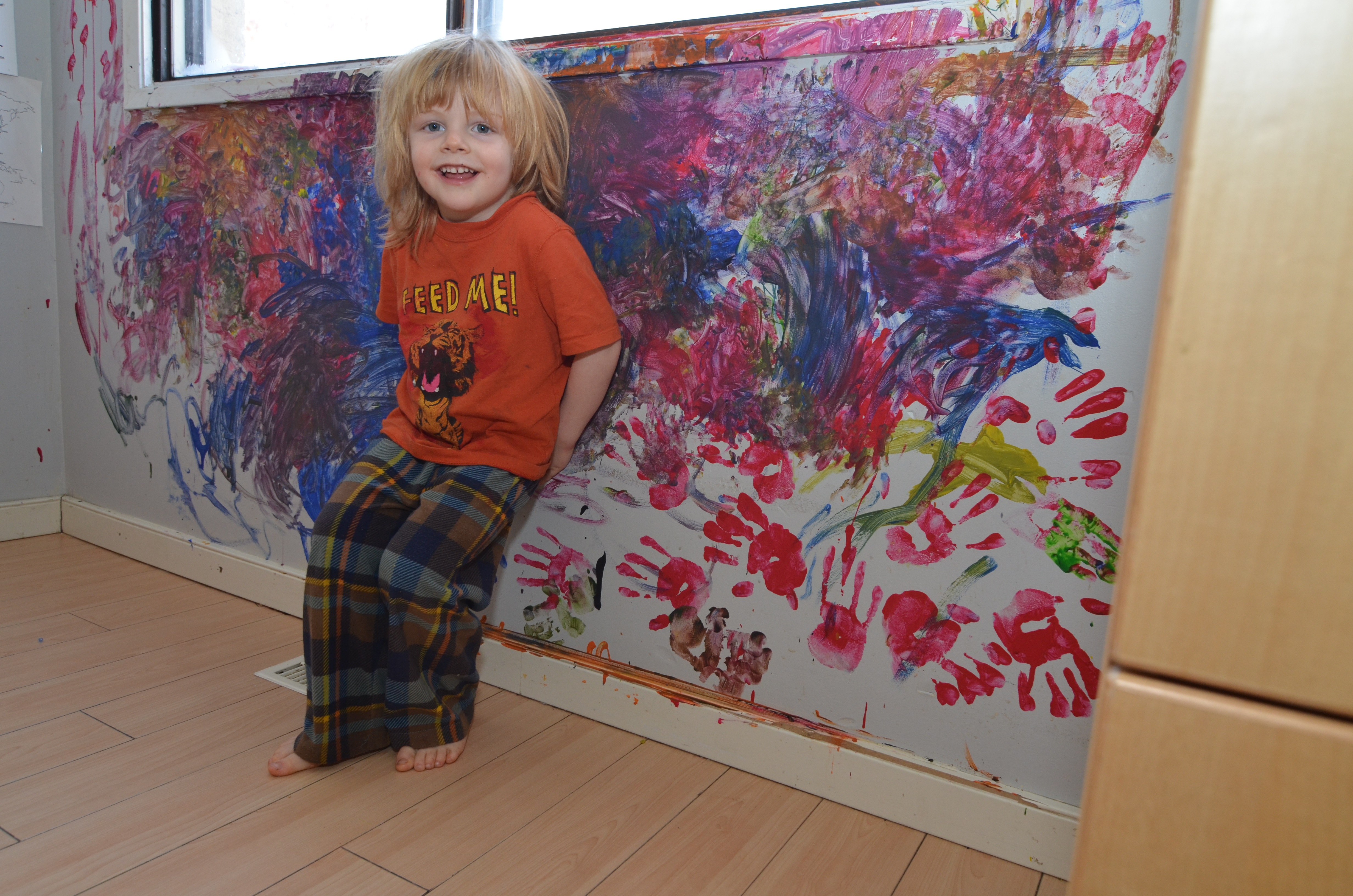
And now I have to deconstruct the lie to her. I have to explain. That they don’t mean to lie. It really does get easier—sort of. The stuff that’s killing you now—be it the lack of sleep, the aching nipples, the endless diapers-laundry-is-she-sick-is-he-teething or be it the toddler tantrums, potty training regressions, “She won’t leave the house!” “Getting him in and out of the car seat is hell”–all of that, it will get easier—and, in fact, end. They all wean. Toilet train. Stop drawing on walls (unless they live in this house). But see, then, other stuff happens that’s really hard too. Ferocious FiveSensitive Seven. Bullies on the playground—social issues with friends and ‘frenemies.’ Broken hearts. Explosive anger at things and issues much, much bigger than all those daily rubs that cause toddlers angst.

“It gets easier”: yeah, I suppose it does, because you figure it out, and adapt, and get coping strategies. But every time you “master” a phase—they change. Grow. Face new challenges. And you’ve got to change, grow and adapt with them. If only you could do so ahead of them…

But you can’t. And so, you see, “it gets easier” … it’s a lie.

And it’s the most destructive lie, the most life-damaging myth you can buy into. See, because if you keep on waiting for things to get easier—if you put living, changing, adapting, figuring out how to dance this dance, walk this path as it is now, with all of its bumps and rubs—if you put all that on hold until it gets easier…

Well. You’ll be fucked. Totally. And completely.

So. My dearest. It doesn’t get easier. It changes. You get better. You grow. Learn. And that little squealer—that awesome toddler—that slightly evil three-year-old—he grows. Learns. Changes. It gets better. When you learn and change and grow and all that—it all gets better.

But. Easier? No.

So. There she is. Frazzled. Exhausted. So fucking tired. And she sees you coming, and you have empathy poring out of your pores. And you want to help her. Offer her empathy. Support.

What are you going to tell her?

xoxo

“Jane”

P.S. Here’s the original post, with its bazillion comments.


A love letter to my flood plain

NBTB Love Letter to flood plain.jpg

This love letter begins, as every good love letter should, while I’m naked in bed…

No. Stop. Sorry. Not like this. First, this:

Prologue

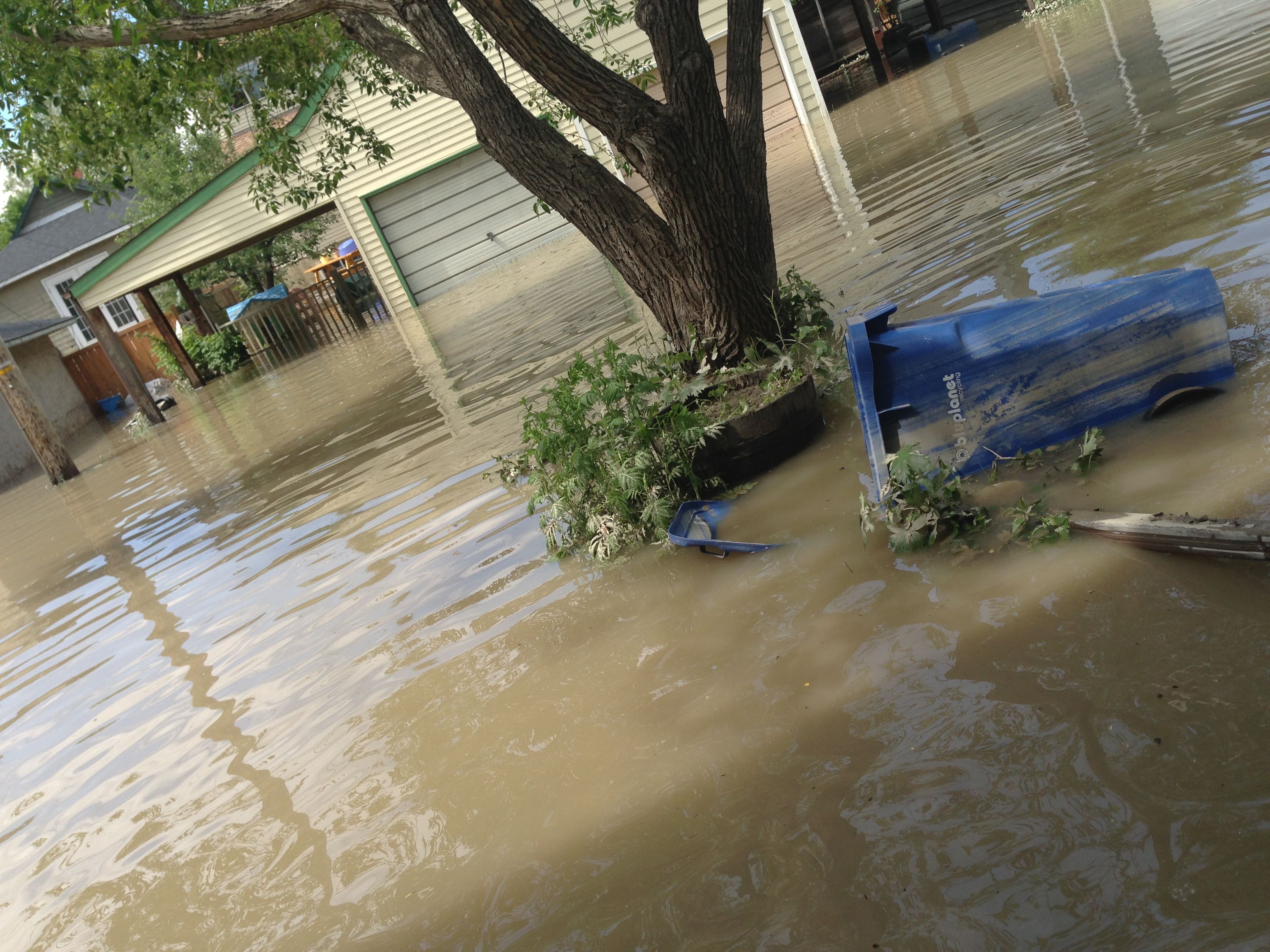
There was this flood last year, and it changed us. So very profoundly. And we know it, feel it, breathe it. Tell it, to each other, to anyone who wants to listen (to many who do not).

But do we tell it, really? Our kids are collecting flood stories from the ‘hood to turn into an archive and into an anniversary performance piece. I tell mine… and it is not until I come back home that I realize that of all the stories I could have told, I chose the least important, least personal.

The safest.

“Makes sense,” my neighbour-the-poet says. “Of course it makes sense.”

Does it?

“What story did you tell?” I ask him, and he tells me. And I am shocked. “That one? Really? You could tell… you could share… that one? That part of you?”

He could, he did. Me? My eyes swell with tears. My most intimate story swims within me. I can tell, spin so many other stories. That one? I’m not even sure I want to hear it.

But there’s one part of my story that’s everyone’s story. It belongs to you, as much, more, as it does to me. Ready?

F-front door2

I.

I’m naked in bed, languorous, lazy, loved, and the psychic-who-lives next door delivers a hot breakfast to me and my love.

This is the magic of the place where I live, this place that I love so ardently that life elsewhere, life without it is hard to imagine.

This act of kindness-nourishment-knowing—it is not extra-ordinary. Not here. On this piece of flood plain where I live, this sort of thing just happens.

All the time.

This happens too: a book placed into my hand. “I just read it. You will love it.”

Always, an embrace when you need. Always, someone to help you move a couch.

Always, someone from whom I can borrow eggs, sugar, salt, a bottle of wine.

And this: emergency, panic. I need to leave my tiniest, who has never, ever been detached from my arms and my breast. And I leave him—with you, without thinking twice about it, I know you will love my precious and keep him safe for me.

“Potluck tonight?” “Gah, I have nothing to bring.” “Don’t worry. We have plenty.”

New Year’s. Summer Solstice (even last year’s one). Halloween. Impromptu sleep-overs all over; in the morning, a kid head-count. Six kids traipse down my stairs. There are five clambering up yours. “Does your mother know you’re here?” “I think so… oh, isn’t that her, at your door?” It is. “Coffee delivery!” Oh, yes.

Someone else’s mother sneaks into my house while I have a doctor’s appointment and washes my kitchen floor. Because.

This place where I live binds people, builds people.

The idea of losing it is unbearable. Unacceptable.

F-The Boat

II.

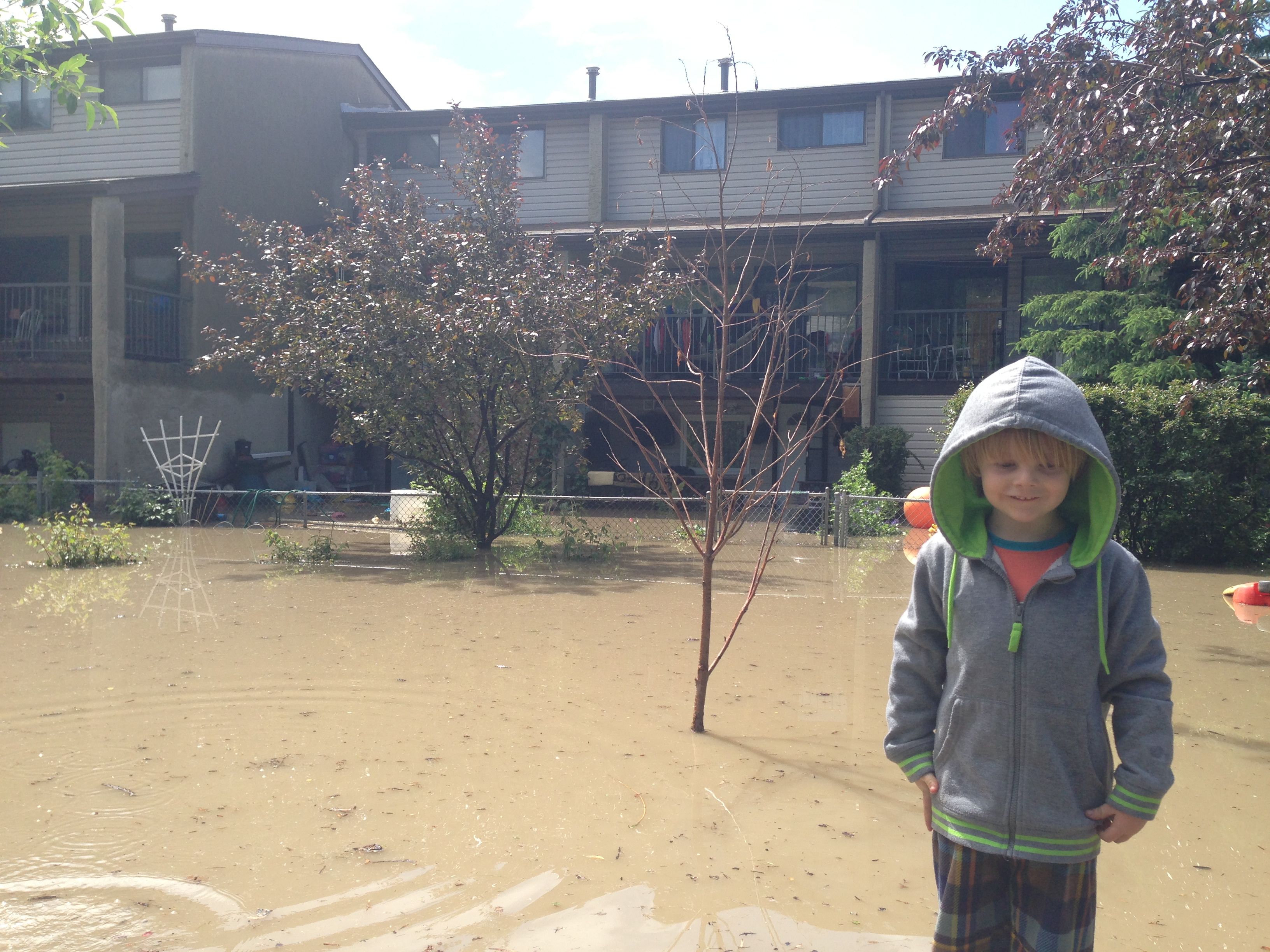
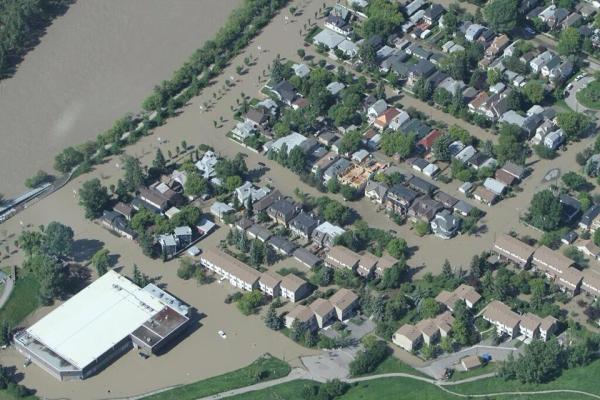
We were never in real danger of losing it. Our streets were not ripped to shreds. The water was out of our houses in a few days—it did not linger for weeks. We are rebuilt. But. In those first days, when the water came—before it receded—before we got back home—we did not know. And we were not rational. And I was terrified.

I could not, would not lose you.

F-Rubber boots

III.

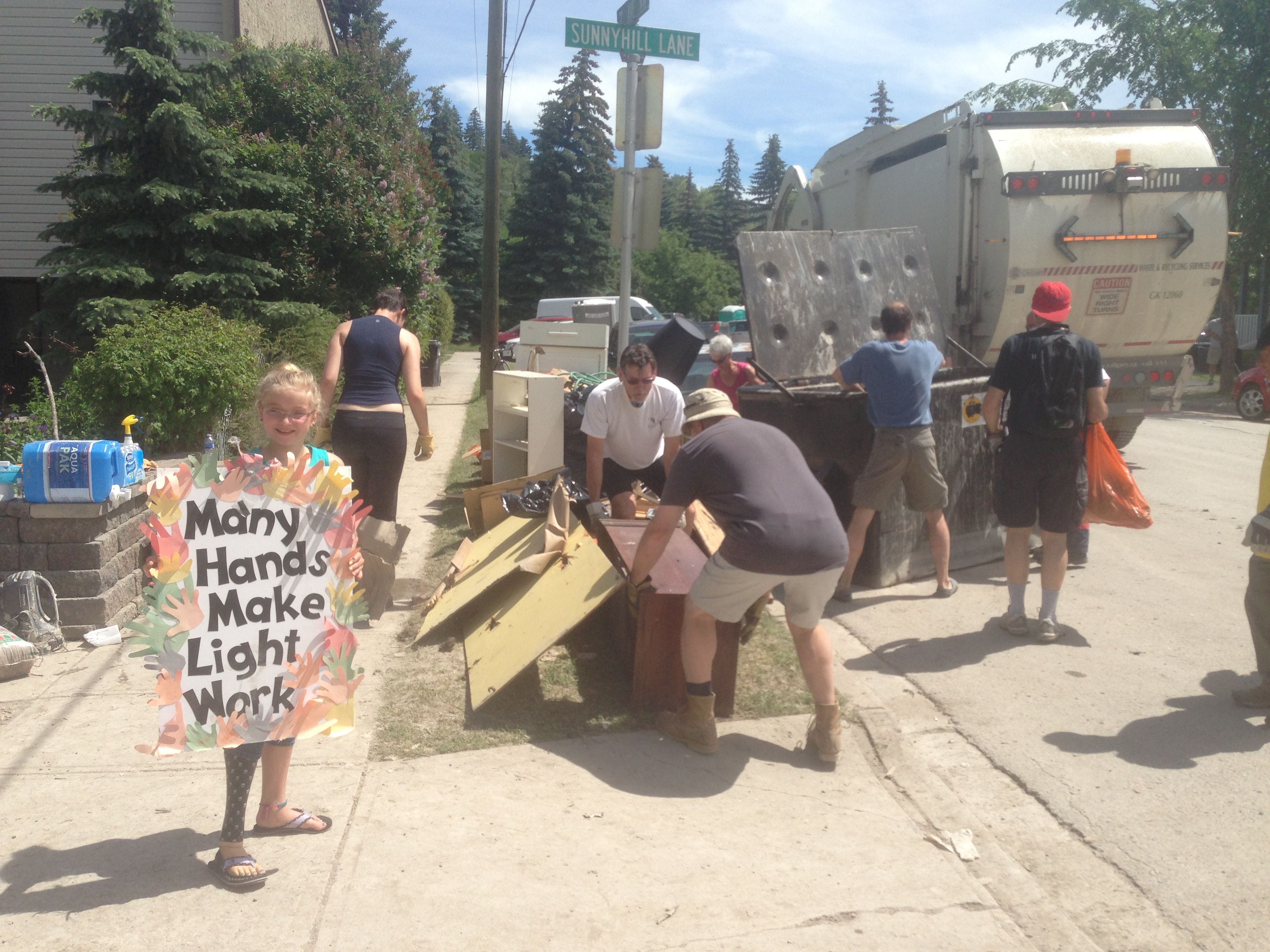
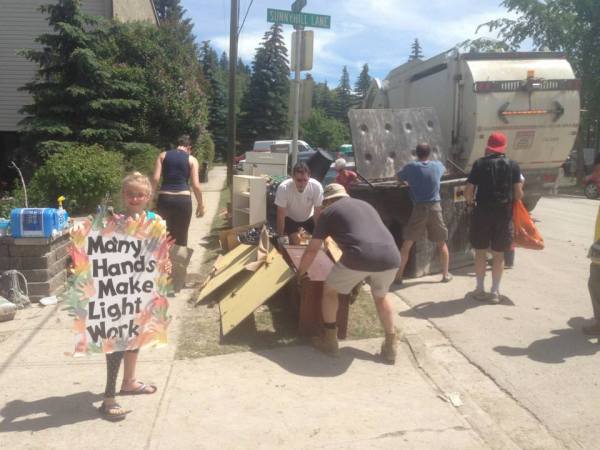
I must have loved you before, of course I must have. But this is when I really fall in love with you: when you are at your ugliest. When there is still knee-deep (wait, over here it’s higher, people are wearing hip-waders and getting soaked) water in Sunnyhill Lane. When there are army trucks rolling down Seventh Avenue. When the air smells of diesel and the vibrations of pumps and generators drown out voices. You are covered with mud and silt and fuck-is-that-sewage? and your streets are lined with the debris of a hundred, thousand lives and you look destroyed and ugly and I love you so desperately nothing but saving you matters.

F-Garbage2

IV.

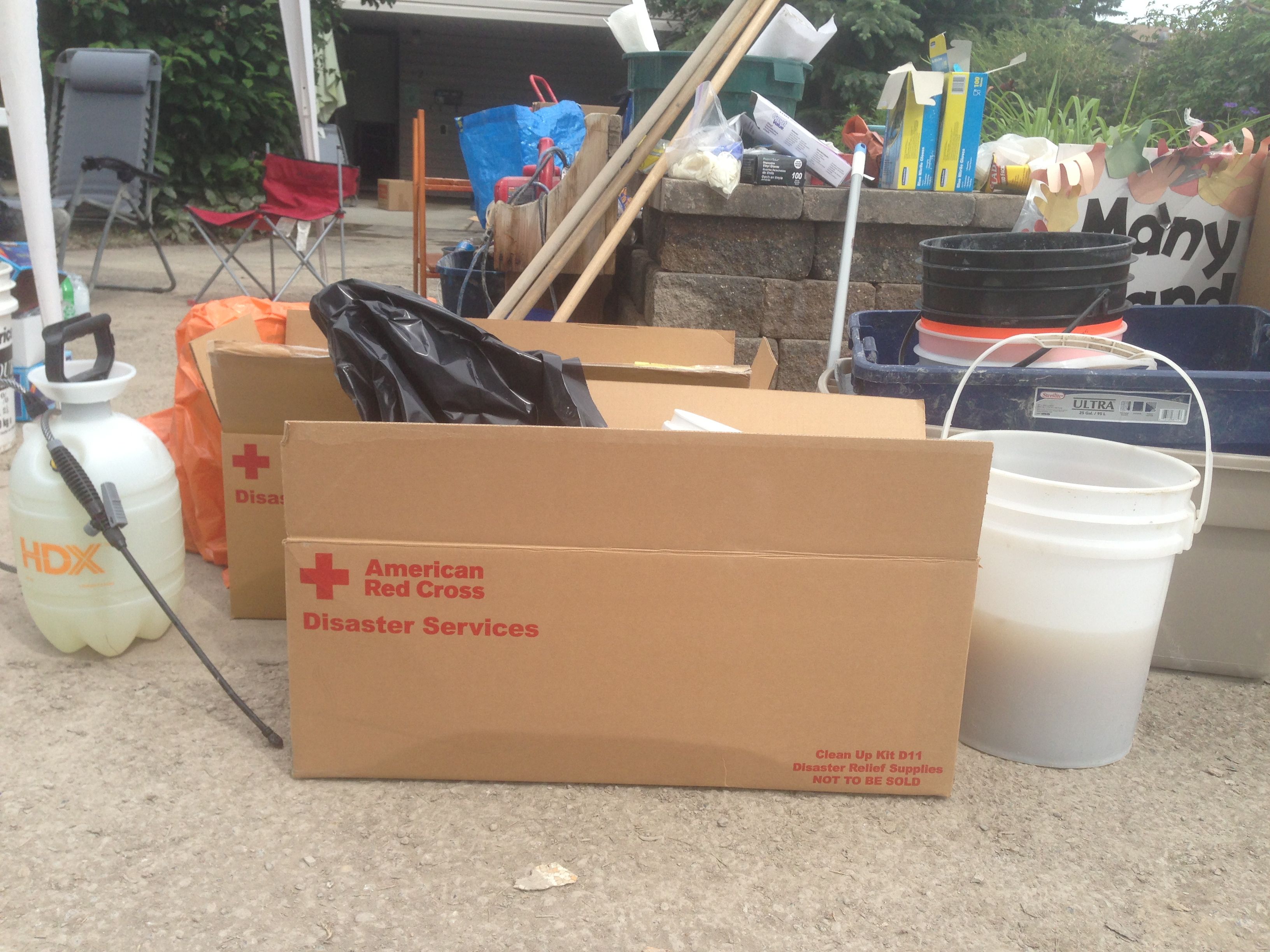
“Christ. It looks like Kandahar,” you say. I look at you, unseeing. I would say, stupid exaggeration, get some perspective, come on, except I’m covered foot-to-toe in mud and so is everyone around me, and there are mountains and mountains of walls-doors-furniture-it’s-not-garbage-it’s-our-lives piled up between the apple trees, and the Red Cross has just delivered a stack of disaster relief kits. We tear through them scavenging for facemasks. Hoping for crowbars. Ha. A mop and a bucket? What the fuck?

F-ARC Disaster Services Kit

V.

You have been, to me, a sanctuary that consisted of a lane, a garden, a Common. A handful of neighbours. You become my everything. As I struggle to save you and you come to save me, you grow. You transcend what you were. You become…

You become a million beating hearts. An army of citizens covered in mud. I love you as I have never loved anything before. And I love them, desperately, passionately, fully, because they are saving you. You are them, they are you.

There are no boundaries.

F-Many Hands Make Light Work

VI.

Then, we all go home.

We come back to our gutted homes; you go back to your unscarred ones. Or go on to help other communities. To High River (which still rends my insides).

We go/come home. But we are all changed.

See, we all love you now in a way we could not even imagine before. You are not just our homes and our communities. You are not just our paths and our riverbanks and our parks and our buildings, our bridges, our streets, our landmarks. You are, of course you are, all of those things. But most of all, you are us. We are you. And we know you—ourselves—so fully and so intimately. There is no theory-to-be-tested, no promises-to-be-fulfilled. There is no uncertainty over what we will-can-could do when asked: we have done it. Everything that had to be done? We did it.

We saved you. You saved us.

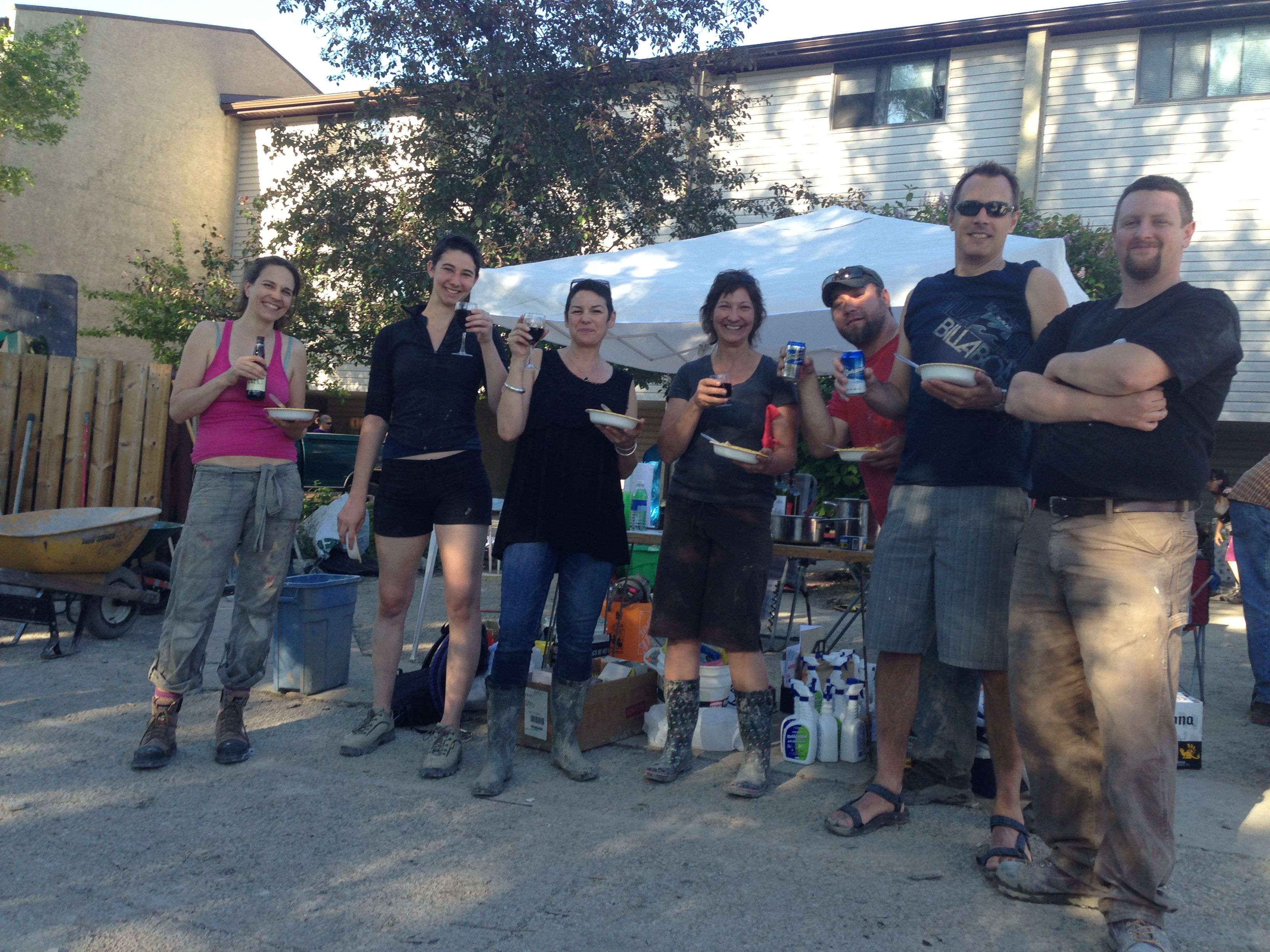
F-Battling the mud

VII.

We are changed. But not all of us know this as fully-intimately-undeniably as those of us who lost and saved know this.

“I lost nothing. I did not help. I was unaffected.”

I walk with him on the river paths—because I hardly ever walk anywhere else—and he claims to be unaffected. And thus… unchanged. And I see, suddenly, how damaged he is. He had no personal loss, he says. He was not covered with mud. Your tears.

I cover him with mine.

He claims to be unaffected… but as he watches me cry into the river… unaffected?

No such thing.

We are all affected.

F-Our house debris

VIII.

This place where I live, this place that I love beyond the pall of all reason, this place that builds and binds, this place of jerrybuilt-during-a-past-boom townhouses, this place where dandelions bloom and little children grow up and old people grow older, this place is mine, and it is me.

This place is precious because it is loved, so loved, all the more so because it was threatened, almost-lost, saved. And as I love it, caress it, press it into me—each walk on its streets, each rediscovery of each of its crevices, curvatures, indentations an act of gratitude, acceptance, surrender—it grows. It becomes your place, our place, you, us.

This place is us, a million beating hearts.

F-Evening shift at SHL

IX.

“If it floods again, will we leave? Will we move?”

“I can’t. I can’t. I can’t even think that.”

F-O on Flooded Common

X.

I have loved and was loved and have eaten and felt loved again, and now I must get out of bed, find clothes, do things. But for the moment, for one more moment, I remain naked, languorous, wrapped up in you. And I need to tell you: I have loved you before this, for so long. But I did not really know how much until you were wrecked, destroyed, broken. And I did not truly value you, see the truth of you until you saved me/I saved you.

My most beloved: thank you.

F-Reunited

un-Epilogue

So. I tell the part of my flood story that’s our flood story, I write it as an imperfect love letter to my imperfect piece of flood plain, which I love, passionately, in all its faults, with all its warts, frustrations.

I am so very, very grateful. Love, gratitude, vulnerability, appreciation, surrender swim inside me, fill me, leak out through my tears.

And my own, innermost flood story, the one that I’m not sure even I want to hear? It is so very simple, really. And it is this: a year ago, I could not feel like this. I would not write like this.

I would not cry like this.

I could not love like this.

NBTB-I love you


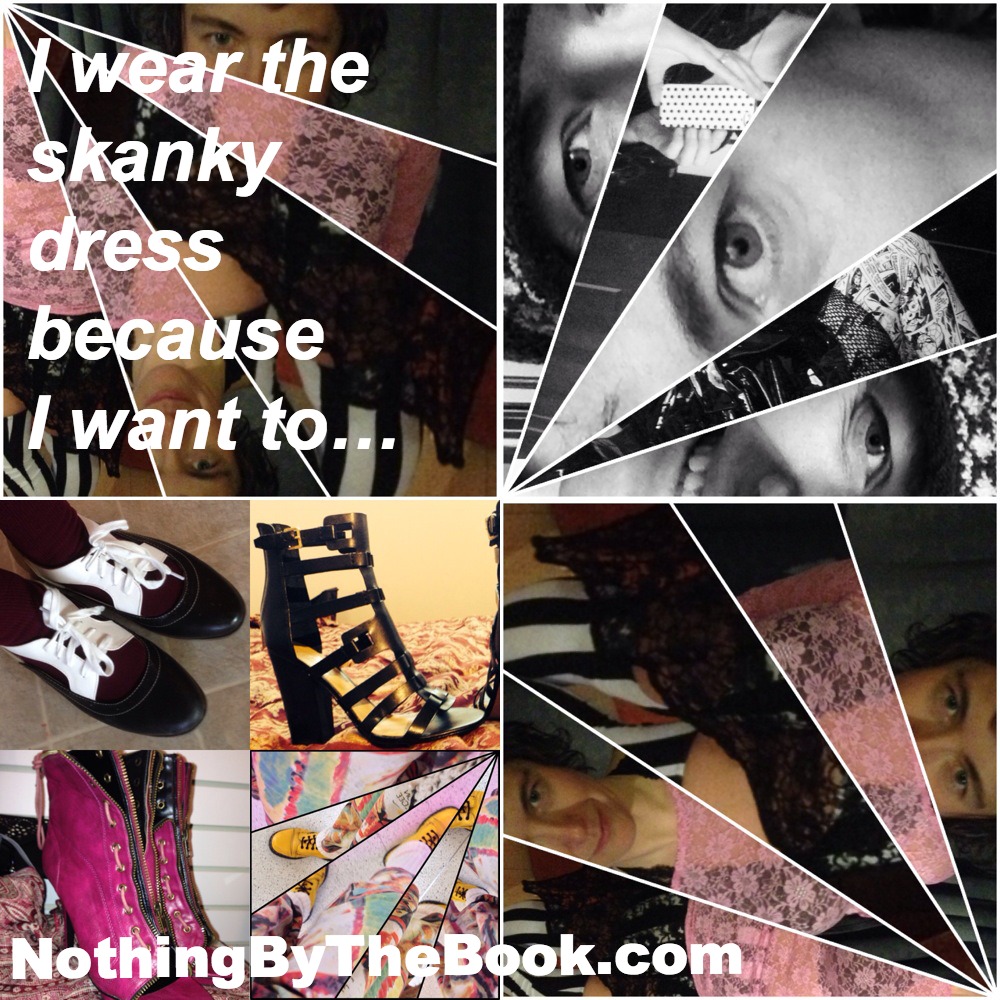
I wear the skanky dress because I want to…

This story begins when someone I don’t know confides in someone I love that she’d like to wear dresses more, but… she doesn’t… because… well… and…

(I’m not there, I don’t know her at all, but I can see this moment, I can see her pause, ponder, scrunch up her forehead and wonder why it is that she, a successful-powerful-intelligent-confident-adult! woman, why is she even thinking about this? Why is wearing-a-dress/not-wearing-a-dress even a thing? Why is this taking up brain power?)

I come into the story when a new dress comes into my life. And I pull it over my head to parade in it in front of someone I love, but I get distracted by a mirror, and I look at myself, from this angle and from that, and I-love-this-dress-so-much-and-me-in-it-and-I-have-a-thousand-thoughts-racing-through-my-head-and-I-freeze-and…

…and he walks by and sees me, and says,

“Admiring how hot you look in your new dress?”

…and I look at him and say…

“Well… that, yeah… but mostly, I’m pondering why is it that it took me three children, four decades and a brush-with-life-in-a-wheel chair to feel comfortable wearing a dress like this?”

Not just a dress that looks like this, you know (although, wow, how it looks, how it looks!)—it’s more complicated than that. Wearing a dress like this. As if it’s my second skin, a part of me that’s just… a part of me…

And he scrunches up his face, and tells me of his conversation about dresses and wearing-not-wearing with a successful-powerful-intelligent-confident-adult woman who wasn’t sure why this even was an issue for her… but it was…

And in that moment, I know. I know exactly why it was an issue. It gets done to us, to our daughters, to all girls—and to some boys, too—the first time we get a pink onesie… but you know all about that, so I won’t bore you with it. Instead, I’ll tell you this story:

I’m 24, and a little brilliant, and in my first (it will be my last) corporate job. It’s my first performance review. I kick ass. They love my work. I’m perfect. Except, there’s this: “She should dress more professionally.”

I go home, cry, and the next day, buy an ugly navy blue suit. I hate it. It pinches, rubs, feels awkward when I sit. Walk. It makes me look like a fucking corporate drone. A woman-pretending-to-be-a-man, badly.

It does the job.

It hides the fact that I have a beautiful body.

Because, apparently, that distracts from my overall competence?

At my next performance review, the addition of the ugly blue suit to my wardrobe is duly noted as a professional achievement. I quit that job for many, many reasons—but the fact that what I wear is commented on, negatively and positively, in a review of my work, is absolutely a contributing factor.

But the damage is done. It started before, of course. In elementary school, when boys snapped girls’ bra straps, just because, and made our growing breasts a cause of embarrassment and something to hide instead of a glorious, glorious developmental leap to enjoy. In junior high school, when… fuck, you know, I’m almost 40, and I don’t want to go there again. If you were a girl in junior high school, you know. If you have a daughter that age, you’re going through it again, and it hurts even more, because it’s her, and nothing’s changed, and what-the-hell-is-wrong-with-this-world?

Fast-forward to university, and feminism and women’s studies and sociobiology, relativist (or is it?) anthropology, cultural studies, post-modernist English lit, Queer cinema studies, and ow-my-head-hurts-who-am-I-how-am-I-why-do-you-keep-on-telling-me-I-can’t-be-this-if-I-am-that? Rational or sexual, intelligent or beautiful, strong-and-in-control or an eroticized-victim?

Some of these things I analyze, process, struggle with… so many more of them just infiltrate me, affect me, attack me, without me really becoming aware of them.

And then, what happens? I would like to say that pregnancy-child birth-lactation changes me. That would be a great story, wouldn’t it? Four times, the belly grows and stretches and stretches, three times, I am Goddess-Life-Birth-Beginning, for a decade, my body-and-breasts are a source of nourishment-love-comfort… and also, not my own, really, they belong to them, and first I can’t get used to that, and then I love it, and then I resent it, and I’m done, and I want ME back…

…and so, changed, and not my own for so long, and then reclaimed… surely, all that’s part of what happens to me?

But while that’s part of the story—because everything is part of the story—it’s not the whole story, nor even it’s most important part. And it’s not an archetypal, inevitable part, either. But we can argue about that another time…

The reclaiming-reinventing my body from the injury that made me contemplate the-rest-of-my-life-in-a-wheelchair is part of the story too, I suppose. But I like to think it just accelerated—brought into stark relief—a process that was already underway…

(Did you forget what I was writing about? This is a story about a dress. Dresses. Femininity, sexuality, self. On we go: …)

I meet her when I’m… 27? 28? She’s a decade my senior. Gorgeous. You’d know who she is if I told you. She kicks ass, and has since she was 22. Actually, probably since she was 12. And I’m interviewing her about how brilliant and amazing she is. And I also know—I’ve heard them slur her beauty, her sexuality—use the existence of those aspects of her as a negation of her professional achievements, an attempt to refute the fact that on her bad day, she can outthink most of them on their best.

So… I see her brilliance-and-sexuality, fully before me, and I am so in love with it—with her confidence and with how… how in her skin she is. But I wonder… I want to know.

I ask her.

“Do they take you seriously?”

I don’t have to explain who they are. She knows. And she laughs. “Hold on,” she says. And she reaches into a drawer.

Hair pulled back in a rubber band. Big, ugly glasses. Earrings and scarf off. Stark, unflattering jacket on.

“I’m like a fucking quick-change artist when I need to be,” she says. “But I bother to do this less and less. Because, you know what? Fuck them. And I know what they say about me, and they say it whether I’m dressed like a frump or a slut. They’ll say it about any woman who’s like us.”

She doesn’t need to operationalize that. Does she for you? “Like us”—powerful. That’s it. Her own, your own… Powerful.

The jacket, glasses come off. The hair comes loose. She looks at me and unsnaps a button on her shirt. “Fuck them,” she repeats. “If this throws them off their game, I’m all for it.”

I watch her career progress, at breakneck speed, in adulation.

I never see those ugly glasses on her face again…

(Interlude: years later, an editor asks me… “How the hell did you get that quote?” And I’m embarrassed. But I tell him, and it was like this: “I waited until he was looking at my tits to ask the question.” On the other end of the line… silence. And then, “And once again, a tip I can never use myself or pass on to other writers.” Sorry. When the playing field is unfair, and they write all the rules… we will play dirty. Because—fuck them.)

I meet him (not my editor; him, Master of the Universe; read on…) when I’m… 30. I’m mired in babies. I don’t think of what I wear as clothes so much as… rags covered with baby puke, urine, and pureed potatoes. When I get the interview, I cry, because I have nothing to wear—the ugly blue suits I bought to fake it in Corporate Canada don’t fit my “popped out two babies in three years” shape. I go “shopping” in my mother’s closet. Go to the interview in something tasteful, elegant, professional. Thoroughly not mine.

So uncomfortable.

I’m off my game, totally.

The jacket chafes me, the white shirt’s buttons are bursting against my milk-full breasts.

He’s wearing jeans and a flannel shirt, and I won’t even tell you what’s on his feet. (Cowboy boots would be an upgrade.) We’re going to see the Premier. And other, more important people.

Himself, he’s one of the most powerful people in the industry, in the province… He’s fully in his skin.

Does he know that I’m not in mine? Does he care?

Do I care if he cares?

Should I?

I’m not sure if my thinking around this event is conscious—or even if it happens in the moment. I do know this: that’s the last time I wear a suit. The last time I go to an interview—an event—anywhere—not in my skin.

What defines, makes up my skin changes over the next decade. At first, there are all those puking and nursing babies, and so what I wear must make my breasts accessible to them and be easily washable and hide stains too. And my shape is changing, fluctuating—what does it want? What do I need to wrap myself in to feel good at this moment, as belly grows/shrinks/flaps/can’t-find-its-waist? And then, I am broken, so broken, and frankly, nothing fits, works, nothing I put on me makes me feel anything but anger at this fragile biological construction’s total and utter betrayal of me…

At this time, in this fog of pain, I think I have no skin. But, I do, I do. Because this happens: I meet him for the first time, and he’s all excited and anxious to meet me. And dressed up. In his skin? In a uniform? I don’t know. He looks at me as we shake hands, and he says…

“Christ, they told me you don’t look like a legal affairs writer. And ah… I mean. I don’t know what I thought a legal affairs writer would look like. But… yeah. Not like this.”

And I laugh. And look down at… my skirt (unprofessionally short) and top (unprofessionally minimalist) and my thoroughly-impractical-because-you-can-bike-in-heels shoes… I ask:

“What do I look like? Who do I look like?”

There are so many possible answers to that question. Only one right one, though. And it is this, and he gives it:

“Yourself.”

My new dress has been rumpled, enjoyed, taken off. He who loves me helps me put it back on. Watches me return to examining myself in it, from various angles.

I am not sure if I can fully articulate, truthfully articulate what brought me to this place of loving this dress, loving myself in this dress, and finding nothing but power-joy-comfort-oh-yes-this-is-me  in this second skin. If I wore this dress 20 years ago, 10 years ago, I would not wear it like this—I would be aware of its effect on them, and even if I chose to flaunt their opinion… I’d still care. Oh, I’d still care.

And I would still be in the chaos of all those dichotomies—this-but-not-that-no-you-can’t-be-both-all. Some examined; most, subconscious infiltrators.

But now, today, at this juncture…

Brilliant-and-sexual. Rational-and-hot. Powerful-and-emotional. Erotic-and-strong. Articulate-and-beautiful. Vulnerable-and-feminist. Professional-and-wearing-whatever-the-fuck-I-want.

xoxo

“Jane”

More like this, but not really: Naked face politics • “Who are you wearing?” clothes as message, value, consciousness

NBTB-I wear the skanky dress

PS “Hi, Jane, first-time reader, and, um… I thought this was a parenting blog. You know? A mommy blog? About kids and snot and stuff?”

“It is, sometimes. And even when it isn’t, it is. Because mothers—parents—are, you know… people? Parenthood adds a dimension to your life, a new (oh-so-important) role. But it doesn’t replace who you are, erase everything you are. Or at least, it shouldn’t… We’ll talk about that in a couple of weeks. In the meantime, if you need a parenting reading fix, edify thyself at Soapbox.”

WILD THING: 7 ways to “attachment parent” the older child

This is for you. You know who you are. Originally published as “Five is hard, or can you attachment parent the older child?” xoxo

Wild Thing 7 ways to AP the older child.jpg

***

It happens to the most attached parents among us. We’ve breastfed, co-slept, and slung our babes happily. It was easy—or, it became easy, once we got into the groove and shook off Aunt Augusta’s disapproving glare. We saw our children grown and flourish, loved, connected, happy. But then, at some point, the demons of self-doubt return. Our child goes through a phase we see as difficult and challenging. Almost inevitably, this happens when we’re not at our best—pregnant, tired, stressed. And we wonder—is it possible to attachment parent the older child?

Five seems to be the milestone when these demons attack most ferociously. Makes sense: it’s such a milestone age in our culture. The preschooler becomes a kindergartener. The stroller’s abandoned; the first loose teeth come. The search for self becomes super-pronounced, and our five-year-old is frighteningly selfish. (I write about that aspect of five in Ferocious Five.)

It hit one of my friends very hard when her eldest daughter turned five. She asked our playgroup community for help, and she framed her struggles under this big question: “Is it possible the attachment parent the older child? This five year-old who’s driving me utterly, completely crazy every moment of every single day? Is it time to bring out the conventional discipline–punishment–toolbox?”

This was my response to my friend. I had seen Cinder through five pretty successfully. Not yet Flora. Bear that in mind as you read (also bear in mind that I had a very specific audience-of-one in mind for this piece. And I do again…). Check out Ferocious Five for the lessons Flora taught me.

(2008). Five is hard. But so is two, three, four, six, sixteen–all in their different ways. Part of the trouble is that our children move onward and forward through the different ages and stages, while we, their imperfect parents, have just figured out how to cope with the preceding one.

Is it possible to attachment parent the older child? Possible, necessary, critical. And here is where the difference between AP “things we do”–co-sleeping, breastfeeding, babywearing–and the AP “things we are” plays large. We don’t carry our five year olds, the majority of us don’t breastfeed them any more, we’re not necessarily co-sleeping with them. The “do” stuff is gone.

The “be” stuff is all that remains.

And how do we “be” with the older children? I think this is one of the points at which our paths can diverge quite dramatically. And I don’t know that there is one *right* answer. For what it is worth, based on my sample of one five-year-old shepherded through some challenging stuff to date, these are the principles that helped us:

1. Make their world larger.

At five, Cinder’s world got larger. We’re homeschooling, so the massive change that is five day a week kindergarten wasn’t part of it–but think of what a huge change that is for the average five-year-old, and how hard it must be sort out, everything so new. Still, even minus kindergarten, it was so clear to us that a five-year-old was very different from a four-year-old. And absolutely, we butted heads because while he had moved on, I was still mothering a four-year-old.

A huge breakthrough for me was to make his world larger–ride his bike on (safe!) streets, cross the street on his own, go into stores on his own, play a bigger role in everything. I can’t quite remember all the different changes we did, but they’re pretty much irrelevant–they wouldn’t necessarily work for your child. Talk with her. What would she like to do now that she couldn’t (or wasn’t interested) in doing a year or six months ago?

2. The only person whose behaviour I can control is myself.

The other thing I always come back when we run into “downs”: the only person whose behaviour I can control is myself. And if I am unhappy with how my child is acting, the first step is not to look for a way to change my child, but to look at myself, within myself, and ask myself what can I do to change how I am reacting and communicating with my children? What am I doing–reflexively, thoughtlessly–that I can change. Start with me. When I’m okay, when I’m balanced, when I’m grounded–well, very often, the problem goes away, because it was in me in the first place. My children mirror me.

And, if the problem really is in the other–if it is all my Cinder being crazy or my Flora being whiney–when I’m taking care of myself, reflecting on my behaviour, and acting from a place within me that’s grounded, well, then I can cope and talk and help them sort through whatever craziness they are going through at the time without losing it.

3. Re-connect, re-attach.

I strongly, strongly believe that any punishment–be it a time out, a withdrawal of privileges, or the most innocuous manufactured consequence–does not help these situations but serves to drive a tiny, but ever growing, wedge between the attached parent and child. The absolutely best thing I’ve ever read about discipline was in Gordon Neufeld’s Hold On To Your Kids–absolutely aimed at parents of older children, through to teens. We’ve talked about this before, you and I, but this is the essence of what I take away from Neufeld’s chapter on “Discipline that Does Not Divide”: “Is [whatever action you were going to take] going to further your connection to your child? Or is it going to estrange you?”

So what do I do when I kind of want to throttle Cinder? I work at re-connecting. I call them re-attachment days. Have a bath together. Wrestle (I’m not advising it for pregnant mamas). Go for coffee (for me) and cookie (for him) at Heartland Cafe, just the two of us (see Ice Cream Discipline). Really focus on him and try to enjoy him. So often, that’s what he’s asking for by being obnoxious–really focused attention from me.

Now if I could only ensure I always give it to him so that we wouldn’t go through the head-butting phase in the first place!

4. Remind myself of what I want to say and how I want to act.

What do I do in the moment? That’s way harder in practice, no question. When I’m really frazzled, I leave notes to myself in conspicuous places with “when Cinder does x–do not say/do this–say/do this instead.” (Fridge and front door best places. Also, bathroom door. See Surviving 3.5 and 5.5–a cheat sheet.) And I tell my children what they are–“Those are reminders to me of how I want to treat you and talk to you, even when what you are doing makes me very, very angry.”

5. Sing.

Sometimes, I sing, “I want to holler really loud, but I’m trying really hard not to, someone help me figure something else to do, I think I’m going to stand on my head to distract myself…” (This works really, really well with two and three year olds too, by the way.)

6. Forgive. Move on.

Sometimes, I don’t catch myself in time and do all the things I don’t want to do: yell, threaten (if there is an “if” and a “then” in a sentence, it’s almost always a threat)… and then I apologize, try to rewind, move forward.

7. Put it all in perspective.

And always, always, I remind myself that 1) the worst behaviours usually occur just before huge developmental/emotional milestones, changes and breakthroughs, 2) my child is acting in the best way he knows at this moment, and if that way is not acceptable to me, I need to help him find another one, and 3) I love the little bugger more than life or the universe, no matter how obnoxious he is. (This is a good exercise too: after a hard, hard day, sit down and make a list of all the things you love about your little one. From the shadow her eyelash make on her cheeks when she sleeps to the way she kisses you goodnight… everything you can think of.)

And, finally, if I want my children to treat me–and others–with respect, I must treat them with respect. No matter how angry or tired I am.

Lots of love and support,

“Jane”

2014. Gods, that’s long-winded and self-important and painfully sincere. But then, I was so. Still. There’s this: “If I want my children to treat me–and others–with respect, I must treat them with respect.” I don’t know that I needed to write 1400 more words, do you? Is it easy to do that when I’m exhausted, empty? Fuck, no. But then, most worthwhile things are hard, at least some of the time…


Moving from guilt to gratitude

I am sick, so sick, achy, feverish, exhausted, so-tired-I-don’t-think-I’ll-even-make-it-to-the-bathroom-even-to’-I-really-need-to-puke-tired…

(Digression-justification: I am obscenely healthy. I hardly ever get sick. And so, when I do, I’m pretty sure I’m going to die. Your husband’s man-flu, for which you mock him mercilessly? Forget it. I’m worse.)

I’m so sick, so-tired-barely-conscious, my rational-disciplined self is incapacitated, and the rest of me chooses this moment of physical vulnerability to assault me emotionally and mentally with… GUILT.

I feel guilty… oh, where do I begin? I feel guilty that I’m sick. That I’m not working-billing. Working-family-raising. That I didn’t get up with the kids. Actually I don’t even know where they are. Are they awake? Are they home? Are they alive?

I feel guilty that I’m too sick-exhausted-I-think-I’m-dying to really care…

I  need to get myself to the bathroom—but I can’t move, I can’t move—and the door opens and my beloved comes in with a puke bucket.

As I retch—I’m pretty sure this isn’t just the flu or the latest reiteration of whatever gastro-intestinal bug is floating around, it’s the plague and tomorrow I will be dead—he tells me he’s cancelled my appointments for the day and his, and the kids are fine, and is there anything else I need? Ginger tea?

I moan something incomprehensible and don’t hear his response. I’m too busy feeling guilty. Not just guilty that he’s taking care of me and the kids. No, that wouldn’t be self-flagellating enough: I’m guilty over our entire lifestyle. Guilty that our work allows my husband to be there for me and the kids on a day like this. We’re so stupid-lucky, elitist-privileged, bubble-wrapped.

So guilty.

I even start to feel guilty about this: if he had a shoot or a client commitment today that couldn’t be rescheduled—there are a dozen people he could call on to help. And they would be there for me, for us. In a heart beat.

As I start to inch my way across the bed to get away from the smell of the barf bucket, I realize that I’m  feeling fully and acutely guilty over being supported, connected. Loved.

That’s when my rational-disciplined self, however close to death it feels, snaps. Can’t take it anymore. And wallops its whiney-guilty counterpart upside the head.

“What’d you do that for? I’m sick! I’m dying! And I feel so GUILTY because…”

SLAP!

My rational-discipline self plays hard ball when roused. IT is on the brink of either slapping the rest of me again or, worse, delivering the mother of all lectures on…

…the door creaks open. “Ginger tea?” my beloved says. And… I am flooded with gratitude.

Gratitude for the tea. For the love that brings it. For the support behind it. For my entire life and everyone in it.

Why is guilt so much easier to indulge in than gratitude is to feel and practice?

I don’t know.

Perhaps it’s because guilt is selfish and self-focused… while gratitude requires humility and awareness of our interdependence, our vulnerability.

I drink my ginger tea. Puke it up almost immediately… then drift off into a feverish-restless sleep-coma-no-not-death.

But I slip into unconsciousness bubble-wrapped in gratitude.

xoxo
“Jane”

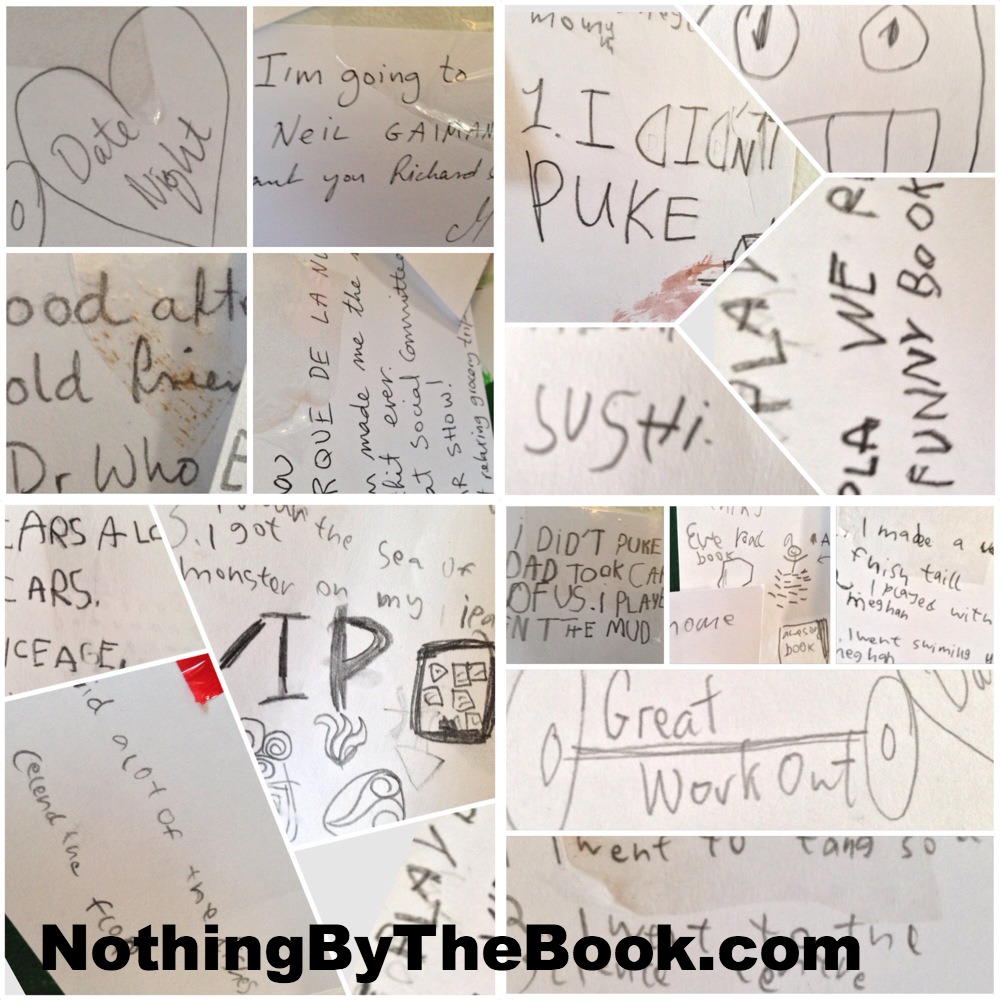
P.S. A. Deathbed experiences make me sappy. Sorry. How do they affect you? B. Clearly, I lived. Thank you for asking. But just barely… I’m pretty sure it was the plague. C. For the last few weeks, Cinder, Flora, Ender and I have been constructing a “Things That Went Right” wall. It’s a simple, fun project inspired by Martin Seligman’s gratitude journal exercise in Flourish: every day, each of us thinks of and writes down three things that went right that day. Three good things. Three exciting things. Or three ordinary things. The week of my plague, “I didn’t puke” was THE good thing each of the kids flagged. It’s all about perspective, right?

What Went Right

P.P.S. Tirzah Duncan aka The Inkcaster wrote a marvellous post about her freeing and beautiful take on beauty last week, and I’d love for you to read it: Beauty is far from skin deep.

For those of you deep in the toddler trenches, pop over to Stephanie Sprenger at Mommy Is For Real for a refresher on the concept of disequilibrium… and a tongue-in-cheek (or is it?) proposition of the massing of transitionin-disequibiriumiated (fine, it’s not a word, but you know exactly what I mean…) toddlers in a toddler “Red Tent.”

Looking for me? I’ve revamped the for-stalkers-and-bloggers-and-no-I’m-a-real-sane-fan! section: Find “Jane”

The unBlogger’s Manifesto

I am a writer.

I am a mother. I am also wife-lover-partner-mate. Daughter-sister-aunt-neighbour-friend. Citizen-voter-kinda-wanna-be-an-activist-but-too-cynical-to-really-make-that-work-volunteer.

I am a deadline-meeting-craving-negotiating-not-really-your-employee-but-I-know-you-sign-my-cheques-and-I-will-deliver-what-you-need-when-you-need-it-professional.

I am so many, many things; I have so many roles, facets, hats. Some I carry always (mother-wife-friend-writer), some I put on and off (cyclist! Except, no, not this month). Sometimes I wear/am six at the same time. Sometimes, one swallows me entirely, eclipses all the others (and if you have children, you do not need to ask which one).

I am so many things, all these things.

What I am not…

I am not a blogger.

(I am not a lawyer-dentist-mechanic-nurse-gas-station-attendant-preschool-teacher either. Nor an eco-warrior-homesteader-radical-homemaker-stay-at-home-mom-academic-marathon-runner-yogi. Do not take what I say here as an attack of a role you embrace, cherish, an identity that defines you. Be who you are. This is not about you. This is about me.)

I am not a blogger.

But…

I have a blog.

I write a blog.

I play in this wonderful place I’ve created and keep on creating. I love my little Nothing By The Book platform. Writing here fills me, feeds me, pleases me. It is part of what I do.

It does not define who, what I am.

(But if it defines who you are, do not frown, get angry, throw nasty things-words at me. Wanna be a Mommy Blogger? Be that. Love that. Jane Austen was once dismissed as a “lady novelist”; does anyone remember the men who labeled and reduced her as such? Humour blogger, homeschool blogger, fashion blogger. If it fits you, wear it, flaunt it. This is not about you. This is about me.)

I blog-write chiefly for me: to create a record of what is; to play with what could be; to process what sucks; to celebrate what rocks. And also, to practice, fine-tune my craft, my skill. There is no other platform a writer writing today has that offers both the freedom and discipline a blog does:

  • The freedom to write on whatever impassions you—and to play with structure-voice-rhythm-delivery in a way no editor-client will ever, ever tolerate
  • The discipline of writing publicly, for an audience.

That means I also, inevitably, constantly, each time, write for you too.

Writers need readers.

(Short digression: Writing for self is completely different than writing for an audience: if you’ve kept a chaotic, self-indulgent, angst-filled diary as a teenager, you know this. Writing for self is—and perhaps should be—undisciplined. And it has its use, its purpose. But keeping a journal does not make you a better writer. Just a more self-aware one. Writing for an audience—regardless of whether it is an audience of one or an audience of hundreds, thousands, millions—is about sharing something, evoking an effect, a response, a reaction. It requires discipline. Thought. Skill. Craft. Blogging hones that.)

But…

I am a writer.

Not a blogger.

unBloggersManifesto

That means my energy in this place goes into—writing. Creating. Re-writing, re-crafting, letting things simmer-marinate-develop-change. Loving what I’ve written. All that other stuff—commenting, Tweeting, sharing, hopping, you-read-me-and-scratch-my-blogging-back-and-I’ll-scratch-yours? Meh. I don’t care. I’ll play, every once in a while, if I want to. I’ll read you, religiously or sporadically, if I love you. And sometimes, I won’t. Often, actually, I won’t. Because being mother-writer-partner-provider-community-member-human takes up a lot of time.

And that’s the way it should be.

I have been telling my cyber-tribes for about six weeks, more, that I’m penning The unBlogger’s Manifesto. I’m worried I’ve oversold and undelivered, because, you see, this is not about you. It’s about me. My priorities, my goals, my clarity. Of what I am. Of what I am not, and do not wish to be.

But, beloved… make it about you. What are you? What are you not?

Clarity’s a rather glorious, if elusive, thing.

For ink-casters-and-word-players, blogging-parents-and-not of all genders, citizens-and-tourists-of-the-blogosphere, and “real” readers everywhere, but most of all for my “Bloggy Sisters.” You know who you are.

xoxo

“Jane”

P.S. “Jeezus, Jane, you’re not gonna go all navel-gazing and self-referential on me going forward, are you? Because I do not come here to read about the ‘to-be-or-not-to-be’ of blogging.”

“No, beloved, never again. Just this once. But I might inflict some writing about writing on you. Because that’s a rather important hat-role-identity. That cool?”

“Maybe. Just don’t bore me.”

“Never, my beloved. Never. I promise.”

“Mittens?”

We come out of the warm YMCA building, the chlorine scent of the swimming pool still clinging to us. Ender, with the determination only a four-year-old possesses, drags his sled down the stairs. Clunk, clunk, clunk. Slam! It lands on the bottom. He looks over his shoulder. Scowls at me. He’s tired. Hungry. Probably, despite the snowpants, sleeping-bag-jacket, and over-the-face toque, cold, because it’s the coldest, snowiest December YYC has seen in 112 years.

He plops down on the sled in a Buddha pose.

“Mittens?”

I ask, kneeling down beside him.

“No! My hands are NOT cold!”

He’s tired. Hungry. Contrary. It’s at least -15 Celsius.

I shrug. Get up. Start pulling the sled.

It’s a beautiful, clear night. The air feels clean—sparkling—even as it hurts my lungs, bites at my exposed cheeks. I pull the sled on the cleared-of-snow-but-there’s-so-much-of-it-everywhere-I-kind-of-want-a-snowmobile paths. Look at the twinkling lights. The sleeping-bag-parka-engulfed people. Turn my head.

“Mittens?”

“No.”

I shrug. Start walking again, my hands warm in my mittens. I think of what 2013 was, and what 2014 might be. I think of milestones, real and artificial. I think of hope-despair-desire-acceptance-creation-destruction-reconstruction. A plot line emerges from all those thoughts, a fascinating one, and I hear a conversation in my head that sets it up, and I fall in love with it, but it doesn’t really fit into what I want to do, ultimately, with that piece of work, and then my thoughts leap to the unBloggers Manifesto I want to write for Nothing By The Book for January, a polemic that in its current form is not doing quite what I need it to do, and I know it’s because I’m pulling too much into it, going off on too many tangents, and for a piece of writing to work, it needs to be focused, and a polemic piece of writing needs to be brutally so, digressions and tangents only work if you pull them back, at just the right time, to the central idea, the theme… or the chorus…

I turn around.

“Mittens?”

“No. Not cold.”

Mittens Pin

I cross the bridge. The lights are beautiful and almost make me forgive Christmas its existence. And I think about… beauty, definitions of, abstraction of, and that thought takes me to my daughter-who’s-about-to-turn-nine, so beautiful in mind-soul-body that it makes me ache, so full of potential and wonder that it’s that thought, and not the cold air, that stops the breath in my throat for a second… and I think about all the ways that I think fail her as a mother, all the ways that I am not what she needs, and tears swirl in my eyes—but maybe I am what she needs? And, really, what a silly question, because I am what she has and she is what I must learn—and, tears still dancing in the corners of my eyes, I turn my head…

“Mittens?”

He shakes his head. I never imagined motherhood to be this—so full of such intense joy and such paralyzing pain. So full of summits and valleys. So glorious, so rewarding—so fucking heart-wrenching. And that thought takes me to twelve different places at once, and I’m not sure how much self-awareness I want to chase in this moment, so I choose to chase the idea that self-awareness, for all the pain it brings, is also a source of power and that takes me to such very, very interesting places…

“Mittens?”

His hands are folded in his lap, and he’s bent over them. Head bopping. Falling asleep. He bops up. Scowls at me.

“Mittens?” I repeat.

“No.”

I walk faster. Over another bridge. Through the steam rising from the cracks in the ice of the river. I look at the water, ice, snow, steam and feel a shot of resentment and fear. I try to see beauty… and not next year’s flood waters. And I grit my teeth and don’t chase that thought. Find another. Oh, this one I like… I smile—my nose runs, because it’s so cold—my mouth opens and I almost stop moving because all I want is that thought and, irreverently and irrelevantly, I also glory in the fact that it came to me in this moment when I am alone… except I am not, because I am MOTHER and I am never alone, even when I am.

I look over my shoulder…

“Mittens?”

“Not! Cold!”

I can’t really run in my boots and on the snow, but I walk as quickly as I can. Home, home. I cannot wait to be home, and not just because it’s cold, and I love that thought, that feeling. I want to get home.

“Mom? My hands are cold.”

I’m about… what? 200 meters away. Maybe less. I kneel down beside the four-year-old. His hands are pulled into the sleeves of his sleeping-bag coat. I blow on his fingers and slip on his mittens. Kiss the tip of his nose.

Do not lecture, and so, enjoy the brief victory of mind over impulse. Pull the sled the last 200 meters home.

I wish I could tell you that the next time we go out in the cold, he says “Yes” the first time I try to put on his mittens. But he won’t.

I wish I could tell you I will never again doubt that I am what my daughter needs or let my thoughts go to all those other unproductive, painful places.

I wish I could tell you that, somewhere between the YMCA and home, I found the answer to EVERYTHING. Because how awesome would that be?

But, I just want to tell you this: You can fight over the mittens. Cajole, badger, plead. Force.

Or you can wait for those little hands to get cold.

And when they do—put on the mittens. Silently. Without the “I told you so’s.” Or too many expectations for the next time.

Fuck, yeah, it’s a metaphor.

Jane

P.S. Happy New Year, beloveds. I am torn what to ask of 2014. In the closing weeks and months of 2013, I rather wanted a less eventful year. But now that it’s here… eventlessness is so boring. And unfulfilling. So, 2014—be eventful. Be FULL. I’ve got plans for you. And you’d better be prepared to rise to the occasion.

P.P.S. “Jane, why are you anthropomorphizing a calendar construct?”
“Because… Metaphors. So useful.”

Coming sometime this month: the unBlogger’s Manifesto. Minus all of its digressions. Or maybe not. Focus is key. But it is digressions that make life and thought interesting…

P.P.P.S. “I love this! I want more!”
“I am so pleased. Connect with Nothing By The Book on Twitter @nothingbythebook, Facebook, and Google+. Or, for a not-in-front-of-the-entire-Internet-please exchange, email  nothingbythebook@gmail.com.”

After the flood: Running on empty and why “So are things back to normal?” is not the right question

photo (12)

He asks the question with a smile, as a casual opener before we move on to “real” issues, and is shocked and appalled when I burst into tears because, well—I don’t cry.

“Are things back to normal?” he says and immediately wishes he hadn’t said it, and doesn’t know where to go from there. And I’m shocked too—I don’t know where the hell those tears have come from, because I’m fine, we’re fine, everything’s just fine.

Except, of course, it’s not.

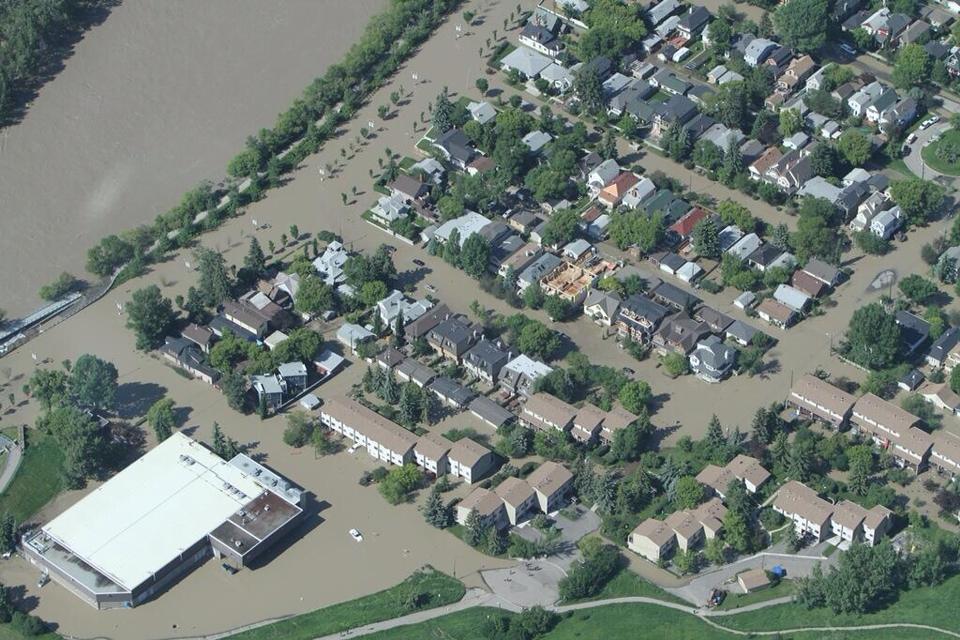
We had this flood in YYC and Southern Alberta back in June, you may remember (my flagship post about it was unLessons from the flood: We are amazing, and if you want facts, visit the evolving Wikipedia entry  or the Calgary’s Herald’s The Great Flood of 2013 page), that devastated my neighbourhood and so much of our city. An army of citizen volunteers turned out in the tens of thousands to respond to the crisis. It was amazing. It was euphoric. It had us walking on air and out of crisis mode in a couple of intense weeks.

People were asking a week, two weeks after the flood—as soon as the rivers receded, as soon as most of the debris that was our basements, our houses, our possessions, our lives, was taken off the streets and into the dumps—“Are things back to normal?”

And in late July, August, euphoric, proud, we could smile and say, “We’re out of crisis mode.” And maybe talk a little about insurance, and the Disaster Recovery Program, and plans for reconstruction. And laud our mayor’s leadership and bitch out the provincial government and, you know, do all those “normal” things.

I’m not sure when “normal” got harder to fake. Maybe in September, when we’d reconnect with people we hadn’t seen for a few months, and they’d say, “So—did you have a good summer?”

Funny—we are so socially programmed to be inoffensively happy and placating, the autoresponse to that question, which the mouth starts to form before the brain has a moment to reflect, is, “Yes. And you? That flood thing? A minor inconvenience. Moving on. Going to Disneyland!”

I did not have a great summer. We did not have a great summer. And things are not back to normal. What does that mean, anyway?

I look at him as if he can give me the answer, but of course he can’t. And he’s never seen me like this before, or under stress before, but he’s spend the summer ripping out friends’ basements, and they’re none of them quite “normal” right now either. But they’re not talking about it. “We’re fine, everything’s fine.” So what’s going on? What’s up with us, what’s tearing us up, as we move into month five after the flood?

I struggle to put it into words.

The obvious answer is that reconstruction is not going well. The rip-outs, it turns out, were the easy part. Putting things back… Well. We’re all at different stages. Sunnyhill’s probably further behind than many others because of our need to rehabilitate all 41 damaged units simultaneously. But I don’t know anyone who was affected who’s totally “done.” Most of us—all of Sunnyhill—have been back home for a long time. But we’re living in reduced, scarred spaces. An eternal mess. That’s hard. I know every time I walk in and out of my front door, every time I see the ripped door casings, the dismantled walls, the hole where my hall closet used to be, my jaw tightens.

So. That kind of sucks. But—really—I’ve been through renovations before. Who hasn’t? We are, I tell him, the mildly inconvenienced. We know this. Bitching and complaining about naked joists, drywall dust and “what the hell did the contractors do now?” seems like such a First World Whine. And that’s the other thing.

We feel bad—guilty—over feeling bad. Because. India. Colorado. Fuck, High River.

That sure doesn’t help.

He refills my glass. He tells me about his friend, whose house is fine but whose rental property was devastated, and how guilty she feels that her own personal loss wasn’t greater. That she was, ultimately, only financially inconvenienced, while her tenants lost—everything.

Stupid, I say.

Human, he counters.

I start crying again. He gives me his napkin to wipe away tears, snot. I hide my face.

We’re exhausted, I say when I can talk again. I’m the mother of three young children who all went through severe insomniac stages—and I’ve never been this physically exhausted. And it’s not from physical labour, the way it was during the crisis. We were entitled to be exhausted then, right? But now—others are doing the work (or getting paid to do work the results of which we’re not seeing, I snarl, and I laugh, and he does too, because that’s “normal” for me, much more normal than these uncontrolled tears). We’re just doing the everyday stuff—well, a little more, and so much of the everyday stuff is more difficult, but… Not entitled to complain. Not engaged in heavy physical labour. And, frankly, letting a lot of the everyday stuff go. Never did one thing to the flooded garden this year. Cleaning windows? Ha. I barely clean the kitchen. And my kids have never eaten so much take-out, ever. So what are we exhausted from?

Living? he says, gently.

I shake my head.

Frankly—I look at him through the wine glass, and it’s the refraction of light through liquid that blurs his features, not the water still swimming in my eyes—frankly, we’re exhausted from being so fucking positive and amazing. We know we pulled off a miracle. We were awesome. We were strong.

And now we’re really tired, and we’re done—except, of course, we’re not done.

Because things are not back to normal.

But tears aren’t swimming in my eyes anymore and I heave a sigh of relief.

Jesus, that felt good, I tell him. And then—I’m so sorry. We were supposed to talk about…

He interrupts me, waves my apology away. And he tells me—how he’s been struggling. Trying to figure out how to be a good friend to his floodster (we don’t do the victim thing in YYC, and survivor’s a rather dramatic term, don’t you think?) friends post-crisis, and feeling at a loss. And how he needed to hear this as much as I needed to tell it. And how he will never ask anyone in any of the affected Calgary neighbourhoods “Are things back to normal?” ever again.

We laugh. Order dessert. More wine.

In this moment, although things are not back to normal, I’m fine. We’re fine.

Or, at least—you know. Functional.

• 

The writer engages in overt emotional manipulation, both to achieve a level of release and to communicate that which is hard to articulate. My family and friends won’t finish reading this post—they’ll be texting me in a panic before they get to the end of the first paragraph. Chill. Although things are definitely not back to normal—and for the love of any and all of the gods I don’t believe in, do not ask your flooded (or otherwise whacked by life’s events) friends and neighbours if things are back to normal, ok? Just don’t—life is unfolding as it must. And in my own beloved little corner of the flood plain, we are all doing what must be done. And—because we’re a community—we’re helping each other through it. (And possibly drinking too much wine, but. So be it.)

But if you’re on the hills and edges of the flood plains—if you’re on the edges of any life affected by a traumatic event—and you’re struggling to figure out how to help your friends who are clearly post-crisis but equally clearly not-ok, do this:

  • Listen. Don’t tell us how strong, wonderful, amazing, or lucky we are. Just listen. Let us feel bad, sad, frustrated, furious. Tired. We know we’re amazing. We kind of need permission to be… whiney.
  • Connect us to help. If you’re a local reader and you need to help a local floodster, a good starting point is the resource list provided by Alberta Health Services here. But babe, remember how I was telling you during the crisis to see the need and fill it, how saying “How can I help?” isn’t enough when people are in shock? Sending your friend the link or telephone number may not be enough. Walk the line between empathy and obnoxiousness as best as you can, but a “May I call and make an appointment for you?” is likely more helpful than “Here’s a link I thought you’d find helpful” email. For your hard-core entrepreneur friends who don’t want to do stress-relief acupuncture and roll their eyes at sacrocranial therapy etc. etc., the Canadian Federation of Independent Business has some hard-core resources—that include getting connected with counsellors if that’s what you need.
  • Recognize that we’re not as… full, or resilient as we used to be. And so—take less. In a way, take more—we’re not as patient or tolerant as we used to be either. Nor necessarily as rational. Deal with it. And, if you can, look for ways to fill us up. (Preferably not just with wine. Although that sometimes does do wonders.)
  • Invite yourself over. Our scarred houses are difficult to love right now. Sometimes, company is difficult to seek out. But isolation really sucks. Come on over.
  • Invite us over, or out. Our scarred houses are a little oppressive right now, but suck us in with all their demands. Get us out.

For my neighbours, who are awesome, and doing all the things. But who are also exhausted and running on empty, and need to have those feelings acknowledged and respected. (Especially my beloved L. So much love and appreciation for all that you’re doing.)

For my friends, who helped so much, and who are always trying to help. In the most creative, occasionally disturbing, ways. (Yeah, I’m talking about you. I’m not saying it didn’t work… but that was really weird. Still. Thank you.)

And, for myself. Cause I really needed to cry.

Cheers.

photo (13)

“Jane”

Sat., Nov. 2nd P.S. You’re breaking my heart but also feeding my soul with what you’re sending to my in-box. Yes, you are free to share this piece wherever you think it needs to be heard. The private place to cry is nothingbythebook@gmail.com. Much love. J.

Share This: Unplanned Twiblings, a birth story of international adoption

It’s about to happen again, in Aisle 9, just as I successfully navigate the kids’ bulky side-by-side double-stroller, past the mountain of soup cans and stop in front of the supply of diapers. The stranger smiles at me and beams at the kids. Makes straight for us. And I know what she’s going to say before it comes out of her mouth, it’s what they always say: “Ooooh! They’re adorable! Are they twins?”

That’s the opening paragraph of the coming-to-motherhood story of one of the most amazing women in my real life, Evelyn Ackah, a Calgary business immigration lawyer. I met Evelyn when Ender was growing in my belly and when she was actively pursuing adoption as a single, black professional women. We were expecting together–and her “pregnancy” was much longer and emotionally much tougher than Ender’s merely biologically difficult gestation. I’ve been privileged to witness her story and as her babies turned two, we thought the world should really hear about her path to motherhood through international adoption, as a single, professional woman of colour. I reached out to one of my former editor at The Globe and Mail (that would be one of Canada’s national newspapers to my Yankee and global readers) who connected Evelyn with the fabulous Jane Gadd who edits The Globe‘s Facts & Arguments page. If you read The Globe, you would have seen Evelyn’s story featured on The Globe and Mail’s Facts & Arguments page  on the Wednesday, October 23, 2013 as Why my kids aren’t twins but twiblings.

Evelyn called the original version “Unplanned Twiblings,” and she’s graciously allowed me to share the full, unedited version here. Enjoy. May her story inspire you–and make you think.

Unplanned Twiblings

by Evelyn Ackah

It’s about to happen again, in Aisle 9, just as I successfully navigate the kids’ bulky side-by-side double-stroller, past the mountain of soup cans and stop in front of the supply of diapers. The stranger smiles at me and beams at the kids. Makes straight for us. And I know what she’s going to say before it comes out of her mouth, it’s what they always say: “Ooooh! They’re adorable! Are they twins?”

I do what I always do. I smile. Nod my head. And thus, effectively, lie. Because they’re not twins―they’re three-and-a-half months apart, actually. I call them my twiblings. My beautiful, unplanned twiblings. But that answer has a backstory that’s too long and complicated to get into with a stranger in a grocery store aisle or that other mother at a playground, who’s pushing a stroller with “real” twins or the people in the waiting room at the doctor’s office.

They all ask. And, much of the time, when they ask―even though I usually do feel the question is intrusive―I am grateful, very grateful, that they do not ask, “Are they yours?”

Mine. They are mine, my children, my family. The end of my journey to become a mother, and the beginning of my parenting adventure.

I always knew I was going to be a mother. No question. The future held a child, maybe two. And when, in my late 30s, I had to accept that my body would not be the route to motherhood, my long-term boyfriend and I immediately looked to adoption. My vision of the future, in 2007 was clear at the time. We took the courses, underwent home studies and dealt with the copious amounts of paperwork becoming an adoptive family entails. I would be a mother. An adoptive mother. I was excited about the process. We planned to adopt from my native country of Ghana, West Africa.  Unfortunately, as Ghana is not a common destination for international adoptions, it was uncharted legal and procedural territory. Every step had to be discovered. And every step took much longer than anticipated.

In 2009, still unmatched in Ghana, I had to revise my vision of my future once again. My partner and I split up. I was 39, single, and with a very demanding career. What was I going to do? Pursue adoption as a single professional woman or give up the dream?  I had no illusions: I knew parenthood wasn’t all smiles and roses. I knew it was a lifetime commitment and incredibly hard work. Could I do it?

Could I afford to wait until I would not be alone?

In the end, I decided that my desire to be a mother was separate, or perhaps even greater, than my desire to be a wife. I was not going to put my adoption journey, already two years long, on hold and wait for the right man to enter my life before continuing. I would do it on my own.

It was, frankly, a difficult, terrifying decision.

But not nearly as difficult as what came after. Between early 2009 and the spring of 2011, I was matched with three children in Ghana. Each match fell through. Each one was heart-breaking and devastating. I was not sure how much I could endure.

I decided to look closer to home, at Canadian private adoptions. And I was shocked to find out how difficult it would be to be chosen to adopt in Canada as a single woman.

My continued research led me to the United States, where I found out certain states accept and encourage single parent adoptions. I settled on Florida as the best fit, both in terms of the legislative process and the fact that there were more children of colour available for adoption. I may have given up on adopting from Ghana… but I still wanted a child that looked like me.

Do you understand how important it is to me, when people see me and my children, that they don’t automatically make an assumption that they are “not really mine,” that they “must be adopted” because their skin, hair, eye colour is different? Think about that the next time you see a Caucasian dad with an Asian daughter, a white woman with a black baby. Don’t ask them, “Are they yours?” “Are they adopted?”  If you must say something, simply smile, and say, “What a beautiful baby or child.”

I was chosen by a family to adopt their fifth child within weeks of starting the application process. I was delirious. I skyped and talked on the phone with the family throughout the final few weeks of the pregnancy. The baby was born, a healthy baby girl. My mother and I had plane tickets booked to fly to Florida… and the day before we were to leave, the birth family parents changed their minds. They were going to keep the baby.

Another heartbreak.

I am a strong woman, truly. But this… I took to my bed. I could not work or think – nothing.

I booked a trip to Mexico for my mother and me to get me away. And again―the day before we were to leave for Mexico―the agency in Florida called. Another match.  A baby boy, born three days ago. The mother picked me, loved my application and album and was ready to sign all the papers immediately. Was I coming right away?

No.

I can’t quite put into words what was happening to me―I was mourning that little girl that I thought I was going to adopt. I didn’t even have nay boys names picked out. I was in such pain, I could not be happy about this turn of events. I was terrified I would be heartbroken again.

My mother and I went to Mexico. It was supposed to be a week on the beach―we lasted four days. And then, we flew to Florida.

And I met my son.

I fell in love with him―immediately and repeatedly. My world spun, and changed. I was a mother. I was a mother! I was sleep-deprived and living in an apartment hotel in Florida, doing all the final paperwork required to take him home. My plate was full. So full.

So of course, that was when I got the call from Ghana. A little girl had been identified. Four months old. Was I interested?

No. Absolutely not. I wasn’t even going to go there. Neither for another heartbreak, or for parenting two children as a single mom. No. Absolutely not.

But after a couple of weeks and lots of family meetings and promises of support, I decided to go for it―somehow it felt like things were meant to be―things had come full-circle.

I would not meet my daughter for another 14 months. I am still both regretful and grateful for that year. I was able to take her out of the orphanage and place her with my extended family in Ghana, so she spent that year surrounded by lots of love and attention. Both she and my son spent the first year of their lives effectively as only children, first children, and I am grateful for that. And I talked and Skyped with her constantly. But yet―she was so far, far away. And was she real? I knew how intensely I loved my son, the impact of his physical presence on me. Could I love another child this much, ever?

I learned birth parents often feel this way when expecting their second―yet she was the oldest child! And when I finally met my daughter, when she was 18 months old, my heart leaped out of me and into her and she was mine, as much as my son was mine. We were a family.

And now, I push a stroller with my twiblings, who are both well into the terrible―er, terrific―twos. I don’t want to underplay it or sugarcoat it: life as a single mother of two little people is challenging. The path to motherhood for me was hard and full of heartbreak and disappointment, and the real journey, the one that begins when the children came into my home, into my life, is emotionally and physically exhausting. And yet so worth it. These are the children I was supposed to raise.

My twiblings.

Evelyn Ackah is a business immigration lawyer with Ackah Law, a Western Canadian boutique practice focused exclusively on business immigration law. Born in Ghana, raised and educated in Vancouver, the one-time Torontonian now lives in Calgary with her two beautiful children.

• 

P.S. You can tell she’s fabulous just from this story, right? If you want a more detailed peek at her professional life, here’s a profile I wrote about her when she was “just” a source and not a friend.

P.P.S. Next week on Nothing By The Book, I think I’m going to tell you why I’m so tired of being an adult.

Any way they have to come: why you should throw out that birth plan and just have that baby

photo (8)

The Ender turns four this week, and as my crunchy friends send him heartfelt birthday wishes, they also wish me a happy birthing day. Except, it really wasn’t. Happy, I mean. But it doesn’t matter. It was. And he came. And we were both healthy. And that was enough.

So today I give you my long, sappy and thoroughly unfunny birthing story. This is how Ender came. The way he had to come. I don’t give you the really unfunny backstory leading up to it–that’s mine to hold and process, only mine, even more than four years later.

If you’d rather experience (or, if you’ve been in my life since 2009, relive) the short version where I regain my sense of humour, it’s here: The last three minutes of Ender’s otherwise criminally long arrival on planet Earth. And if birth stories give you the heebee-jeebees–and I totally understand, baby, the miracle of birth is horribly gross, really, the things we do for the continuation of the species, crazy, utterly crazy–go read … um, how about the day Flora decided we were going to keep Ender, even though he’s not a girl? Yeah, that’s a good one, “He’s a Keeper.” And it’s short. Minimal time commitment.

But if you’ve got a little bit of time and glory in the full story… here we go…

This is the long version of Ender’s arrival, the last 12 or so hours, written for and published in  Birthing magazine.

As dawn breaks over Calgary’s first winter snowstorm in  October 2009, I’m 14 days post-estimated-due-date and on the parking lot usually known as Crowchild Trail, en route to the Rockyview Hospital for an induction.

“It’s a good thing you’re not really in labour,” Sean, my partner, says. “Or else we really would be having this baby in the van.”

Ha ha ha. I try not to get angry at my uterus, cervix, DNA code—whichever part of me it is that is not working the way I think it ought to. I try to be philosophical. They come as they must, and all that matters is that they come, healthy, safe. I almost believe it.

Continue reading

Ferocious Five

Did you guess where I am? I should have packed more painkillers. Fortunately, there are drug stores and hot tubs everywhere. While I’m away–you know where I am, right? Figured it out?–a bunch of my friends have daughters who are turning five in the next little while. Here’s a recap of Flora’s Ferocious Five.

IMG_0615

2007. Flora is five years and three weeks old today—the three weeks is important, as important as the “half” was when she was four and a half. She’s just come off a very long—for our healthy, active girl—illness, almost two weeks of intermittent fever, sore throat and cough, sniffles and overall body aches, with two days of puking thrown in at the start just for fun. She’s physically well now, but weak. And fragile. Each of her nerves and emotions is exposed to the harsh air of every day life, and the smallest of life’s trials rub her raw and send her spiraling into misery.

It’s driving us mad.

We’ve been here before with her. She celebrated turning two by being sad for three weeks, non-stop. (Funny thing about time: at the time, we thought it was months. Perhaps an entire year. Fortunately, I keep records. It was three weeks on the dot, 21 days of almost incessant crying, over everything.) Between three and four—and especially on either side of three and a half—life thwarted her at every step and she barely survived (us too). At four and a half there was a brief—six days, but oh dear god what a six days—reprisal.

So this is Take Four of Flora being uber-fragile, and I’m trying very hard to approach it as a yet another opportunity handed to me by the universe to crack the Flora code. (We successfully cracked the Cinder code when he was two [this post is coming to the blog Archives soon!] and haven’t been significantly challenged in our interpretation of it since then; Flora is proving to be more complex. Perhaps we women really are.) However hard, each take has offered amazing insights and lessons. The first time around, when she was two and in tears, the lesson to us was simple. Happiness comes from within. We cannot make her happy or peaceful—it is not, indeed, our responsibility to make her happy. The best we can do is provide a certain type of environment, some coping tools—but the only one who can make Flora happy (or not) is Flora.

The lesson of Take Two was more nebulous, and it wasn’t really about Flora. It was about me and you (yes, you, the reading you, the you walking past my yard, the you I pass on the park path, the you paying a visit to my house while she’s having a meltdown). In a nutshell, it was: you don’t matter. Your opinion doesn’t matter, your reaction to Flora or to my reaction to Flora or to anything else that’s happening right now in Flora’s world doesn’t matter. Sorry. You don’t want to hear that, but I need to remind myself of it, throw you out of my mind, and focus on me and Flora. Then, I need to put me to the side—I’ll come back to me later, recharge, re-examine, ponder exactly why I was feeling the way I was and wanting to react the way I was, I’ll do all that, but later.

Right now, with you and me out of the way, I need to focus on Flora, I need to help her cope, work out some tools that she can use to help find herself, work through whatever inner turmoil she’s experiencing right now, and come back to a place of balance. This moment is all about her, and I need to surrender to that first. Only then can I help her… and maybe helping her just means being there while she can’t help herself. And then, when there is a moment when she wants and needs and is open to help—then, I step in. Without my baggage, without making this about me—much less you—but just her.

This lesson is much harder than calculus and I’m still studying it, reviewing it, intermittently failing it, because, at least some of the time, I want you to approve of my and my child and my parenting.

Flora—the current, five year old Flora—is stirring on the couch beside me now making whimpering unhappy noises as she wakes up from a quasi-nap, and I’m revisiting the second part of the lesson. Not about me. About her. What does she need? (Part of me says, a kick in the head.) Apparently, she says, her whole self covered with the blanket. Translation: control over her surroundings.

Take Three’s lesson was simple, so long as Take Two’s lesson was mastered. Repeat: it’s not about you or me. It’s about her. In capital letters: It’s about HER. Between three and five, children are as purely and completely selfish as selfish can be. They’re not psychotic, unsocialized, undisciplined: they just are. Purely, beautifully selfish. The world is all about them, and that’s all that matters to them.

This can suck to the rest of us having to live in the world alongside them. Until, that is, we realize that developmentally speaking, this is normal and inevitable… and it is possible to “work” with it. Asking a child in that stage to do something—or stop doing something, or, ha!, feeling something—because of the effect it has on other people is a recipe for frustration. They can’t comply: they don’t hear you. Oh, they can learn to fake complicity through coercive discipline. But they don’t get it. The world is about them.

At four and half, and into five, I know this. Flora’s world is all about her. In retrospect, on either side of five, Cinder’s world was all about him too. But he manifested it in a different way and it was easier to live with. It was all about doing stuff. For Flora, it’s about feeling stuff. Waaay more complex.

So, here we are in Take Four. Obviously, for me, part of the lesson here is a remedial review of Take Two. It’s not about me. It’s all about her. This part, I’m doing pretty well on. I need to work a little bit more on the fact that you don’t matter. And also, I need to flip the fact that it’s not about me on its head. I actually need to make it about me: that is, seize each of these moments as an opportunity to work on ME. MY response. MY feelings and MY expression of them. MY understanding. What am I doing in this moment and why, and can I be the me in this moment that I want to be? Can I be that me just a little bit longer? One more minute? Another after that?

People pay big money for transcendental moments like this: they go to workshops, retreats, read books, meditate… and lucky me, motherhood is delivering these life-changing, self-reflecting opportunities to me just about every day…

First published in Life’s Archives, January 27, 2007, with this note: I wrote this post more than two years ago. Flora is now seven and three and a half months—she could probably tell you her age precisely to the day, perhaps the hour. And while we are not in “Take Five,”  we are still learning our sensitive, fragile Flora. She’s learning us too—the selfishness of five is long gone, replaced by hyper-awareness to the feelings of others, and hyper-despair when they are negative. Sometimes, this hyper-awareness makes me long for the selfishness of five. But that’s a topic for a future post.

More like this: Searching for Strategies for Sensitive Seven and Emotional Eight 

Also see: Five is hard: can you attachment parent the older child?


I’m the adult: not burdening children with responsibility for fixing our black moods

I’m so angry, I’m vibrating. You know that feeling? When you’re not sure if it’s the world around you that’s shaking or your innards? I’m so angry, I want to scream, stomp, feel my fist crash into something hard and preferably breakable…

Instead, I get into the car with all three of my kids. Safe, eh?

Close my eyes. Take a deep breath. Sternly tell myself: “Thy truck is not a weapon and you will not feel better if you mow down an unfortunate pedestrian.” Take another deep breath. Try to get the world to stop shaking.

Fail.

Grip the steering wheel. Start driving.

The two little redheads in the backseat are oblivious of my mood. They’re talking to each other, over each other. Excited about where we’re going.

The older, messy-haired blonde in the front seat beside me… he picks up on every nuance. And he starts to talk to me, frenetically. About the Redwood Forest. The new Redwood biome in Minecraft about which he’s so excited. He offers story after story, asks question after question, trying to lure me out of my anger, hate, blackness.

I don’t realize what he’s doing, not right away. I answer monosyllabically, barely hearing him through my anger. And then, suddenly, something he says—or maybe the way he says, the pitch of his voice—breaks through the fog, the blackness, and I stare at him in horror.

He’s trying to fix me.

He’s trying to make me feel better.

He’s taking responsibility for making my black mood go away.

…and here you might think, Jane, what the hell? Why the horror? Why is this a bad thing? Oh, it is. Hold on. Read on.

“My beautiful boy,” I say, and I reach for his hand, and squeeze it. “I appreciate… I very much appreciate what you are trying to do. But it’s my bad mood. And I’m the only one who can get me out of it. Don’t—don’t take it on yourself.”

He frowns, doesn’t understand.

But it doesn’t matter. Me realizing what he was doing—enough. I grit my teeth one final time. Take one—two–three–more breaths. Wish I could close my eyes, but there’s a semi to the right of me and a cement truck to the left, so I just shake my head side to side.

I’m not happy, not tranquil or joyous. But. I am sane. The black fog of anger recedes.

At this precise moment, the two redheads in the backseat—oblivious to everything but their own interaction and joy—start up a chorus of:

Ender: Fox in box. Fox in box. Fox in box.

Flora: Moist. Moist. Moist. Moist.

…because they know just how to push my buttons. But, I’m sane again, so I just yell at them in the usual Mom way—not the psycho bitch from hell who will devour you alive if you say one more word you little beasts way. They giggle and fall silent.

Cinder keeps on talking about the Redwood Forest, but now only because he wants to, not because he’s trying to jar me out of blackness.

Not his responsibility. Never.

Do you understand?

Do you understand the danger of making a child feel responsible for taking you out of your foul mood?

Not for putting you in a foul mood. That’s different. I’ve got no qualms at all about saying, “Mommy’s pissed off because you dumped the potty over the balcony and stuck a crayon up the dog’s butt.”

But when when I’m unhappy—when you’re unhappy–when you and I are angry, black, broken, all those ugly, ugly feelings that come on all of us (and always at the most inconvenient times, no?)—it’s our job to work on ourselves and get ourselves out of that dark place.

Or–a therapist’s.

Not our children’s. It’s not their responsibility. Not their burden.

Never.

They’ll take it on, you know, if you don’t stay aware. And I’m not crazy or dogmatic: a little love and care from the people around you, even the little people, when you’re down, is a beautiful thing. Nothing like a hug or a bowl of chocolate chips put into a frazzled mother’s hand at just the right time to turn a hard moment around.

A little love, awareness, affection. A beautiful thing.

Taking on responsibility for fixing a parent’s, an adult’s blackness?

Not their responsibility. Not their burden.

Ever.

xoxo

“Jane”

Cinder long messy hair unhappyP.S. Don’t worry, the black mood is gone, and I love everyone and everything again. Well, maybe not everyone. Or everything. But–all the important people. And enough things. But. Anger as a parent. A terrifying thing, is it not? Close your eyes (unless you’re driving). Breathe….

Photo: Cinder in an unhappy mood of his own. But, if I recall right, this was had a very direct cause: swarms of pre-flood mosquitoes the size of hummingbirds with the appetites of vampire bats.

P.P.S. My social media whoring outreach efforts continue, so if you love me, follow me on Twitter:  or like Nothing by the Book on Facebook–or both? Why don’t you do both?

Or, add me to your circles on GOOGLE+: Jane Marsh on

If you’re looking for the real me, or want to follow my YYC Twitter feed,  .

And now, a few words about parasites, getting ostracized, and serial communists

Ender on the Common a week and a half later. Massive clean up effort, by hundreds of volunteers. Thank you!

So here’s how it happened: I’m sitting on our beautiful unflooded Common* with some of my favourite people and wine is flowing and the fire is crackling and we’re talking about all the signs of “normal” that are returning to our lives: the police stopping speeders, peace officers handing out parking tickets, citizens complaining about “the City,” neighbours starting to rag on each other… And I start expounding, aided by the freely flowing wine, about how that’s THE thing about community that people just don’t get. That it’s messy and conflict-ridden and hard and…

… and I blather on, because this is a huge horse of mine in these post-flood days, and as I say, “And community IS full of assholes and parasites… and bitches and mean girls and…”—at that precise moment, I see the essay and I fall in love with it. Oh, yes. Community, such a fuzzy-wuzzy warm word, rose-coloured glasses and hugs and smiles and planting flowers and front porches and granola-making organic-gardening hippies—oh, yes. And the punchline of the piece—I love it, I feel my toes curl in anticipation of how I’m going to lead up to it—the punchline is going to be, “Community is full of assholes, bitches and mean girls. And parasites.” And I’m going to repeat it a couple of times in the piece, like a chorus, and I’m going to build it around the YYC Attachment Parenting Village, because oh-yes-oh-yes-the-contrast—the immediate association of baby-wearing-co-sleeping-gentle-discipline-mamas and the bitches and mean girls line, oh-yes…

So I write it, first in my head, and then on-line, and I touch a raw nerve, of course, but…

Fuck.

Not quite the one I intended.

Now, that doesn’t happen to me very often—because I am an extremely effective manipulator of feelings and reactions when I write, even on those rare occasions when I so fall in love with a phrase or a sentence that I build everything around that. But. Here, I own my failure. Clearly, if I feel so many of you—not so much those of you publicly commenting on the post on my blog, but those of you dissecting it in other fora and in particular those of you sending me emotive private messages about it—missed its key point, I’ve failed as a writer.

“Yo, Jane, first visit here. What the hell are you yammering on about?”

“Yo, welcome. This: Why you need to get off your shy, lazy introverted ass and start building your tribe RIGHT NOW. But you can finish reading this missive first before going back in time to misunderstand the first one… It mostly stands alone, after the next paragraph.”

So. I own my failure. Should have refined, revised. But. I think my failure is also part of this attachment to a utopian vision of community so many people buy into. D’you know what I mean? When I say tribe, community, you don’t think bitches, mean girls, assholes and parasites, do you? No. You think perfection, utopia, eternal friendship, unconditional love, and warm bowls of soup… and when you talk about building your tribe, finding your tribe you seek perfection and utopia—or at least a hell of a lot more of that than I do. And beloved, when you seek perfection in community, it will always, always, always disappoint you.

And I really, really, really want you to have a tribe. So I am now going to pick up a sledge hammer and whack your brain with it, very bluntly, three times. Ready? Three points. Hear them. Understand them. Or die alone.

Here we go:

1. Community is not selfless.

Community, tribe does not equal charity. Or unconditional help and support. Or love, peace and eternal grooviness. And, so, you see, community is not selfless. It does not act selflessly as an entity, nor do its members act selflessly as individuals. You get out of community what you put into it. But not in the way you think.

I’m not talking about quid-pro-quo/I scratch-your-back-your-scratch-mine kind of thing here. That, beloved, is called reciprocal altruism, and it’s an essential part of most social relationships. Social transactions in a community are more complex, and they work like this. Patty’s really sick, and so Anne watches her kids for weeks and Sarah pops in every few days with groceries. When Anne’s marriage starts to implode, Lucy steps in to watch her kids so Anne and her partner can go to counselling sessions. Sarah calls Anne every few days to check in on her. When Sarah has a new baby, Karen sets up a meal train for her… And so it goes.

That’s how community works. It’s a collection of bonds. See? That’s how you get out of a community what you put into it. Not necessarily—in fact, rarely—from the person you give it to.

Now… Sarah is not feeding Patty and checking in on Anne because she’s anticipating payback down the line when she needs it, of course not. She does all that because she’s just a good person, right? A good friend. She loves Patty. She wants to help Anne. But each of those acts builds her social capital. And when she needs it, the community will give it back to her. Patty may not help her out, because maybe when Sarah’s in need, Patty’s life will still be a mess. But someone will. Guaranteed. Because Sarah’s part of a community in which she’s invested.

But that community, it’s not selfless. Not at all. It only carries its parasites for a while. If Patty just keeps on collecting and never gives back—she starts getting less and less. And funny thing: it’s rarely a conscious, explicit decision. It’s not that the community gets together and says, “Patty’s a parasite and we’re done with her.” It’s more subtle. People notice, as individuals. And, as individuals, choose to send their energy and help elsewhere.

So, beloved. Don’t be a parasite. Give, contribute, build, help. When you can. Because you never know when life will force you to collect.

Reader freak-out: Are you calling me a parasite?

Jane: Maybe. Are you?

2. Community is supposed to ostracize.

Holy fuck, did you hear that? That was a thousand jaws dropping, rose-coloured glasses smashing into little pieces. And gentle readers unsubscribing en masse. But yes, beloved. You do not include without excluding. You do not define what something, some circle is without leaving someone outside it. THERE IS NO SUCH THING AS AN ALL-INCLUSIVE COMMUNITY. Every community, as it defines itself, defines who it includes within its circle and who it places outside them. Every community has rules. Articulated rules. And unspoken rules. And it punishes the members who break them.

Once, someone asked me to write up a piece on their little sub-community, and she wanted the dominant image to be “a diverse group of like-minded people.” Ha. You can be a tribe/community that values diversity up-the-wazoo—there will still be some type-a-thing you’ll exclude. Want to run a puppy mill in Sunnyhill? Get the fuck out. Not gonna happen. Crackhouse next door? No. Not part of what I want my diverse community to be, sorry. Joining an AP support group and looking for validation of your choice to sleep train your three-month old? Sorry. Wrong forum. A Richard Dawkins-loving atheist looking for affirmation in a creationist book club? Why the hell would you do that to yourself?

Community excludes and ostracizes. Rejects as well as embraces. That’s part of what it does.

Reader freak-out: You’re supporting ostracization and shunning and cyber-bullying!

Jane: No, I’m not. More on that in a future post. In the meantime, read the above paragraph again. Think about your tribes, communities and what defines them. What makes them what they are? Do their definitions truly exclude NO ONE? Really? Because I can give you a list of six people immediately that you would want to exclude out of your community, no matter how inclusive you claim it is. Community excludes. There’s no getting around that.

It totally sucks to be on the receiving end of that. Totally. Which brings us to sledge hammer point three:

3. It’s okay to leave.

We live in a really amazing, unprecedented world right now. For the first time ever, many of us get to choose our tribe, our community. We’re not stuck with the one we’re born into. We can work to change our community… or we can choose to leave. Find a new one. Start a new one.

This is an amazing, awesome and absolutely revolutionary idea. And it’s not true for all of humanity, and certainly not all of North Americans. But it’s true for me. All of my tribes, bar my extended family, are tribes of my choosing and creating. And I know it’s true for many of you. If you’re privileged enough to have access to the Internet and free time enough to surf and blog, you’re free enough to choose your tribe(s), your communities.

So. You can choose. You can leave.

As a new mother, I went through three different playgroups before I found one in which there was enough commonality between myself and the other women that I chose to stay and get to know them. As an adult looking for a “home,” I had two horrible misfires before finding my piece of beloved flood plane. As a fledging homeschooler, I’ve lost count of the number of on-line fora I’ve stumbled through before finding a couple that worked for me for a while… and then, decided to leave all those and start another that did what I needed such a forum to do… and no more.

You can choose. You can leave.

But… community is messy. And it takes time. And every, every, EVERY community has its assholes, bitches, mean girls, and parasites. So if you’re leaving all the time—if every time you encounter a community’s wart, conflict, friction, pain or dark side, you immediately run… oh, beloved. You will die alone and unhappy.

You will never find a tribe that works for you, my serial communist. Because… messy. Hard.

Worth it.

Reader freak out: Did you just call me a communist?

Jane: A serial communist, no less. What? You’ve got a problem with that?

xoxo

“Jane”

* What is this Common about which you keep blathering? The common green space onto which many of the units at our housing co-op back onto. My extended backyard. My world. The reason I can raise and homeschool three children in 1000 square feet of badly designed space. Where I meet my neighbours and entertain my friends. The most important physical space in my life. Do you have a Common? Get one. Make one. Turn your backyard into one by inviting friends over to hang and drop in—all the time. Take over a public park with friends—preferably at the same time each week, each day. Spread the word. That piece of green space in your neighbourhood no one uses it? Make it your own. Make it your Common. Community needs common spaces, and it needs them to be used. Loved.

PS Worth reading: The talented Katia Bishop, who usually blogs at I Am The Milk, had an article last week on MamaPop that really resonated with me: 7-Year-Old Girl Sent Home From School For Having The Wrong Hairstyle. Have a read… And a think. And if you haven’t yet read The AP Hair Style: I don’t brush my children’s hair. It’s a massive philosophical thing, really–well. Have a peak there too. But read Katia’s post first.

What defines you as a parent?

It’s beautiful, hot and sultry, a day that belongs to the peak of summer and not early fall, and my children are running wild at a playground, shouting, laughing. Occasionally crashing and crying. And suddenly, Flora runs up to me, shaking with laughter, and:

Flora: Mom, mom, mom, mom, listen! I have a story, such a good story for your blog! O… what’s his name on the blog again?

Jane: Ender.

Flora: Yeah, yeah, yeah—Ender was just playing with that cute little girl, do you see her?

I look. Smile. Nod. Ender and another three-year-old are across the playground, solemnly engaged in filling each other’s shirts and pants with gravel.

Flora: Yeah, yeah, yeah, so she was playing there, and he filled a bucket with gravel and dumped it on her head. And she burst into tears.

I don’t like where this story is going. I will edit it considerably in the telling, I think.

Flora: And O… Ender said, “Don’t cry, don’t cry, I love you. Here, you do it now!” And look, they’re just dumping gravel all over each other all happy and everything. And the best part is, he’s not dumping gravel on me!

And I kiss Flora, and glance around for Ender’s playmate’s mother, to ensure that she’s one of those-type-of-mothers, and not these-types-of-mothers, but before I find her, I hear a voice out of the corner of my left ear:

Beautiful stranger: Excuse me… this is going to sound really weird, but are you Nothing By The Book?

Now, if you’re a fellow blogger about to go into swoons of envy, let me assure you that a) this hardly ever happens to me and b) I may live in a million-plus town, but the out-on-the-fringe-sub-culture community here is teeny-weeny and this isn’t as epic an event as it might seem to you—and not nearly as ego-gratifying to me as you might think. Or so I maintain, and I am the writer and teller of the story. Speaking of, back to the tale:

Jane: More or less.

Beautiful stranger: Are those your children?

And her eyes, and mine, go to Cinder—hanging upside down from a tree—Flora—dancing ‘round and ‘round and ‘round and whispering to herself—and Ender… filling his playmate’s shoes with gravel and then dumping it on her head.

I fight the urge to disclaim my relationship to Ender.

Jane: Yeah.

And suddenly, I know what she’s going to say before she says. Oh, yes, I know it and I brace myself for it, and she says:

Beautiful stranger: They look so clean!

And I swallow my laughter, and look at Cinder’s wild hair, freshly (self) washed and (self) brushed this morning, and Flora’s 12 tiny braids (“I want 24 mom, pleeeeeeeze!” “Not today, babe, that will take me at least an hour. Raincheck?”), and even Ender’s gravel-filled head looks pretty presentable, and I can’t help it, I say:

Jane: They’ve never had lice either.

But as I say it, I regret it, immediately, because it’s borderline-mean, isn’t it? I’m assuming she’s read The AP Hair Style: I don’t brush my children’s hair. It’s a massive philosophical thing, really and had one-of-those reactions to it, and she’s assuming…

Actually, you know what? I’m not going to assume what she’s assuming. Or even that she’s assuming.

I look at her thoughtfully. Introduce my real self. Ask her name. And which of the children are hers.

There’s a toddler, going up and down, up and down the slide. And a brand-new baby, sleeping in half-a-double-stroller.

And I feel, immediately, such a wave of affection and empathy for her, because she’s in one of those toughest, most draining phases, isn’t she? Toddler, baby. Erratic sleep patterns. Everything in life a constant adjustment, struggle. Never enough time. Barely a sense of self… Maybe still waiting for things to get easier… (Oh, beloved, do you still believe that lie?)

And then, a wave of fear and horror, almost repulsion, because she looks at me with anxiety and eagerness and eyes and a heart so full of questions and I clam up, dam up, because she’s looking for a guru and I fucking hate that.

And you think, you hypocrite, then why do you blog about parenting and children and child-rearing un-philosophies, and I answer—I’m a writer. Try to stop me from writing. Try. But this by-product, it’s, truly, truly hard to deal with.

I’m so busy clamming, damming I miss the question, and I ask her to repeat it. And laugh, as I look at her hairless baby, and not much more hair-endowed toddler, because she essentially asks me whether, if she believes that good grooming—brushed and cut hair, matched clothes, all of that—if she believes those things are important, does that mean she’s not an attachment parent?

She’s still on that hair post you see, and I briefly regret using the “AP” tag in it, because its meaning to me is historical and laden with more than 11-years of relationships and reinterpretations, and she’s brand new to the journey, and in the most vulnerable stage of it, and…

… and fucking hell, she’s looking at me with “enlighten me” eyes again, and I need to fix that, right now.

Without being mean.

I cast my eyes over Cinder-way, and send him a psychic message that now would be a really great time for him to… whack another child. Swear. Throw an age-inappropriate temper tantrum. Steal his sister’s hat and run off with it…

Instead, the brat retrieves a small child’s lost ball. Picks up a stray coffee cup and tosses it into the garbage. Strikes up a polite conversation with gravel-girl’s mother.

They never do what you want them to, do they?

Sigh.

Flora, at this age and stage, will be absolutely no help at all—she is perfect behaviour incarnate right now, however briefly—and while Ender’s could usually be counted to behave as a normal, and not aspirational-ideal child, he is currently too busy making gravel-angels with his future fourth wife (he has a list) to perform.

Fine.

Up to me.

And words.

I know what she’s really asking. It’s not about hair-brushing, anymore than my original post was. It’s about the big stuff: principles, philosophies, self-definitions. What she’s really asking me is this very simple, but very big question:

What is it that I do that defines me as a parent?

And what I want to tell her, very clearly, loudly, powerfully, is this:

Why would you ever let an Internet stranger define who you are or are not as a parent? As a person?

Except that’s not helpful, because I know the answer to it: it’s because she’s searching and self-defining, and how she’s defining and creating her story is in opposition to how her mother defined herself, and it’s different from how she’s seen her next-door neighbour do it and so different from her sister-in-law, and she’s uncertain, and it’s so hard… And so, as she’s searching, she’s also, sub-consciously, always searching for approval, from anyone, anything…

Even a mouthy Internet stranger. Even one whose position on hair-brushing kind of appalled her…

My mind’s scripting a long, complicated answer to what it is that really defines me—her—any of us—as a parent, and how it’s the same thing that defines as people and how being is more important than doing even though the doing is what people see—and I have this huge tangent developing about how bottle-nursing with love is better than breastfeeding with resentment and how Ender was never, ever “baby-worn” because I was so broken when he was born and how no matter how often I fail at any of my lofty aspirational parenting goals, no matter how often I fail to do what I want to do, what I know is right, none of that changes what I am, as a parent, as a person, because…

… I meet her eyes again. And she’s so tired. And so anxious. And she’s standing next to me, with no sense of who I am but some knowledge of what I do and too full of what I write. And she’s on such an early, fragile stage of her journey. And she so desperately wants approval. Re-assurance.

And I so don’t want to be a guru. On a pedestal.

But you know what? Fuck it. This moment isn’t about me. It’s about her.

“You,” I say, “are a really, really fucking amazing mother. I see it in how you look at your kids. It’s flowing out of every part of you. You are a great, great mother. All the things you do, or don’t do, that get labeled as—whatever, attachment parenting, permissive, authoritarian, helicopter—insert label of choice here—all those things that you do or don’t do? They barely matter. It doesn’t matter what you do, someone out there will criticize it, take you apart for it. But what you are—this amazing woman who loves, loves, loves and cares so much for them? That’s who you are, what you are—what defines you as a parent. Don’t let anyone ever belittle that, make you doubt that.”

The baby stirs and starts to fuss, and she goes to feed it. And while the little is latching on, the toddler stumbles and gets a bleeding nose and starts to cry. And she tends to one and to the other, and they’re both crying, because she’s pulled in two directions, and she’s already exhausted. And she pulls it together, and does what needs to be done… and they’re in the stroller, homeward-bound, where she has so much more, so much more to do.

An amazing mother.

An amazing woman.

Who should never, ever need the approval of Internet strangers. Or, god forbid, that of Aunt Augusta.

But when she does—when she comes to you, vulnerable and tired and aching for affirmation—give it.

How you treat her defines you as a person. As a parent.

Leaving soapbox—now.

xoxo,

“Jane”

P.S. Beautiful stranger: you know where to find me. Coffee, and a “thunk” off my pedestal are in order. If we meet with kids, I promise to yell at them at least twice, and if we meet in the afternoon, I can almost guarantee an Ender-meltdown.

P.P.S. And what happened in the blogosphere this week? I haven’t a clue. Super self-involved this week. Oh, what a week. Month. Summer. But, on the day we were celebrating #yycpride in Calgary, I connected with Seven Little Mexicans on Twitter, and I think you should check out their super cool blog “because funny things happen when two girls try to make a baby.” New to Twitter, they are, so give them a follow at @7littleMexicans.

When I am an old woman, I’m not going to complain about young people

When I am an old woman, I’m going to wear a ridiculous string bikini when I go to the beach or a pool. My varicose veins, wrinkles, saggy bits or rolly bits offend you? Deal with it. I won’t care—all I’ll want is to feel the sun on every part of me.

When I am an old woman, I’ll dye my hair pink—or maybe old lady brown if that’s what I want—or maybe I’ll let be sparse and grey. Or maybe I’ll have a collection of wigs. Oh, yeah. Wigs. I could totally rock a wig collection. Beehives. Betty Boos. A Marilyn Monroe, and an entire shelf of Lady Gagas…

I’ll probably trade my collection of fuck-me heels for all sorts of sensible shoes—but I’ll paint my toes all the colours of the rainbow. And wear toe rings. Ha!

I’ll wear ridiculous costume jewelry. And a fannypack. Or maybe, I’ll finally develop a taste and passion for tiny purses. And purse dogs? Or I’ll have 12 cats. Anything could happen.

Frankly, I’m not a hundred per cent sure what kind of old woman I’m going to be—I’m unpredictable, or so I’d like to think—but there is one thing about my old age I can promise you right now—the promise I want to make, right now, today, to my children, grandchildren, great-grandchildren. And to yours, too. And it’s this:

When I am an old woman, I’m going to love young people.

Or, to put it another way: When I am an old woman, I’m not going to sit around talking about how young people today suck.

Children, grandchildren: I promise. I’m going to love you, and I am not going to slag, abuse and dismiss your generation, because it is different—younger—than my own.

Old people have always abused young people. You know? The so-called “traditionalists” hated the baby boomers. The baby boomers can’t stand millennialists; don’t understands Gen-X. “Young people today are no good!” “They know nothing!” “Ungrateful!” “Entitled!” “Spoiled rotten!”

Nothing new, of course. There’s graffiti from Ancient Rome to that effect, and I bet 40-year-old Cro-Magnons sat around their fires at night abusing the young ‘uns. “Those spears they insist on using! What the hell’s wrong with bludgeoning an animal to death with a stone the way we used to do it?” “I know! And have you seen how they’re stitching the skins together instead of just loping them over their shoulders? What’s up with that?”

D’you know how you know you’re getting old? It’s not a chronological thing. It’s when you start to hate young people. It’s when you start to say things like “children these days are so badly brought up,” and “what the heck are those mothers thinking?” and “don’t get me started on teenagers today” and “in my day, we used to know how to work.”

Yeah. D’you know why you’re saying that? Entire books have been and will be written about that, but let me boil it down to this: you’re peaking and passing your prime, and you see them coming up behind you, and into their power and it scares the shit out of you.

It’d be funny if it weren’t so pathetic—because, no matter how much you slam young people, no matter how much you belittle them and their values, the end game is this: you’re getting older and older. You’re gonna die. They’re going to take over.

And you’re going to spend your evening days bitching about how they’re mucking it all up.

Cause you—you’ve done such a stellar job of it in your time, eh?

Anyway. That’s not going to be me. Me, when I’m an old woman, I’m going to love young people. I’m going to think they’re amazing. Because, see, I already do. When I look at my children, and their friends: fuck. Blown away. These little souls think in amazing ways. Love in ways most of my generation is not capable of. When I look at my older friends’ children—their teenagers, their twenty-somethings who are coming into their own as adults right now: they rock. They’re moving into new frontiers, charting new life paths, taking career and professional risks their parents couldn’t have imagined. They’re amazing.

Not unilaterally amazing, of course. I’m not one of these fuzzy-wuzzy people who love all humanity, definitely not a natural-born humanitarian. I know my children’s generation is full of wankers, losers and assholes. But so is mine. And so, dear Great-Aunt Augusta, is yours. Frankly, you’re not such an awesome prize yourself, dear. You’re judgemental, narrow-minded, terrifyingly selfish and, how to I put it not-so-gently? Racist.

I’ll take the wankers, losers and assholes of my generation—and of my children’s generation—over the median of what defined “normal” and was acceptable in yours anytime.

And when I’m an old woman—I’m going to love young people. I might not understand their values or passions or technologies. I might not like their clothes and music. But I’m not going to dismiss everything they love, do and make as worthless or somehow lacking because it’s different from what I loved, did and made.

I’m going to love them.

Are you?

Late last week, several of my beautiful blogging sisters participated in a parenting around the world carnival where they took on helicopter parenting. Their pieces were absolutely thought-provoking, each in a different way. If you didn’t read them last week, I encourage you to pop over and have a think with them today:

Deb @ Urban Moo Cow: I would rather he break his arm

Jessica @ School of SmockYour Hovering Doesn’t Help: A Quiz and a Simple Step

Sarah @ Left Brain BuddhaCTFD: The Tao of Parenting

Stephanie @ Mommy, For RealAdvocating for Your Children vs. Being a Helicopter Parent

Carisa @ Carisa Miller: Do You Read MeGiving My Children More Space

For bloggers I love only (you know who you are): Triberr. Check it out. It’s a total time-saver. I’m at Ain’t Nothing But a Blog Thing with some of my favourite bloggers, and if you’re a homeschooling blogger, I want to get a Tribe going under Undogmatic Unschoolers.

For real people (ha! you know what I mean): I’ve got this project on the go that would benefit from the Very Important People involved having the perception that I have a social media presence that matches my stats, so if you don’t already follow @nothingbtbook on Twitter or like
Nothing by the Book on Facebook… do it. You’ll be able to say you knew me before I got stinking famous, and I won’t contradict you.

xoxo

“Jane”

The 2 a.m. phone call: why sleeping through the night is irrelevant

Sleeping Ender in Wagon

It’s 2 a.m. The telephone rings. It’s dark and I’m groggy as I race through the house for the telephone. I don’t get there in a time and I’m in a brief moment of panic as I crouch beside it and wait for it to ring again. My Flora’s sleeping out of the house this night and this phone call can only be about her.

The phone rings again; I pick up; the panic subsides. Yes, it’s Flora. Sleep over fail. She woke up in a strange place, a strange bed and is frightened. Wants to come home.

Sean runs over to get her—and we’re both briefly grateful about the place we live, where sleepovers take place a couple of doors down instead of across the city—and a short two minutes later, she’s in my arms, face pressed against my chest. She’s whispering “the whole story”: how it was so fun, and they had a great time, and she had no trouble at all falling asleep, and then she woke up, and it was dark and strange and she didn’t want to stay…

I listen and then shush her, tell her to go back to sleep. She presses tight against me. Now that she feels perfectly safe and secure, she also feels embarrassed that she bailed. I reassure her in a sleepy voice… and shush her again. “Now sleep, Flora, sleep.”

She presses against me. On the other side of me, Ender flips over, rolls. But doesn’t wake. It’s doesn’t happen very often these days that I find myself squished between two little bodies and I take a sleepy minute to savour the moment.

And I think about how much parenting takes place in these dark hours—when, really, we’re at our worst. Exhausted. Unconscious. Still on duty, but too tired to perform.

None of that ends when the baby (toddler, preschooler, kindergartener!) “sleeps through the night.” Our Cinder actually reached that milestone relatively quickly—sometime around two years. And so what? A few weeks of blissfully uninterrupted sleep followed. Then came the night terrors. When the first wave of those subsided, he got out of diapers—and had to get up to pee in the night. Six times a night, it seemed (probably just once or twice). Then Flora arrived and being awake for Cinder became irrelevant because I was waking up for Flora. When she nightweaned, she started waking up at 3 a.m., raring to go for the day. When she’d sleep late (aka, until 5 a.m.), Cinder would have night terrors. Inevitably, on the nights both kids slept soundly, the dog would have diarrhea…

Or, naturally, I would have insomnia.

As I’m cataloging the different stages of post-child sleep deprivation, Flora presses her closer against me. “I’m going to roll over; you can hug my back,” I whisper. “Can’t I roll over with you?” she whimpers. “No, stay there—Ender’s on the other side.” I readjust, so does she. “I like your soft side better,” she sighs. Her head is between my shoulder blades. But her breathing is winding down—sleep is almost there.

“Mom?”

“Sleep, Flora.”

“Does Monday come after Sunday?”

“Yes. Sleep, Flora.”

“Is tomorrow Sunday?”

“Yes. Sleep, baby.”

“And then Monday?”

“Mmmm.”

“Good. I have plans on Monday.”

And she’s asleep. Ender does another flip. But doesn’t wake up. I send a prayer to Morpheus—or should I be petitioning Ra?–that neither of them wakes up with the sunrise. It’ll probably be a four pot, not four cup, coffee day, tomorrow, I think as I feel my breathing reach the sleep rhythm. And I’m out.

I don’t  belittle or dismiss sleep deprivation. It’s tough. There’s a reason sleep deprivation is a form of torture. And each family needs to find its own unique solution to ensuring all members—especially the primary caretaker—gets enough sleep. But “sleeping through the night”? That’s irrelevant. Because kids keep on needing their parents at night, long after they wean. Sometimes just for a minute, for a quick squeeze and reassurance. Sometimes for longer. But if not exactly forever—for a long, long time.

Ender wakes up that morning, by the way, at 5:30 a.m. I curse Morpheus and tell off Ra. Then we tiptoe downstairs. I make coffee. Pull the electronic babysitter—aka Backyardiggans on Netflix—onto duty. Cuddle the Ender. Write most of this post.

Flora streaks downstairs at 7 a.m. “Hi, Mom, I’m going to Meghan’s!” she calls. “Hug? Kiss?” I holler. She backtracks. Hug. Kiss. And for Ender. And for Maggie the runt terrier. And she’s off.

I look at Ender. Hug. Kiss. Soon, I’ll roll off the couch and make the second pot of coffee. By the third pot, I’ll be ready to face the day.

Pot number four, I decide to save for the inevitable afternoon crash.

Koala sleeping on a tree top

 (N.B. For those concerned about my caffeine intake, I should clarify they’re pretty small coffee pots. It was a purchasing mistake. We thought the small press would make us drink less coffee. Nope. It just makes coffee drinking a more labour-intensive process. Live and learn. On the plus side, the coffee is always fresh.)

First published The 2 a.m. phone call: why sleeping through the night is irrelevant, June 10, 2012, Nothing By The Book

Why you need to get off your shy introverted ass and start building your tribe right now―and how to do it

My favourite friends in cyber-space are all mildly (or not so mildly) anti-social introverts. Not that different from my most beloved in-real-life friends. “I don’t think we set out to be misanthropes,” one told me a little while ago. “It’s just that there are so many idiots out there.” “It’s not that I hate most people,” another told me, without a hint of defensiveness, and really, without that much wine consumption in evidence. “I just don’t have enough time or energy to deal with their stupid shit.”

“Jesus,” my beloved partner said, listening in on the latter conversation. “Are you ever lucky you found each other. And also kind of amazing. How did you ever manage to become friends, actually? I mean, the first time you met, did you just glower at each other across the room in mutual hatred?”

Oh, lover, I’m so glad you asked. Not mutual hatred, exactly, but… see, the story of our introverted, mildly dysfunctional “come over for a playdate, but don’t expect me to talk to you the whole time you’re here, okay, cause I’m not really into that” friendship is actually a story of how you successfully build community.

Its central thesis is, really, that you don’t need to love thy neighbour to build community. To have a tribe. The gods know I don’t, and the tribe I have, baby―each of you should covet.

But I’m telling the story all wrong. Backwards. I think the story starts in 2002, when my son was born while all of my university-era friends were either childless, single or both. Plus,  most of them were no longer living in the city I moved back to. You can tell where that plot line is going? New mother. Alone. Alienated. Whatever will she do?

She’s going to build a tribe. And I did. So, skip ahead with me 11 years, to YYC’s epic flood, and meet them.

I’d introduce you to each personally, but as you can see, there are fucking hundreds of them, and, honestly, I don’t even know most of their names. See that woman, over there, with a baby strapped to her back, pulling another kid and a cooler in a wagon? She came to save me on a Wednesday night when I was having a total breakdown and couldn’t cope with the idea of cleaning one more thing, putting one more thing away―making one more decision. And then offered me her house as a sanctuary to stay in for the upcoming few days, if things were getting too crowded at my parents house, where we were evacuated.

I had never met her before. Ever.

She showed up that Wednesday, because another woman texted her to let her know I needed help, now. I had never met that woman until Monday.

I met a dozen, more, of them for the first time that Monday, when they answered my call for help for my physical community, my beloved Sunnyhill. They came―to wield crowbars, shovels, buckets, wheelbarrows. To watch children. To pick up filthy, barely-salvageable clothes to wash. To bring food. To drop off their husbands:

“He’s a carpenter. He’ll be great at deconstruction. And make sure you call us when you’re ready to rebuild.”

“He’s got lots of experience in flood restoration. Use him!”

“He’s really annoying, but very strong.” (Ha, ha, ha. No, really, she really did say that. But why-ever would you immediately think I was talking about you?)

“He’s coming with our generator, pumps, fans, and pick-up truck. What else do you need?”

They came to do the hundred things that needed to be done. Later, when things calmed down, I saw on on-line fora how they were berating themselves that they didn’t do more, feeling guilty that they didn’t do enough. Jesus Christ. They fed us, watched our kids, cleaned our clothes, supplied us with pretty much everything we needed, from labour to bleach, de-moulder, and, at one point, two Bobcats (score!). The ones who couldn’t come or “do” kept the lines of communication flowing, monitoring Facebook, Twitter, texts and e-mail. I’d shout out on-line “We needed razor-blade scrapers, because that goddamn lino is not coming out!” and someone would arrive wielding one. Ditto face masks, work gloves, shovels, bleach, bleach, bleach, shop vacs, fans―everything and anything.

More? They totally and completely saved us. What more could they have done?

They even brought red wine and chocolate. (And beer. Copious amounts of beer.)

Here’s the first important take-away: I get how each individual might think she could have done more, but, see, as a community―they did everything that needed to be done. They saved us, all 41 of our flooded homes in Sunnyhill. (And then, they went on into other neighbourhoods…)

Here’s the second important take-away: this is WHY you need to get off your shy introverted ass and start building your tribe right now. Not because I’m predicting an epic natural disaster in your future.

But life throws tough times your way all the time. New baby. Sick child. Dying parent. Paralyzing illness. Job loss. Partner loss. Immense life complications. Emotional, physical pain. Getting through any of it, all of it, alone is impossible.

Your tribe gets you through it.

And you, my cynical cyber-friend, I see you rolling your eyes, and I see you want to say, “Fuck, chick, I have friends, you have friends, friends got our backs, I know this, what snake oil do you think you’re selling?”

This snake oil, friend: a tribe is not your friends. Friends are friends, and I know you’ve got them. A tribe―a community―is the people who are going to come help you when you need them even if they hate your fucking guts some―all―of the rest of the time.

No, really. Stay with me here, because this is what you need to know, to understand, to find your tribe and to build it. See, my beloved lonely heart, if you’ve been on the parenting or life journey for a while and you feel you’re walking it alone most of the time, you’re looking for the wrong thing. You say you’re looking for a tribe, community, connection.

But you’re probably looking for perfection. Unconditional, frictionless support. Perfect understanding. “A perfect fit.”

Not such thing, baby. Community―any real community has warts:

It’s full of assholes, bitches, mean girls and parasites. People who piss you off. People who take advantage of “the system,” whatever it is. People you dislike, and who dislike you right back. Community is messy: full of fights and hurt feelings and misunderstandings. Community is really, really―REALLY―hard work.

That’s your third take-away, baby: warts. Messy. Hard. A pain in the ass sometimes. Being part of a community is NOT being part of a circle of people just like you. (I’m not sure, but I think that might actually be the definition of a cult.)

Community includes people you don’t like. And also people you’ve never met, or will only meet in times of their great need―or yours.

Back to the end of the story: so these hero women ripping out drywall, insulation, floors and stairs in Sunnyhill, feeding us and our volunteers, running errands, and otherwise saving us? They were connected, in the main, by the attachment parenting community in Calgary. Which―to jump back to the beginning of my story―I found when, as a new mother, I was looking for other mothers, connections.

I think, back then, much like you, my lonely heart friend, I may have been looking for perfection. Because it took me a long, long time―years―to build the connections that, a few weeks ago, saved my home and my neighbourhood.

But here’s your fourth take away: building a tribe, community takes time. Years. You’re not going to find it the first day you stumble into a playground. The first time you share a meal. The first time you meet a group of other new parents at a zoo or park get-together. (Although, the first time you rip out a flooded-and-rotting-about-to-collapse-upon-your-heads shed together, you might well be buds for life.)

Building community takes years.

Especially if you’re the same sort of misanthrope with severe intimacy issues as I am.

Ready for the fifth one? You’ll love it, beloved introvert. The current main forum for the attachment parenting mamas in YYC has more than 600 members. That, beloved, is my definition of hell. Too crowded. Too many strangers. Too many fragile egos, too many unknowns for someone with my vaguely anti-social tendencies. I wasn’t even on the forum when these women decided to save Sunnyhill’s collective ass.

My connection to it was historic―and I was connected to people who were still active, who were connected to others, who were connected to others, who were connected to others, including three or four other families in Sunnyhill who at one time or another were active members of the community, who were connected to others, who were connected to…

See?

Community isn’t my bond to 600 people. Community is the entire collection of bonds. You know all those cliches: “United we stand!” “Strong together!”

Yeah. Cliches are cliches because they’re usually true.

That’s your fifth take-away: Community is the entire collection of bonds among the individuals who are part of it. Who touch it. And so you see, to build your tribe―you don’t need 600 or 60 BFFs. You invest and foster the handful of relationships that really feed you. You benefit, ultimately, from all the others―indirectly most of the time, very directly, come something like an epic flood. And you do contribute to all the others as well, indirectly most of the time, directly when they need you.

Well, unless you’re a total parasite.

But then, community supports some parasites too.

So if you’re still with me, lonely heart, I suspect you are currently in the grip of this thought:

“Woman, if that’s your cynical view of community, why the hell did all those people come to help you? Cause you sure don’t sound like Princess Community Sunshine.”

I’m not. And you should take heart: self-avowed misanthrope here. With severe intimacy issues, did I mention that? (Ask my next door neighbour sometime how long it took me to connect with her.) And I have a tribe everyone should covet. So if I got this amazing thing going for me―you can do it too.

And, this is so important: my “cynical” view of community is why I have community. Multiple, overlapping communities. See, because I don’t expect perfection―in fact, because I know community is a warty, messy, hard pain in the ass―I don’t run from it crying when my feelings get hurt, when people tick me off.

And, most important of all: they didn’t come to help me. See? They didn’t come because they loved me. They came because this is what a tribe does. What a community does: whatever needs to be done. It saves your ass when it has to. Not because it loves you, or owes you, personally. But because―it is something bigger than you and your handful of personal relationships.

So, beloved. If you’re on your life or parenting journey and you don’t have this tribe―you don’t have a community that you know is going to save you when disaster, depression, life strikes―get off your lazy introverted ass and start building it right now. You’ve got to. Alone, you will not make it.

And as you build, remember this:

A community is that group around you that does what needs to be done. That’s its definition. Nothing more. Nothing less.

You  need one. Don’t think you’re self-sufficient. Or that your nuclear family–or your extended family–is enough. It’s not.

Community is messy. Annoying. Full of assholes, bitches, mean girls and parasites. It’s worth it anyway.

Building community takes time. Years. Which is why you need to start NOW.

Finally: Community is the entire collection of bonds among the individuals who are part of it. It doesn’t mean having 6000, 600, 60 best friends. It doesn’t mean loving everyone within it.

It really just means recognizing that you are part of something greater, more important than yourself, your house, your nuclear family. And being part of it… in a way that works for you.

IMG_0443

P.S. I chose to highlight the attachment parenting community of Calgary in this story both because of the sheer amount of physical and social labour its members committed to saving Sunnyhill and also for, frankly, story-telling effectiveness (writers manipulate. It’s what we’re paid to do. Keep that in mind every time you read an allegedly “objective” newspaper or magazine article). But there were multiple tribes saving Sunnyhill’s collective bohunkus as well as its individual homes. We were a community saved by a community of communities if you like. Among those of my own tribes that came to help us was the one I forged while at a university student paper―my former colleagues there came with spouses, friends, and members of their own other tribes. My entire extended family–my parents, brother and his wife, sister-in-law and her partner, my in-laws near and far… I tend to take their contribution to the disaster for granted, because, you know–family. That’s what they do. They save your ass, no questions asked. And my professional tribe too, editors I’ve both pleased and frustrated, interview subjects I’ve flattered and skewered, readers who’ve in the past sent me fan letters… and hate letters, too. I add this PS both to honour and thank them, and also, to reassure you with this: it is possible, that as you go along on the parenting journey, you don’t really connect with other people as parents. That you’ll never find a playgroup that results in meaningful connections.

“Fuck, Jane, this is how you reassure me? What’s wrong with you?”
“Shut up and let me get to the point, will you?”

That doesn’t mean you give up on community. Find it elsewhere: in your professional life. In the arts community, or another passion. In politics (um… well, maybe). It’s out there. And it starts with one relationship.

Go. Build.

Just remember―it’s messy.

“This is brilliant!”
“Oh, thank you. Then you might really like this: After the Flood: Sunnyhill Clean Up Day 8. And you’ve read the epic flood story already, right? No? It’s here: unLessons from the Flood: We are Amazing.

That hitting thing…

Kids Wall 2

Toddlers hit. Not all toddlers. But a lot of toddlers. Like, almost all toddlers, at least some of the time. And some of them—not a few, either, a lot—go through phases when they hit all the time. Attachment parented toddlers hit. Breastfed toddlers hit. Bottle-fed toddlers hit. Babyworn toddlers hit. Toddlers of parents who never raise their voices hit. Really. It’s not just your little guy.

When my first little guy when through this hitting phase, I felt incredibly isolated. Alone. And judged up the wazoo. Here’s our story.

From Life’s Archives. “That Hitting Thing,” March 8, 2006. Cinder’s not quite four; Flora’s one and change.

2006. It happened today, in the playroom, and my head is still whirring. “Flora!” Cinder yells. “You wrecked my tower. That bothers me! Bothers me! I am so angry I want to hit you! But I don’t want to hit you! Grrr!” I poke my head in from the hallway. Cinder is standing closing and opening his fists and breathing. He sees me looking, looks at me. “I didn’t hit Flora,” he announces. “But I’m not proud of you!” he yells at her. She gurgles and hands him a Lego block. They start building the tower together.

I’ve been waiting for this day for… what, two years? Two years to the day, I think. And I know today isn’t the cure. It’s not the turn around, the end. He will hit his little sister again, probably later today. He will push her, pinch her. But he’s working through it—we’re muddling through it, he’s “getting” it. And the fact that this huge emotional break through—this discovery by himself that just because he wants to hit he doesn’t have to hit—has come on the heels of eight nights of peeing the bed puts all sorts of things into perspective for me. Makes me feel not quite so resentful as I wash the sheets and covers for the ninth day in a row…

I’ve been delaying posting this “hitting thing” exposition until I felt I could clearly articulate where we were, why, and how we got there. I don’t think that’s going to happen in the next few weeks or even months. But based on some conversations I’ve had with other mothers of closely spaced siblings—particularly when the older is a boy!—I think this is a story that must be told, in all of its messiness.

Continue reading

unLessons from the Flood: We are amazing

I didn’t really panic until I hit the first police barricade and was told I couldn’t get into my neighbourhood. The police officer and I eyed each other through my window.

“We can’t let any more cars into Sunnyside,” he said.

“I need to go get my husband,” I said.

“And our dog!” Flora piped up.

“We can’t let any more cars into Sunnyside,” he repeated. Then looked at me again. Cut his eyes to the right.

He might as well have said, “But you know the area well, of course.”

I nodded.

Sharp turn right. How many other ways into Sunnyside? The main roads would be blocked off… but, yeah. Residential streets. Roundabouts. Alleys.

Text from Sean:

“Worst case scenario, park on McHugh’s Bluff. I’ll bike up the hill.”

It’s good to have a Plan C.

But Plan B worked: about 12 minutes later, after several not-entirely legal turns—one of them right in front of another police cruiser—I was in my driveway. The sky was blue, although the clouds south of the city were terrifying, and coming closer.

And I was home… and my neighbours were throwing things into their cars… and, yet, none of us really felt a particular sense of urgency, even though we got, at 5:45 p.m., the call to get out of our neighbourhood by 7 p.m.

See, our city’s two rivers, the Elbow and the Bow, get angry every once in a while. We get massive snow melt most years; every few years, they rip our riverbanks. And there was crazy flooding already south and west of the city—but… we were so sanguine. I mean, this is Calgary. One of Canada’s largest cities. Natural disasters don’t happen here.

Still. We’re responsible citizens.

“Are we going to flood?” Flora asked, in tears.

“No,” I said, firmly. “This is a precautionary evacuation. We’re just leaving so that the emergency crews don’t have to worry about us. Chill. Grab some books, your iPad—sleep-over at Grandma’s. No big deal.”

But. Those clouds. Disconcerting.

An hour later, with some clothes, computers, and Sean’s film equipment (our livelihood) in the truck, we were in evacuation traffic. But of course, right? What in a big city emergency doesn’t involve a traffic jam? Especially when you’re evacuating 100,000 people in a city of a million?

Texts from family and friends: “Are you guys high enough? Are you safe? Are you dry?”

Our response: “Evacuating. But safe. No worries.”

That was Thursday, June 20, 2013.

It was, honestly, kind of fun.

Ender’s commentary: “Does the river have a leak? Shouldn’t someone plug it?”

We laughed.

The rain that came down on us as we were navigating evacuation traffic and already flooded bridge and road closures to get to the safety of my parents’ house—providentially on very, very high ground—was a little scary.

But. You know. It was rain.

“Kind of an adventure, hey?” Cinder said. “Holy crap, look at that thunder!”

Kind of fun.

***

It stopped being fun in the morning when we saw what the rivers had done.

Our neighbourhood looked like this:

1016656_10151869419296055_1976328282_n

… and, by comparison, we got off easy.

If you want your heart torn to pieces, google “High River flood images” and see what the rivers have done to our neighbours in High River.

Not that Calgary was unscathed. The damage was… astounding. Our downtown core—the financial core, the business centre of one of Canada’s largest, richest cities—under water. Paralyzed. Some 100,000 of our people—out of their homes.

The rivers—gone mad. Still flowing, ripping.

It was, we found out, not just the worst flood ever in Canadian history, but the worst natural disaster in Canadian history.

“Well,” I told Sean—who’s from Manitoba, a Canadian province famed for its rampaging waters and regular floods, “when Calgary and Alberta do something, we do it all the way. Even natural disasters. Eat your heart out, Winnipeg! Our flood’s more epic than yours!”

And we laughed hysterically. Because, you know. If you don’t laugh…

We spent the first day after the flood doing what our amazing mayor, Naheed Nenshi, told us to do. Staying home. Staying off the roads. Letting the emergency crews do what they had to do.

It was the hardest thing ever.

You know how you watch the reactions of survivors of natural and other disasters on the news, and there’s all these people clamouring to go home, even though it’s dangerous and stupid?

I will never mock them again.

We wanted to go home.

We wanted to see home.

On Saturday—day two after the flood—we broke. We started calling and Facebooking and connecting with the people in Sunnyhill—our immediate community—and we met in a safe area… to plan? Compare notes? Cry? I’m not sure why we met. I think we needed to see that we were all ok.

And then… we broke orders. We didn’t mean to, you know. We were just going to stop on top of the McHugh Bluff to look.

But.

Home.

We walked down.

Thigh-high water in our street, spilling over sidewalks, lawns, and the adjacent Curling Club parking lot.

Water everywhere.

No way of getting “home.”

1049215_10151457921115936_1466564193_o 

We looked.

The kids played on the playground—high and dry.

I let tears flow for the first time.

I don’t think the pictures really do it justice.

There was so much, so much water.

So much destruction.

It was overwhelming.

Our children—how resilient are children?—thought it was kind of cool. “Can we swim in it?” Cinder asked at one point. “Jesus Christ, no, it’s probably full of sewer water,” I choked out. They ran. Climbed trees…

976564_10151457921200936_451385240_o

Cinder took this photo of our Common area from the Tall Pine.

… and skipped rocks in the flood waters. Ender earned himself a cameo in one of the flood videos:

 (That’s one of our neighbours kayaking through our Common. An experienced paddler, she was rescuing some of our people’s documents. You see, we didn’t really take that evac order that seriously. Some of us didn’t even take underwear, much less passports… The video is by Calgarian Bradley Stuckel and co.–did they not do a beautiful job? My filmmaker husband is uber-impressed.)

On Sunday (the flood waters came over Thursday/Friday night), Sean and I sold our children to friends, and, along with most of the flooded out Sunnysiders, waded into our neighbourhoods ahead of the all-clear from the city to see what the hell was going on with our houses.

It was, I’d like to say upfront, after seeing what we waded through, an incredibly stupid and dangerous thing to do.

But you see… it was home. We had to go see.

We reacted, all of us, in different ways to what we saw.

Sean went shopping for clean up and demolition supplies, and then to a community planning meeting.

I, unable to deal with the massive destruction on the ground floor, went up to our kitchen, and cleaned out the fridge—power, of course, was off, and had been since Thursday, and everything was rancid. And then cleaned, scrubbed the fridge. Because that, I could do.

And then…

And then, friends, my city’s people pulled off a miracle.

I think, in the future, the enormity of what the flood did to Calgary will be underplayed because of the rapidity with which the city stabilized and returned to some semblance of “normal” within a week.

We evacuated Thursday, June 20, 2013.

A week later, parts of our downtown were open for business.

The majority of the flooded houses in my neighbourhood had been ripped and disinfected: saved. All of the 41 (I said 38 in my earlier posts on calgarybusinesswriter.com: forgive me, numbers not a strong suit, ever) flooded units in my little sub-community of Sunnyhill were gutted, cleaned, bleached, demolded: saved. (Here’s my initial call for help to our friends, neighbours, and citizens; here’s the thank you and another thank you because one is just not enough—and here’s my take on why and how they performed this miracle.)

We lost, as a city, as a province, a mind-blowing amount of infrastructure. Roads. Bridges. Our beloved Zoo! Individual houses, and so many possessions (me: never buying anything. Ever again). But our response to this crisis, as a community, as individuals, has been amazing.

What grabs the headlines during so many other crises, and disasters? Looting. Riots. In Calgary, we had too many volunteers. And the Calgary Police Service wrote the citizens a thank you letter

Our people opened their houses to evacuated relatives, friends and strangers. Started a laundry brigade for the evacuees. Fed displaced residents and the army of volunteers. Turned out in hordes to rip out basements, clean up debris, help any way they could.

Laughed in the middle of the chaos:

1017494_390212467750550_223949073_n

We put up “Need Sewer, Need Power, Need Cute Firefighter” signs in our windows:

1044617_405363556244770_417656396_n

(This isn’t my photo; it’s a FB/Twitter viral sensation–if you took it, tell me and I will happily credit you.)

Why our mayor is awesome and you should have nenvy too: “To all the people with the ‘Need Cute Firefighter’ signs in their windows’: We’re working on it,” he tweeted in response. And man, he delivered:

1011040_676062429076992_486927966_n

Ender wanted to pose with the cute firefighters. It was totally Ender. Not his mother. Really. Um. Moving on…

We have a crazy amount of work ahead of us, as individuals, as neighbourhoods, as communities—as a city and as a province.

Are we back to normal? Not quite. But we’re “back.” And we’re working on defining our new normal.

But after what YYC did in these last two weeks—we’re gonna get her done. No question about it. Because—we are Calgary. We acted as a community, to save our communities.

We are amazing.

You want to see more pictures of how amazing we are? Of course. Here are a few more:

This slideshow requires JavaScript.