Filing, flooding, interviewing—or, “Confluence”

I.

“Filed!” You’re talking about your taxes; when I scream, “Filed!”—or, to be more accurate, type it as a Facebook status update, I’m talking about stories. Meeting deadlines. It’s a verb that determines timelines in my house: “I file on Thursday, so we can go to Banff on Friday”; “I need to file by Monday morning, so no, we can’t do that on the weekend”; “Mom? Have you filed yet? Because we really need to go grocery shopping?”

I filed this morning. Glory, relief, joy.

II.

Flora: I know my Mom’s a writer, but sometimes it seems like what she really does for work is talk on the telephone.

Cinder: Ha. Sometimes, I think what she does for work is swear at the computer.

Ender: Penis?

Sean: Would you guys get the hell out of the house now, so your Mom can do her interview in peace?

III.

photo (18)

Soon, so very soon, I will have a space-place of my own again. But these days, sometimes, too often, my car is my office.

IV.

So. There was this flood. And we are coming up on its one year anniversary… it’s one month and one week away. It’s going to be a hard, stressful June.

“Have you been by the river today?”

“The Bow is low… the Elbow is really running hard, already.”

“And the snow… there is so much snow in the mountains.”

I walk across a bridge with a friend and see, out of the corner of my eye, a piece of unreclaimed bank, still ravaged. I bend over the railing. Throw up.

I’m supposed to be “reclaiming” my lost living space. Instead, I’m anticipating losing it again.

And that’s all of us right now. So. What do we do? So many things… but the one I want to tell you about is the Sunnyside YYC Flood Scrapbook and Theatre Project,  a collaboration of Trickster Theatre, Sunnyside School, and the Hillhurst-Sunnyside Community Association. Community kids will be working together to capture the shared community experiences from the June 2013 Flood. It’s a massive project: the kids will be working with community volunteers to gather photos and video footage from residents and to capture stories of the flood and the recovery that followed. Their goal is to create a digital scrapbook and archive of the community’s flood experience, which will serve, in addition to its obvious and overt purpose, as inspiration for the creation of public performance pieces. These will be performed on June 20th and 21st, 2014… our anniversary.

Artistic guidance for the project comes from Trickster Theatre, and  support from the Sunnyside School Society and The Calgary Foundation, for which we are all so very grateful.

Sean and Falstaff Productions are providing video support for the project. To help get our kids rolling on the story-gathering task, he filmed me giving Flora interview tips—and Flora’s first interview with one of our neighbours.

Flora is brilliant, and I’m terribly earnest and long-winded. If you have 10 minutes to kill:


Link to FP video on Youtube: Tell Me Your Story: Interview Tips for Kids

V.

And… if you have a floodster or a dozen in your life… this is going to be a really hard month. Bear with us.

xoxo

“Jane”

I wear the skanky dress because I want to…

This story begins when someone I don’t know confides in someone I love that she’d like to wear dresses more, but… she doesn’t… because… well… and…

(I’m not there, I don’t know her at all, but I can see this moment, I can see her pause, ponder, scrunch up her forehead and wonder why it is that she, a successful-powerful-intelligent-confident-adult! woman, why is she even thinking about this? Why is wearing-a-dress/not-wearing-a-dress even a thing? Why is this taking up brain power?)

I come into the story when a new dress comes into my life. And I pull it over my head to parade in it in front of someone I love, but I get distracted by a mirror, and I look at myself, from this angle and from that, and I-love-this-dress-so-much-and-me-in-it-and-I-have-a-thousand-thoughts-racing-through-my-head-and-I-freeze-and…

…and he walks by and sees me, and says,

“Admiring how hot you look in your new dress?”

…and I look at him and say…

“Well… that, yeah… but mostly, I’m pondering why is it that it took me three children, four decades and a brush-with-life-in-a-wheel chair to feel comfortable wearing a dress like this?”

Not just a dress that looks like this, you know (although, wow, how it looks, how it looks!)—it’s more complicated than that. Wearing a dress like this. As if it’s my second skin, a part of me that’s just… a part of me…

And he scrunches up his face, and tells me of his conversation about dresses and wearing-not-wearing with a successful-powerful-intelligent-confident-adult woman who wasn’t sure why this even was an issue for her… but it was…

And in that moment, I know. I know exactly why it was an issue. It gets done to us, to our daughters, to all girls—and to some boys, too—the first time we get a pink onesie… but you know all about that, so I won’t bore you with it. Instead, I’ll tell you this story:

I’m 24, and a little brilliant, and in my first (it will be my last) corporate job. It’s my first performance review. I kick ass. They love my work. I’m perfect. Except, there’s this: “She should dress more professionally.”

I go home, cry, and the next day, buy an ugly navy blue suit. I hate it. It pinches, rubs, feels awkward when I sit. Walk. It makes me look like a fucking corporate drone. A woman-pretending-to-be-a-man, badly.

It does the job.

It hides the fact that I have a beautiful body.

Because, apparently, that distracts from my overall competence?

At my next performance review, the addition of the ugly blue suit to my wardrobe is duly noted as a professional achievement. I quit that job for many, many reasons—but the fact that what I wear is commented on, negatively and positively, in a review of my work, is absolutely a contributing factor.

But the damage is done. It started before, of course. In elementary school, when boys snapped girls’ bra straps, just because, and made our growing breasts a cause of embarrassment and something to hide instead of a glorious, glorious developmental leap to enjoy. In junior high school, when… fuck, you know, I’m almost 40, and I don’t want to go there again. If you were a girl in junior high school, you know. If you have a daughter that age, you’re going through it again, and it hurts even more, because it’s her, and nothing’s changed, and what-the-hell-is-wrong-with-this-world?

Fast-forward to university, and feminism and women’s studies and sociobiology, relativist (or is it?) anthropology, cultural studies, post-modernist English lit, Queer cinema studies, and ow-my-head-hurts-who-am-I-how-am-I-why-do-you-keep-on-telling-me-I-can’t-be-this-if-I-am-that? Rational or sexual, intelligent or beautiful, strong-and-in-control or an eroticized-victim?

Some of these things I analyze, process, struggle with… so many more of them just infiltrate me, affect me, attack me, without me really becoming aware of them.

And then, what happens? I would like to say that pregnancy-child birth-lactation changes me. That would be a great story, wouldn’t it? Four times, the belly grows and stretches and stretches, three times, I am Goddess-Life-Birth-Beginning, for a decade, my body-and-breasts are a source of nourishment-love-comfort… and also, not my own, really, they belong to them, and first I can’t get used to that, and then I love it, and then I resent it, and I’m done, and I want ME back…

…and so, changed, and not my own for so long, and then reclaimed… surely, all that’s part of what happens to me?

But while that’s part of the story—because everything is part of the story—it’s not the whole story, nor even it’s most important part. And it’s not an archetypal, inevitable part, either. But we can argue about that another time…

The reclaiming-reinventing my body from the injury that made me contemplate the-rest-of-my-life-in-a-wheelchair is part of the story too, I suppose. But I like to think it just accelerated—brought into stark relief—a process that was already underway…

(Did you forget what I was writing about? This is a story about a dress. Dresses. Femininity, sexuality, self. On we go: …)

I meet her when I’m… 27? 28? She’s a decade my senior. Gorgeous. You’d know who she is if I told you. She kicks ass, and has since she was 22. Actually, probably since she was 12. And I’m interviewing her about how brilliant and amazing she is. And I also know—I’ve heard them slur her beauty, her sexuality—use the existence of those aspects of her as a negation of her professional achievements, an attempt to refute the fact that on her bad day, she can outthink most of them on their best.

So… I see her brilliance-and-sexuality, fully before me, and I am so in love with it—with her confidence and with how… how in her skin she is. But I wonder… I want to know.

I ask her.

“Do they take you seriously?”

I don’t have to explain who they are. She knows. And she laughs. “Hold on,” she says. And she reaches into a drawer.

Hair pulled back in a rubber band. Big, ugly glasses. Earrings and scarf off. Stark, unflattering jacket on.

“I’m like a fucking quick-change artist when I need to be,” she says. “But I bother to do this less and less. Because, you know what? Fuck them. And I know what they say about me, and they say it whether I’m dressed like a frump or a slut. They’ll say it about any woman who’s like us.”

She doesn’t need to operationalize that. Does she for you? “Like us”—powerful. That’s it. Her own, your own… Powerful.

The jacket, glasses come off. The hair comes loose. She looks at me and unsnaps a button on her shirt. “Fuck them,” she repeats. “If this throws them off their game, I’m all for it.”

I watch her career progress, at breakneck speed, in adulation.

I never see those ugly glasses on her face again…

(Interlude: years later, an editor asks me… “How the hell did you get that quote?” And I’m embarrassed. But I tell him, and it was like this: “I waited until he was looking at my tits to ask the question.” On the other end of the line… silence. And then, “And once again, a tip I can never use myself or pass on to other writers.” Sorry. When the playing field is unfair, and they write all the rules… we will play dirty. Because—fuck them.)

I meet him (not my editor; him, Master of the Universe; read on…) when I’m… 30. I’m mired in babies. I don’t think of what I wear as clothes so much as… rags covered with baby puke, urine, and pureed potatoes. When I get the interview, I cry, because I have nothing to wear—the ugly blue suits I bought to fake it in Corporate Canada don’t fit my “popped out two babies in three years” shape. I go “shopping” in my mother’s closet. Go to the interview in something tasteful, elegant, professional. Thoroughly not mine.

So uncomfortable.

I’m off my game, totally.

The jacket chafes me, the white shirt’s buttons are bursting against my milk-full breasts.

He’s wearing jeans and a flannel shirt, and I won’t even tell you what’s on his feet. (Cowboy boots would be an upgrade.) We’re going to see the Premier. And other, more important people.

Himself, he’s one of the most powerful people in the industry, in the province… He’s fully in his skin.

Does he know that I’m not in mine? Does he care?

Do I care if he cares?

Should I?

I’m not sure if my thinking around this event is conscious—or even if it happens in the moment. I do know this: that’s the last time I wear a suit. The last time I go to an interview—an event—anywhere—not in my skin.

What defines, makes up my skin changes over the next decade. At first, there are all those puking and nursing babies, and so what I wear must make my breasts accessible to them and be easily washable and hide stains too. And my shape is changing, fluctuating—what does it want? What do I need to wrap myself in to feel good at this moment, as belly grows/shrinks/flaps/can’t-find-its-waist? And then, I am broken, so broken, and frankly, nothing fits, works, nothing I put on me makes me feel anything but anger at this fragile biological construction’s total and utter betrayal of me…

At this time, in this fog of pain, I think I have no skin. But, I do, I do. Because this happens: I meet him for the first time, and he’s all excited and anxious to meet me. And dressed up. In his skin? In a uniform? I don’t know. He looks at me as we shake hands, and he says…

“Christ, they told me you don’t look like a legal affairs writer. And ah… I mean. I don’t know what I thought a legal affairs writer would look like. But… yeah. Not like this.”

And I laugh. And look down at… my skirt (unprofessionally short) and top (unprofessionally minimalist) and my thoroughly-impractical-because-you-can-bike-in-heels shoes… I ask:

“What do I look like? Who do I look like?”

There are so many possible answers to that question. Only one right one, though. And it is this, and he gives it:

“Yourself.”

My new dress has been rumpled, enjoyed, taken off. He who loves me helps me put it back on. Watches me return to examining myself in it, from various angles.

I am not sure if I can fully articulate, truthfully articulate what brought me to this place of loving this dress, loving myself in this dress, and finding nothing but power-joy-comfort-oh-yes-this-is-me  in this second skin. If I wore this dress 20 years ago, 10 years ago, I would not wear it like this—I would be aware of its effect on them, and even if I chose to flaunt their opinion… I’d still care. Oh, I’d still care.

And I would still be in the chaos of all those dichotomies—this-but-not-that-no-you-can’t-be-both-all. Some examined; most, subconscious infiltrators.

But now, today, at this juncture…

Brilliant-and-sexual. Rational-and-hot. Powerful-and-emotional. Erotic-and-strong. Articulate-and-beautiful. Vulnerable-and-feminist. Professional-and-wearing-whatever-the-fuck-I-want.

xoxo

“Jane”

More like this, but not really: Naked face politics • “Who are you wearing?” clothes as message, value, consciousness

NBTB-I wear the skanky dress

PS “Hi, Jane, first-time reader, and, um… I thought this was a parenting blog. You know? A mommy blog? About kids and snot and stuff?”

“It is, sometimes. And even when it isn’t, it is. Because mothers—parents—are, you know… people? Parenthood adds a dimension to your life, a new (oh-so-important) role. But it doesn’t replace who you are, erase everything you are. Or at least, it shouldn’t… We’ll talk about that in a couple of weeks. In the meantime, if you need a parenting reading fix, edify thyself at Soapbox.”

space-that-is-me-my-heart-mind-made-into-place

I.

You come into my house, and I am twirling, spiraling, dancing: half-delirious with joy and excitement. There are things I want to show you, share with you… Are you ready? I take your hand and dance with you through the hallway—walls, floors, baseboards!* —and into the place-space I really want to show you, the space most precious to me, my space.

I stand at its threshold, and beam. Spread my arms open and spin around: it’s tiny, but it’s mine, all mine, and it’s real-rebuilt-unspoilt. As I spin, I point to my little desk, and the couch-I-can-lounge-on-or-invite-friends-to-crash-on, and the rug no-child-or-dog-has-peed-on-yet, and the old, dusty Tiffany lamp Sean got me for a birthday way back when, and the little shelf of beloved-books that are there, within hand’s reach of me when I sit on the couch, and the window through which speckles of sunlight-and-outdoor-fairy-dust come in, and…

Mine, all mine, precious to me, and I am so happy, so happy to share it with you. Because I love you.

And you…

You look around, at this space-that-is-me, that is my heart-mind-made-into-place, and you say…

“Sort of a sloppy paint job, eh? I can see the spots you missed on the ceiling.”

And you say…

“Is that an Ikea sofa bed? I can’t stand Ikea furniture. And that colour… grey? What were you thinking?”

And you say…

“That Mexican blanket is so frayed and worn. Plus–taaacky! You should just throw it out.”

And you say…

“That secretary desk just doesn’t belong there at all.”

And you say…

“Why did you put a white rug there? You know it’s only going to get filthy, and you know you’ll never clean it.”

And you say…

“Is that the picture that was in your bedroom before? I’ve never liked it.”

You are in this space-that-is-me, my heart-mind-made-into-place, and you are violating me with every word.

I collapse into my grey—cheap, unfashionable, whatever, MINE, and it does what I need it to do—Ikea couch, wrap the frayed blanket (I LOVE IT) around me and turn away from you (I HATE YOU right now) and look at my shelf of beloved-books-that-always-make-me-happy and I reach out for one of them.

And you say…

“Jesus, are you still obsessed with Jane Austen? I don’t get how you can re-read those books over and over and over again. They’re so boring. Can’t you find something more interesting, more productive to do with your time?”

And our relationship is over. You never get to come into space-that-is-me, my-heart-mind ever again.

II.

You’ve never done this to me. You would never do this to me. As you read the story above—you were appalled, were you not? You thought, I know you did—what sort of terrible, terrible person would ever do that to a friend?

And yet… the average well-meaning, loving parent… does something like this… ALL THE TIME… to children.

ALL THE TIME.

III.

You come into their world, their moment, their space, their joy—and there they are, twirling, spiraling, dancing: half-delirious with joy and excitement. There are things they want to show you, share with you… Are you ready? They want to show you/tell you about their space-place-passion-joy, and it doesn’t matter what it is: an arrangement of sticks, a new graphic novel, a Youtube video that’s touched off something inside them, this cool thing they’ve built in Minecraft, a new Barbie doll outfit, what Sophia said at the playground. The way they’ve stacked their cars, rearranged their stuffies. Reorganized your kitchen cupboards.

It is a thing that is precious to them, and they are so happy, so happy to share it with you. Because they love you.

And you…

You look at what they are baring to you, and you say…

“What a mess!”

And you say…

“Did you spend the whole day watching Youtube videos again?”

And you say…

“I don’t get why you keep on reading crap like this.”

And you say…

“What a waste of time.”

And you say…

“Can’t you ever put your things away?”

And you say…

“I don’t understand why you hang out with her.”

And you say…

“Can’t you find something more interesting, more productive to do with your time?”

You are violating them with your every word.

And your relationship is over.

It won’t die the first time you do this. No. It will take a while.

But eventually… you will never get to come into space-that-is-them, their-heart-mind-space ever again.

IV.

Children give their heart-mind-space-place-come-within-me-be-inside-me-and-see-what-I-love… so freely. Don’t take it for granted.

Don’t wreck it.

Honour it.

You wouldn’t tell me—would you? —all those terrible things? (And if you would, baby—therapy. Now. Today; don’t wait for tomorrow.) You wouldn’t, of course you wouldn’t. Because you know you would violate me. With every word. And our relationship would be over, and my space-place-heart-mind closed to you forever.

Don’t do it to your children.

This soapbox moment brought to you by my own need for eternal vigilance over the tendency to treat our children worse than we would treat friends or strangers.

xoxo

“Jane”

NBTB-space-that-is-me

*If you’re new here, you might need to know… there was this flood: unLessons from the flood: we are amazing and After the flood: Running on empty, and why “are things back to normal” is not the right question. And now, 10.5 months later, I have my space back (well, almost, almost, any day now…), and am reimagining it. And it is quite, quite wonderful.

And when I get a cheap grey IKEA couch in there, and my frayed Mexican blanket, and a rug no-child-or-dog-has-peed-on-yet, and my most-beloved-books… it will be even better. And when I invite you into it, invite you in because I love you–you will look at it through MY eyes before you say anything. Because… you love me. And want to understand how I feel about this space-that-is-me, understand me–not hear yourself talk.

Of course you will.

Now. Go do the same thing when your child invites you in…

On big egos, scared-scarred-little-boys, and what to do when one of them tells you, my girl, that you have a big ego

I look at her and she takes my breath away. She is just so perfectly… herself. And I am envious. And in such love, my lungs, heart, stomach ache…

Jane: Do you know how utterly amazing you are? You are just awesome.

Flora: Aw. Thank you.

And she smiles her incredible smile at me. She’s at that lovely, unwrecked age when she still knows how to take a compliment, you know? When you tell her she’s beautiful, she just smiles a lovely smile that says, “I know.” When you tell her she’s clever, she looks at you, a little surprised—“Isn’t it obvious? Why must you say so?”

But the world-around-us is making inroads, attempting all sorts of assaults at her sense of self. And while she accepted the compliment as her natural due… she’s self-reflective enough to ponder whether that was ok. And so, she scrunches up her lovely, brilliant face, and looks at me…

Flora: Mom? Is it bad to have a big ego?

Oh, my beloved. The questions you ask. And would not your life be easier if I could just give you pap, pat answers? I hold her look and ponder my answer.

Jane: I suppose it depends on what you do with that ego…

But that’s no answer at all, is it? And it’s actually the wrong question, too. So I try again, to come closer to truth:

Jane: I think it’s probably worse to have no ego at all that to have a big one

She thinks on that for a while. Is not sure she understands. Asks for clarification. And so I ask her… what’s her perception? What does she think—is it good or bad to have a big ego? What does she understand by ego? What does she mean by “big ego”? Is she thinking of someone specific?

Flora: Someone with a big ego is someone who thinks they are oh-so-great.

And, oh-yes, she’s thinking of someone specific…

But is someone with a big ego really someone who thinks they are oh-so-great? I want to see where she takes this, so I ask her—how do you know that they think they are oh-so-great?

Flora: Well, they tell you how great they are. All the time.

Right. So listen to this, my Flora: in my experience—and in my line of work, I’ve become something of an expert on big egos, and egos-that-want-to-be-big-but-are-actually-egos-of-scarred-and-scared-little-boys—the people who tell you how great they are (all the time) don’t actually have big egos. They are scarred-and-scared-insecure-and-easily-threatened-little-boys-and-girls who need to talk big to feel big…

Flora: So… they tell you they’re oh-so-great… because they’re actually worried they aren’t?

Exactly, my love. The people with big-secure-confident-I’m-your-Mona-Lisa-and-I-know-it-down-to-my-toes egos… they don’t need to tell you how great they are. (You do it for them, to them, all the time, unprompted…)

My Flora is fascinated, and slightly perturbed. She stoops down, sits down. Thinks and thinks. Finally:

Flora: Do I have a big ego?

Ah, THE question. And so how do we answer that, within the parameters we have set? And with some consideration for the inroads the world-around-us is making into her mind?

Jane: Well… do you think you’re oh-so-great?

And what she says, beloved, what she says… well, this is what she says:

Flora: Well, I don’t know if I’m oh-so-great… but I’m pretty good. And pretty cool. Most of the time. Except sometimes, when I’m an obnoxious jerk. Sometimes on purpose, sometimes by accident… but generally, I’m just… I’m pretty good.

I’m me.

My blogging colleague Jen Rose at Something Clever 2.0 once commented here, “Flora for President!” Let me up that, today, to “Flora, Ultimate Ruler of the Universe!” Cause what a wonderful universe that would be…

Jane: So I think you have a perfectly healthy, solid ego that doesn’t need to tell others how great it is, because it is confident that it’s just awesome, and that’s pretty awesome.

She glows with… Floraness. And… did I tell you already? I look at her and she takes my breath away. She is just so perfectly… herself. I love her so much, my lungs, heart, stomach ache…

She smiles and me. And slants her eyes … and smiles again…

Flora: So if someone tells me I have a big ego… should I just kick him in the balls as hard as I can?

Well… um.

So…

What would you say?

xoxo

“Jane”

NBTB-On big egos

P.S. Somewhere, out there, I’m sure there is an article–course–workshop on how to write short, pithy, search engine friendly post headlines. Don’t tell me about it. I don’t care.

WILD THING: 7 ways to “attachment parent” the older child

This is for you. You know who you are. Originally published as “Five is hard, or can you attachment parent the older child?” xoxo

Wild Thing 7 ways to AP the older child.jpg

***

It happens to the most attached parents among us. We’ve breastfed, co-slept, and slung our babes happily. It was easy—or, it became easy, once we got into the groove and shook off Aunt Augusta’s disapproving glare. We saw our children grown and flourish, loved, connected, happy. But then, at some point, the demons of self-doubt return. Our child goes through a phase we see as difficult and challenging. Almost inevitably, this happens when we’re not at our best—pregnant, tired, stressed. And we wonder—is it possible to attachment parent the older child?

Five seems to be the milestone when these demons attack most ferociously. Makes sense: it’s such a milestone age in our culture. The preschooler becomes a kindergartener. The stroller’s abandoned; the first loose teeth come. The search for self becomes super-pronounced, and our five-year-old is frighteningly selfish. (I write about that aspect of five in Ferocious Five.)

It hit one of my friends very hard when her eldest daughter turned five. She asked our playgroup community for help, and she framed her struggles under this big question: “Is it possible the attachment parent the older child? This five year-old who’s driving me utterly, completely crazy every moment of every single day? Is it time to bring out the conventional discipline–punishment–toolbox?”

This was my response to my friend. I had seen Cinder through five pretty successfully. Not yet Flora. Bear that in mind as you read (also bear in mind that I had a very specific audience-of-one in mind for this piece. And I do again…). Check out Ferocious Five for the lessons Flora taught me.

(2008). Five is hard. But so is two, three, four, six, sixteen–all in their different ways. Part of the trouble is that our children move onward and forward through the different ages and stages, while we, their imperfect parents, have just figured out how to cope with the preceding one.

Is it possible to attachment parent the older child? Possible, necessary, critical. And here is where the difference between AP “things we do”–co-sleeping, breastfeeding, babywearing–and the AP “things we are” plays large. We don’t carry our five year olds, the majority of us don’t breastfeed them any more, we’re not necessarily co-sleeping with them. The “do” stuff is gone.

The “be” stuff is all that remains.

And how do we “be” with the older children? I think this is one of the points at which our paths can diverge quite dramatically. And I don’t know that there is one *right* answer. For what it is worth, based on my sample of one five-year-old shepherded through some challenging stuff to date, these are the principles that helped us:

1. Make their world larger.

At five, Cinder’s world got larger. We’re homeschooling, so the massive change that is five day a week kindergarten wasn’t part of it–but think of what a huge change that is for the average five-year-old, and how hard it must be sort out, everything so new. Still, even minus kindergarten, it was so clear to us that a five-year-old was very different from a four-year-old. And absolutely, we butted heads because while he had moved on, I was still mothering a four-year-old.

A huge breakthrough for me was to make his world larger–ride his bike on (safe!) streets, cross the street on his own, go into stores on his own, play a bigger role in everything. I can’t quite remember all the different changes we did, but they’re pretty much irrelevant–they wouldn’t necessarily work for your child. Talk with her. What would she like to do now that she couldn’t (or wasn’t interested) in doing a year or six months ago?

2. The only person whose behaviour I can control is myself.

The other thing I always come back when we run into “downs”: the only person whose behaviour I can control is myself. And if I am unhappy with how my child is acting, the first step is not to look for a way to change my child, but to look at myself, within myself, and ask myself what can I do to change how I am reacting and communicating with my children? What am I doing–reflexively, thoughtlessly–that I can change. Start with me. When I’m okay, when I’m balanced, when I’m grounded–well, very often, the problem goes away, because it was in me in the first place. My children mirror me.

And, if the problem really is in the other–if it is all my Cinder being crazy or my Flora being whiney–when I’m taking care of myself, reflecting on my behaviour, and acting from a place within me that’s grounded, well, then I can cope and talk and help them sort through whatever craziness they are going through at the time without losing it.

3. Re-connect, re-attach.

I strongly, strongly believe that any punishment–be it a time out, a withdrawal of privileges, or the most innocuous manufactured consequence–does not help these situations but serves to drive a tiny, but ever growing, wedge between the attached parent and child. The absolutely best thing I’ve ever read about discipline was in Gordon Neufeld’s Hold On To Your Kids–absolutely aimed at parents of older children, through to teens. We’ve talked about this before, you and I, but this is the essence of what I take away from Neufeld’s chapter on “Discipline that Does Not Divide”: “Is [whatever action you were going to take] going to further your connection to your child? Or is it going to estrange you?”

So what do I do when I kind of want to throttle Cinder? I work at re-connecting. I call them re-attachment days. Have a bath together. Wrestle (I’m not advising it for pregnant mamas). Go for coffee (for me) and cookie (for him) at Heartland Cafe, just the two of us (see Ice Cream Discipline). Really focus on him and try to enjoy him. So often, that’s what he’s asking for by being obnoxious–really focused attention from me.

Now if I could only ensure I always give it to him so that we wouldn’t go through the head-butting phase in the first place!

4. Remind myself of what I want to say and how I want to act.

What do I do in the moment? That’s way harder in practice, no question. When I’m really frazzled, I leave notes to myself in conspicuous places with “when Cinder does x–do not say/do this–say/do this instead.” (Fridge and front door best places. Also, bathroom door. See Surviving 3.5 and 5.5–a cheat sheet.) And I tell my children what they are–“Those are reminders to me of how I want to treat you and talk to you, even when what you are doing makes me very, very angry.”

5. Sing.

Sometimes, I sing, “I want to holler really loud, but I’m trying really hard not to, someone help me figure something else to do, I think I’m going to stand on my head to distract myself…” (This works really, really well with two and three year olds too, by the way.)

6. Forgive. Move on.

Sometimes, I don’t catch myself in time and do all the things I don’t want to do: yell, threaten (if there is an “if” and a “then” in a sentence, it’s almost always a threat)… and then I apologize, try to rewind, move forward.

7. Put it all in perspective.

And always, always, I remind myself that 1) the worst behaviours usually occur just before huge developmental/emotional milestones, changes and breakthroughs, 2) my child is acting in the best way he knows at this moment, and if that way is not acceptable to me, I need to help him find another one, and 3) I love the little bugger more than life or the universe, no matter how obnoxious he is. (This is a good exercise too: after a hard, hard day, sit down and make a list of all the things you love about your little one. From the shadow her eyelash make on her cheeks when she sleeps to the way she kisses you goodnight… everything you can think of.)

And, finally, if I want my children to treat me–and others–with respect, I must treat them with respect. No matter how angry or tired I am.

Lots of love and support,

“Jane”

2014. Gods, that’s long-winded and self-important and painfully sincere. But then, I was so. Still. There’s this: “If I want my children to treat me–and others–with respect, I must treat them with respect.” I don’t know that I needed to write 1400 more words, do you? Is it easy to do that when I’m exhausted, empty? Fuck, no. But then, most worthwhile things are hard, at least some of the time…


How my four-year-old receptionist defies the uterus-less CEO… and why that’s going to change the world

The landline rings, but I don’t care. There was a time when I would leap out of the shower and race to the telephone naked, but these days, only telemarketers and wanna-be-politicians ever call on it. I’m in the kitchen (fully clothed) doing battle with the sink and a frozen chicken, and pondering whether I should say yes or no to a new project—and whether my tepid disinclination to say yes is rational and should perhaps be off-set by the disturbing state of the family bank account—and…

“Mom! Are you going to get the telephone?”

“No!”

My elder two children are ignoring it too: they were reared in the pre-cell phone era when clients and editors called me on the landline, and answering the phone in the wrong way brought the Wrath of Psychotic-Bitch-Mom. The four-year-old lacks the training and the trauma. The phone is beguiling him. Plus, the ringtone is annoying.

“Mom! Please! Can I get it?”

Oh, why not? It’s probably a telemarketer, and it’s good practice for them to experience a four-year-old, isn’t it? I turn my head from the chicken for a minute, holler:

“OK!”

So… back to the inside of my head… will I say yes? Will I say no? I think I will say no, I’m pretty sure—I really don’t want to do it, and the part of it that’s intriguing isn’t sufficiently intriguing to make up for the part of it that a lobotomized chimpanzee could do, but, on the other hand, we need to eat. And go on exotic vacations…

From the other room, I hear,

“Hello?”

…and then…

“That is not how you say my mom’s name. Are you sure you know her?”

(There are so many, many different ways of mispronouncing “Jane.”)

“I’m Ender.”

“I’m not in school, ever! I’m four.”

“Mom! This guy really wants to talk to you!”

“Ma-baby—I’m busy killing a chicken. Hang up or tell him to call back.”

“My mom is killing a chicken. Well, not really. It’s already dead. But frozen. Also, I don’t think she finished her second cup of coffee this morning. And the dog peed in the basement, and I spilled cereal all over the couch, and the plumber hasn’t come so there’s no sink in the bathroom and she won’t play cars with me. She’s a big grouch, actually. Are you sure you really want to talk to her?”

“Mom? He says to tell you his name is… and it’s important.”

Oh, fuck.

Editor.

New editor.

Who has clearly not inherited the rolodex sticky-note that said “Do not call at home; communicate by email; in emergencies, email or text to schedule a time for a phone call.” (Digression: do people have rolodexes anymore? And do those of you under-28 know what that exotic word means?)

Goddammit.I wipe my icky hands on my clothes, and make my way to the phone…

“Hello, Jane here. … Hi. … So I’m not sure that I’ve had a chance to tell you this—but never, ever spontaneously call me at home. Now… give me five minutes to anaesthetize the children, and I’ll call you back on my cell from a locked, padded room…”

My real self has this column out right now, officially titled “Changing the status quo in the Canadian workplace”—more poetically self-titled “The CEO has a uterus—wait, the problem is that he doesn’t but half of his workforce does.” Here’s its key theme:

This is a story about why I don’t work for you.

Don’t roll your eyes. You should care, because I’m brilliant. …And it’s not just me. See her, over there? She’s even smarter than I am: she can see connections in trends, economic forecasts and people’s spending patterns that would make you rich beyond the dreams of avarice if you deployed her talents on the behalf of your corporation. And that one over there? You know that hole in your talent pipeline you’re looking to fill? She’d be perfect for it. …

We all left, because—hey, here’s something you’re not gonna hear a woman tell you very often, pay attention, darling—we all left because—eyes lower, lower, love, away from my face, lower, keep on going down… see this? We’ve all got this thing there called a uterus. Your wife’s got one, your daughter too. Your mother—that’s how you came to be, you know that, right? We’ve got these things, and that’s where new people incubate. And after they’re born, well, we’re kind of attached to them.

And even if we weren’t—the survival of the whole entire species depends on us, you know, taking care of them. Feeding them. Taking days off work when they’re sick or in high need… What? Nannies, day care? Not enough, dude, not enough—and you don’t get it, because, let me be politically incorrect here and blunt, you don’t get it, because you have a penis and a wife.

(Full unedited text of the Strategy Session, Alberta Venture column here)

It’s garnering fascinating responses from readers, varying from “Yes! Thank you for articulating this!” from many women readers-leaders to the ever-so-insightful “I wouldn’t have hired you anyway, bitch” from an alleged oil patch exec.* I end it with a call to arms—asking you to change the dominant culture of most workplaces by… well, by changing it. By acting like it’s already changed. Not by seeking accommodation—but by taking what you need. Whatever that means in your family-life reality.

And—and this, perhaps is even more important—by supporting those of your colleagues who are taking what they need. Not trying to pull them down to suffering through the unworkable status quo—just because you suffered through it. Just because you… weren’t able… didn’t have the courage… or weren’t sufficiently secure-privileged-arrogant-stubborn—I know I am all those things—to demand the change you needed.

A tentative knocking on my closed door. A whisper.

“Mom?”

Louder.

“Moooom? Are you done on the phone?”

“Yes, my baby. What do you need?”

“I just need you.”**

I let him in. Wrestle him on the bed for a while. Ponder if I’m going to say yes or no… where does the money-challenge-time-fulfillment-life matrix tell me to go right now? Remember there’s a raw chicken carcass waiting for me in the kitchen, and a client-of-a-client who needs some handholding. And, of course, the project that I really want and need to focus on that always get the short-shift… Skooch the four-year-old receptionist off the bed. Bribe his siblings to look after him.

And then—go do all the things that need to be done. My way.***

xoxo
“Jane”

Four-year-old receptionist.jpg

She likes footnotes:

* I generally don’t engage. I did that time. “You couldn’t afford my left foot, asswipe.”

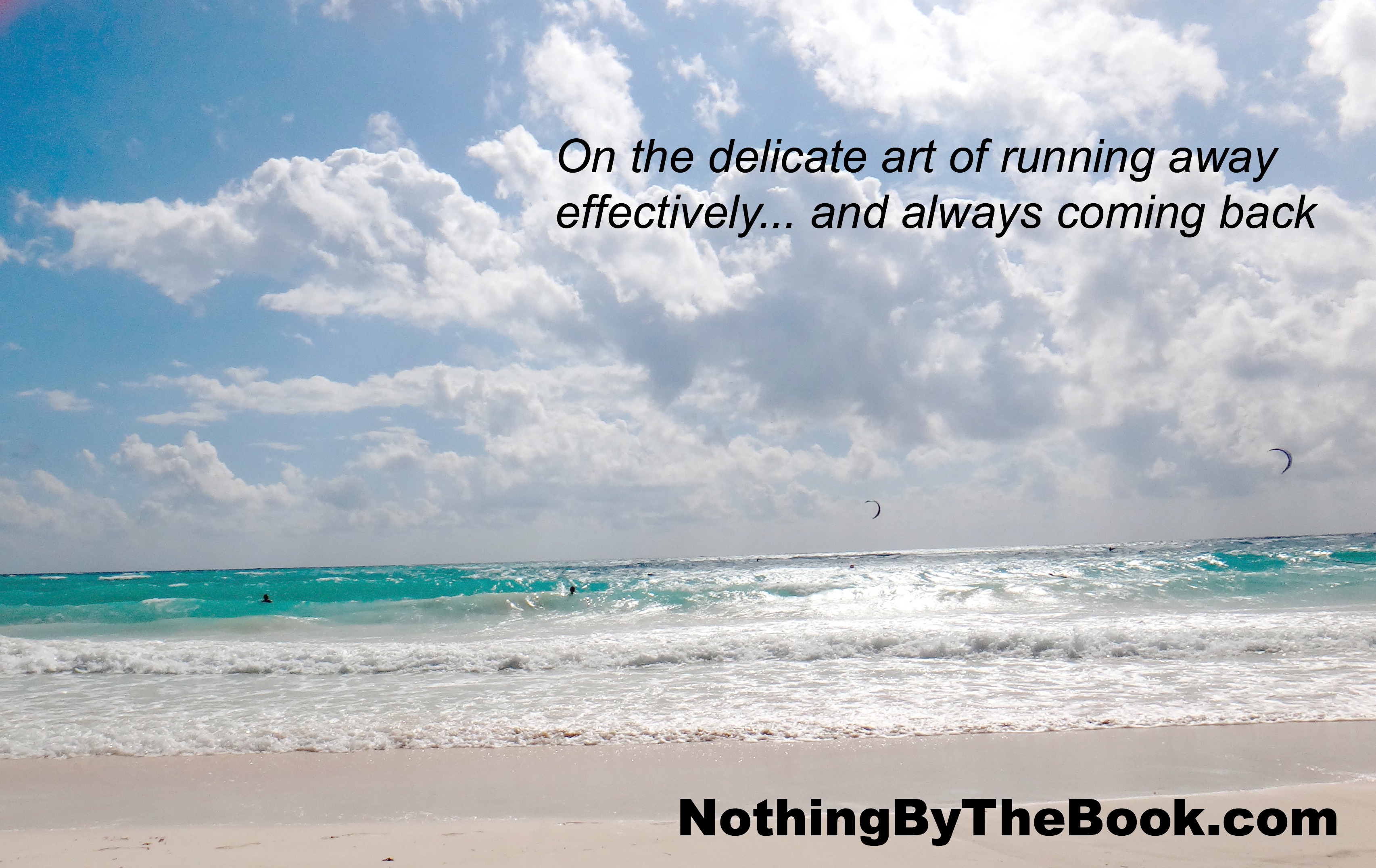
** They need us so much, don’t they? Lest you think I advocate motherhood-martyrhood, please also read this: On the delicate art of running away… and always coming back.

*** It’s not supposed to be like that. The real secret to working at home with children is to get the children—or yourself—out of the house. More here: The naked truth about working from home, the real post. For more of my children’s encounters with clients and sources on the landline, see The naked truth about working from home, the teaser.

Next week… a surprise.

Looking for me?  Find “Jane”

“I just want my kids to be happy!” Really? I don’t. Here’s why…

Flora is bent over her loom, all concentration. Fingers sore, forehead creased. Snap! Something goes wrong—it’s all undone, all that work for nothing! She sobs in frustration. Starts again. Forehead creased. So focused. Happy? No, not so much.

Cinder is building worlds in Minecraft. He’s changing—hacking—a map or mod. Nothing’s going right. And finally, when it does—the Internet crashes. Then his computer freezes. “Fuck!” he screams. Restarts the router, the computer. Runs around the block a few times. Returns to his project. “This sucks! I’m so angry and frustrated!” he tells me as he sits back down at the desk. Swears some more as he waits for his applications to boot up.

Ender is trying to make a perfect “O.” No, he’s building a car ramp. Wait, he’s fiddling with his brother’s Lego. Now he’s reorganizing the kitchen pantry. “Mom? Is there anything I can cut?” I give him the tray of mushrooms, an aging cucumber, a cutting board, a knife. He massacres the vegetables. Focused. Determined. Happy? I don’t know… certainly not when he nicks his finger, bleeds, and needs a bandaid…

I’m bent over my laptop, salty water leaking out the corners of my eyes. I’ve just finished and sent out another assiduously, arduously tailored pitch and in the time I’ve been working on it, four new rejections pop into my in-box. Four. One of them back so quickly I know the recipient didn’t even bother reading the covering email, never mind the requested 50-page pitch package. I am deflated, battered, rejected, exhausted, angry, discouraged, oh, and in tears. Happy? Ha! I want to curl up into the fetal position on the filthy floor of the public washroom of the cafe in which I’m working* and wail at the universe.

I splash water at my face, wail to a friend via text, accept comfort and almost believe it, eat a chocolate croissant. Get back to work. Happy? No. But… moving on. In pursuit.

In pursuit, but not of happiness. I think the “just do what makes you happy,” “I just want my kids to be happy,” “Surely I deserve to be happy!” way of thinking—this cult of happiness North Americans pursue and sell to the rest of the world via their movies, ads and products—contributes to the First World epidemics of depression, entitlement, overconsumption, constant dissatisfaction. If we are taught—inculcated—with the idea that we are supposed to be happy and in pursuit of happiness—if not at always, at least most of the time, we are doomed to be disappointed and dissatisfied—if not always, at least most of the time.

I don’t want my kids to be doomed, disappointed or constantly dissatisfied.

And so, I don’t want them to “just be happy.”

Because happiness is a mood. A transient mood at that. A symptom, a byproduct, a reflection. A feeling.

It is not a goal, an achievement.

Now, beloved, listen to this: I’m not at all depressive or negative. I feel bliss frequently, and when I don’t experience it for a while, I will chase hits of dopamine as often, with as much abandon, maybe more, as you do. I think it’s wonderful to feel happy. And I absolutely want my children to feel happy, often, frequently, sustainably.

But I don’t “just want them to be happy.”

I want them to be… fulfilled. To know how to get full. And how to fill others. I want them to be purposeful, to have purpose, and live lives of meaning. I want them to be resilient. And grateful. To contribute, build, create, change. Help. Love. Be loved.

I want them to pursue difficult things. To glow with success and satisfaction when they succeed—to cry and mourn and to learn and find a way to move forward when they fail. I want them to know how to think… how to persevere… and you know, also, how to give up. Because that’s a skill too, and sometimes, you’ve got to stop beating your head against the wall, step away, and look around for a rope ladder with which to climb over that wall… or maybe a sledgehammer with which to demolish it…

I want them to be… human. Alive. Fully alive, aware. And that means: they will be sad. So sad. Angry. Thwarted. Frustrated. Discouraged. Disappointed. Battered. Rejected. Full of suffering, angst.

And then, later, or even at the same time, they will be in the flow, productive, thrilled, ecstatic, stoked, oh-so-happy.

But in the pursuit of something other, grander, more important, more meaningful, bigger than “just being happy.”

Flora walks out of her martial arts class head held high, but on the brink of tears, and they come when she’s safe in the car. “I think I did well,” she gets out between sobs. “I don’t think I screwed anything up. But, oh, I’m so upset! So anxious and unhappy right now!” When she gets her new belt… she will be ecstatic, walking in air. So-happy.

Cinder calls me to come see what he’s build. It’s taken hours. It’s beautifully complex. He’s spent. But so satisfied. He barely remembers how much swearing he was thrusting at the computer screen earlier in the day.

Ender crawls into my lap in tears. He wants to see his cousin, he wants to go to Legoland, he wants to have Ikea meatballs for lunch, he is so-so-unhappy, life is terrible, awful, he is exhausted. I read him books; he falls asleep. I am exhausted too. Happy? In this moment? No. But… fulfilled. Determined. Purposeful. Conscious. Aware.

I kiss his forehead, cheek as I tuck him in. Feel a shot of bliss and happiness. Enjoy it for a moment… then traipse down to the laptop. Stare at my cracked-spiderweb screen. Take a deep breath. Start writing. Seek flow, creation, accomplishment…

Happy? No.

Better.

xoxo

“Jane”

I just want my kids to be happy-not.jpg

*Cafes, my office away from home. Because a) flood and b) reconstruction and c) the secret to working at home with kids is to run away from them.

Looking for me? I’ve revamped the for-stalkers-and-bloggers-and-no-I’m-a-real-sane-fan! section: Find “Jane”

Next week on Nothing By The Book: The return of Cinder and Ender penis stories, Flora’s interpretative dance of the new math, and Jane’s surrender to existential angst (also possibly in interpretative dance).

This week in my real life: My real self wrote this column The CEO has a uterus: no, wait, the problem is that he doesn’t. It’s sort of going to change the world and you should check it out.

Moving from guilt to gratitude

I am sick, so sick, achy, feverish, exhausted, so-tired-I-don’t-think-I’ll-even-make-it-to-the-bathroom-even-to’-I-really-need-to-puke-tired…

(Digression-justification: I am obscenely healthy. I hardly ever get sick. And so, when I do, I’m pretty sure I’m going to die. Your husband’s man-flu, for which you mock him mercilessly? Forget it. I’m worse.)

I’m so sick, so-tired-barely-conscious, my rational-disciplined self is incapacitated, and the rest of me chooses this moment of physical vulnerability to assault me emotionally and mentally with… GUILT.

I feel guilty… oh, where do I begin? I feel guilty that I’m sick. That I’m not working-billing. Working-family-raising. That I didn’t get up with the kids. Actually I don’t even know where they are. Are they awake? Are they home? Are they alive?

I feel guilty that I’m too sick-exhausted-I-think-I’m-dying to really care…

I  need to get myself to the bathroom—but I can’t move, I can’t move—and the door opens and my beloved comes in with a puke bucket.

As I retch—I’m pretty sure this isn’t just the flu or the latest reiteration of whatever gastro-intestinal bug is floating around, it’s the plague and tomorrow I will be dead—he tells me he’s cancelled my appointments for the day and his, and the kids are fine, and is there anything else I need? Ginger tea?

I moan something incomprehensible and don’t hear his response. I’m too busy feeling guilty. Not just guilty that he’s taking care of me and the kids. No, that wouldn’t be self-flagellating enough: I’m guilty over our entire lifestyle. Guilty that our work allows my husband to be there for me and the kids on a day like this. We’re so stupid-lucky, elitist-privileged, bubble-wrapped.

So guilty.

I even start to feel guilty about this: if he had a shoot or a client commitment today that couldn’t be rescheduled—there are a dozen people he could call on to help. And they would be there for me, for us. In a heart beat.

As I start to inch my way across the bed to get away from the smell of the barf bucket, I realize that I’m  feeling fully and acutely guilty over being supported, connected. Loved.

That’s when my rational-disciplined self, however close to death it feels, snaps. Can’t take it anymore. And wallops its whiney-guilty counterpart upside the head.

“What’d you do that for? I’m sick! I’m dying! And I feel so GUILTY because…”

SLAP!

My rational-discipline self plays hard ball when roused. IT is on the brink of either slapping the rest of me again or, worse, delivering the mother of all lectures on…

…the door creaks open. “Ginger tea?” my beloved says. And… I am flooded with gratitude.

Gratitude for the tea. For the love that brings it. For the support behind it. For my entire life and everyone in it.

Why is guilt so much easier to indulge in than gratitude is to feel and practice?

I don’t know.

Perhaps it’s because guilt is selfish and self-focused… while gratitude requires humility and awareness of our interdependence, our vulnerability.

I drink my ginger tea. Puke it up almost immediately… then drift off into a feverish-restless sleep-coma-no-not-death.

But I slip into unconsciousness bubble-wrapped in gratitude.

xoxo
“Jane”

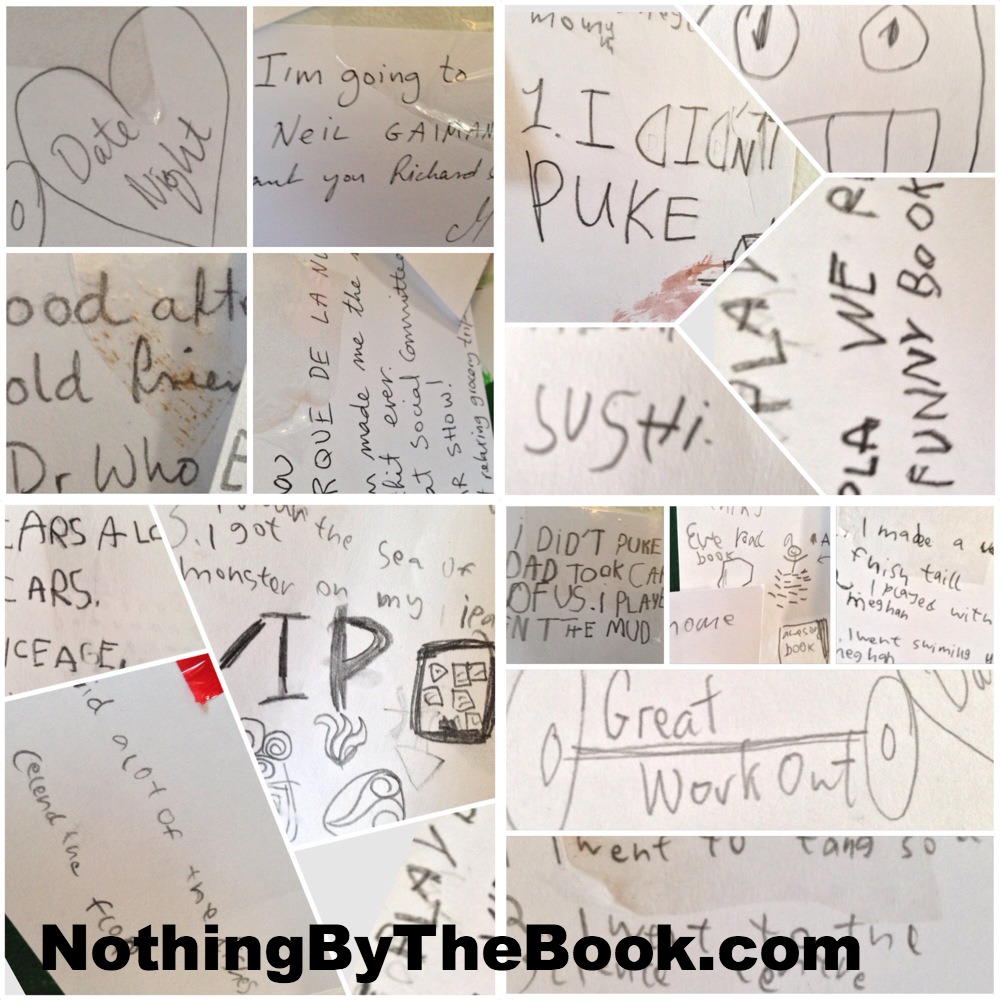
P.S. A. Deathbed experiences make me sappy. Sorry. How do they affect you? B. Clearly, I lived. Thank you for asking. But just barely… I’m pretty sure it was the plague. C. For the last few weeks, Cinder, Flora, Ender and I have been constructing a “Things That Went Right” wall. It’s a simple, fun project inspired by Martin Seligman’s gratitude journal exercise in Flourish: every day, each of us thinks of and writes down three things that went right that day. Three good things. Three exciting things. Or three ordinary things. The week of my plague, “I didn’t puke” was THE good thing each of the kids flagged. It’s all about perspective, right?

What Went Right

P.P.S. Tirzah Duncan aka The Inkcaster wrote a marvellous post about her freeing and beautiful take on beauty last week, and I’d love for you to read it: Beauty is far from skin deep.

For those of you deep in the toddler trenches, pop over to Stephanie Sprenger at Mommy Is For Real for a refresher on the concept of disequilibrium… and a tongue-in-cheek (or is it?) proposition of the massing of transitionin-disequibiriumiated (fine, it’s not a word, but you know exactly what I mean…) toddlers in a toddler “Red Tent.”

Looking for me? I’ve revamped the for-stalkers-and-bloggers-and-no-I’m-a-real-sane-fan! section: Find “Jane”

On the delicate art of running away… and always coming back

I.

I am still, hot, languid. Utterly relaxed. I am fully, completely obligation-free. I am—did I mention? Still. Zen. And no one is budging me, no one needs me.

I am bliss. But no, that’s not right. Not bliss. I am just… still. I am paused. I am not doing. I am barely being.

I am—I was, for I am now back, but more on that later—I am “run away.”

(You might think I should have written “I have run away.” But I haven’t done anything. I AM. I am run away.)

II.

I’ve reached that terrifying age when, instead of wedding invitations and “We’re pregnant!” announcements, our friends are separating, divorcing. That one-in-two statistic? Playing out, in full force, among my friends, my loves. Sometimes, it makes sense (“How on earth did those two ever get together and stay together long enough to make two children?”). Sometimes, it hurts as much as if it were my own closest relationship being torn asunder (“But… but… you two are so… but I love you both! No!”).

Sometimes, they agonize over the decision, discuss, torment, suffer together for months and years before ending it.

But sometimes, he, or she, runs away, leaving the other partner, the family, in shock.

Runs away, and not metaphorically. He doesn’t come back from a business trip. He ends the marriage, the relationship, the family… by email.

Her friends rally around her. Condemn him (it’s not always him, of course; sometimes, it’s her. But in my life in recent years, it’s been mostly him). Show their unconditional love and support for her by unexamined anger and malice against him. “Rat-fuck bastard.” “Dickweed.” “Good men, sane men don’t do this.”

I go home and cry in my husband’s arms.

Because, you see—I get it. I get the desire to run away. And I get how, if the nature of this most intimate of relationships is such that you cannot articulate your (past-and-present) frustration, your (in-the-moment) unhappiness, your (intermittent-but-it’s-been-here-much-too-long) angst, your children-are-exhausting-the-house-is-killing-me-work-sucks-life-is-a-slog-right-now-and-I-don’t-know-what-to-do-about-it feelings… if you cannot articulate all that to the person you come home to, sleep with… one day, you will snap. And run away, fully. And not come back.

III.

In a life full of obligations, in a house full of three young children, I am mistress of the five-second, five-minute run away. I turn my back on the buttsacks ransacking the living room and screaming at each other, and give my attention fully, completely to the taste of chocolate. To that first, scalding, fabulous sip of coffee. I disappear into the bathroom. The bedroom. Put all the kids in the car… and then don’t get in for a while. Sell them to a neighbour and go for a walk alone. Lie very still in the sun while they run on the periphery of my vision, awareness…

Sometimes, I run away without actually physically moving. Just into my head, into my thoughts.

“Mom! You’ve spaced out again! Come back!”

I come back. I always come back.

But—I come back, willingly, only because I know how to run away… Does that make sense? I acknowledge my need to run away. And I fill it.

Five seconds. Five minutes. Easy.

Five hours—I need to plan for. Carve out. Insist on, when obligations get too intense. A full life—and a life with children, with family, with meaningful work, is always full, no matter what else you add on to it—is full of things that must be done. For me, running away for five hours here and there—that’s something that must be done too. It must happen.

IV.

Being present and being “in the moment” is all the rage in parent-lit and pop-psych right now. But it’s just as important to recognize, I think, that being sane requires being absent sometimes. And respecting, feeding that need in yourself.

If you don’t—if you deny it—when you snap—and you will snap—and you run away—you will not come back.

V.

I am, for the first time since I’ve had children, run away for… seven days. For seven days, I am still. On pause. Totally obligation free. Absent-from-children-marriage-house-work. Present-in-self. And sometimes, even not really present-in-self. Just… fully, completely, gloriously run away. Absent.

(I was going to run away to write. Instead, I sleep. I am still.)

VI.

I come back.

I come back—so here’s the thing—I come back NOT re-energized, not full of pep-and-zeal-and-new-plans. Better. I come back with “still” within me. I infect my children, my husband, my neighbours with it.

Not this still: My life is still busy. My house is still a disaster (my four-year-old asks his six-year-old friend if their contractors are also “incompetent m@th#rf*ck%rs” and I turn brick red as my elder two children waggle their eyebrows at me… “Where did he learn that from, huh, Mom, huh, Mom?”). My existential angst is still here (always will be).

This still: When I need to be fully present—I am, and I can give that freely, un-resentfully. Gratefully, even. When being present becomes fucking exhausting, too much—that five second, five minute run away makes me… find that still. Pause.

And—most importantly, perhaps—lets me come back quickly.

Reminds me, also, of how critical that five hour run away is, and to not neglect it, no matter what.

VII.

I’ve always know this about myself. That I need to withdraw, disappear, be absent from whatever/whoever it is that most often demands my presence (attachment parents, take note). I’ve (usually) done this, guilt-free. Joyfully. Occasionally, with a degree of almost-wanton abandonment.

My life partner has known this about me too, even before I fully-truly articulating it for him.

But here’s the funny thing: despite seeing, honouring and facilitating my run-aways for me… he felt guilty about his desire, his need to do the same.

There is nothing unique about my desire and my practice of being run away (or yours). There is nothing unique about his guilt (or yours). Worse, there is nothing unique about our—and yours—inability to articulate this need… never mind to our closest loves, but even to ourselves.

And if you cannot articulate your (past-and-present) frustration, your (in-the-moment) unhappiness, your (intermittent-but-it’s-been-here-much-too-long) angst, your the-children-are-exhausting-the-house-is-killing-me-work-sucks-life-is-a-slog-right-now-and-I-don’t-know-what-to-do-about-it feelings… if you cannot articulate all that to yourself… never mind the person you come home to, sleep with… one day, you will snap. And run away, fully. And not come back.

(“Didn’t you say something pretty much exactly like that already?”
“Indeed, I did. I say it again. I don’t want you to miss it.”)

VIII.

I am back.

I will need to run away—I will run away—I will BE run away—again. For five seconds, five minutes, five hours. When finances and circumstances permit, five days, maybe more (but first, the Daddy gets to run away for a longer stretch; it is only fair).

Because I know how to run away, I will always come back.

How about you?

Art of Running Away NBTBxoxo

“Jane”

P.S. My friend Sarah at Left Brained Buddha turns almost 40 this week, and meditates on this age and stage in a lovely way. Have a read: This is Almost 40.

“Who are you wearing?”—clothes as message, value, consciousness

whoareyouwearingmom

I.

Flora: Mom? Can we go to that store again?

Jane: Which store?

Flora: You know. The one where we get all of our best stuff? Where I got my unicorn purse and cherry necklace?

And I laugh and laugh, and hug her, because she’s talking about Value Village, a thrift store chain.

The last time we went to Value Village, she and I, we spent an outrageous $80 and bought two pairs of winter boots, a faux fur coat for Flora’s Cousin It costume, a red leather 70s trench coat for me, three hats, a stuffed snake for Ender, and a new Christmas dress—clearly unworn by the donator—for Flora. Plus, a double-scythe for Cinder’s Halloween costume.

II.

Ender: I need an orange shirt, orange pants, and orange socks.

Jane: I can do an orange shirt and orange socks. You don’t have any orange pants.

Ender: Can we buy some?

Jane: Maybe.

Ender: We have to. I only wear orange now.

We compromise on green with dinosaur designs. I promise to keep an eye out for orange pants next time Flora and I go to Value Village. Which is… about twice a year.

III.

I dislike stores. Shopping. Both the actual act, and the metaphor. My children dress in the largess of clothing-hand-me-down chains—there are many, many benefits to living in a real community—and in the results of the retail therapy of their grandmothers. They are thoroughly and completely unfamiliar with designers, labels. At best, vaguely aware of the names of stores where one buys new clothes.

You snicker and tell me all this will change when they are teenagers. Perhaps. That’s fine. They are their own people, for all that they are my children. They will make their own choices. All I can do is lay a groundwork, a foundation—of habit. And, I suppose, although I hate to use such a value-laden word: of values.

IV.

But what values? I struggle to articulate them even to myself without accusing myself of hypocrisy. Because it’s not that I don’t care about clothes, how they look—how they make me feel. I care, very much. I may leave the house with a naked face, always and without reflection or compunction, but I never leave the house wearing a burlap sack.

Or yoga pants.

I think of clothes as both uniform-mask and canvas-expression. Sometimes, they are a barrier between me and the world: they protect me by the message they send. Sometimes, they are the opposite, their message is an enthusiastic, unhidden manifestation of everything I am or want to be. Every once in a while, the message is a secret, or an in-joke. I wear the scarf she gave me to carry her with me through the day; the purple pants I hate for you because you love them and I love you; I wrap myself in the coat my mother bought me to remind myself how much she loves me.

I don’t denigrate the power of clothes, what they communicate, what they mean.

V.

Flora pulls out a soft, well-worn sweater out of the bag her friend’s eldest sister dropped off at our house. “Oh, I will love this one,” she says. “I will make so many good memories in it.”

VI.

I don’t denigrate the talent, skill and power of designers, either. I like—love—beautiful clothes. They don’t just happen: they need to be dreamed. Created. Marketed. Sold. Copied and made affordable—or donated, passed on down the line, until I can claim them at the thrift store, consignment boutique, or out of the back of a friend’s closet.

I don’t resent what other people spend on clothes. Why would I? While the jeans I’m wearing today cost $6 in a clearance pile at Superstore (but they make me look so fucking good) and my winter jacket is a $22 third-hand U-Turn purchase (but so mod, I love it), I’m also wearing a $200 bra. And my shoes, while 15 years old, were not bought on sale. We all have different priorities.

I don’t denigrate the mom who lives in her yoga pants, any more than I judge the exec in her Armani suit. (I notice her shoes; covet them.)

VII.

So, back to the question: what foundation, what values? I suppose it comes down to consciousness, conscious choice. Not blindly copying what’s worn on the runway, by the celebrity, by peers and friends. But thinking about—why? To what purpose? At what cost?

Who are you wearing? Why? To what purpose, message? At what cost?

“Jane”

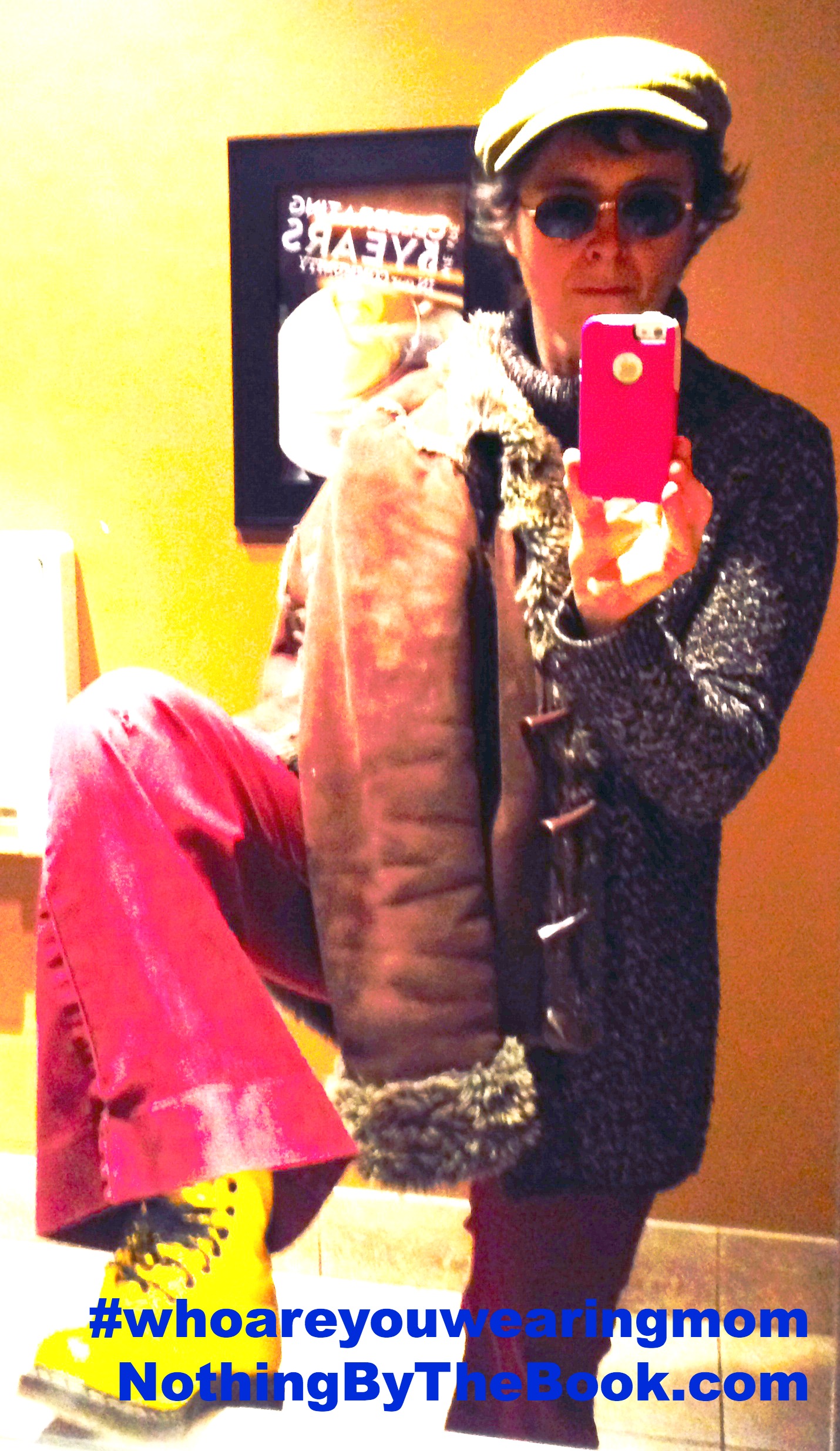
The wardrobe: Third-hand cap from the Peacock Consignment Boutique, $12. Sunglasses from Value Village, $6. Coat from U-Turn, $22. Top (obscured by coat) from friend’s closet, free. Jeans, from clearance pile at Superstore, $6. The yellow Doc Martens that are my calling card when I wear sensible shoes… bought brand new.

This post was written as part of the “Who Are You Wearing?” Moms Vs. The Award Season project masterminded by I Am The Milk’s Katia Bishop, and originally inspired by the #365feministselfie initiative (She calls it “#365feministselfie meets red carpet” which is just brilliant, don’t you think?) If you’re going to play–the link’s below, and use  #WhoAreYouWearingMom when you share.) who-are-you-wearing-2

Here’s who THEY’re wearing:

Katia at I Am The Milk

Jen at My Skewed View

Jean at Mama Schmama

Sarah at Left Brain Buddha

Stephanie at Mommy, For Real

Deb at Urban Moo Cow

Sarah at The Sadder but Wiser Girl

Kristi at Finding Ninee

Rachel at Tao of Poop

Want to play? Do it here: Powered by Linky Tools Click here to enter your link and view this Linky Tools list…

Naked face politics

There is no preamble, no set-up. She simply looks at me and says:

“Mom? Why don’t you ever wear make-up?”

And I look back at her, and pause. And ponder. What do I say? It has been years—not decades, but more than a decade, more—since I’ve thought about my always-naked face. What does she need to know? What does she want to know? Should I tell her that I’m too practical-busy-lazy, that when one naps in the middle of the day with babies and toddlers, one doesn’t want to smear mascara-eye-shadow-foundation on pillows? Sort of true, maybe, except I don’t think that’s quite how it happened.

I can’t quite remember when or why I chose a naked face. Or if it was even a choice…

I could tell her it’s because I exercise in the middle of the day and I love that clean up involves nothing but the quickest of showers, a wipe with a towel.

I could tell her it’s an aesthetic thing and choice and preference, one devoid of any merit, because most of the women in her life dress their faces, and I love them, she loves them, and I want her to honour their choice. And, in a couple of years, she will long for mascara and eye-liner and blush and all those things—I wallpapered my face enthusiastically as a teenager too—and I don’t want her to, ever, think that I’m judging her, denigrating her preference of the moment.

If she was older, I might tell her that in my experience lovers always prefer the taste of naked skin to the taste of cosmetics… but no, not now, I won’t tell her that.

I could tell her I like my skin. My eyes. My lips. Just the way they are. And I like to smear on lipstick for special occasions, sure, but it gets on wine glasses and her daddy’s shirts and… TMI. Stop.

I could tell her… oh, so much. Too much. I’m an anthropologist by training, after all, and I know too much about the “why” theories for most of humanity’s quaint customs.

I don’t know what to tell her, because she’s an almost-pre-teen girl in a sick culture that warps beauty and body image and aesthetics and personal choice and turns everything into a weapon, a war, a conflict, an assault on her own sense of beauty and self and joy, and oh, why-does-raising-a-daughter-have-to-be-so-fucking-hard and oh, why-do-I-always-overthink-everything, why-can’t-I-just-say, “Because I don’t want to” and be done with it?

I should tell her… what? What the hell should I tell her?

But then, she answers herself:

“Is it because it wouldn’t be fair to the other moms? Because you’re so beautiful already?”

Flora, my most beloved child, I’ve said before I know I’m not supposed to have a favourite… but at moments like this… it’s really hard for your brothers to compete with you.

I wrap my arms around her. Press my naked face against her naked face. Kiss her. Love her. And she says:

“We’re so lucky we’re so beautiful, aren’t we?”

Flora, my most beloved. We are. You are. Hold on to this feeling as you grow.

“Jane”

N.B. I wrote this post before Avital Norman Nathman of The Mamafesto brought the #365FeministSelfie project, masterminded by Veronica Arreola from Viva La Feminista, to my attention. Naked face, painted face, happy face, sad face, angry face–REAL face. Real people. An aesthetic of the real, as seen-captured by the subject, without a mediating eye. That’s power. And also… play, joy. I’ve been in since Day 2. Come celebrate the reality of you with me, on Twitter or Instagram with #365FeministSelfie–or, you know what? Privately. Just for yourself. There’s power in that too.

The photos, Week 1. Do I love them? One of them is awesome. Two of them make me cringe. All of them are me.

Naked Face Politics Pin

“Mittens?”

We come out of the warm YMCA building, the chlorine scent of the swimming pool still clinging to us. Ender, with the determination only a four-year-old possesses, drags his sled down the stairs. Clunk, clunk, clunk. Slam! It lands on the bottom. He looks over his shoulder. Scowls at me. He’s tired. Hungry. Probably, despite the snowpants, sleeping-bag-jacket, and over-the-face toque, cold, because it’s the coldest, snowiest December YYC has seen in 112 years.

He plops down on the sled in a Buddha pose.

“Mittens?”

I ask, kneeling down beside him.

“No! My hands are NOT cold!”

He’s tired. Hungry. Contrary. It’s at least -15 Celsius.

I shrug. Get up. Start pulling the sled.

It’s a beautiful, clear night. The air feels clean—sparkling—even as it hurts my lungs, bites at my exposed cheeks. I pull the sled on the cleared-of-snow-but-there’s-so-much-of-it-everywhere-I-kind-of-want-a-snowmobile paths. Look at the twinkling lights. The sleeping-bag-parka-engulfed people. Turn my head.

“Mittens?”

“No.”

I shrug. Start walking again, my hands warm in my mittens. I think of what 2013 was, and what 2014 might be. I think of milestones, real and artificial. I think of hope-despair-desire-acceptance-creation-destruction-reconstruction. A plot line emerges from all those thoughts, a fascinating one, and I hear a conversation in my head that sets it up, and I fall in love with it, but it doesn’t really fit into what I want to do, ultimately, with that piece of work, and then my thoughts leap to the unBloggers Manifesto I want to write for Nothing By The Book for January, a polemic that in its current form is not doing quite what I need it to do, and I know it’s because I’m pulling too much into it, going off on too many tangents, and for a piece of writing to work, it needs to be focused, and a polemic piece of writing needs to be brutally so, digressions and tangents only work if you pull them back, at just the right time, to the central idea, the theme… or the chorus…

I turn around.

“Mittens?”

“No. Not cold.”

Mittens Pin

I cross the bridge. The lights are beautiful and almost make me forgive Christmas its existence. And I think about… beauty, definitions of, abstraction of, and that thought takes me to my daughter-who’s-about-to-turn-nine, so beautiful in mind-soul-body that it makes me ache, so full of potential and wonder that it’s that thought, and not the cold air, that stops the breath in my throat for a second… and I think about all the ways that I think fail her as a mother, all the ways that I am not what she needs, and tears swirl in my eyes—but maybe I am what she needs? And, really, what a silly question, because I am what she has and she is what I must learn—and, tears still dancing in the corners of my eyes, I turn my head…

“Mittens?”

He shakes his head. I never imagined motherhood to be this—so full of such intense joy and such paralyzing pain. So full of summits and valleys. So glorious, so rewarding—so fucking heart-wrenching. And that thought takes me to twelve different places at once, and I’m not sure how much self-awareness I want to chase in this moment, so I choose to chase the idea that self-awareness, for all the pain it brings, is also a source of power and that takes me to such very, very interesting places…

“Mittens?”

His hands are folded in his lap, and he’s bent over them. Head bopping. Falling asleep. He bops up. Scowls at me.

“Mittens?” I repeat.

“No.”

I walk faster. Over another bridge. Through the steam rising from the cracks in the ice of the river. I look at the water, ice, snow, steam and feel a shot of resentment and fear. I try to see beauty… and not next year’s flood waters. And I grit my teeth and don’t chase that thought. Find another. Oh, this one I like… I smile—my nose runs, because it’s so cold—my mouth opens and I almost stop moving because all I want is that thought and, irreverently and irrelevantly, I also glory in the fact that it came to me in this moment when I am alone… except I am not, because I am MOTHER and I am never alone, even when I am.

I look over my shoulder…

“Mittens?”

“Not! Cold!”

I can’t really run in my boots and on the snow, but I walk as quickly as I can. Home, home. I cannot wait to be home, and not just because it’s cold, and I love that thought, that feeling. I want to get home.

“Mom? My hands are cold.”

I’m about… what? 200 meters away. Maybe less. I kneel down beside the four-year-old. His hands are pulled into the sleeves of his sleeping-bag coat. I blow on his fingers and slip on his mittens. Kiss the tip of his nose.

Do not lecture, and so, enjoy the brief victory of mind over impulse. Pull the sled the last 200 meters home.

I wish I could tell you that the next time we go out in the cold, he says “Yes” the first time I try to put on his mittens. But he won’t.

I wish I could tell you I will never again doubt that I am what my daughter needs or let my thoughts go to all those other unproductive, painful places.

I wish I could tell you that, somewhere between the YMCA and home, I found the answer to EVERYTHING. Because how awesome would that be?

But, I just want to tell you this: You can fight over the mittens. Cajole, badger, plead. Force.

Or you can wait for those little hands to get cold.

And when they do—put on the mittens. Silently. Without the “I told you so’s.” Or too many expectations for the next time.

Fuck, yeah, it’s a metaphor.

Jane

P.S. Happy New Year, beloveds. I am torn what to ask of 2014. In the closing weeks and months of 2013, I rather wanted a less eventful year. But now that it’s here… eventlessness is so boring. And unfulfilling. So, 2014—be eventful. Be FULL. I’ve got plans for you. And you’d better be prepared to rise to the occasion.

P.P.S. “Jane, why are you anthropomorphizing a calendar construct?”
“Because… Metaphors. So useful.”

Coming sometime this month: the unBlogger’s Manifesto. Minus all of its digressions. Or maybe not. Focus is key. But it is digressions that make life and thought interesting…

P.P.P.S. “I love this! I want more!”
“I am so pleased. Connect with Nothing By The Book on Twitter @nothingbythebook, Facebook, and Google+. Or, for a not-in-front-of-the-entire-Internet-please exchange, email  nothingbythebook@gmail.com.”

Why insomniacs, obsessives, the mildly neurotic and the otherwise troubled and imperfect make better parents

It’s 2:13 a.m. and I am very, very awake, listening to shadows, watching noises (it’s 2.13 a.m. in the morning—that’s when one listens to shadows, you know), and alternating between looking my demons straight in their frightening faces or hiding from them behind empty “life is good” mantras.

Tip-tap-tip-tap. A tiny little body hurtles into the bed, crawls in beside me.

“I can’t sleep, Mama!” the four-year-old lies, and, as he curls up against my body, falls back into deep, deep sleep. I inhale the smell, essence of him. He becomes my non-empty mantra…

Tip-tap-tip-tap. Flop. A not-so-tiny body clambers into bed between her Daddy and me.

“Mom? I had a horrible, horrible nightmare.”

I hold her. She whispers the dream, already fading, into my ear. Closes her eyes. Minutes pass. Maybe hours.

“Mommy? I can’t sleep.”

I tell her to try a little more, a little harder, a little longer—but before long, we both give up on sleep and the bed, and tip-tap-tip-tap downstairs. I wrap her in blankets and put on a show for her. Get her a bowl of cereal.

“You’re the best mom in the world,” she says, and that disarms one of the demons that was keeping me awake. I could probably sleep now. But—I look at the clock—it’s now 5 a.m., and I often write really well at precisely 5 a.m. …

I’ve often had erratic sleep patterns, both in hard times of high stress and in glorious times of high creativity and excitement, and I know that my own knowledge and acceptance that sometimes—often—an uninterrupted eight hours of sleep just wasn’t going to happen—helped me be a better night-time parent. When my littles woke me up at night—and woke me again and again—I was able to take it much more in stride, I think, than an adult who hasn’t known insomnia. An adult for whom the pre-child norm was a solid uninterrupted eight. Who hasn’t been NOT able to sleep, no matter how physically exhausted—no matter how much she really, really wanted to.

It’s always easier to accept what we’ve experienced ourselves—to understand what we’ve also lived. Especially… if we accept that part of ourselves. If we don’t resent it, fight it, hate it.

Sometimes, I can’t sleep.

Sometimes, I get angry. Irrational. Bat-shit crazy, really.

Sometimes, I don’t want to be with people. Not even the people I love. Not even, my most beloved, you.

Sometimes—I don’t want to eat. I know it’s delicious and you worked really hard to make that meal… but I’m just not hungry. Not at all. Or just not for that.

Sometimes, I don’t want to do the fun thing you planned for me to do. I just want to curl up on the couch with my book. (Or blog ;P)

Sometimes, I procrastinate. And procrastinate. And don’t do that thing that I really ought to do before I do anything else…

Sometimes, I’m moody and unsettled.

Sometimes, I’m completely obsessed with this one utterly unimportant, irrelevant thing, and you can’t distract me from it no matter what you do…

Sometimes—oftentimes—my kids, my mate, other people I love, have exactly those same feelings, needs.

Knowing, accepting—not resenting, not hating—those parts of me makes it easier to accept, to love those parts of them.

Being utterly, completely imperfect makes me a better parent. A better friend.

How about you?

xoxo

“Jane”

photo (17)

P.S. What? I’m versatile. Sometimes, I’m utterly sweet and sappy. Sometimes, I’m an elitist bitch with a tongue like a guillotine. Imperfect. Deal with it. Love me as I am or screw off.

P.P.S. Recent posts in a similar vein from my tribe: Stephanie Sprenger pens a lovely Letter to my daughter who is just like me and Kristi Campbell wishes she was a more perfect mom.

P.P.P.S. If you’re a YYC or AB floodster and you’ve been sent here to read THAT post, and you’re a little confused about what the hell is up with THIS post, you are at the right blog. You’re looking for this: After the flood: Running on empty and why “So, are things back to normal?” is not the right question.

##

Why I love them

I.

Why I love her:

Her bead work spills and runs all over the room, everywhere, everything wrecked, hours of work, destroyed, and:

Flora: Aaaaaaaah! There are not enough bad words in my vocabulary to express how I feel right now!

photo (15)

II.

Why I love him:

Cinder: Want me to turn off Mom’s computer so you can learn a few new ones?

(He doesn’t. So I really love him. And he makes Flora laugh.)

photo (14)

III.

Why I love him:

Sean: Oh, sweetheart. Want Daddy to help you pick them up?

IV.

Why I love him:

Ender: Moooooom! Look how brilliant I am! I am swinging from this rope, upside down, holding all my snakes with my feet! AND, I have a pencil in my nose!

Proof I love him: I take the pencil away. My wholesome neglect and permissiveness only go so far.

photo (16)

V.

Why they love me:

Jane: I am in a piss-bad mood, stressed, and possibly completely insane. No one talk to me, and more importantly, for fcksk, no one listen to anything I say!

VI.

Oh, how they know me:

Cinder: Is it because I was a big buttsack* all day?

Ender: It’s because I peed in the garbage can, not the toilet.

Flora: I think it’s because Mercury’s in retrograde.**

Sean: I’m going to run out and get some chocolate.***

* It’s a metaphor. Don’t think about it too much. Don’t. You did, didn’t you?

** Also, how you know we live next door to a psychic.

*** I really am that easy.

xoxo

“Jane”

P.S. So… apparently half of Calgary needed to read Tuesday’s After the flood: Running on empty and why “Are things back to normal?” is not the right question post. Thank you for the tremendous response. I’m on deadline and behind on everything non-billable, but yes of course you can share it, reprint it, reblog it, and photocopy it (although … wouldn’t it be easier to just email the link?). Thank you.

P.P.S. Flora was Cousin Itt. Cinder was–creepy. Ender was sometimes a dragon and sometimes a dinosaur–anyway, a reptile with an identity crisis.

After the flood: Running on empty and why “So are things back to normal?” is not the right question

photo (12)

He asks the question with a smile, as a casual opener before we move on to “real” issues, and is shocked and appalled when I burst into tears because, well—I don’t cry.

“Are things back to normal?” he says and immediately wishes he hadn’t said it, and doesn’t know where to go from there. And I’m shocked too—I don’t know where the hell those tears have come from, because I’m fine, we’re fine, everything’s just fine.

Except, of course, it’s not.

We had this flood in YYC and Southern Alberta back in June, you may remember (my flagship post about it was unLessons from the flood: We are amazing, and if you want facts, visit the evolving Wikipedia entry  or the Calgary’s Herald’s The Great Flood of 2013 page), that devastated my neighbourhood and so much of our city. An army of citizen volunteers turned out in the tens of thousands to respond to the crisis. It was amazing. It was euphoric. It had us walking on air and out of crisis mode in a couple of intense weeks.

People were asking a week, two weeks after the flood—as soon as the rivers receded, as soon as most of the debris that was our basements, our houses, our possessions, our lives, was taken off the streets and into the dumps—“Are things back to normal?”

And in late July, August, euphoric, proud, we could smile and say, “We’re out of crisis mode.” And maybe talk a little about insurance, and the Disaster Recovery Program, and plans for reconstruction. And laud our mayor’s leadership and bitch out the provincial government and, you know, do all those “normal” things.

I’m not sure when “normal” got harder to fake. Maybe in September, when we’d reconnect with people we hadn’t seen for a few months, and they’d say, “So—did you have a good summer?”

Funny—we are so socially programmed to be inoffensively happy and placating, the autoresponse to that question, which the mouth starts to form before the brain has a moment to reflect, is, “Yes. And you? That flood thing? A minor inconvenience. Moving on. Going to Disneyland!”

I did not have a great summer. We did not have a great summer. And things are not back to normal. What does that mean, anyway?

I look at him as if he can give me the answer, but of course he can’t. And he’s never seen me like this before, or under stress before, but he’s spend the summer ripping out friends’ basements, and they’re none of them quite “normal” right now either. But they’re not talking about it. “We’re fine, everything’s fine.” So what’s going on? What’s up with us, what’s tearing us up, as we move into month five after the flood?

I struggle to put it into words.

The obvious answer is that reconstruction is not going well. The rip-outs, it turns out, were the easy part. Putting things back… Well. We’re all at different stages. Sunnyhill’s probably further behind than many others because of our need to rehabilitate all 41 damaged units simultaneously. But I don’t know anyone who was affected who’s totally “done.” Most of us—all of Sunnyhill—have been back home for a long time. But we’re living in reduced, scarred spaces. An eternal mess. That’s hard. I know every time I walk in and out of my front door, every time I see the ripped door casings, the dismantled walls, the hole where my hall closet used to be, my jaw tightens.

So. That kind of sucks. But—really—I’ve been through renovations before. Who hasn’t? We are, I tell him, the mildly inconvenienced. We know this. Bitching and complaining about naked joists, drywall dust and “what the hell did the contractors do now?” seems like such a First World Whine. And that’s the other thing.

We feel bad—guilty—over feeling bad. Because. India. Colorado. Fuck, High River.

That sure doesn’t help.

He refills my glass. He tells me about his friend, whose house is fine but whose rental property was devastated, and how guilty she feels that her own personal loss wasn’t greater. That she was, ultimately, only financially inconvenienced, while her tenants lost—everything.

Stupid, I say.

Human, he counters.

I start crying again. He gives me his napkin to wipe away tears, snot. I hide my face.

We’re exhausted, I say when I can talk again. I’m the mother of three young children who all went through severe insomniac stages—and I’ve never been this physically exhausted. And it’s not from physical labour, the way it was during the crisis. We were entitled to be exhausted then, right? But now—others are doing the work (or getting paid to do work the results of which we’re not seeing, I snarl, and I laugh, and he does too, because that’s “normal” for me, much more normal than these uncontrolled tears). We’re just doing the everyday stuff—well, a little more, and so much of the everyday stuff is more difficult, but… Not entitled to complain. Not engaged in heavy physical labour. And, frankly, letting a lot of the everyday stuff go. Never did one thing to the flooded garden this year. Cleaning windows? Ha. I barely clean the kitchen. And my kids have never eaten so much take-out, ever. So what are we exhausted from?

Living? he says, gently.

I shake my head.

Frankly—I look at him through the wine glass, and it’s the refraction of light through liquid that blurs his features, not the water still swimming in my eyes—frankly, we’re exhausted from being so fucking positive and amazing. We know we pulled off a miracle. We were awesome. We were strong.

And now we’re really tired, and we’re done—except, of course, we’re not done.

Because things are not back to normal.

But tears aren’t swimming in my eyes anymore and I heave a sigh of relief.

Jesus, that felt good, I tell him. And then—I’m so sorry. We were supposed to talk about…

He interrupts me, waves my apology away. And he tells me—how he’s been struggling. Trying to figure out how to be a good friend to his floodster (we don’t do the victim thing in YYC, and survivor’s a rather dramatic term, don’t you think?) friends post-crisis, and feeling at a loss. And how he needed to hear this as much as I needed to tell it. And how he will never ask anyone in any of the affected Calgary neighbourhoods “Are things back to normal?” ever again.

We laugh. Order dessert. More wine.

In this moment, although things are not back to normal, I’m fine. We’re fine.

Or, at least—you know. Functional.

• 

The writer engages in overt emotional manipulation, both to achieve a level of release and to communicate that which is hard to articulate. My family and friends won’t finish reading this post—they’ll be texting me in a panic before they get to the end of the first paragraph. Chill. Although things are definitely not back to normal—and for the love of any and all of the gods I don’t believe in, do not ask your flooded (or otherwise whacked by life’s events) friends and neighbours if things are back to normal, ok? Just don’t—life is unfolding as it must. And in my own beloved little corner of the flood plain, we are all doing what must be done. And—because we’re a community—we’re helping each other through it. (And possibly drinking too much wine, but. So be it.)

But if you’re on the hills and edges of the flood plains—if you’re on the edges of any life affected by a traumatic event—and you’re struggling to figure out how to help your friends who are clearly post-crisis but equally clearly not-ok, do this:

  • Listen. Don’t tell us how strong, wonderful, amazing, or lucky we are. Just listen. Let us feel bad, sad, frustrated, furious. Tired. We know we’re amazing. We kind of need permission to be… whiney.
  • Connect us to help. If you’re a local reader and you need to help a local floodster, a good starting point is the resource list provided by Alberta Health Services here. But babe, remember how I was telling you during the crisis to see the need and fill it, how saying “How can I help?” isn’t enough when people are in shock? Sending your friend the link or telephone number may not be enough. Walk the line between empathy and obnoxiousness as best as you can, but a “May I call and make an appointment for you?” is likely more helpful than “Here’s a link I thought you’d find helpful” email. For your hard-core entrepreneur friends who don’t want to do stress-relief acupuncture and roll their eyes at sacrocranial therapy etc. etc., the Canadian Federation of Independent Business has some hard-core resources—that include getting connected with counsellors if that’s what you need.
  • Recognize that we’re not as… full, or resilient as we used to be. And so—take less. In a way, take more—we’re not as patient or tolerant as we used to be either. Nor necessarily as rational. Deal with it. And, if you can, look for ways to fill us up. (Preferably not just with wine. Although that sometimes does do wonders.)
  • Invite yourself over. Our scarred houses are difficult to love right now. Sometimes, company is difficult to seek out. But isolation really sucks. Come on over.
  • Invite us over, or out. Our scarred houses are a little oppressive right now, but suck us in with all their demands. Get us out.

For my neighbours, who are awesome, and doing all the things. But who are also exhausted and running on empty, and need to have those feelings acknowledged and respected. (Especially my beloved L. So much love and appreciation for all that you’re doing.)

For my friends, who helped so much, and who are always trying to help. In the most creative, occasionally disturbing, ways. (Yeah, I’m talking about you. I’m not saying it didn’t work… but that was really weird. Still. Thank you.)

And, for myself. Cause I really needed to cry.

Cheers.

photo (13)

“Jane”

Sat., Nov. 2nd P.S. You’re breaking my heart but also feeding my soul with what you’re sending to my in-box. Yes, you are free to share this piece wherever you think it needs to be heard. The private place to cry is nothingbythebook@gmail.com. Much love. J.

Share This: Unplanned Twiblings, a birth story of international adoption

It’s about to happen again, in Aisle 9, just as I successfully navigate the kids’ bulky side-by-side double-stroller, past the mountain of soup cans and stop in front of the supply of diapers. The stranger smiles at me and beams at the kids. Makes straight for us. And I know what she’s going to say before it comes out of her mouth, it’s what they always say: “Ooooh! They’re adorable! Are they twins?”

That’s the opening paragraph of the coming-to-motherhood story of one of the most amazing women in my real life, Evelyn Ackah, a Calgary business immigration lawyer. I met Evelyn when Ender was growing in my belly and when she was actively pursuing adoption as a single, black professional women. We were expecting together–and her “pregnancy” was much longer and emotionally much tougher than Ender’s merely biologically difficult gestation. I’ve been privileged to witness her story and as her babies turned two, we thought the world should really hear about her path to motherhood through international adoption, as a single, professional woman of colour. I reached out to one of my former editor at The Globe and Mail (that would be one of Canada’s national newspapers to my Yankee and global readers) who connected Evelyn with the fabulous Jane Gadd who edits The Globe‘s Facts & Arguments page. If you read The Globe, you would have seen Evelyn’s story featured on The Globe and Mail’s Facts & Arguments page  on the Wednesday, October 23, 2013 as Why my kids aren’t twins but twiblings.

Evelyn called the original version “Unplanned Twiblings,” and she’s graciously allowed me to share the full, unedited version here. Enjoy. May her story inspire you–and make you think.

Unplanned Twiblings

by Evelyn Ackah

It’s about to happen again, in Aisle 9, just as I successfully navigate the kids’ bulky side-by-side double-stroller, past the mountain of soup cans and stop in front of the supply of diapers. The stranger smiles at me and beams at the kids. Makes straight for us. And I know what she’s going to say before it comes out of her mouth, it’s what they always say: “Ooooh! They’re adorable! Are they twins?”

I do what I always do. I smile. Nod my head. And thus, effectively, lie. Because they’re not twins―they’re three-and-a-half months apart, actually. I call them my twiblings. My beautiful, unplanned twiblings. But that answer has a backstory that’s too long and complicated to get into with a stranger in a grocery store aisle or that other mother at a playground, who’s pushing a stroller with “real” twins or the people in the waiting room at the doctor’s office.

They all ask. And, much of the time, when they ask―even though I usually do feel the question is intrusive―I am grateful, very grateful, that they do not ask, “Are they yours?”

Mine. They are mine, my children, my family. The end of my journey to become a mother, and the beginning of my parenting adventure.

I always knew I was going to be a mother. No question. The future held a child, maybe two. And when, in my late 30s, I had to accept that my body would not be the route to motherhood, my long-term boyfriend and I immediately looked to adoption. My vision of the future, in 2007 was clear at the time. We took the courses, underwent home studies and dealt with the copious amounts of paperwork becoming an adoptive family entails. I would be a mother. An adoptive mother. I was excited about the process. We planned to adopt from my native country of Ghana, West Africa.  Unfortunately, as Ghana is not a common destination for international adoptions, it was uncharted legal and procedural territory. Every step had to be discovered. And every step took much longer than anticipated.

In 2009, still unmatched in Ghana, I had to revise my vision of my future once again. My partner and I split up. I was 39, single, and with a very demanding career. What was I going to do? Pursue adoption as a single professional woman or give up the dream?  I had no illusions: I knew parenthood wasn’t all smiles and roses. I knew it was a lifetime commitment and incredibly hard work. Could I do it?

Could I afford to wait until I would not be alone?

In the end, I decided that my desire to be a mother was separate, or perhaps even greater, than my desire to be a wife. I was not going to put my adoption journey, already two years long, on hold and wait for the right man to enter my life before continuing. I would do it on my own.

It was, frankly, a difficult, terrifying decision.

But not nearly as difficult as what came after. Between early 2009 and the spring of 2011, I was matched with three children in Ghana. Each match fell through. Each one was heart-breaking and devastating. I was not sure how much I could endure.

I decided to look closer to home, at Canadian private adoptions. And I was shocked to find out how difficult it would be to be chosen to adopt in Canada as a single woman.

My continued research led me to the United States, where I found out certain states accept and encourage single parent adoptions. I settled on Florida as the best fit, both in terms of the legislative process and the fact that there were more children of colour available for adoption. I may have given up on adopting from Ghana… but I still wanted a child that looked like me.

Do you understand how important it is to me, when people see me and my children, that they don’t automatically make an assumption that they are “not really mine,” that they “must be adopted” because their skin, hair, eye colour is different? Think about that the next time you see a Caucasian dad with an Asian daughter, a white woman with a black baby. Don’t ask them, “Are they yours?” “Are they adopted?”  If you must say something, simply smile, and say, “What a beautiful baby or child.”

I was chosen by a family to adopt their fifth child within weeks of starting the application process. I was delirious. I skyped and talked on the phone with the family throughout the final few weeks of the pregnancy. The baby was born, a healthy baby girl. My mother and I had plane tickets booked to fly to Florida… and the day before we were to leave, the birth family parents changed their minds. They were going to keep the baby.

Another heartbreak.

I am a strong woman, truly. But this… I took to my bed. I could not work or think – nothing.

I booked a trip to Mexico for my mother and me to get me away. And again―the day before we were to leave for Mexico―the agency in Florida called. Another match.  A baby boy, born three days ago. The mother picked me, loved my application and album and was ready to sign all the papers immediately. Was I coming right away?

No.

I can’t quite put into words what was happening to me―I was mourning that little girl that I thought I was going to adopt. I didn’t even have nay boys names picked out. I was in such pain, I could not be happy about this turn of events. I was terrified I would be heartbroken again.

My mother and I went to Mexico. It was supposed to be a week on the beach―we lasted four days. And then, we flew to Florida.

And I met my son.

I fell in love with him―immediately and repeatedly. My world spun, and changed. I was a mother. I was a mother! I was sleep-deprived and living in an apartment hotel in Florida, doing all the final paperwork required to take him home. My plate was full. So full.

So of course, that was when I got the call from Ghana. A little girl had been identified. Four months old. Was I interested?

No. Absolutely not. I wasn’t even going to go there. Neither for another heartbreak, or for parenting two children as a single mom. No. Absolutely not.

But after a couple of weeks and lots of family meetings and promises of support, I decided to go for it―somehow it felt like things were meant to be―things had come full-circle.

I would not meet my daughter for another 14 months. I am still both regretful and grateful for that year. I was able to take her out of the orphanage and place her with my extended family in Ghana, so she spent that year surrounded by lots of love and attention. Both she and my son spent the first year of their lives effectively as only children, first children, and I am grateful for that. And I talked and Skyped with her constantly. But yet―she was so far, far away. And was she real? I knew how intensely I loved my son, the impact of his physical presence on me. Could I love another child this much, ever?

I learned birth parents often feel this way when expecting their second―yet she was the oldest child! And when I finally met my daughter, when she was 18 months old, my heart leaped out of me and into her and she was mine, as much as my son was mine. We were a family.

And now, I push a stroller with my twiblings, who are both well into the terrible―er, terrific―twos. I don’t want to underplay it or sugarcoat it: life as a single mother of two little people is challenging. The path to motherhood for me was hard and full of heartbreak and disappointment, and the real journey, the one that begins when the children came into my home, into my life, is emotionally and physically exhausting. And yet so worth it. These are the children I was supposed to raise.

My twiblings.

Evelyn Ackah is a business immigration lawyer with Ackah Law, a Western Canadian boutique practice focused exclusively on business immigration law. Born in Ghana, raised and educated in Vancouver, the one-time Torontonian now lives in Calgary with her two beautiful children.

• 

P.S. You can tell she’s fabulous just from this story, right? If you want a more detailed peek at her professional life, here’s a profile I wrote about her when she was “just” a source and not a friend.

P.P.S. Next week on Nothing By The Book, I think I’m going to tell you why I’m so tired of being an adult.

On wanting to eat cake, magic pee, fairies, adult temper tantrums, and sub-performing grey matter

I.

Flora: Blow out your candles, Ender, blow them out and make a wish! … And what did you wish for?

Ender: I wished that I could eat some cake!

See? Wishes do come true. And I suppose this is the point at which I should make the obvious sappy comment about how maybe happiness is just about … wanting what you can get.

Maybe. But how incredibly boring and safe would such a life be? If all you ever wanted was the cake that was put, that moment, in front of you?

II.

“To ensure peak performance, your mom needs eight hours of peaceful, uninterrupted sleep each night. This will never happen, but it’s important to set goals.”

“Remarkably, despite their size, moms can sleep on as little as three inches of bed. Science has no explanation of this.”

from M.O.M.* (Mom Operating Manual),
written by Doreen Cronin and illustrated by Laura Cornell
*batteries not included

III.

Flora: I really hate the people who think science explains everything.

Jane: Really? Why?

Flora: What about all the things science can’t explain? Like unicorns? And fairies?

Jane: Um… well…

Flora: Don’t you dare give me another evolution lecture. I WILL believe in fairies.

All right, my beloved. Believe. Believe.

IV.

My brain is slow. The hamster that operates the wheel is lazy. The machinery is worn out. I’m grasping for words, simple words, all elusive, out of reach. Clumsy sentences. Awkward paragraphs. Lack of motivation, desire, ability to finish, to start. Nothing is working. Nothing is right. I’m stupid. Incompetent. I poke at the keyboard. Stare at the screen. Howl.

Cinder: See, and this is why I don’t think it’s fair when you lecture me about getting mad at the computer when I play Minecraft.

Jane: I want you to be better disciplined and better behaved than I am.

Cinder: Probably not going to happen.

Probably not. But. We always hope, don’t we. We always want them to be better than their imperfect parents.

V.

“Should your mother be experiencing a minor malfunction, your best option is simply avoidance. Tiptoe quietly to another part of the house until the coast is clear.”

“If you cannot leave the room, camouflage can be very effective during minor malfunctions. Silence is key. … Take your surroundings into account. If you are behind the sofa, a tall leafy branch is probably not a great idea.”

from M.O.M.* (Mom Operating Manual),
written by Doreen Cronin and illustrated by Laura Cornell
*batteries not included

VI.

Ender: Mama, I did it! I peed in the potty!

Jane: Oh, Ender, that’s… there’s nothing here.

Ender: It’s imaginary pee. Flora can see it.

Of course.

VII.

I do all the things that need to be done. Always. I force that goddamn hamster in my brain to perform, no matter how lazy he’s feeling. Meet every deadline. Then, do all the things that didn’t get done while I was doing all the things that had to be done. Well, maybe not all of them. But—a few.

And now, I’m trying to get hamster to get this post across the finish line—even as he tries to convince me that his higher purpose right now is to have a nap. And that while he naps, someone—the fairies, maybe?—will come and oil his wheel and the rest of my machinery, and everything will magically work better soon.

I scowl at him. Eat cake. But then—choose to want more. Always.

Because life is supposed to be full. Interesting. Hard.

xoxo

“Jane”

photo (11)

P.S. M.O.M.* (Mom Operating Manual), written by Doreen Cronin and illustrated by Laura Cornell is a brilliant picture book, targeted I would say at four to six-year-olds, but my entire crew howled as we read it. Check it out. If you’re in YYC, we’ll be returning our copy to the library shortly. But you probably don’t want to wait for that. It’s $14 and change at Chapters-Indigo.

*batteries not included

Ferocious Five

Did you guess where I am? I should have packed more painkillers. Fortunately, there are drug stores and hot tubs everywhere. While I’m away–you know where I am, right? Figured it out?–a bunch of my friends have daughters who are turning five in the next little while. Here’s a recap of Flora’s Ferocious Five.

IMG_0615

2007. Flora is five years and three weeks old today—the three weeks is important, as important as the “half” was when she was four and a half. She’s just come off a very long—for our healthy, active girl—illness, almost two weeks of intermittent fever, sore throat and cough, sniffles and overall body aches, with two days of puking thrown in at the start just for fun. She’s physically well now, but weak. And fragile. Each of her nerves and emotions is exposed to the harsh air of every day life, and the smallest of life’s trials rub her raw and send her spiraling into misery.

It’s driving us mad.

We’ve been here before with her. She celebrated turning two by being sad for three weeks, non-stop. (Funny thing about time: at the time, we thought it was months. Perhaps an entire year. Fortunately, I keep records. It was three weeks on the dot, 21 days of almost incessant crying, over everything.) Between three and four—and especially on either side of three and a half—life thwarted her at every step and she barely survived (us too). At four and a half there was a brief—six days, but oh dear god what a six days—reprisal.

So this is Take Four of Flora being uber-fragile, and I’m trying very hard to approach it as a yet another opportunity handed to me by the universe to crack the Flora code. (We successfully cracked the Cinder code when he was two [this post is coming to the blog Archives soon!] and haven’t been significantly challenged in our interpretation of it since then; Flora is proving to be more complex. Perhaps we women really are.) However hard, each take has offered amazing insights and lessons. The first time around, when she was two and in tears, the lesson to us was simple. Happiness comes from within. We cannot make her happy or peaceful—it is not, indeed, our responsibility to make her happy. The best we can do is provide a certain type of environment, some coping tools—but the only one who can make Flora happy (or not) is Flora.

The lesson of Take Two was more nebulous, and it wasn’t really about Flora. It was about me and you (yes, you, the reading you, the you walking past my yard, the you I pass on the park path, the you paying a visit to my house while she’s having a meltdown). In a nutshell, it was: you don’t matter. Your opinion doesn’t matter, your reaction to Flora or to my reaction to Flora or to anything else that’s happening right now in Flora’s world doesn’t matter. Sorry. You don’t want to hear that, but I need to remind myself of it, throw you out of my mind, and focus on me and Flora. Then, I need to put me to the side—I’ll come back to me later, recharge, re-examine, ponder exactly why I was feeling the way I was and wanting to react the way I was, I’ll do all that, but later.

Right now, with you and me out of the way, I need to focus on Flora, I need to help her cope, work out some tools that she can use to help find herself, work through whatever inner turmoil she’s experiencing right now, and come back to a place of balance. This moment is all about her, and I need to surrender to that first. Only then can I help her… and maybe helping her just means being there while she can’t help herself. And then, when there is a moment when she wants and needs and is open to help—then, I step in. Without my baggage, without making this about me—much less you—but just her.

This lesson is much harder than calculus and I’m still studying it, reviewing it, intermittently failing it, because, at least some of the time, I want you to approve of my and my child and my parenting.

Flora—the current, five year old Flora—is stirring on the couch beside me now making whimpering unhappy noises as she wakes up from a quasi-nap, and I’m revisiting the second part of the lesson. Not about me. About her. What does she need? (Part of me says, a kick in the head.) Apparently, she says, her whole self covered with the blanket. Translation: control over her surroundings.

Take Three’s lesson was simple, so long as Take Two’s lesson was mastered. Repeat: it’s not about you or me. It’s about her. In capital letters: It’s about HER. Between three and five, children are as purely and completely selfish as selfish can be. They’re not psychotic, unsocialized, undisciplined: they just are. Purely, beautifully selfish. The world is all about them, and that’s all that matters to them.

This can suck to the rest of us having to live in the world alongside them. Until, that is, we realize that developmentally speaking, this is normal and inevitable… and it is possible to “work” with it. Asking a child in that stage to do something—or stop doing something, or, ha!, feeling something—because of the effect it has on other people is a recipe for frustration. They can’t comply: they don’t hear you. Oh, they can learn to fake complicity through coercive discipline. But they don’t get it. The world is about them.

At four and half, and into five, I know this. Flora’s world is all about her. In retrospect, on either side of five, Cinder’s world was all about him too. But he manifested it in a different way and it was easier to live with. It was all about doing stuff. For Flora, it’s about feeling stuff. Waaay more complex.

So, here we are in Take Four. Obviously, for me, part of the lesson here is a remedial review of Take Two. It’s not about me. It’s all about her. This part, I’m doing pretty well on. I need to work a little bit more on the fact that you don’t matter. And also, I need to flip the fact that it’s not about me on its head. I actually need to make it about me: that is, seize each of these moments as an opportunity to work on ME. MY response. MY feelings and MY expression of them. MY understanding. What am I doing in this moment and why, and can I be the me in this moment that I want to be? Can I be that me just a little bit longer? One more minute? Another after that?

People pay big money for transcendental moments like this: they go to workshops, retreats, read books, meditate… and lucky me, motherhood is delivering these life-changing, self-reflecting opportunities to me just about every day…

First published in Life’s Archives, January 27, 2007, with this note: I wrote this post more than two years ago. Flora is now seven and three and a half months—she could probably tell you her age precisely to the day, perhaps the hour. And while we are not in “Take Five,”  we are still learning our sensitive, fragile Flora. She’s learning us too—the selfishness of five is long gone, replaced by hyper-awareness to the feelings of others, and hyper-despair when they are negative. Sometimes, this hyper-awareness makes me long for the selfishness of five. But that’s a topic for a future post.

More like this: Searching for Strategies for Sensitive Seven and Emotional Eight 

Also see: Five is hard: can you attachment parent the older child?


I’m the adult: not burdening children with responsibility for fixing our black moods

I’m so angry, I’m vibrating. You know that feeling? When you’re not sure if it’s the world around you that’s shaking or your innards? I’m so angry, I want to scream, stomp, feel my fist crash into something hard and preferably breakable…

Instead, I get into the car with all three of my kids. Safe, eh?

Close my eyes. Take a deep breath. Sternly tell myself: “Thy truck is not a weapon and you will not feel better if you mow down an unfortunate pedestrian.” Take another deep breath. Try to get the world to stop shaking.

Fail.

Grip the steering wheel. Start driving.

The two little redheads in the backseat are oblivious of my mood. They’re talking to each other, over each other. Excited about where we’re going.

The older, messy-haired blonde in the front seat beside me… he picks up on every nuance. And he starts to talk to me, frenetically. About the Redwood Forest. The new Redwood biome in Minecraft about which he’s so excited. He offers story after story, asks question after question, trying to lure me out of my anger, hate, blackness.

I don’t realize what he’s doing, not right away. I answer monosyllabically, barely hearing him through my anger. And then, suddenly, something he says—or maybe the way he says, the pitch of his voice—breaks through the fog, the blackness, and I stare at him in horror.

He’s trying to fix me.

He’s trying to make me feel better.

He’s taking responsibility for making my black mood go away.

…and here you might think, Jane, what the hell? Why the horror? Why is this a bad thing? Oh, it is. Hold on. Read on.

“My beautiful boy,” I say, and I reach for his hand, and squeeze it. “I appreciate… I very much appreciate what you are trying to do. But it’s my bad mood. And I’m the only one who can get me out of it. Don’t—don’t take it on yourself.”

He frowns, doesn’t understand.

But it doesn’t matter. Me realizing what he was doing—enough. I grit my teeth one final time. Take one—two–three–more breaths. Wish I could close my eyes, but there’s a semi to the right of me and a cement truck to the left, so I just shake my head side to side.

I’m not happy, not tranquil or joyous. But. I am sane. The black fog of anger recedes.

At this precise moment, the two redheads in the backseat—oblivious to everything but their own interaction and joy—start up a chorus of:

Ender: Fox in box. Fox in box. Fox in box.

Flora: Moist. Moist. Moist. Moist.

…because they know just how to push my buttons. But, I’m sane again, so I just yell at them in the usual Mom way—not the psycho bitch from hell who will devour you alive if you say one more word you little beasts way. They giggle and fall silent.

Cinder keeps on talking about the Redwood Forest, but now only because he wants to, not because he’s trying to jar me out of blackness.

Not his responsibility. Never.

Do you understand?

Do you understand the danger of making a child feel responsible for taking you out of your foul mood?

Not for putting you in a foul mood. That’s different. I’ve got no qualms at all about saying, “Mommy’s pissed off because you dumped the potty over the balcony and stuck a crayon up the dog’s butt.”

But when when I’m unhappy—when you’re unhappy–when you and I are angry, black, broken, all those ugly, ugly feelings that come on all of us (and always at the most inconvenient times, no?)—it’s our job to work on ourselves and get ourselves out of that dark place.

Or–a therapist’s.

Not our children’s. It’s not their responsibility. Not their burden.

Never.

They’ll take it on, you know, if you don’t stay aware. And I’m not crazy or dogmatic: a little love and care from the people around you, even the little people, when you’re down, is a beautiful thing. Nothing like a hug or a bowl of chocolate chips put into a frazzled mother’s hand at just the right time to turn a hard moment around.

A little love, awareness, affection. A beautiful thing.

Taking on responsibility for fixing a parent’s, an adult’s blackness?

Not their responsibility. Not their burden.

Ever.

xoxo

“Jane”

Cinder long messy hair unhappyP.S. Don’t worry, the black mood is gone, and I love everyone and everything again. Well, maybe not everyone. Or everything. But–all the important people. And enough things. But. Anger as a parent. A terrifying thing, is it not? Close your eyes (unless you’re driving). Breathe….

Photo: Cinder in an unhappy mood of his own. But, if I recall right, this was had a very direct cause: swarms of pre-flood mosquitoes the size of hummingbirds with the appetites of vampire bats.

P.P.S. My social media whoring outreach efforts continue, so if you love me, follow me on Twitter:  or like Nothing by the Book on Facebook–or both? Why don’t you do both?

Or, add me to your circles on GOOGLE+: Jane Marsh on

If you’re looking for the real me, or want to follow my YYC Twitter feed,  .

And now, a few words about parasites, getting ostracized, and serial communists

Ender on the Common a week and a half later. Massive clean up effort, by hundreds of volunteers. Thank you!

So here’s how it happened: I’m sitting on our beautiful unflooded Common* with some of my favourite people and wine is flowing and the fire is crackling and we’re talking about all the signs of “normal” that are returning to our lives: the police stopping speeders, peace officers handing out parking tickets, citizens complaining about “the City,” neighbours starting to rag on each other… And I start expounding, aided by the freely flowing wine, about how that’s THE thing about community that people just don’t get. That it’s messy and conflict-ridden and hard and…

… and I blather on, because this is a huge horse of mine in these post-flood days, and as I say, “And community IS full of assholes and parasites… and bitches and mean girls and…”—at that precise moment, I see the essay and I fall in love with it. Oh, yes. Community, such a fuzzy-wuzzy warm word, rose-coloured glasses and hugs and smiles and planting flowers and front porches and granola-making organic-gardening hippies—oh, yes. And the punchline of the piece—I love it, I feel my toes curl in anticipation of how I’m going to lead up to it—the punchline is going to be, “Community is full of assholes, bitches and mean girls. And parasites.” And I’m going to repeat it a couple of times in the piece, like a chorus, and I’m going to build it around the YYC Attachment Parenting Village, because oh-yes-oh-yes-the-contrast—the immediate association of baby-wearing-co-sleeping-gentle-discipline-mamas and the bitches and mean girls line, oh-yes…

So I write it, first in my head, and then on-line, and I touch a raw nerve, of course, but…

Fuck.

Not quite the one I intended.

Now, that doesn’t happen to me very often—because I am an extremely effective manipulator of feelings and reactions when I write, even on those rare occasions when I so fall in love with a phrase or a sentence that I build everything around that. But. Here, I own my failure. Clearly, if I feel so many of you—not so much those of you publicly commenting on the post on my blog, but those of you dissecting it in other fora and in particular those of you sending me emotive private messages about it—missed its key point, I’ve failed as a writer.

“Yo, Jane, first visit here. What the hell are you yammering on about?”

“Yo, welcome. This: Why you need to get off your shy, lazy introverted ass and start building your tribe RIGHT NOW. But you can finish reading this missive first before going back in time to misunderstand the first one… It mostly stands alone, after the next paragraph.”

So. I own my failure. Should have refined, revised. But. I think my failure is also part of this attachment to a utopian vision of community so many people buy into. D’you know what I mean? When I say tribe, community, you don’t think bitches, mean girls, assholes and parasites, do you? No. You think perfection, utopia, eternal friendship, unconditional love, and warm bowls of soup… and when you talk about building your tribe, finding your tribe you seek perfection and utopia—or at least a hell of a lot more of that than I do. And beloved, when you seek perfection in community, it will always, always, always disappoint you.

And I really, really, really want you to have a tribe. So I am now going to pick up a sledge hammer and whack your brain with it, very bluntly, three times. Ready? Three points. Hear them. Understand them. Or die alone.

Here we go:

1. Community is not selfless.

Community, tribe does not equal charity. Or unconditional help and support. Or love, peace and eternal grooviness. And, so, you see, community is not selfless. It does not act selflessly as an entity, nor do its members act selflessly as individuals. You get out of community what you put into it. But not in the way you think.

I’m not talking about quid-pro-quo/I scratch-your-back-your-scratch-mine kind of thing here. That, beloved, is called reciprocal altruism, and it’s an essential part of most social relationships. Social transactions in a community are more complex, and they work like this. Patty’s really sick, and so Anne watches her kids for weeks and Sarah pops in every few days with groceries. When Anne’s marriage starts to implode, Lucy steps in to watch her kids so Anne and her partner can go to counselling sessions. Sarah calls Anne every few days to check in on her. When Sarah has a new baby, Karen sets up a meal train for her… And so it goes.

That’s how community works. It’s a collection of bonds. See? That’s how you get out of a community what you put into it. Not necessarily—in fact, rarely—from the person you give it to.

Now… Sarah is not feeding Patty and checking in on Anne because she’s anticipating payback down the line when she needs it, of course not. She does all that because she’s just a good person, right? A good friend. She loves Patty. She wants to help Anne. But each of those acts builds her social capital. And when she needs it, the community will give it back to her. Patty may not help her out, because maybe when Sarah’s in need, Patty’s life will still be a mess. But someone will. Guaranteed. Because Sarah’s part of a community in which she’s invested.

But that community, it’s not selfless. Not at all. It only carries its parasites for a while. If Patty just keeps on collecting and never gives back—she starts getting less and less. And funny thing: it’s rarely a conscious, explicit decision. It’s not that the community gets together and says, “Patty’s a parasite and we’re done with her.” It’s more subtle. People notice, as individuals. And, as individuals, choose to send their energy and help elsewhere.

So, beloved. Don’t be a parasite. Give, contribute, build, help. When you can. Because you never know when life will force you to collect.

Reader freak-out: Are you calling me a parasite?

Jane: Maybe. Are you?

2. Community is supposed to ostracize.

Holy fuck, did you hear that? That was a thousand jaws dropping, rose-coloured glasses smashing into little pieces. And gentle readers unsubscribing en masse. But yes, beloved. You do not include without excluding. You do not define what something, some circle is without leaving someone outside it. THERE IS NO SUCH THING AS AN ALL-INCLUSIVE COMMUNITY. Every community, as it defines itself, defines who it includes within its circle and who it places outside them. Every community has rules. Articulated rules. And unspoken rules. And it punishes the members who break them.

Once, someone asked me to write up a piece on their little sub-community, and she wanted the dominant image to be “a diverse group of like-minded people.” Ha. You can be a tribe/community that values diversity up-the-wazoo—there will still be some type-a-thing you’ll exclude. Want to run a puppy mill in Sunnyhill? Get the fuck out. Not gonna happen. Crackhouse next door? No. Not part of what I want my diverse community to be, sorry. Joining an AP support group and looking for validation of your choice to sleep train your three-month old? Sorry. Wrong forum. A Richard Dawkins-loving atheist looking for affirmation in a creationist book club? Why the hell would you do that to yourself?

Community excludes and ostracizes. Rejects as well as embraces. That’s part of what it does.

Reader freak-out: You’re supporting ostracization and shunning and cyber-bullying!

Jane: No, I’m not. More on that in a future post. In the meantime, read the above paragraph again. Think about your tribes, communities and what defines them. What makes them what they are? Do their definitions truly exclude NO ONE? Really? Because I can give you a list of six people immediately that you would want to exclude out of your community, no matter how inclusive you claim it is. Community excludes. There’s no getting around that.

It totally sucks to be on the receiving end of that. Totally. Which brings us to sledge hammer point three:

3. It’s okay to leave.

We live in a really amazing, unprecedented world right now. For the first time ever, many of us get to choose our tribe, our community. We’re not stuck with the one we’re born into. We can work to change our community… or we can choose to leave. Find a new one. Start a new one.

This is an amazing, awesome and absolutely revolutionary idea. And it’s not true for all of humanity, and certainly not all of North Americans. But it’s true for me. All of my tribes, bar my extended family, are tribes of my choosing and creating. And I know it’s true for many of you. If you’re privileged enough to have access to the Internet and free time enough to surf and blog, you’re free enough to choose your tribe(s), your communities.

So. You can choose. You can leave.

As a new mother, I went through three different playgroups before I found one in which there was enough commonality between myself and the other women that I chose to stay and get to know them. As an adult looking for a “home,” I had two horrible misfires before finding my piece of beloved flood plane. As a fledging homeschooler, I’ve lost count of the number of on-line fora I’ve stumbled through before finding a couple that worked for me for a while… and then, decided to leave all those and start another that did what I needed such a forum to do… and no more.

You can choose. You can leave.

But… community is messy. And it takes time. And every, every, EVERY community has its assholes, bitches, mean girls, and parasites. So if you’re leaving all the time—if every time you encounter a community’s wart, conflict, friction, pain or dark side, you immediately run… oh, beloved. You will die alone and unhappy.

You will never find a tribe that works for you, my serial communist. Because… messy. Hard.

Worth it.

Reader freak out: Did you just call me a communist?

Jane: A serial communist, no less. What? You’ve got a problem with that?

xoxo

“Jane”

* What is this Common about which you keep blathering? The common green space onto which many of the units at our housing co-op back onto. My extended backyard. My world. The reason I can raise and homeschool three children in 1000 square feet of badly designed space. Where I meet my neighbours and entertain my friends. The most important physical space in my life. Do you have a Common? Get one. Make one. Turn your backyard into one by inviting friends over to hang and drop in—all the time. Take over a public park with friends—preferably at the same time each week, each day. Spread the word. That piece of green space in your neighbourhood no one uses it? Make it your own. Make it your Common. Community needs common spaces, and it needs them to be used. Loved.

PS Worth reading: The talented Katia Bishop, who usually blogs at I Am The Milk, had an article last week on MamaPop that really resonated with me: 7-Year-Old Girl Sent Home From School For Having The Wrong Hairstyle. Have a read… And a think. And if you haven’t yet read The AP Hair Style: I don’t brush my children’s hair. It’s a massive philosophical thing, really–well. Have a peak there too. But read Katia’s post first.