It’s not about balance: creating your family’s harmony

Ever since Cinder arrived and completely changed our universe, I envisioned life post-children as… family life. Not adult-centred. Not child-centred.

Family-centred.

I was lucky here, as I had had a pretty good model. My parents lived full lives, with us in them, part of them, along for the entire exhilarating ride. Among the legacies they’ve left me that I cherish is the belief that “parenting” isn’t a part of life, isn’t a job, isn’t a stage—it’s, simply, life.

Just life. Life with children, life as a family. We all struggle through this in the early days of the journey. We talk about the need for balance. Balance. I don’t really like that word in the context of family life. Because it’s not about balance, it’s not about give and take. It’s about… what? Harmony? Fulfillment?

It’s about every member of the family getting the nourishment he or she needs.

I want my children to be happy, fulfilled, loved, and respected—and me too, I want those things for myself as well. Both my children and I—and my partner, their father—deserve to be happy, fulfilled, loved, and respected. And we are happy, fulfilled, love, and respected… most of the time. (There are always bad days or, more precisely, bad moments. I think that’s another secret we learn on the journey: that bad moments can be just that, moments. Well, unless they become patterns. But that, again, is another story.)

In a family, when one member of the family isn’t feeling happy, fulfilled, loved, and respected—there are repercussions on everyone. It’s a situation that must be addressed.

Parents’ needs and children’s needs are often talked about in combative language, and words like compromise, sacrifice, trade-off etc. often make an appearance. It’s unfortunate—very Western—very unnecessary. Because it’s all just, well, life. Figuring out how to best get along, live, thrive—sometimes just barely survive!—as a family, in whatever the universe is throwing at you at the moment.

What does this mean for me as a mother of young children, for me as a person? Simply this: I did not stop being a person—with needs, wants, ideas, passions, biological rhythms and all that—when I had children. I added another layer of complexity—amazing complexity—loving complexity—complexity and experience I wouldn’t trade for anything else in the world. I am pursuing my life path, my life journey still.

My children are part of my journey, and they have their own, and I’m part of theirs… but their journey is not mine, just as my journey is not theirs. I am not putting my life on hold while I give them a dream childhood. I am still living my life, time is still flowing, stuff is happening. I’m just living it with my children. Different pace, different priorities than before, of course.

Balance? Life with young children is inevitably unbalanced. So I don’t seek balance. I seek harmony.

Sometimes I even find it.

In the end, this is the biggest secret power of women, of mothers–and of fathers, of parents–in the middle of the utmost chaos, conflicting pressures, we find a solution, we create our harmony. And it’s our harmony, our unique blend, formula, solution, to address the unique needs and challenges of the quirky individuals that make up our individual quirky families. No one else can create it for us; no one else can copy ours.

What do you aim for? Balance? Harmony? Something else altogether?

From Life’s Archives, Feb 21, 2008, Harmony, not Balance. It’s not often I pull out something I wrote about the parenting journey in the first years that still fully resounds with me… but this is one of those pieces. If I were writing it today, it would still be essentially the same. Well, more polished and more cohesive. I’m getting much more sleep these days.

Every Cathedral Should Have Stained Glass

Honouring the private lives of children

The insight comes at this moment: My children, 5.95 and 3.4 at the time, are on the floor in my living room/office, playing a rather odd game that involves some plastic dinosaur figures, a couple of Lego Exoforce structures, and a plot line that combines some kind of intergalatic battle with a game of hide and seek and a trip to Banff. They’ve just come down from upstairs, where they were hanging out in Sean’s “workshop,” which has numerous breakable things in it. I was not in there, hovering over them, to ensure they didn’t break the printer, put magnets on the hard drives, or brought the pile of intricately arranged video tapes on top
of the bureau crashing down on their heads.

I didn’t have to hover―not because they are “better” or more “obedient” children than the child who would do all that, but because they’re in a different developmental cycle. I have Sharpie marker traces on our (trashed) leather couch, basement floor and several stuffed toys from a different phase, after the onset of which the Sharpies were put away in a high, unreachable, unseeable place. There was a DVD destroying incident, after which Sean’s workshop was off limits for a long while.

The Sharpies are still away. The door to the workshop is once again perpetually open.

 That’s by the way (another by the way: the game on the floor below me, by the way, now includes a ghost haunting, and I’m trying to figure out how this fits into the previous going to Banff via intergalatic battle bit, but that’s probably just as irrelevant). We all figure out how to deal with the “in the moment” issues thrown at us by our children with ways that address the “in the moment” needs and fit into our big picture philosophy of life, more or less adequately.

Today, I want to put another issue on the table, the issue of 
privacy and the inner life of the child.

Now, my partner and I spend a lot of time with our children. Oodles. We both work from home. We homeschool. We could be together 24/7. And one of the breakthroughs for me on the parenting journey―it happened, as always, later than it should have–was that as they’ve gotten older, my children need more space, more privacy, more alone time. Not to the exclusion of time with each other and time with their parents and time with other people in their lives–but alone time, uninterrupted time to just be by themselves, to do their own thing without being watched (however unobtrusively), without being questioned about it, without having to account for that time.


Sometimes, when Cinder has a crazy day(s), one of the things that’s been missing from his rhythm is this alone time. He’s been with me and his sister 24/7 and frankly, he just wants us to go away, but that’s a hard thing to say to people you love, so he acts like a bum instead to make us go away. I’m working on giving him the words to say it, and helping him recognize that it’s ok
to say, “I just want to be by myself for a while.”

His sister recognizes this about herself much more intuitively. She will take a basket of toys into the bathroom and close the door on herself, announcing that she “needs some privacy.” And she’ll stay there for a long stretch of time, 30 minutes, an hour–until someone desperately has to pee because we only have one bathroom–playing by herself, being by herself, enjoying her privacy.

Children need a private inner life. This need manifests in different ways and is fulfilled in different ways, but I do think it’s pretty much universal–everyone needs some space in which to just be themselves, by themselves, without an audience, however loving or unobtrusive.

Filling this need, safely, as a parent, involves a whole lot of judgement calls. Cinder just wandered past my desk carrying a pair of scissors. I followed him onto the balcony, saw that he had a pile of construction paper on the table there, and retreated. Had he been three, instead of almost six, and heading towards his sister’s precious dolls (or head!), I probably would have stayed. Had be been heading somewhere with a box of matches―or for a box of matches―I would have offered rather obtrusive supervision. Judgement calls.

Cinder and Flora wrap up their focused (unsupervised) together time. They call me away from my own alone, private time and time of reflection, and we all three embark on a very complicated craft that requires my participation and very active supervision (“No! Melted wax is hot! Gah!”). And then they’re tired of each other, and of me. Flora takes a basket of toys to the bathroom. Cinder heads outside to run laps around the Common. When they come back to me, I resolve not to ask them what they were doing, what they were thinking.

Maybe they’ll tell me. Maybe they won’t. Either outcome’s okay.

Children have private lives and they need privacy. (Based on an April 2008 day and previously published list post).

What are your thoughts on the private lives of children? How do your children take their private time? How did you come to recognize this need?

sharpies!

The 2 a.m. phone call: why sleeping through the night is irrelevant

It’s 2 a.m. The telephone rings. It’s dark and I’m groggy as I race through the house for the telephone. I don’t get there in a time and I’m in a brief moment of panic as I crouch beside it and wait for it to ring again. My Flora’s sleeping out of the house this night and this phone call can only be about her.

The phone rings again; I pick up; the panic subsides. Yes, it’s Flora. Sleep over fail. She woke up in a strange place, a strange bed and is frightened. Wants to come home.

Sean runs over to get her—and we’re both briefly grateful about the place we live, where sleepovers take place a couple of doors down instead of across the city—and a short two minutes later, she’s in my arms, face pressed against my chest. She’s whispering “the whole story”: how it was so fun, and they had a great time, and she had no trouble at all falling asleep, and then she woke up, and it was dark and strange and she didn’t want to stay…

I listen and then shush her, tell her to go back to sleep. She presses tight against me. Now that she feels perfectly safe and secure, she also feels embarrassed that she bailed. I reassure her in a sleepy voice… and shush her again. “Now sleep, Flora, sleep.”

She presses against me. On the other side of me, Ender flips over, rolls. But doesn’t wake. It’s doesn’t happen very often these days that I find myself squished between two little bodies and I take a sleepy minute to savour the moment.

And I think about how much parenting takes place in these dark hours—when, really, we’re at our worst. Exhausted. Unconscious. Still on duty, but too tired to perform.

None of that ends when the baby (toddler, preschooler, kindergartener!) “sleeps through the night.” Our Cinder actually reached that milestone relatively quickly—sometime around two years. And so what? A few weeks of blissfully uninterrupted sleep followed. Then came the night terrors. When the first wave of those subsided, he got out of diapers—and had to get up to pee in the night. Six times a night, it seemed (probably just once or twice). Then Flora arrived and being awake for Cinder became irrelevant because I was waking up for Flora. When she nightweaned, she started waking up at 3 a.m., raring to go for the day. When she’d sleep late (aka, until 5 a.m.), Cinder would have night terrors. Inevitably, on the nights both kids slept soundly, the dog would have diarrhea… Or, naturally, I would have insomnia.

As I’m cataloging the different stages of post-child sleep deprivation, Flora presses her closer against me. “I’m going to roll over; you can hug my back,” I whisper. “Can’t I roll over with you?” she whimpers. “No, stay there—Ender’s on the other side.” I readjust, so does she. “I like your soft side better,” she sighs. Her head is between my shoulder blades. But her breathing is winding down—sleep is almost there.

“Mom?”

“Sleep, Flora.”

“Does Monday come after Sunday?”

“Yes. Sleep, Flora.”

“Is tomorrow Sunday?”

“Yes. Sleep, baby.”

“And then Monday?”

“Mmmm.”

“Good. I have plans on Monday.”

And she’s asleep. Ender does another flip. But doesn’t wake up. I send a prayer to Morpheus—or should I be petitioning Ra?–that neither of them wakes up with the sunrise. It’ll probably be a four pot, not four cup, coffee day, tomorrow, I think as I feel my breathing reach the sleep rhythm. And I’m out.

I don’t  belittle or dismiss sleep deprivation. It’s tough. There’s a reason sleep deprivation is a form of torture. And each family needs to find its own unique solution to ensuring all members—especially the primary caretaker—gets enough sleep. But “sleeping through the night”? That’s irrelevant. Because kids keep on needing their parents at night, long after they wean. Sometimes just for a minute, for a quick squeeze and reassurance. Sometimes for longer. But if not exactly forever—for a long, long time.

Ender wakes up that morning, by the way, at 5:30 a.m. I curse Morpheus and tell off Ra. Then we tiptoe downstairs. I make coffee. Pull the electronic babysitter—aka Backyardiggans on Netflix—onto duty. Cuddle the Ender. Write most of this post.

Flora streaks downstairs at 7 a.m. “Hi, Mom, I’m going to Meghan’s!” she calls. “Hug? Kiss?” I holler. She backtracks. Hug. Kiss. And for Ender. And for Maggie the runt terrier. And she’s off.

I look at Ender. Hug. Kiss. Soon, I’ll roll off the couch and make the second pot of coffee. By the third pot, I’ll be ready to face the day.

Pot number four, I decide to save for the inevitable afternoon crash.

Koala sleeping on a tree top

 (N.B. For those concerned about my caffeine intake, I should clarify they’re pretty small coffee pots. It was a purchasing mistake. We thought the small press would make us drink less coffee. Nope. It just makes coffee drinking a more labour-intensive process. Live and learn. On the plus side, the cafe is always fresh.)

Biking as a metaphor for life

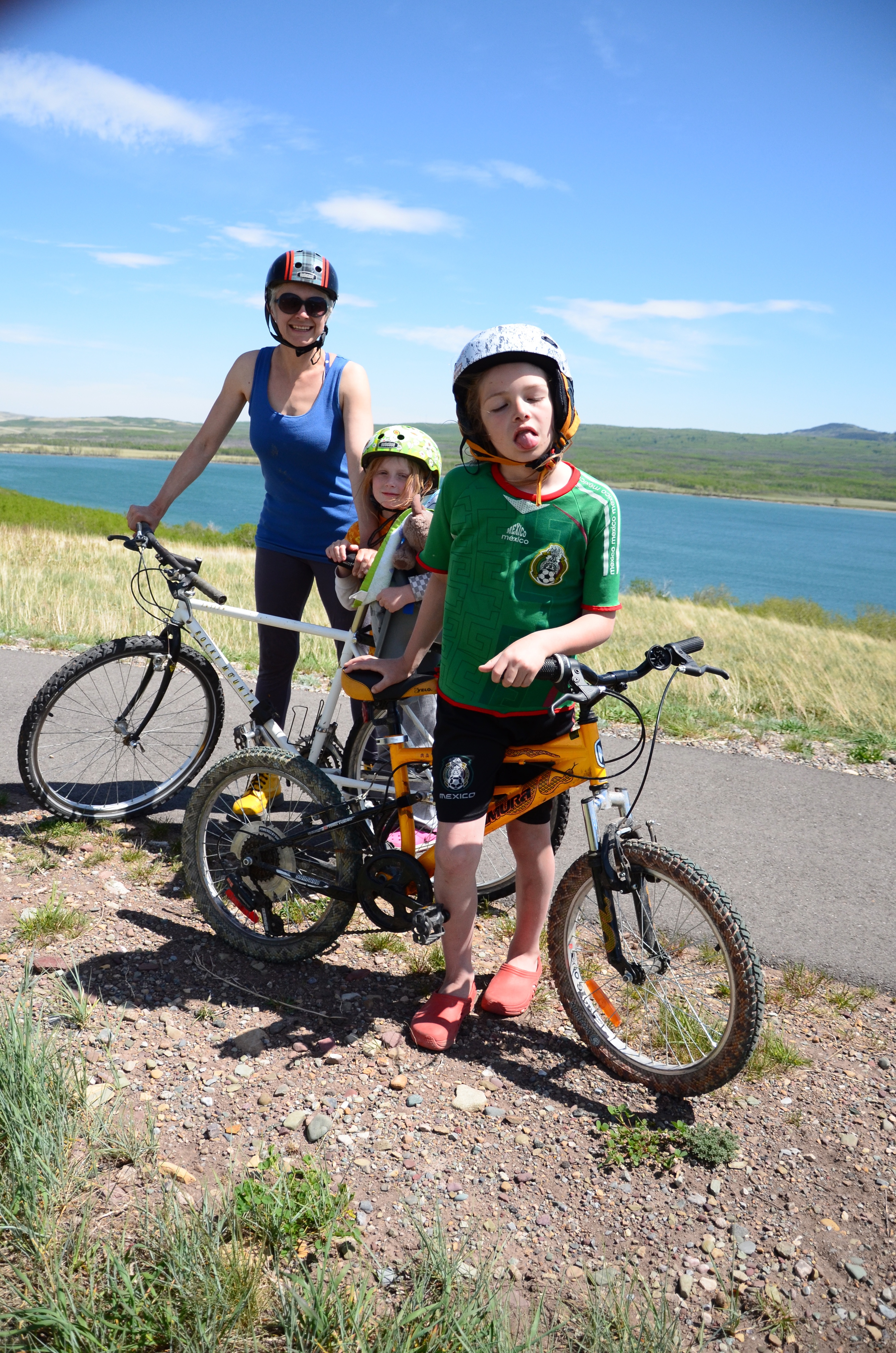
We’re out on our bikes all the time again, and we’re a bit of a gong-show―Ender, Maggie the rat, er, runt Terrier in the biggest bicycle ever (this one), Cinder on his snake bike, Flora on a bike she can barely lift―but needs to ride instead of the little one she can handle because that’s the only way she can keep up with her big brother. Cinder’s usually up ahead, Flora chases him for a while then falls back to ride with me. Ender squeals with delight and Maggie squeals with terror. And I get all sappy, watching them ride, and remembering that it wasn’t that long ago that I had both Cinder and Flora in a trailer behind me… and then Cinder on training wheels… and then Cinder on a little bike…

When Cinder dropped his training wheels and we started going for longer bike rides, I noticed one day how we were usually riding–he in front, setting the pace, going like a madman at first, then slower and slower, and me behind, pulling his sister in the trailer, keeping an eye on the path and possible obstacles, the two of us occasionally stopping to talk, then moving on…

And I was earnestly, sappily, struck with how we biked was so reflective of how I saw parenting and learning and living and all of that.

 And I got so in love with this metaphor, and started writing it out in more detail in my head and developing it into a huge life-changing thesis that I was going to write up for one of my yahoo groups or an article or maybe an entire book … that I stopped paying attention to the path and the real universe around me and I rode right into a post.

Lesson learned?

Nope. I’m cycling hard, chasing Cinder, keeping an eye on Flora, restraining Maggie, chatting to Ender, but my mind again turns the moment into a metaphor and a story―and bam!

It might even have been the same lightpost.

Biking in Waterton Lakes National Park

Here we are after conquering a hill in Waterton Lakes National Park. Ender’s napping in the baby seat and missing the view.

Love letter discipline

Love Letter Discipline

When my kids are having “one of those days”—you know which ones I mean, the ones where nothing works right, and you’re wondering how wrong is it, really, to post your child on Kijiji… or Freecycle—I have two fool-proof strategies.

Strategy 1: I take them out for ice cream. (That’s yesterday’s post).

Strategy 2: I write them love letters.

Seriously. Sometimes in my head, sometimes—on the really, really “those” days—physically. Here is an example of Flora’s:

To My Flora,

You are my most beautiful, brilliant little daughter. And you will grow and grow into my most beautiful, brilliant big daughter. And I will love you every minute and every second and every nano-second of your amazing life. I will love you when you laugh and when you cry, when you’re angry and when you’re happy, when you’re celebrating the world and when you’re fighting it, when you need me to hold you and when you need to be alone. I will love you, every part of you, forever and ever and for always. Because you are Flora, because you are you.

And here is one for Cinder:

To My Cinder,

You are my most beautiful, brilliant not-so-little son. And you will grow and grown into my ever-bigger beautiful, brilliant son. And I will love you every minute and every second and every nano-second of your amazing life. I will love you when you’re full of joy and when you’re full of sadness. I will love you when you do what I ask you to do and when you march off listening to the beat of your own drummer. I will love you when you’re strong and when you’re weak, when you’re creating and when you’re deconstructing, when you’re wild and when you’re calm. I will love you when we are together and understand each other, and I will love you when we are apart and don’t. I will love you, every part of you, every thought of you and every moment of you, for ever and ever and for always. Because you are Cinder, because you are you.

By the time I finish writing or thinking one of these—or simply re-reading one I wrote during a previous crisis—I’m usually regrounded and recharged. Able to put the current moment’s craziness in perspective. Reminded of how much I love the little beasts, no matter how beastly they seem in this particular moment.

Got a moment? Write your own love letters to the munchkins. Don’t wait until you want to freecycle the little dudes. Do it now—and then when one of those days come, pull them out and read them.

And then take the kids out for ice cream.

I’ve recently shared a very long love letter to Cinder with you on occasion of his birthday, and you’ll find a very long love letter to Flora here. These longer letters were not written or composed in the heat of an “everyone’s evil!” moment, but I do refer to them in the heat of the moment quite often.

If you’ve written a love letter to your beasts… er, I mean beloved munchkins, please share it.

Love heart

A love letter to the boy who’ll set the world on fire

Cinder turns 10 today. 10. Double digits. Join me in celebrating the boy by re-reading the love letter I wrote him when he was still nine… and in a very liminal phase.

August, 2011. Yesterday, I accidentally slipped my feet into my 9-year-old son’s shoes. And they fit well enough that I took a few steps in them before realizing my mistake. This first-born baby of mine, seven pounds eleven ounces nine years ago―the size of a grain of rice ten years ago, just part of cosmic dust before then―is now so long, so tall, so strong. Stronger than me. No longer in a sling, no longer kept safe and satisfied only in my arms―the journey has been gradual, but this year, this day, this moment, it strikes me, smacks me in the face.

I love him. When he was that babe in arms and I looked at him and fell in love with him for the first time―and then every day, every hour, all over again―I didn’t think it was possible to love anything, any creature, any person this much. And then I loved him more and more every single day, and today, when I look at his tousled, tangled head, his lanky, long legs, the eyelashes that half-cover those sometimes mischievous, sometimes sad eyes, I fall in love all over again and again, and I can’t believe it is possible to love anything, any person this much. But now I know that tomorrow, and the day after and the year after, I will love him even more.

He isn’t bliss everyday. Being a nine year old boy in 2011’s North America isn’t easy. Sure, you can dismiss this as a First World Whine―hey, he isn’t toting guns in Sierra Leone, living in a shanty town in Rio de Janeiro, starving in East Africa. Over-privileged middle class white boy of over-educated parents, what are your woes? Lusting after an X-box game, having to eat roast asparagus for dinner again? Our world dismisses his … heck, call it was it is, existential angst. But it’s there, and it’s real.

My nine year old boy, my love, is searching for his purpose in life. A little child no longer, yet a long way from man, he is on a journey. He wants to be useful. He wants to work. To grow. To contribute. And it is so hard, in 2011. Were he growing up in any other historical era―1000 years ago, 500, even 50 years ago―this angst would not exist. He would help on the farm, in the fields. Chop wood. Practice hunting. Fighting.

Don’t misunderstand me: I don’t romanticize. We live longer, healthier, safer now than ever before in human history, for all our fears and complaints. But with this life comes the existential angst of our children. Especially such children as my son. See, he is the boy that you’d take on the hunt with you as soon as he could keep up with the men, because he’s got a strong arm and a good eye, and never gets tired. He’s the son who’d chop a cord of wood for you, then tame a colt or two, all before breakfast. He’d see the enemy coming before anyone else because he’d be up in the highest tree. You’d never lack for food―or protection―with him in your tribe.

What do you expect of this boy wonder in 2011? Well, you’d like him to sit quietly at a table and colour a pretty picture. Then cut up some cardboard and glue it, and maybe some dried up pasta too―look, we’ve got googly eyes, isn’t that cool?―to a piece of paper. Sit and listen to a story. Sit and read a book. Walk, don’t run. Write about this. Tell us about your feelings. Don’t be too noisy, don’t be too active, don’t be too disruptive.

But for goodness’ sake, don’t play too many video games, because that’s just not good for your brain. (Stop. I must digress. Video games invade my love letter, but ever wonder why today’s eight year old, nine year old, 12 year old boys love video games so much? Can you see it? Can you see the hunt, the fight, the chase? Those little buttons, those dudes on the screen―they’re speaking to their genes. They’re channeling the Caveman inside. Come full circle, video games back to love letter. I love my son. My son loves video games. I know why.)

My little love, growing so tall, so lanky, so strong. Searching. He wants to become a man, a useful, productive, important part of his tribe. What tribe? Where is it? When he was four, he decided he knew what he wanted to be when he grew up: the man who starts the fire at his community’s firepit. That’s who he’s going to be. But the path is long, and it’s tough, and not very obvious. So he’s struggling, searching, misstepping. And there I am, watching―he is my heart outside of me, exposed, and I want to protect him, help him, ease things for him, but there is so little I can do. So much of this he must struggle through alone, my love, and all I can do is be there―present, supportive, unconditional. There when he needs me, in the background when he thinks he doesn’t. Loving him, celebrating him, feeling blessed and grateful that he is my son… making sure he knows that I love him, celebrate him, and feel blessed and grateful that I am his mother.

It is another day, another night, and he is silent, falling asleep. He talked a lot today, about his game, the smell of rain, the trajectory of a roundhouse kick, the peskiness of little sisters. Then silent, perturbed. The eyes close, I see the brain, spirit, soul still working. Searching. What will he be? Fully himself, fully wonderful.

I write this to remind myself―to hold myself steady during the moments when he is not bliss. To remind myself of what matters and what doesn’t. To remind myself that the work we started, the bonds we weaved when he was a babe at breast, a toddler on hip, that work isn’t over. It continues, every day. Every choice, every word, said and unsaid, builds that bond and builds that relationship. Or harms it.

I don’t like to think of parenthood, motherhood as work. It’s not. It’s life, part of life, a definition of my life, as much a part of it as eating, sleeping, breathing. But the work metaphor creeps in, because in 2011 North America, everything that requires any effort at all is work. So―this love letter is my work. Put explicit into words, to exist outside of me as affirmation and expression and reminder. I love you, my beautiful son, unconditionally, perfectly, fully, in all your moods and moments. What will you be? What you are. Fully yourself, fully full of wonder. Cosmic dust transformed into a gift, to me, to the world.

The cinder path

The cinder path (Photo credit: Wikipedia)

How I got deprogrammed and learned to love video games

Cinder’s just shy of 10, and the big passion of his life is Minecraft. Or Terraria. Or both, but usually just one or the other. He loves them so much, he’s convinced his Mac-using parents to get him a PC laptop so he can play them more effectively. He loves them so much that his show of choice is watching Minecraft or Terraria videos on Youtube. (A digression for a Cinder recommendation: for Terraria, nothing beats Total Biscuit and Jesse Cox; for Minecraft, Antvenom is King, and Cavemanfilms is pretty good too. Now you know where to go.)

My boy loves video games. And this is a wonderful thing.

I never thought I’d find myself saying this. Video games were never a part of my childhood, and my experience of them as an on-looker—sister, girlfriend, wife—was, well, blah. Wasn’t interested. Didn’t understand the appeal. Could tell you one thing for sure: no kid of mine was going to waste his childhood playing video games. Could rattle of spades of research about how detrimental to the proper development of a child excessive (any) video game playing could be.

Well. What changed?

Simply this: My boy loves video games, and I love my boy. He started getting drawn to them about age eight, I suppose, meeting them at this friend’s house or that, telling us about them with excitement, in vivid detail. His game-playing father entered into his interest; his game-ignorant mother started to agonize. What to do? For what reason? With what consequences?

I spare you my internal angst, as first one online game and then another (“It’s educational, Mom!” Supported by Dad’s: “Really, Jane, it’s educational.”) got introduced. Then the X-box (“It’s Kinect, Jane—they’ll be exercising and moving while they play—isn’t that good?”). Then an iPad and all the apps and games that enabled. Here’s what steered me through it, though: I love my boy. He loves these things; he’s drawn to them. What’s he getting out of it? Why? How?

I love my boy, and if I love my boy, I can’t be dismissive and contemptuous of something he loves.

So, I’d sit beside him and watch him play. Listen to him talk about the games afterwards. In-between. Eavesdrop while he talked about with his friends. Watch while they acted out game scenes on the trampoline or on the Common.

I might tell you about all the things I’ve seen him learn from gaming another time (for one example, check out this salon.com piece about Minecraft ). Rattle of spades of research about how playing video games actually makes kids smarter (Here’s Gabe Zichermann talking about this on Ted Talks). But it really comes down to this:

I love my boy. My boy loves video games. His reasons for loving them are complex—but no less valid than my love for Jane Austen novels, or John Fluevog shoes. I do not have to love them just because he loves them—I do not have to make myself play them or enjoy them as he does, just because I love him. But because I love him, I can’t say—or think and believe—that what he loves and enjoys is a waste of time. Of no value. Stupid.

Flip it. Think of something you love. Knitting? Film noir? Shiny cars? Collecting porcelain miniatures? Whatever. Doesn’t matter what. I’m thinking of my Jane Austen novels, which I reread probably half-a-dozen times a year. Now think of how you feel when someone who’s supposed to love you and care about you—your partner, your best friend, your mother—thinks that hobby or activity is of no value. And takes every opportunity to tell you so. Do those interactions build your relationship? Inspire you with love and trust for the person showing such open contempt for something that brings you joy?

I love my boy. My boy loves video games. And I love that he loves them. I love that they bring him joy.

As I finish writing this up, Ender’s having the tail-end of his nap in my arms, and Flora’s listening to The Titan’s Curse. Cinder grabs his lap top, and sits down beside me on the couch. He pulls up an Antvenom video on Youtube. “I need to get this mod,” he says. “Cool one?” I ask. “Too cool,” he says. I watch him watching for a while.

I love my boy.

“Love you, Mom,” he says. “What do you want to do when my video’s over?”

Minecraft Castle

Minecraft Castle (Photo credit: Mike_Cooke)

Five is hard: can you attachment parent the older child?

It happens to the most attached parents among us. We’ve breastfed, co-slept, and slung our babes happily. It was easy—or, it became easy, once we got into the groove and shook off Aunt Maud’s disapproving glare. We saw our children grown and flourish, loved, connected, happy. But then, at some point, the demons of self-doubt return. Our child goes through a phase we see as difficult and challenging. Almost inevitably, this happens when we’re not at our best—pregnant, tired, stressed. And we wonder—is it possible to AP the older child?

Five seems to be the milestone when these demons attack most ferociously. Makes sense: it’s such a milestone age in our culture. The preschooler becomes a kindergartener. The stroller’s abandoned; first loose teeth come. The search for self becomes super-pronounced, and our five-year-old is frighteningly selfish. (I write about that aspect of five in Ferocious Five.)

It hit one of my friends very hard when her eldest daughter turned five. She asked our playgroup community for help, and she framed her struggles under this big question: “Is it possible the attachment parent the older child? This five year-old who’s driving me utterly, completely crazy every moment of every single day? Is it time to bring out the conventional discipline–punishment–toolbox?”

This was my response. I had seen Cinder through five pretty successfully. Not yet Flora. Bear that in mind as you read. Check out Ferocious Five for the lessons Flora taught me.

Five is hard. But so is two, three, four, six, sixteen–all in their different ways. Part of the trouble is that our children move onward and forward through the different ages and stages, while we, their imperfect parents, have just figured out how to cope with the preceding one.

Is it possible to attachment parent the older child? Possible, necessary, critical. And here is where the difference between AP “things we do”–co-sleeping, breastfeeding, babywearing–and the AP “things we are” plays large. We don’t carry our five year olds, the majority of us don’t breastfeed them any more, we’re not necessarily co-sleeping with them. The “do” stuff is gone. The “be” stuff is all that remains.

And how do we “be” with the older children? I think this is one of the points at which our paths can diverge quite dramatically. And I don’t know that there is one *right* answer. For what it is worth, based on my sample of one five-year-old shepherded through some challenging stuff to date, these are the principles that helped us:

1. Make their world larger.

At five, Cinder’s world got larger. We’re homeschooling, so the massive change that is five day a week kindergarten wasn’t part of it–but think of what a huge change that is for the average five-year-old, and how hard it must be sort out, everything so new. Still, even minus kindergarten, it was so clear to us that a five-year-old was very different from a four-year-old. And absolutely, we butted heads because while he had moved on, I was still mothering a four-year-old.

A huge breakthrough for me was to make his world larger–ride his bike on (safe!) streets, cross the street on his own, go into stores on his own, play a bigger role in everything. I can’t quite remember all the different changes we did, but they’re pretty much irrelevant–they wouldn’t necessarily work for your child. Talk with her. What would she like to do now that she couldn’t (or wasn’t interested) in doing a year or six months ago?

2. The only person whose behaviour I can control is myself.

The other thing I always come back when we run into “downs”: the only person whose behaviour I can control is myself. And if I am unhappy with how my child is acting, the first step is not to look for a way to change my child, but to look at myself, within myself, and ask myself what can I do to change how I am reacting and communicating with my children? What am I doing–reflexively, thoughtlessly–that I can change. Start with me. When I’m okay, when I’m balanced, when I’m grounded–well, very often, the problem goes away, because it was in me in the first place. My children mirror me.

And, if the problem really is in the other–if it is all my Cinder being crazy or my Flora being whiney–when I’m taking care of myself, reflecting on my behaviour, and acting from a place within me that’s grounded, well, then I can cope and talk and help them sort through whatever craziness they are going through at the time without losing it.

3. Re-connect, re-attach.

I strongly, strongly believe that any punishment–be it a time out, a withdrawal of privileges, or the most innocuous manufactured consequence–does not help these situations but serves to drive a tiny, but ever growing, wedge between the attached parent and child. The absolutely best thing I’ve ever read about discipline was in Gordon Neufeld’s *Hold On To Your Kids*–absolutely aimed at parents of older children, through to teens. We’ve talked about this before, but this is the essence of what I take away from Neufeld’s chapter on “Discipline that Does Not Divide”: “Is [whatever action you were going to take] going to further your connection to your child? Or is it going to estrange you?”

So what do I do when I kind of want to throttle Cinder? I work at re-connecting. I call them re-attachment days. Have a bath together. Wrestle (I’m not advising it for pregnant mamas 🙂 ). Go for coffee (for me) and cookie (for him) at Heartland Cafe, just the two of us. Really focus on him and try to enjoy him. So often, that’s what he’s asking for by being obnoxious–really focused attention from me.

Now if I could only ensure I always give it to him so that we wouldn’t go through the head-butting phase in the first place!

4. Remind myself of what I want to say and how I want to act.

What do I do in the moment? That’s way harder in practice, no question. When I’m really frazzled, I leave notes to myself in conspicuous places with “when Cinder does x–do not say/do this–say/do this instead.” (Fridge and front door best places. Also, bathroom door.) And I tell my children what they are–“Those are reminders to me of how I want to treat you and talk to you, even when what you are doing makes me very, very angry.”

5. Sing.

Sometimes, I sing, “I want to holler really loud, but I’m trying really hard not to, someone help me figure something else to do, I think I’m going to stand on my head to distract myself…” (This works really, really well with two and three year olds too, by the way.)

6. Forgive. Move on.

Sometimes, I don’t catch myself in time and do all the things I don’t want to do: yell, threaten (if there is an “if” and a “then” in a sentence, it’s almost always a threat)… and then I apologize, try to rewind, move forward.

7. Put it all in perspective.

And always, always, I remind myself that 1) the worst behaviours usually occur just before huge developmental/emotional milestones, changes and breakthroughs, 2) my child is acting in the best way he knows at this moment, and if that way is not acceptable to me, I need to help him find another one, and 3) I love the little bugger more than life or the universe, no matter how obnoxious he is. (This is a good exercise too: after a hard, hard day, sit down and make a list of all the things you love about your little one. From the shadow her eyelash make on her cheeks when she sleeps to the way she kisses you goodnight… everything you can think of.)

And, finally, if I want my children to treat me–and others–with respect, I must treat them with respect. No matter how angry or tired I am.

Lots of love and support, 

“Jane”

Jane Austen, Watercolour and pencil portrait b...

Searching for Strategies for Sensitive Seven

I’m sitting on the chaise beside my Sensitive Seven. She’s watching Minecraft videos because she needs to chill; I’m trying to crack Twitter.The brothers are still sleeping, and we are alone. Enjoying this rare moment, because even though each of us is, on the surface engaged in something else, we are also together.

I reach out and squeeze a little hand; she leans over and gives me a little kiss. She is at peace and happy, and that makes me ecstatic, because that hasn’t been happening very often lately.

Seven has been a huge milestone age for both of my children who’ve crossed it; if you’ve got a seven year-old, or a child teetering on the edge of that seventh birthday, you’ll have seen it too—I am yet to meet a parent who hasn’t been amazed by the change of seven. But if the seven change with my eldest suddenly gave him a transfusion of self-awareness, world-awareness, an incredible increase in impulse control, and a blooming in social skills and brought with it almost no negatives, the seven change with this already sensitive girl has me, more often than I’d like to admit, longing for the selfishness of Ferocious Five.

Flora is my EQ-intense child, the relationship and network builder. The one who after 15 minutes in a room with people, at age three, knew everyone’s name—and one fact about them that “made them just like me,” no matter how different or strange they might appear. This is a gift, an incredible gift: but, oh, it’s a hard one. That ability to make such immediate and strong connections comes at a price. This beautiful child of mine is so vulnerable to, well, everything. Bad moods of others. Unintentionally hurtful words. Her own thoughts.

With my physical, intense Cinder, I’ve had to work to give him words and awareness of his feelings and emotions, to help him find expression. With my sensitive, effusive Flora, I find myself having to do the opposite: to help her build boundaries, limits, separations. With Cinder, I still have to remind him, often, that other people’s feelings and thoughts matter, that he has to pay attention to them—and he has to make a concentrated effort to do so. Flora enters into all of these intuitively and immediately. Too much so. And I find myself saying to get, too often, “It doesn’t matter what X thinks.” Or, “Jeezus, Flora, why are you crying over that? It doesn’t matter: it’s not important.”

But of course it does. It matters to my Sensitive Seven very, very much, and when I say “It doesn’t matter,” she hears, “I don’t matter to you” or “It doesn’t matter what I think,” or, at best, “You don’t understand me.”

So I sit beside her on the chaise, and squeeze her little hand. Send her a series of quiet messages. “I love you.” “You matter to me more than anything.” And look for ways to hold her close and offer her comfort and safety when she needs it as she struggles through this phase. Practices to help her find self-discipline over her intense emotions without denying them. Coping strategies that recognize the value and the gift of her intense golden heart… but also help that golden heart navigate tough emotional situations without falling apart.

This is not a “Seven Strategies for Sensitive Seven” Post. We’re still exploring, searching. But if it were, it would go like this:

1. Take every opportunity to say (and imply) “I love you.” “You matter to me.” “Your feelings matter to me.”

I think I do this a lot–but for Sensitive Seven, I don’t do this enough. I must do this more often.

2. When you see your Sensitive Seven heading down the breakdown path, attempt to insert a pause. I find distraction does not work so well with the Flora, but then it never did. Still, a combination of mental and physical removal, even temporary, is possible and provides the space for some reflection and regrouping. “Hey, babe, come here, I need to talk to you.” “About what?” No, not the impending crisis. “Our trip to Banff next week—have you thought about what you’re going to pack?” “Oh… no… is my striped dress clean?” “Crap, no. I’ll have to pop in a load of laundry tomorrow. What are you and M up to over there?” “Oh, we’re playing Secret Super Agents, and she’s being really bossy—she just said…” “Yeah? You feeling angry?” “Yes!” “Come inside with me and help me get a snack together?”

And maybe she says OK and comes inside, and gets grounded, and returns to the play. Or maybe she gets grounded and makes the rational decision to stop the play before she disintegrates. Or, she goes back out to play and disintegrates.

I don’t have a fool-proof system or strategy, did I mention that?

3. When the crisis and emotional maelstorm hits, just hold her and ride it out. If I didn’t head it off, I’ve got to let it happen. Distraction won’t work, yelling won’t work, bribery won’t work. The tears must come, and she must find her own peace. I can hold her if she lets me, or let her be alone if she rejects my presence.

And I can’t take it personally.

4. Talk about what happened, and explore strategies for how it could have unfolded differently—after. Long after. Like, not five minutes after she calms down. But next day—or five days later. When there’s distance, and the capacity for distances reflection—by both of you.

This is the time to explore strategies and techniques for creating pause and regrouping when Sensitive Seven is heading for a breakdown. Not when she’s already in the middle of one.

5. Take her out for ice cream. A Value Village browsing trip. Hang. Let her talk without judgement, interruption, redirection. Listen. Learn. Be interested. Be together.

I don’t understand my Flora. There. I’ve said it. She is so different from me. How she thinks, how she feels: she is not me at seven. Nor her brother at seven. She is herself, and right now she is her own, full Sensitive Seven. My assumptions about how she feels, thinks and should react are often totally off-base. I need to pause, and just be with her. In a non-crisis, loving situation.

NB I have a great post from Life’s Archives about “Ice Cream Discipline.” I’ll have to dig it up for you soon.

6. Give her plenty of “alone” time for recharging and regrouping. Flora comes across as an intensely outgoing, social child who thrives on play with her friends. And this is indeed a true aspect of her character. But it has a price—or a complement. Because she is so empathetic and so emotionally involved and out-there with her friends, social play burns her out. Intense social play needs to be balanced with solitary time. Much of the time, Sensitive Seven will do that herself. Sometimes, she forgets. And then, I need to create that time and gently enforce it.

7. Forgive myself and move on when I do it all wrong. If I were keeping score, I “get” Sensitive Seven one in three times on a good day, and one in a dozen on an average day. So be it. Perfection is not the goal: being the mother I am—who mucks up, but reflects, and tries again—is good enough.

Robert Plutchik's Wheel of Emotions

Robert Plutchik's Wheel of Emotions (Photo credit: Wikipedia)

“Get back home Loretta!”

Flora’s Orff Music class wraps up for the year today, so I’ve got music on my mind. Now, Flora loves music. She always has, even though her mama and papa—not really. Although her mama remembers just about all the Beatles, Rolling Stone and Dylan lyrics that were her “Raffi” when she was the babe of flower children. I weaned Flora by singing her Yellow Submarine at night. After she committed Yellow Submarine to memory, she focused on Lucy in the Sky with Diamonds, She Loves You, and It’s been a Hard Day’s Night.

At three and a half, she became fixated on Get Back. How fixated? A vignette: she’s playing with her dollhouse, and just as her daddy wanders out to see what she’s doing, one doll is saying to the other, “Get back home, Loretta! Your mama’s waiting for you. In her high heeled shoes and her low cut sweater… Get back home, Loretta!”

Later, a dinosaur named Sweet Loretta Martin tells a dinosaur named Jo-Jo that he isn’t really a loner, and they should go to the park together because it was full of California grass.

She’s seven now, and it’s been a long time since she’s grooved on the Beatles. They were replaced by Johnny Cash for a long while. Then (really) Weird Al—specifically The Saga Begins although Flora always called it That Anakin Guy and preferred the Lego version. And now—Minecraft video parodies (this is her favourite one). But when she’s out of sorts, and she can’t sleep, I can still usually soothe her with Yellow Submarine… and Ender’s now playing with a dinosaur that still goes by the name Jo-Jo.

Sweet Loretta Martin, I’m sad to report, has been eaten by a voracious Boston Terrier.

Photograph of The Beatles as they arrive in Ne...

Get Back vignette from Life’s Archives UC, August 26, 2008

“Why isn’t it natural? Why isn’t anything about mothering and parenting natural?”

Length warning: this isn’t a post. It’s not even an essay. It runs on for more than 2,200 words. It would make a space-conscious editor cry. So if you’re on the run and just skimming right now, skip me. Come back when you have time for a leisurely read.

2012. One of the tough consequences of being a writer, especially one prone to documenting life as it unfolds—and one’s life philosophy as it develops—is that you leave behind a record of what you used to think. Non-writers can rewrite their history much more easily than those of us who write…

As we were discussing my “recycling” of past posts to build up this blog’s archive, a friend asked for this, what she remembered as one of my most “powerful and poignant” posts, written in the fervour of new motherhood when Cinder was three and Flora nine months old, an impassioned rant about why “parenting” (in very self-conscious quotation marks) wasn’t—here come those quotation marks again—“natural.”

I found it… read it… and wasn’t sure what to do with it. See, I’m glad I wrote it then. But I could not write it now. As I evaluate it from this vantage point, I have mixed feelings. It’s important. It expresses my frustration and anger and passion and, dare I say, mission at that stage of my journey. And it makes me blush a little at the zeal, and wonder how much judgement for those on a different path, or a different tangent, or simply a different stage along the path, is (or was) hiding behind the zeal and the passion. 

I started editing it to… soften it? Write it as I would argue it now, because the key points are important—and I could argue them so much more effectively and rationally now, because I would do so with much more compassion and understanding. But then, I stopped. I will write that post—the more rational and compassionate one. But this one, impassioned, inflamed, and zealous, flawed though I now think it is, deserves to stand alone.

Well. With that sort of build up… what follows better deliver. Continue reading

The day I stopped reading parenting books

My friends and I have been passing this Science Daily article to each other—a short piece reporting UK research to the effect that for some five decades now, child-rearing “experts” via their manuals and how-to books, having been telling mothers to do impossible things. The authors use the term “setting the bar too high”; I would use the expression “setting mothers (and fathers) up for failure.”

Now, if you’re a 21st century parent like me, you’ve consumed at least half-dozen different parenting books, a bunch of them before your baby’s first birthday. Probably more, right? How many? I think in the first two to three years of my own journey, I read them all. This is the (short) story of when I stopped reading them and why. Flora was about 10 months old, and Cinder three and change.

From 2005: My son peed in my daughter’s ear today, and in the split second of silence between my “Oh, God, Cinder, gross, gross, gross, what were you thinking?” and his ear-splitting, half-remorseful, half-angry “Waaaaaaaaaaaah!”, I condemned myself as a parent. He did this because I breastfed him too long/not long enough, because I did not script the introduction of his new sister into his life as perfectly as, say, Dr. Sears did each of his eight children, because I let him eat too much Halloween candy, because I laugh at his other scatological jokes, because I did not punish him that time he peed on the pigeons in the park…

Minutes later, we’re washing Flora’s head together, Cinder repeating to himself, “We pee in the potty, we pee in the potty, sorry Flora, sorry mommy,” then, “but I can pretend pee on Flora, right, Mommy? Is that funny?” I look at him and blink my eyes. I really don’t know what to say. I have half a shelf of parenting books, including Dr. Sears’ Discipline Book and What to Expect the Toddler Years (the book I love to hate). If I look in the index, I will not find, “pee on sibling” or “how to discipline when pees on sibling” or “pretend pee and poop play, how to deal with.” I’m on my own here, and if I say or do the wrong thing, Flora will smell like urine for the rest of her life.

Cinder climbs into the tub beside Flora and piles bubbles on her head. “Flora is a bubblehead, bubblehead, bubblehead,” he sings. “Look, Mommy, I’m washing Flora,” he says. And at that precise moment, I have an epiphany, at least party because my crisis has been averted—he is no longer looking for guidance as to whether pretending to pee on Flora is funny; I don’t need to provide that particular answer right now.

Here’s my epiphany: I’m a damn good mother, and will remain a damn good mother regardless of how I handle the “pee on sibling” incident. One, in the long run, my specific response to this specific challenge doesn’t matter. He will not be peeing on his sister when he’s six; much less when he’s sixteen. Two, three minutes later, it’s all forgotten—at least by Cinder and Flora—apparently one of those events the universe just throws at you to see if you have a sense of humour. Three… parenting books suck.

From Life’s Archives, November 7, 2005 —Yes, he really peed on her // The Day I Stopped Reading Parenting Books

Calliope Hummingbird / Stellula calliope - fem...

From 2012: So is it true? Have I really stopped reading parenting books? Well… there’s a chapter of Gordon Neufeld’s Hold On To Your Kids I revisit almost every year (I’ll tell you which one, and why, soon). I’ve kept Myla and Jon Kabat-Zinn’s Everyday Blessings: The Inner Work of Mindful Parenting on the bookshelf still… I haven’t re-read since the pee-in-ear incident, but I think the world’s a better place because that book exists. And I do have a handful of blogs on living with children, learning and family adventures I like to visit. I like to laugh at their adventures, empathizes with their misadventures (so many of theme echo my own), and maybe get inspired by their solutions—or reject their solutions as inappropriate to my family and our path. None of them—not even Dr. Neufeld—will ever—nor should they—tell me what to do when my son pees in my daughter’s ear. I’ve got to figure that out for myself.

Ferocious Five

For all the mothers of five-year-old girls, current and coming-up-on-five, in my life.

From Life’s Archives, January 27, 2007

Flora is five years and three weeks old today—the three weeks is important, as important as the “half” was when she was four and a half. She’s just come off a very long—for our healthy, active girl—illness, almost two weeks of intermittent fever, sore throat and cough, sniffles and overall body aches, with two days of puking thrown in at the start just for fun. She’s physically well now, but weak. And fragile. Each of her nerves and emotions is exposed to the harsh air of every day life, and the smallest of life’s trials rub her raw and send her spiraling into misery.

It’s driving us mad.

We’ve been here before with her. She celebrated turning two by being sad for three weeks, non-stop. (Funny thing about time: at the time, we thought it was months. Perhaps an entire year. Fortunately, I keep records. It was three weeks on the dot, 21 days of almost incessant crying, over everything.) Between three and four—and especially on either side of three and a half—life thwarted her at every step and she barely survived (us too). At four and a half there was a brief—six days, but oh dear god what a six days—reprisal.

So this is Take Four of Flora being uber-fragile, and I’m trying very hard to approach it as a yet another opportunity handed to me by the universe to crack the Flora code. (We successfully cracked the Cinder code when he was two [this post is coming to the blog Archives soon!] and haven’t been significantly challenged in our interpretation of it since then; Flora is proving to be more complex. Perhaps we women really are.) However hard, each take has offered amazing insights and lessons. The first time around, when she was two and in tears, the lesson to us was simple. Happiness comes from within. We cannot make her happy or peaceful—it is not, indeed, our responsibility to make her happy. The best we can do is provide a certain type of environment, some coping tools—but the only one who can make Flora happy (or not) is Flora.

The lesson of Take Two was more nebulous, and it wasn’t really about Flora. It was about me and you (yes, you, the reading you, the you walking past my yard, the you I pass on the park path, the you paying a visit to my house while she’s having a meltdown). In a nutshell, it was: you don’t matter. Your opinion doesn’t matter, your reaction to Flora or to my reaction to Flora or to anything else that’s happening right now in Flora’s world doesn’t matter. Sorry. You don’t want to hear that, but I need to remind myself of it, throw you out of my mind, and focus on me and Flora. Then, I need to put me to the side—I’ll come back to me later, recharge, re-examine, ponder exactly why I was feeling the way I was and wanting to react the way I was, I’ll do all that, but later.

Right now, with you and me out of the way, I need to focus on Flora, I need to help her cope, work out some tools that she can use to help find herself, work through whatever inner turmoil she’s experiencing right now, and come back to a place of balance. This moment is all about her, and I need to surrender to that first. Only then can I help her… and maybe helping her just means being there while she can’t help herself. And then, when there is a moment when she wants and needs and is open to help—then, I step in. Without my baggage, without making this about me—much less you—but just her.

This lesson is much harder than calculus and I’m still studying it, reviewing it, intermittently failing it, because, at least some of the time, I want you to approve of my and my child and my parenting.

Flora—the current, five year old Flora—is stirring on the couch beside me now making whimpering unhappy noises as she wakes up from a quasi-nap, and I’m revisiting the second part of the lesson. Not about me. About her. What does she need? (Part of me says, a kick in the head.) Apparently, she says, her whole self covered with the blanket. Translation: control over her surroundings.

Take Three’s lesson was simple, so long as Take Two’s lesson was mastered. Repeat: it’s not about you or me. It’s about her. In capital letters: It’s about HER. Between three and five, children are as purely and completely selfish as selfish can be. They’re not psychotic, unsocialized, undisciplined: they just are. Purely, beautifully selfish. The world is all about them, and that’s all that matters to them.

This can suck to the rest of us having to live in the world alongside them. Until, that is, we realize that developmentally speaking, this is normal and inevitable… and it is possible to “work” with it. Asking a child in that stage to do something—or stop doing something, or, ha!, feeling something—because of the effect it has on other people is a recipe for frustration. They can’t comply: they don’t hear you. Oh, they can learn to fake complicity through coercive discipline. But they don’t get it. The world is about them.

At four and half, and into five, I know this. Flora’s world is all about her. In retrospect, on either side of five, Cinder’s world was all about him too. But he manifested it in a different way and it was easier to live with. It was all about doing stuff. For Flora, it’s about feeling stuff. Waaay more complex.

So, here we are in Take Four. Obviously, for me, part of the lesson here is a remedial review of Take Two. It’s not about me. It’s all about her. This part, I’m doing pretty well on. I need to work a little bit more on the fact that you don’t matter. And also, I need to flip the fact that it’s not about me on its head. I actually need to make it about me: that is, seize each of these moments as an opportunity to work on ME. MY response. MY feelings and MY expression of them. MY understanding. What am I doing in this moment and why, and can I be the me in this moment that I want to be? Can I be that me just a little bit longer? One more minute? Another after that?

People pay big money for transcendental moments like this: they go to workshops, retreats, read books, meditate… and lucky me, motherhood is delivering these life-changing, self-reflecting opportunities to me just about every day…

I wrote this post more than two years ago. Flora is now seven and three and a half months—she could probably tell you her age precisely to the day, perhaps the hour. And while we are not in “Take Five,”  we are still learning our sensitive, fragile Flora. She’s learning us too—the selfishness of five is long gone, replaced by hyper-awareness to the feelings of others, and hyper-despair when they are negative. Sometimes, this hyper-awareness makes me long for the selfishness of five. But that’s a topic for a future post. 

Bust of Flora

House Rules

A moment to pass on a message I needed to hear re-affirmed today:

“In this house…

We do second chances.

We do grace.

We do real.

We do mistakes.

We do I’m sorry.

We do loud. (Really well).

We do hugs.

We do family.

We do love.”

From the Plain & Simple Facebook Blog: https://www.facebook.com/pages/Plain-Simple/175012759267245

Before Ender

… or what the psychic said

The cards were laid out on the picnic table, and the psychic was looking at them pensively. “Interesting,” she said. “Well, I’d say you’re definitely going to have another child. A boy—but not at all like Cinder. Very artistic, very creative—I see him as an artist, a musician? And I see him as… well, this is an intrusive question, but did you lose a baby? Because I see him as someone who’s tried to be born to you before and it didn’t happen, and he’s trying again.”

Well. You know me. Smart-ass cynic, and psychic predications and tarot cards are a fun amusement, and nothing more. But I was a little shaken. It was the summer of 2008, and Janine Morigeau, neighbour, friend and Tarot card reader extraordinaire, was giving us short readings in the sunshine of the Common. I asked the question that had been pressing on me for some time, “Would Sean and I have more children?”

I’ve always wanted more—he not so much—but after our experience with the pregnancy that gave us Flora, we were loath to do it again. And ever since we lost our little baby that would have been born sometime in July 2004, we’ve intermittently talked about adoption. In the months immediately following the miscarriage, I was so shaken and broken and empty, I didn’t think I could face the risk of that again. And when Flora started to grow in me, the first months of the pregnancy were marred by an overwhelming fear that I would lose her… to be replaced, in the second half by the scary—fortunately, as it turned out, utterly erroneous—results of the ultrasound that I would lose her after she was born.

Throughout 2008, we talked and pondered and weighed. By the time Janine read my cards that summer, we had made a decision: no pregnancy, but more babies. Adoption. And for various reasons, we made the decision to adopt from “the system”—i.e., Alberta Children’s Services. We filled out the paperwork (there was a lot of it), took the pre-screening tests, and, in October and November 2008, took the intensive Adoptive Parents Preparation Course.

The first parts of the course had us—well, me anyway, I think Sean was more cautious from the start—fantasizing about our new, bigger family. We wouldn’t adopt just one child, but two. Why not? We had so much to give: so much love, a wonderful family-and-friends support system, a lifestyle absolutely suited to help children “with issues” thrive.

And then we got to the final day, a session focused entirely on FASD. Now, even going into the process, we were not nearly selfless enough to plan for an FASD child. We knew that even a very young child from the System would come with issues, with trauma, and would require extra love, work and effort… but we did not think we were equipped to deal with an FASD child. The seminar on FASD cemented that. To their credit, the Alberta Children’s Services people did not try to soft pedal the issue. “Strategies, Not Solutions” was the title and theme of the presentation. They discussed environments and structures that help FASD children and their families cope… but that was the language. “Cope.” “Manage.” “Support.” It was god-awful.

And then there was the statistic. 30 per cent of the children in the system are already diagnosed with FASD. 90 per cent come from homes in which maternal drinking is/was a factor. I couldn’t get passed those numbers. We wanted a young child—preferably a baby. But where FASD is involved, early intervention just doesn’t mean what you’d think it ought to mean.

I was shattered. It was funny, because entering the process, I was much more enthused about adoption than Sean—he had his two perfect babies and all was fine with his reproductive world. At the end of the seminars, he was more comfortable than I. We would be excellent adoptive parents, so good for one of these troubled children. He saw the FASD risk—but it didn’t paralyze him as it did me. It paralyzed me completely. The couple who led the seminar had three biological children and one adopted FASD daughter, the youngest child. They were in their 60s now, and she an adult—and they were still actively parenting her. And when they died, her siblings would have to parent her.

I couldn’t do that, and I couldn’t bequeath that to Cinder and Flora.

A part of me still regrets this decision: wishes I could have been more selfless, more giving. But, but. So it was, the decision was made.

But I very, very badly still wanted more children, and Sean very, very badly loved me and wanted to make me happy even if the idea of me pregnant again terrified him, and by January 2009, a little Ender was growing. Best as we can tell, he got made in beautiful Mazatlan, which would account for his sunny disposition.

The pregnancy was awful. I spent the first two months of it flat on my back or crawling on all fours as my ligaments loosened and my joints left their proper spots, and the last two months, between the slipped SI joints, dislocated pelvis, and pinched sciatic nerve—that left most of my right leg with no feeling in it—barely able to walk. The last five weeks of it, sleepless, exhausted, in prodromal labour. And in one incredible, amazing moment, it was all over, all forgotten, none of it mattered, and I’d do it again, again, again, if the end result was anything like this: my beautiful, beautiful, perfect Ender, my third most miraculous of miracles.

This is the story of his first year. This post was originally written as the introduction to The Story of E, our 2010 Family Christmas Book. To read about how Ender joined us, go to The Last Three Minutes.

2011 In Brief

It’s November 29, 2011, and I’m putting the finishing touches on this year’s family book—our collection of the year’s posts, stories and photographs into an old school, hard copy yearbook that goes out to family as a Christmas present (via www.blurb.comand, per force, reflecting on the year. What was 2011 like in our little micro-world? It’s hard to pin down: in many ways, it was a year of change and adaptation, of a search for rhythms and routines and passions. It was the year Ender turned two with all that entails—the transformation of baby into full-fledged toddler with an iron will was complete, and while the parents, going through this change for the third time, were prepared, the siblings were occasionally caught off-guard! It was the year Flora turned six… and catapulted toward seven at a frenetic speed, losing teeth, gaining wisdom, enchanting and challenging the world all the while. It was the year Austen turned nine and started searching, in earnest for the meaning of life and his place in the world.

It was the year we added Maggie, our Boston Terrier puppy to the mix, and found out that raising a puppy when she’s your only child versus raising a puppy when she’s your fourth and the last on the totem pole is a whole different kettle of fish. The year we ran away from winter for five glorious Mexico weeks… the year we embraced Calgary in the summer and rediscovered cycling and the beauty of our parks and pathways… the year Flora learned to swim with her face underwater, the year Austen discovered Minecraft, and the year Ender almost lost his thumb (also the year Austen didn’t het a Swiss army knife for Christmas).

Through it all, it was, as it always should be, a year of family. There’s a funky Erma Bombeck quote that captures the mood well: “We were a strange little band of characters trudging through life sharing diseases and toothpaste, coveting one another’s desserts, hiding shampoo, borrowing money, locking each other out of our rooms, inflicting pain and kissing to heal it in the same instant, loving, laughing, defending, and trying to figure out the common thread that bound us all together.”

We end the year with, and in, gratitude. It had its downs as well as ups, tumultuous moments and scary ones. But overall, 2011 was a year of necessary lessons, positive changes, and in most areas, a step in the right direction.

Interested in getting your hands on a 2011 Yearbook? I’m working on making that possible on-line.

A Love Letter to the Golden Heart

A dragonfly, broken wings, it’s dying―surely, there’s something she can do to save it. A soft bed in a safe place. Protection. But no―death comes, tears come, tenderness overflowing, and my little daughter’s life is broken, ruined, the worst day ever, nothing’s ever right… until this thought comes―Can I put it in my museum?

Rebound. Recover. But every time she looks at that dragonfly, she remembers―the attempt to save, the death, the tragedy.

She remembers everything she’s ever felt, my Golden Heart, she remembers why, and she will tell you about it, in detail. Words and stories flow from her; when she is silent, they flow too―onto paper, in colours, bold strokes, small dots.

She is my lesson, my meditation, my wonder. I don’t remember as well as she does, but I do remember this: the first time I held her in my arms and looked at those eyes, so blue, so blue―still so blue―and that tuft of red hair, but I didn’t see them, I saw Daughter, My Daughter, girl child, future mother, the future… I saw… what? Something so big and so frightening and so wonderful I still can’t articulate it: her connection to me and to all her future daughters and daughters’ daughters and my connection to my mother and her mother and all the mothers before… a feeling so big and overwhelming, love is an inadequate word. Love is just the beginning.

I love my little daughter, and she loves. She loves―well, people, of course, her family, her friends―but she loves the world in a way so intense and deep, it frightens me who loves her and who wants to protect her, shelter her, keep her safe, because I see how exposed, how vulnerable she is. She gives her heart, on her outstretched hands. She will love you as she loves the dragonfly, the leaves on the tree―does it hurt them when they fall? No? Are you sure?―the grass beneath her feet, the dandelions that she gathers into bouquets every spring.

It’s dangerous to love like that, and it terrifies me. It is is easy to hurt this precious child, to betray her. Even those of us who love her madly: perhaps especially those of us who love her madly. And those who do not really care? It terrifies me. As I hold her and listen to her speak of her heart, her loves, her feelings, I want to equip her for the scary future… but yet, every attempt to do so is a destruction of something about her that is the best thing about her, the most critical, defining feature of her.

So I hold her and I listen and I stroke her hair.

My Golden Heart, I call her, and I tell her what an amazing gift it is to feel as fully as she does. And how difficult it is to reign those feelings in, to hold them in abeyance, to reflect on them―but how necessary, at least sometimes. Does she hear? Understand? Does it help? I don’t know. The tears fall, and I hold her close, and I will myself to be patient, because my natural inclination is to not honour this aspect of my daughter most precious, to make her repress, behave, smile, bury that pain…

As she gets older, she does. I see it―and the price it terrible. It is, for her, not self-control, but denial of herself. Is there a middle way, another way? We will struggle with this, she and I forever, perhaps all of her and my life. I don’t have the answer, I don’t see a path.

So I hold her. I am her mother and I am her ally. There are plenty of enemies out there who will make her repress, bury and hide.

I will not be one of them.

A moment of pure joy, pure excitement: she feels these as fully, as dramatically as the pain and the tears. And spreads it. I feel it, the world feels it―she infects us with her love. She flies, leaps, exults. And we run with her, carried by her joy and love.

My Golden Heart, a gift to the world. I kiss the tip of her nose, her fingertips. She flies away. I watch her, with adulation, with concern, with fear. She is my lesson: will she teach me trust?

A Love Letter To The 9-year-old

Yesterday, I accidentally slipped my feet into my 9-year-old son’s shoes. And they fit well enough that I took a few steps in them before realizing my mistake. This first-born baby of mine, seven pounds eleven ounces nine years ago―the size of a grain of rice ten years ago, just part of cosmic dust before then―is now so long, so tall, so strong. Stronger than me. No longer in a sling, no longer kept safe and satisfied only in my arms―the journey has been gradual, but this year, this day, this moment, it strikes me, smacks me in the face.

I love him. When he was that babe in arms and I looked at him and fell in love with him for the first time―and then every day, every hour, all over again―I didn’t think it was possible to love anything, any creature, any person this much. And then I loved him more and more every single day, and today, when I look at his tousled, tangled head, his lanky, long legs, the eyelashes that half-cover those sometimes mischievous, sometimes sad eyes, I fall in love all over again and again, and I can’t believe it is possible to love anything, any person this much. But now I know that tomorrow, and the day after and the year after, I will love him even more.

He isn’t bliss everyday. Being a nine year old boy in 2011’s North America isn’t easy. Sure, you can dismiss this as a First World Whine―hey, he isn’t toting guns in Sierra Leone, living in a shanty town in Rio de Janeiro, starving in East Africa. Over-privileged middle class white boy of over-educated parents, what are your woes? Lusting after an X-box game, having to eat roast asparagus for dinner again? Our world dismisses his … heck, call it was it is, existential angst. But it’s there, and it’s real.

My nine year old boy, my love, is searching for his purpose in life. A little child no longer, yet a long way from man, he is on a journey. He wants to be useful. He wants to work. To grow. To contribute. And it is so hard, in 2011. Were he growing up in any other historical era―1000 years ago, 500, even 50 years ago―this angst would not exist. He would help on the farm, in the fields. Chop wood. Practice hunting. Fighting.

Don’t misunderstand me: I don’t romanticize. We live longer, healthier, safer now than ever before in human history, for all our fears and complaints. But with this life comes the existential angst of our children. Especially such children as my son. See, he is the boy that you’d take on the hunt with you as soon as he could keep up with the men, because he’s got a strong arm and a good eye, and never gets tired. He’s the son who’d chop a cord of wood for you, then tame a colt or two, all before breakfast. He’d see the enemy coming before anyone else because he’d be up in the highest tree. You’d never lack for food―or protection―with him in your tribe.

What do you expect of this boy wonder in 2011? Well, you’d like him to sit quietly at a table and colour a pretty picture. Then cut up some cardboard and glue it, and maybe some dried up pasta too―look, we’ve got googly eyes, isn’t that cool?―to a piece of paper. Sit and listen to a story. Sit and read a book. Walk, don’t run. Write about this. Tell us about your feelings. Don’t be too noisy, don’t be too active, don’t be too disruptive.

But for goodness’ sake, don’t play too many video games, because that’s just not good for your brain. (Stop. I must digress. Video games invade my love letter, but ever wonder why today’s eight year old, nine year old, 12 year old boys love video games so much? Can you see it? Can you see the hunt, the fight, the chase? Those little buttons, those dudes on the screen―they’re speaking to their genes. They’re channeling the Caveman inside. Come full circle, video games back to love letter. I love my son. My son loves video games. I know why.)

My little love, growing so tall, so lanky, so strong. Searching. He wants to become a man, a useful, productive, important part of his tribe. What tribe? Where is it? When he was four, he decided he knew what he wanted to be when he grew up: the man who starts the fire at his community’s firepit. That’s who he’s going to be. But the path is long, and it’s tough, and not very obvious. So he’s struggling, searching, misstepping. And there I am, watching―he is my heart outside of me, exposed, and I want to protect him, help him, ease things for him, but there is so little I can do. So much of this he must struggle through alone, my love, and all I can do is be there―present, supportive, unconditional. There when he needs me, in the background when he thinks he doesn’t. Loving him, celebrating him, feeling blessed and grateful that he is my son… making sure he knows that I love him, celebrate him, and feel blessed and grateful that I am his mother.

It is another day, another night, and he is silent, falling asleep. He talked a lot today, about his game, the smell of rain, the trajectory of a roundhouse kick, the peskiness of little sisters. Then silent, perturbed. The eyes close, I see the brain, spirit, soul still working. Searching. What will he be? Fully himself, fully wonderful.

I write this to remind myself―to hold myself steady during the moments when he is not bliss. To remind myself of what matters and what doesn’t. To remind myself that the work we started, the bonds we weaved when he was a babe at breast, a toddler on hip, that work isn’t over. It continues, every day. Every choice, every word, said and unsaid, builds that bond and builds that relationship. Or harms it.

I don’t like to think of parenthood, motherhood as work. It’s not. It’s life, part of life, a definition of my life, as much a part of it as eating, sleeping, breathing. But the work metaphor creeps in, because in 2011 North America, everything that requires any effort at all is work. So―this love letter is my work. Put explicit into words, to exist outside of me as affirmation and expression and reminder. I love you, my beautiful son, unconditionally, perfectly, fully, in all your moods and moments. What will you be? What you are. Fully yourself, fully full of wonder. Cosmic dust transformed into a gift, to me, to the world.

Pre-Birthday Joy

I’m not sure who I’m more in love with right now: the adorable about-to-be-six-year-old who is so excited about tomorrow she can barely stop vibrating, or the two seven- and eight-year-old boys–Cinder and his best friend K–who gave up playing Plants versus Zombies and instead spent all night blowing up balloons and plastering the house with pink ribbon and hearts for her big day tomorrow.

2010 Post-Mortem

So, the year ends. For us, a year that’s been both tumultuous and with pockets of deep contentment, a year marked by constant change—personified by the ever-growing Ender and his siblings—but also a commitment—of sorts—to certain key constants. We begun it and end it: in Calgary, at the foot of McHugh Bluff, a family of five living in 1000 square feet and one bathroom (reminding ourselves occasionally that in Europe this would be the height of luxury!), homeschooling, writing and filming, and otherwise continuing on our chosen, slightly-off-kilter journey. We are very privileged that you are part of our journey, although on your own, unique path. Thank you for being part of our and our children’s lives.