I’m going to do everything I can to convince my daughter NOT to be a stay-at-home mom. Want to know why?

There are a lot of posts in my quiver, in my mind that I don’t write. Because… hard. You know the kind? A story you long to tell, a panegyric you need to scream out… but you don’t, because half, more, the people in your life will be grievously offended?

This is one such post.

I write it for Flora. And for your daughter, too.

We’re sitting in a coffee shop—on a park bench—on my beloved Common—in my kitchen. And you’re in agony.

Your marriage is ending—really, it’s over, it’s just a question of how, when—and you’re terrified.

You’re terrified of—well, everything, really, because all change, especially that kind of change, is terrifying—but you’re, particularly, specifically, terrified of…

What? I ask. Again. You always wait for me to ask, before you say, you say…

… you say money, you say economic consequences, you say financial vulnerability…

… you say if you took that out of the equation, you’d be able to think clearer, plan better, but you can’t. Of course you can’t. How can you take that out of the equation? It’s everything.

You say if you could be sure, if you knew, you’d be financially ok, your kids would be ok—you’d walk. You’d have left a long time ago. Or: you wouldn’t be so terrified at the thought of being left. You would be more rational about him leaving…

And I say… nothing. I make supportive friend noises, and tell you you’ll be all right. Say words like lawyers, child support payment guidelines, protection, blah-blah-blah. Meaningless, meaningless words, because I know, you know, how it will all play out.

We know that as you disentangle-separate-end, you will fight, bitterly, over his money.

It doesn’t matter that it was our money before.

Now it’s his. And it affects everything, 21st century pro-woman, pro-child laws be damned. The person who signs the cheques holds the power. Defines the rules of engagement. Has the most power.

That’s just the way it is.

I know this. You know this. We’ve seen this play out, in our lives, how many times? The circles we move in, dominated by attachment parenting-homeschooling-radical-homemaker-yes-I’m-a-stay-at-home-parent-and-proud-of-it people, however self-proclaimed in their lifestyle radicality, end up being so predictably hetero-conventional. He earns money. She “stays” home. It’s their—our!—money. We’re a team! A family! Everything is ours.

Until there’s no love, friendship, affection, respect, and only anger, resentment, betrayal, emptiness. Fury. Bitterness.

And then—ours? Ha. It’s mine.

You don’t understand. But I do. Because it’s not a male-female thing. Not a greedy-bad-selfish husband versus giving-good-selfless wife. It’s a breadwinner versus dependent dynamic. And it sucks that in our most intimate relationships who makes the money matters so much. But it does. Oh, it does.

In my family, it’s usually me—and it’s our money when things are good. But when I get angry? It’s mine and could you fucking stop wasting it?

(Sean pauses at this moment and looks at me. You sure you want to be writing this? he asks. I need to, I say. Can you take it? His eyes return to the screen.)

You’re listening, but she, she’s appalled. Do you see her? She’s there on the periphery, right there… And she screams: It’s ours, ours. We’re a team. Forever. He appreciates everything I do, everything I sacrifice.

Sure. For now. While things are good.

And now, you’re angry. Because you’re not stupid or naïve. And the decision to stop earning, to stop building a career, to become financially dependent on someone you love-trust-are-building-a-forever-life-with… you didn’t make it lightly. Or alone. You made it together. And so, for five, 10, 15, 20 years, that’s what you did… and now?

I want to tell you… I want to tell you that staying out of fear, financial or otherwise, is worse than leaving in uncertainty. I want to tell you to make your decision on the assumption that everything will be ok… but will it? I don’t know. I can’t tell you. The financial and emotional consequences of the dissolution of the worst and most dysfunctional of marriages are vast.

And really… yours isn’t so bad.

Still. I’ll tell you none of that. I’ll make my supportive friend noises. Give you contact details for lawyers and links to the child support guideline tables*** and mediators’ addresses.

And heave a great, grateful sigh of relief… that it’s my money.

That my decisions to stay and love and work and build and negotiate and change and continue and grow together—complicated though they are—they never include financial fear. Dependence on someone else writing a cheque. Paying the bills.

(Buying my compliance in the decisions he makes for our (his!) children.)

(This is really difficult to read, Sean says. I nod. I know. And yet… why? “I don’t need you. But I want you.” It shouldn’t be difficult. It should, actually, be glorious. I am free and independent, and I choose to be here, with you—when I could be, would be just fine without you. But I want you. I want this, us. But. Need? No. Not financially, anyway. And that’s all we’re talking about here, my beloved. Money.)

She —that woman over there, who is convinced that her partnership-lovership-marriage is forever? — is so angry with me. I don’t understand her, she says. Her partner. Their love. Their trust. How they’re rewriting the rules of conventional marriage… by living what looks like a conventional marriage (he at work, she at home) but what is actually radical homemaking** and how they’re going to save the world and raise a new generation of children who…

It’s a beautiful story. And why argue? She won’t listen to me anyway. And maybe, who knows? Maybe she will be one of the lucky one-in-two. After all, 57 per cent of the American women married between 1985 and 1989 were still married 15 years later. Only (only!) 43 per cent were divorced.* Maybe her guy is completely exempt from and unaffected by dominant social habits and mores. Maybe he really will believe it’s our money, and that the work she does in the house and garden, with the children and all those quotidian tasks that make his career possible is just as valuable as the work he does that brings in the money that pays the bills and buys all the things.

I haven’t seen a man—or woman, for that matter—for whom that holds true come end-game. But they could exist. They could be evolving.

But… “maybe” is not good enough for my Flora. Nor are those odds. I want her, whether she loves one partner forever or walks any other path, free. Loving and staying because she wants to. Not because she feels she has to. Staying and being in the relationship without giving up her power—her economic clout—because we live in a world in which money matters. And who makes the money matters.

Now you’re really angry with me, because… well. Because. I understand. Be angry. It’s fine. I deserve it. Your agony and fear terrify me, even though they don’t play out in the path I walk… because my Flora, my Flora, suppose my Flora walks your path? Suppose she chases a fairy tale… and wakes up in a cage?

I want her free. Independent. Making choices out of love, commitment, reflection, and yeah, reason, sure, reason. But, not fear. Never fear.

“Jane”
nbtb-NOT-SAHM

* “Marital Status & Living Arrangements: Most People Make Only One Trip Down the Aisle, But First Marriages Shorter, Census Bureau Reports.” Census.gov. Retrieved 2012-03-27. via Wikipedia

**Radical Homemakers is the title of a rather fascinating book by Shannon Hayes  … which is worth reading regardless of whether you hated every word I’ve written above or nodded furiously at each paragraph.
***Canadian Child Support Table Guidelines


A “lost” year: on standing still, moving forward, stepping back

Come. Come in. I have something I want to show you. Here, over here: this box. That one. And that pile over there. Remember, I told you about them? My papers, my manuscripts, my letters. The record of my early creative life.

They’re all terribly, terribly bad. I mean—not just a little bad. God-awful. It’s hard to say what’s worse—the novel I wrote when I was 13 and the sheafs of heavy metal music-inspired poetry I churned out when I was 15 are probably absolutely the worst, although the novel I wrote when I was 16, and the one I started when I was 18 are pretty bad too.

There is no reason to save them, to hold on to them. They make me cringe, you know, when I look at them? They are so very, so very terribly, wonderfully bad.

They stink.

photo (1)

Flora: What are you doing, Mom?

Jane: I’m trying to write something that’s simultaneously truthful and not asshat pretentious, and failing miserably.

Flora: Oh. Are you going to be much longer? Because I need you to take me to the craft store to buy me more clay.

Jane: Yeah, ok. In a bit. Hold on. I’m trying to explain why I’ve spent an entire year tripping over boxes of molding, unreadable papers.

They actually do stink. I’m pretty sure they’re actively molding. Maybe, if I procrastinate long enough, the mold will finish what the flood started. Maybe, I’m waiting for a force of nature to take agency away from me again…

Cinder: Mom? What are you doing?

Flora: Ssssh. She’s writing about how she can’t throw out those stinky papers.

Cinder: Isn’t it because she’s lazy?

Jane: Silence, progeny. I’m wallowing in artistic existential angst here.

photo

There must be, I think, a part of me that enjoys the wallowing. That wants to stay here, looking at those boxes, looking at the curling edges, the black splotches, red splotches that used to be ink. There’s clearly a part of me that’s getting off on the drama of the destruction…

There’s also a part of me that’s really pleased that this early work is so fucking bad. You know? Wouldn’t it be terrible—it must be so terrible—to look at what you did 20, 30 years ago and say—that was my best work! Why can’t I write like that any more? What’s happened to me? Definitely not the issue here. Those boxes are not full of my best work.

But, but… they are this titillating record of potential. You know? That poem, the one you tried so hard not to read when separating the wet pages, but you did, and you laughed out loud at its pathos? It’s awful-bad, I know. But there’s that one phrase… you know? That one phrase… I like it still, and looking at it, I see the places it’s gone in the intervening 25 years, and I like that. And while I’m embarrassed by the overall badness of the piece… those four words in a row… they please me.

And I’m reluctant to let them go.

Ender: Moooooooooom! What are you doing? I need you!

Jane: I’m trying to explain why I’ve been stuck, unmoving, unproductive… why I’ve felt tethered, trapped by the past, unable to move into the future, paralyzed by what was, torn between denying it and embracing, obsessed with the idea and yet working really hard at not thinking about it, not dealing with it…

Ender: I’m hungry. And I need you to get my bike out of the shed. And I can’t find my shoes. And also, I think I pooped my pants.

Jane: Right. I should do something about all of those things. Just give me a few more minutes here…

Do I need to let them go? An impossible question. What would I have done, had the flood not rampaged through them? The most likely answer: nothing. They would have stayed in their boxes. Existing. Unexamined. For years, decades, a lifetime.

I don’t like being forced to examine them. Examine myself: who I was, what I thought, how I dreamed.

Flora: Mom? Are you still angsting?

Jane: Yes!

Cinder: Seriously? Do you want me to just go chuck them for you?

Jane: No!

Ender: Somebody! Needs! To! Clean! My! Bum!

I had this not-so-secret plan, after I failed to be able to deal with the remnants of the papers right after the flood (I burned my destroyed letters; I couldn’t touch the manuscripts), that I would mark the anniversary of the loss with a big, cleansing bonfire. I’d invite my writer friends, and we’d be all very solemn and supportive, and then get rip-roaring drunk, and we’d burn my past, and a new stage of uber-creativity would rise from the ashes…

photo 1

I know. Cliché. But, why not?

So here I am, a year later. And there they are, my boxes, my papers, my past. Still unexamined, unsalvaged. Neither discarded nor saved.

In limbo.

Me? I look back at this past year as, in many ways, a lost year. A year in which I both failed to move forward and didn’t have the ability to look back: a year in which I stood still. But maybe I had to. Maybe, for possibly the first time in my life, I just had to stand in place for a while…

Cinder: OMG, Mom, are you still writing about those stinky papers?

Flora: Hey! She’s a writer! That’s what she does! But could you please hurry up? We have things to do! Places to go!

Ender: I’m! Still! Poopy! And! Hungry!

Jane: Almost done. Almost done…

So. I’m not quite sure I’m done standing still. Maybe that’s what it is. Maybe I need to stand still a little longer. Digest-marinate-process all that I was a little longer.

Cinder: Moooom!

But not for too much longer. Not forever. Because I have things to do. Places to go. Stories to write. A life to live.

My terrible-no-good poems and novels—and hey, here’s a short story I wrote in my 20s, and this one actually doesn’t totally suck… it’s not good, but it’s not god-awful either—my papers, I think, will stay in their purgatory for a little longer. Just a little longer. And when I’m ready to get moving again, I will let them go.

But not today.

No bonfire this year.

But, there will be a hell of a party…

xoxo

“Jane”

NBTB-A lost year

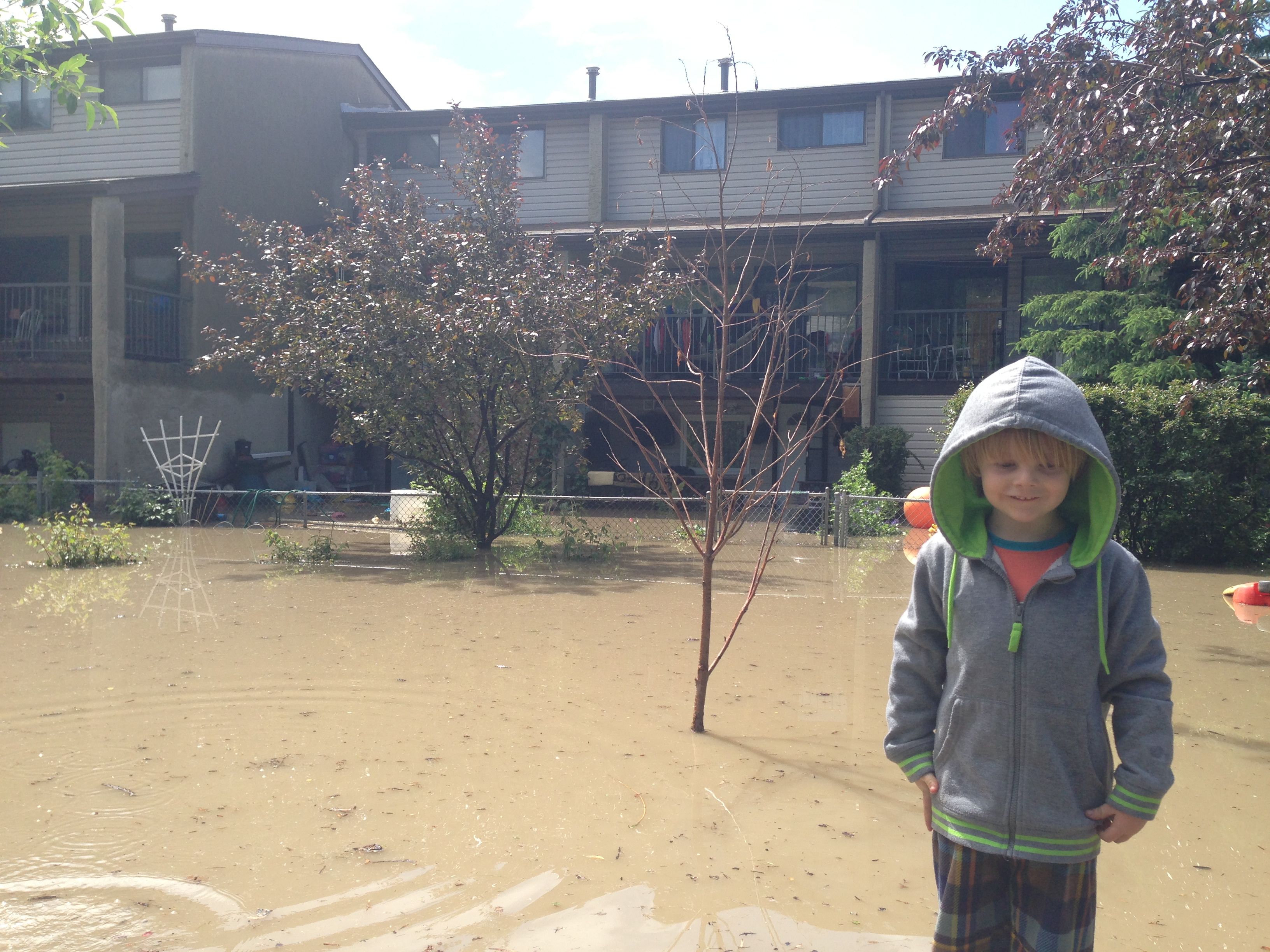
P.S. An invitation: If you’re in Calgary, you should spend some part of your weekend celebrating the one-year anniversary of the flood and Neighbour Day in one of the communities you helped to save. If you worked in Sunnyhill, our big celebration is on Saturday, June 21, from 5 p.m. on; the greater Sunnyside celebration is on Sunday, June 22, 4 p.m. to 7 p.m. at the site of the Crisis Café.

If you have no idea what I’m blathering on about, YYC Flood 101:

Where have you been, Jane?” June 27, 2013

“Everything back to normal, Jane?” July 4, 2013

unLessons from the flood: we are amazing  July 9, 2013

Running on empty: why “so are things back to normal?” is not the right question October 29, 2013

A love letter to my flood plain, June 11, 2014

A love letter to my flood plain

NBTB Love Letter to flood plain.jpg

This love letter begins, as every good love letter should, while I’m naked in bed…

No. Stop. Sorry. Not like this. First, this:

Prologue

There was this flood last year, and it changed us. So very profoundly. And we know it, feel it, breathe it. Tell it, to each other, to anyone who wants to listen (to many who do not).

But do we tell it, really? Our kids are collecting flood stories from the ‘hood to turn into an archive and into an anniversary performance piece. I tell mine… and it is not until I come back home that I realize that of all the stories I could have told, I chose the least important, least personal.

The safest.

“Makes sense,” my neighbour-the-poet says. “Of course it makes sense.”

Does it?

“What story did you tell?” I ask him, and he tells me. And I am shocked. “That one? Really? You could tell… you could share… that one? That part of you?”

He could, he did. Me? My eyes swell with tears. My most intimate story swims within me. I can tell, spin so many other stories. That one? I’m not even sure I want to hear it.

But there’s one part of my story that’s everyone’s story. It belongs to you, as much, more, as it does to me. Ready?

F-front door2

I.

I’m naked in bed, languorous, lazy, loved, and the psychic-who-lives next door delivers a hot breakfast to me and my love.

This is the magic of the place where I live, this place that I love so ardently that life elsewhere, life without it is hard to imagine.

This act of kindness-nourishment-knowing—it is not extra-ordinary. Not here. On this piece of flood plain where I live, this sort of thing just happens.

All the time.

This happens too: a book placed into my hand. “I just read it. You will love it.”

Always, an embrace when you need. Always, someone to help you move a couch.

Always, someone from whom I can borrow eggs, sugar, salt, a bottle of wine.

And this: emergency, panic. I need to leave my tiniest, who has never, ever been detached from my arms and my breast. And I leave him—with you, without thinking twice about it, I know you will love my precious and keep him safe for me.

“Potluck tonight?” “Gah, I have nothing to bring.” “Don’t worry. We have plenty.”

New Year’s. Summer Solstice (even last year’s one). Halloween. Impromptu sleep-overs all over; in the morning, a kid head-count. Six kids traipse down my stairs. There are five clambering up yours. “Does your mother know you’re here?” “I think so… oh, isn’t that her, at your door?” It is. “Coffee delivery!” Oh, yes.

Someone else’s mother sneaks into my house while I have a doctor’s appointment and washes my kitchen floor. Because.

This place where I live binds people, builds people.

The idea of losing it is unbearable. Unacceptable.

F-The Boat

II.

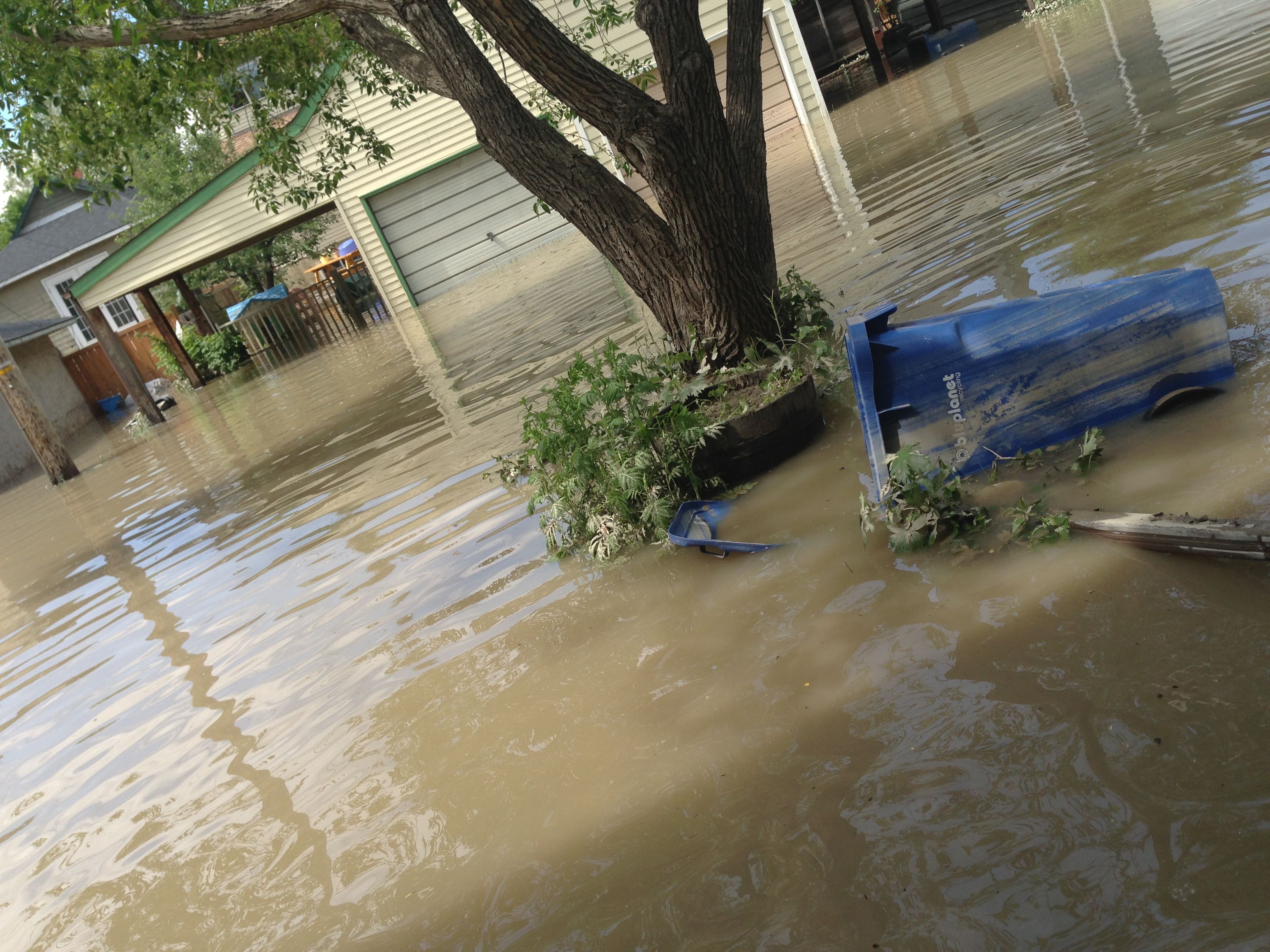
We were never in real danger of losing it. Our streets were not ripped to shreds. The water was out of our houses in a few days—it did not linger for weeks. We are rebuilt. But. In those first days, when the water came—before it receded—before we got back home—we did not know. And we were not rational. And I was terrified.

I could not, would not lose you.

F-Rubber boots

III.

I must have loved you before, of course I must have. But this is when I really fall in love with you: when you are at your ugliest. When there is still knee-deep (wait, over here it’s higher, people are wearing hip-waders and getting soaked) water in Sunnyhill Lane. When there are army trucks rolling down Seventh Avenue. When the air smells of diesel and the vibrations of pumps and generators drown out voices. You are covered with mud and silt and fuck-is-that-sewage? and your streets are lined with the debris of a hundred, thousand lives and you look destroyed and ugly and I love you so desperately nothing but saving you matters.

F-Garbage2

IV.

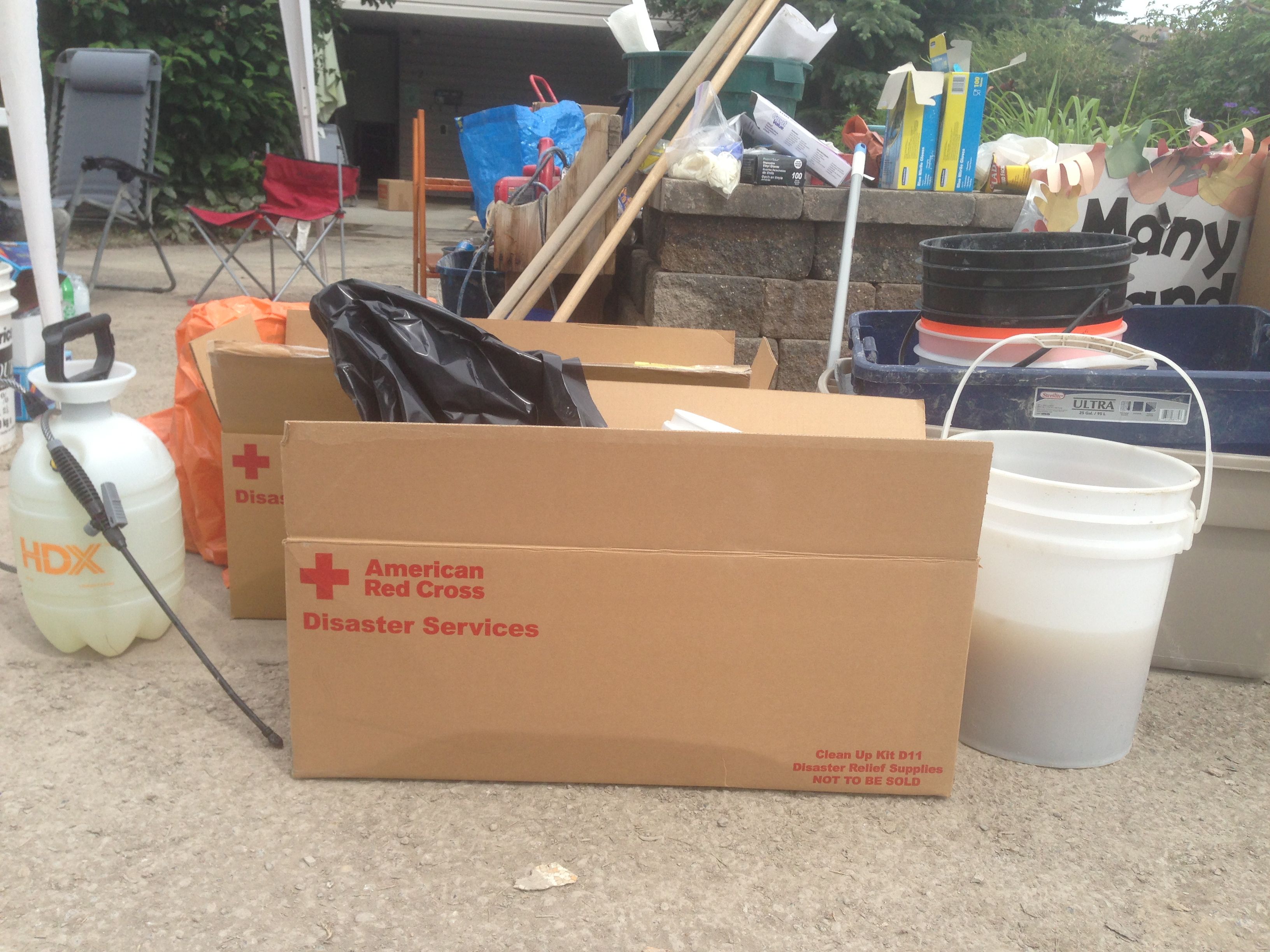
“Christ. It looks like Kandahar,” you say. I look at you, unseeing. I would say, stupid exaggeration, get some perspective, come on, except I’m covered foot-to-toe in mud and so is everyone around me, and there are mountains and mountains of walls-doors-furniture-it’s-not-garbage-it’s-our-lives piled up between the apple trees, and the Red Cross has just delivered a stack of disaster relief kits. We tear through them scavenging for facemasks. Hoping for crowbars. Ha. A mop and a bucket? What the fuck?

F-ARC Disaster Services Kit

V.

You have been, to me, a sanctuary that consisted of a lane, a garden, a Common. A handful of neighbours. You become my everything. As I struggle to save you and you come to save me, you grow. You transcend what you were. You become…

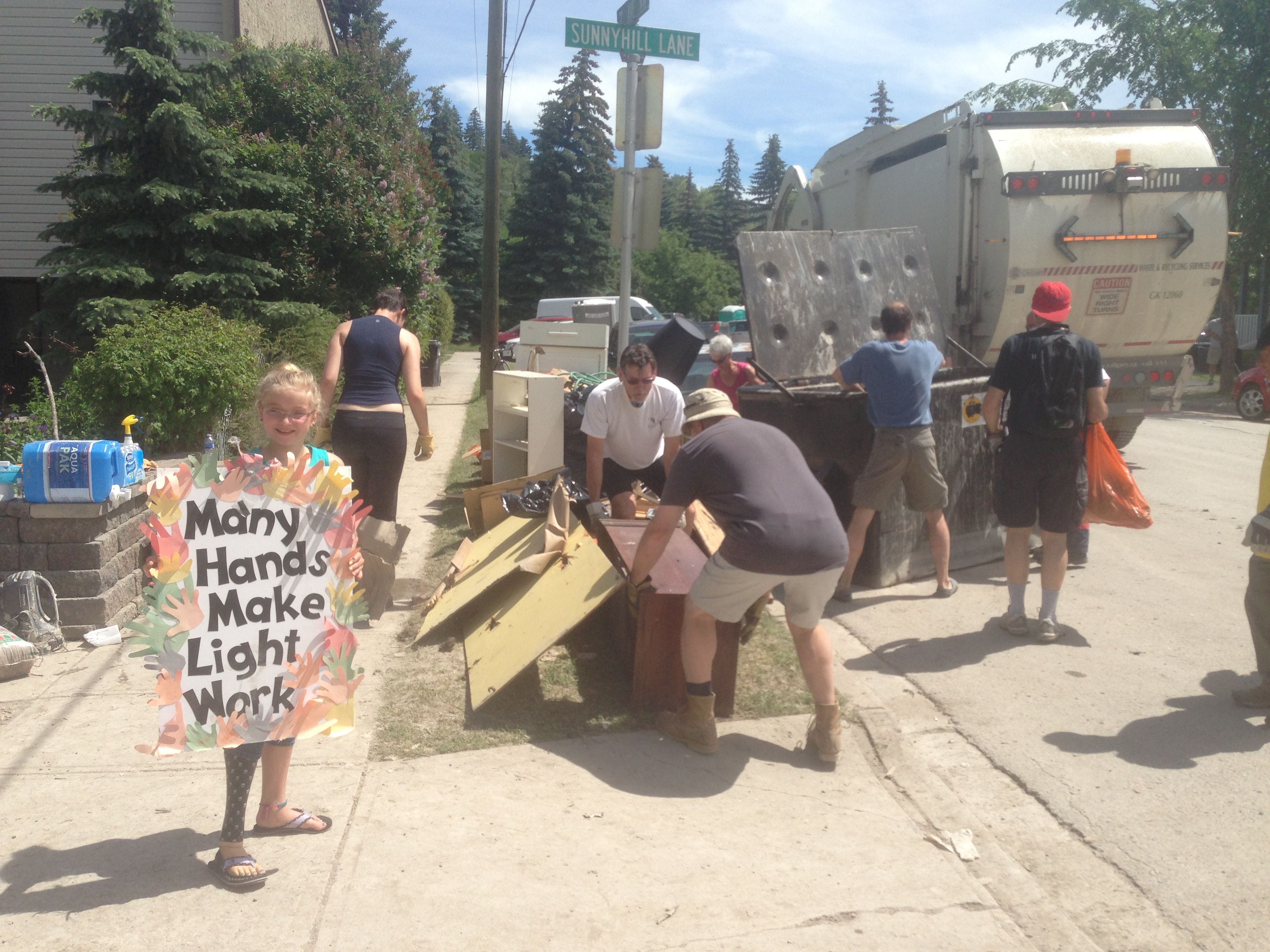
You become a million beating hearts. An army of citizens covered in mud. I love you as I have never loved anything before. And I love them, desperately, passionately, fully, because they are saving you. You are them, they are you.

There are no boundaries.

F-Many Hands Make Light Work

VI.

Then, we all go home.

We come back to our gutted homes; you go back to your unscarred ones. Or go on to help other communities. To High River (which still rends my insides).

We go/come home. But we are all changed.

See, we all love you now in a way we could not even imagine before. You are not just our homes and our communities. You are not just our paths and our riverbanks and our parks and our buildings, our bridges, our streets, our landmarks. You are, of course you are, all of those things. But most of all, you are us. We are you. And we know you—ourselves—so fully and so intimately. There is no theory-to-be-tested, no promises-to-be-fulfilled. There is no uncertainty over what we will-can-could do when asked: we have done it. Everything that had to be done? We did it.

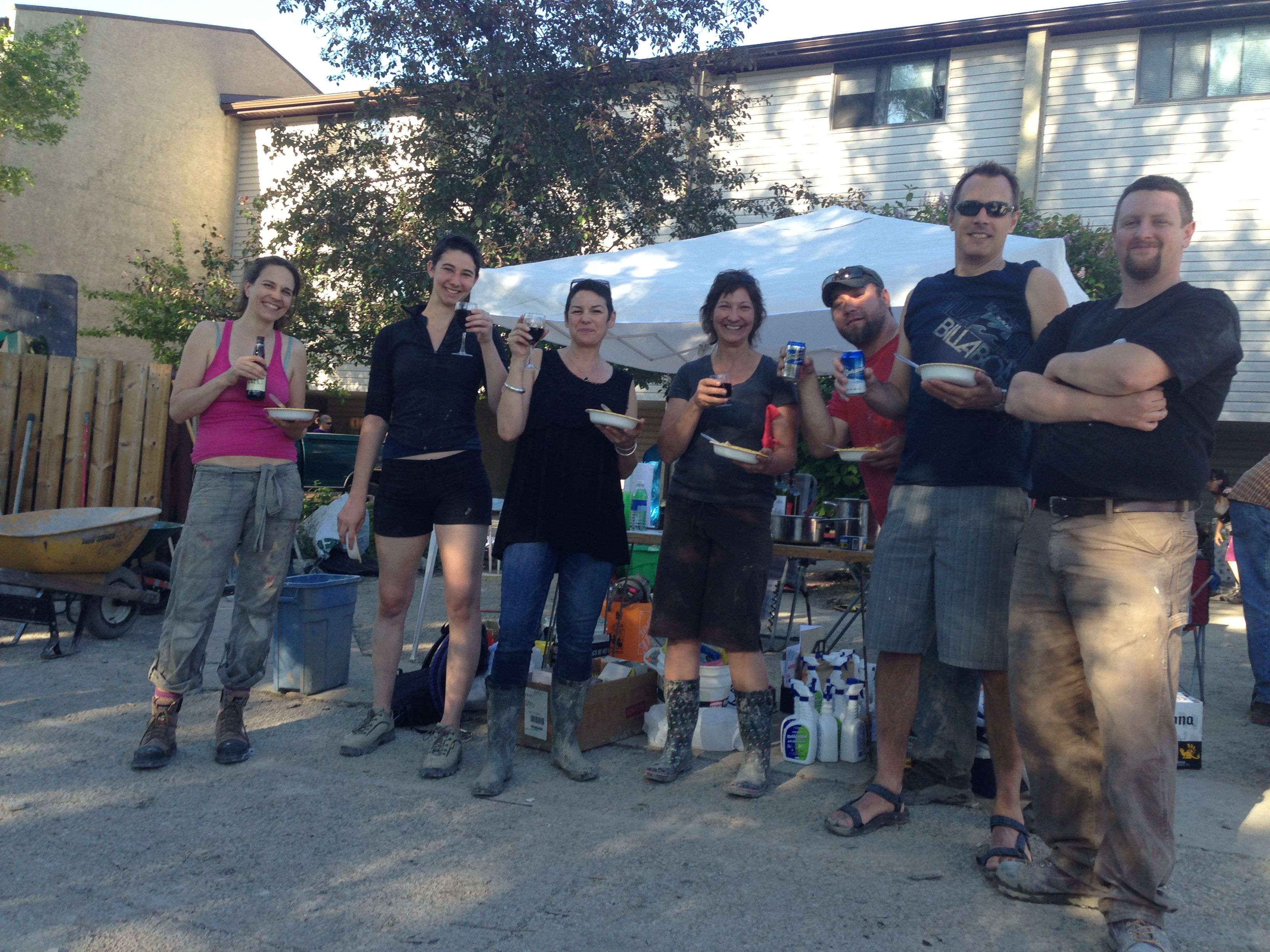
We saved you. You saved us.

F-Battling the mud

VII.

We are changed. But not all of us know this as fully-intimately-undeniably as those of us who lost and saved know this.

“I lost nothing. I did not help. I was unaffected.”

I walk with him on the river paths—because I hardly ever walk anywhere else—and he claims to be unaffected. And thus… unchanged. And I see, suddenly, how damaged he is. He had no personal loss, he says. He was not covered with mud. Your tears.

I cover him with mine.

He claims to be unaffected… but as he watches me cry into the river… unaffected?

No such thing.

We are all affected.

F-Our house debris

VIII.

This place where I live, this place that I love beyond the pall of all reason, this place that builds and binds, this place of jerrybuilt-during-a-past-boom townhouses, this place where dandelions bloom and little children grow up and old people grow older, this place is mine, and it is me.

This place is precious because it is loved, so loved, all the more so because it was threatened, almost-lost, saved. And as I love it, caress it, press it into me—each walk on its streets, each rediscovery of each of its crevices, curvatures, indentations an act of gratitude, acceptance, surrender—it grows. It becomes your place, our place, you, us.

This place is us, a million beating hearts.

F-Evening shift at SHL

IX.

“If it floods again, will we leave? Will we move?”

“I can’t. I can’t. I can’t even think that.”

F-O on Flooded Common

X.

I have loved and was loved and have eaten and felt loved again, and now I must get out of bed, find clothes, do things. But for the moment, for one more moment, I remain naked, languorous, wrapped up in you. And I need to tell you: I have loved you before this, for so long. But I did not really know how much until you were wrecked, destroyed, broken. And I did not truly value you, see the truth of you until you saved me/I saved you.

My most beloved: thank you.

F-Reunited

un-Epilogue

So. I tell the part of my flood story that’s our flood story, I write it as an imperfect love letter to my imperfect piece of flood plain, which I love, passionately, in all its faults, with all its warts, frustrations.

I am so very, very grateful. Love, gratitude, vulnerability, appreciation, surrender swim inside me, fill me, leak out through my tears.

And my own, innermost flood story, the one that I’m not sure even I want to hear? It is so very simple, really. And it is this: a year ago, I could not feel like this. I would not write like this.

I would not cry like this.

I could not love like this.

NBTB-I love you


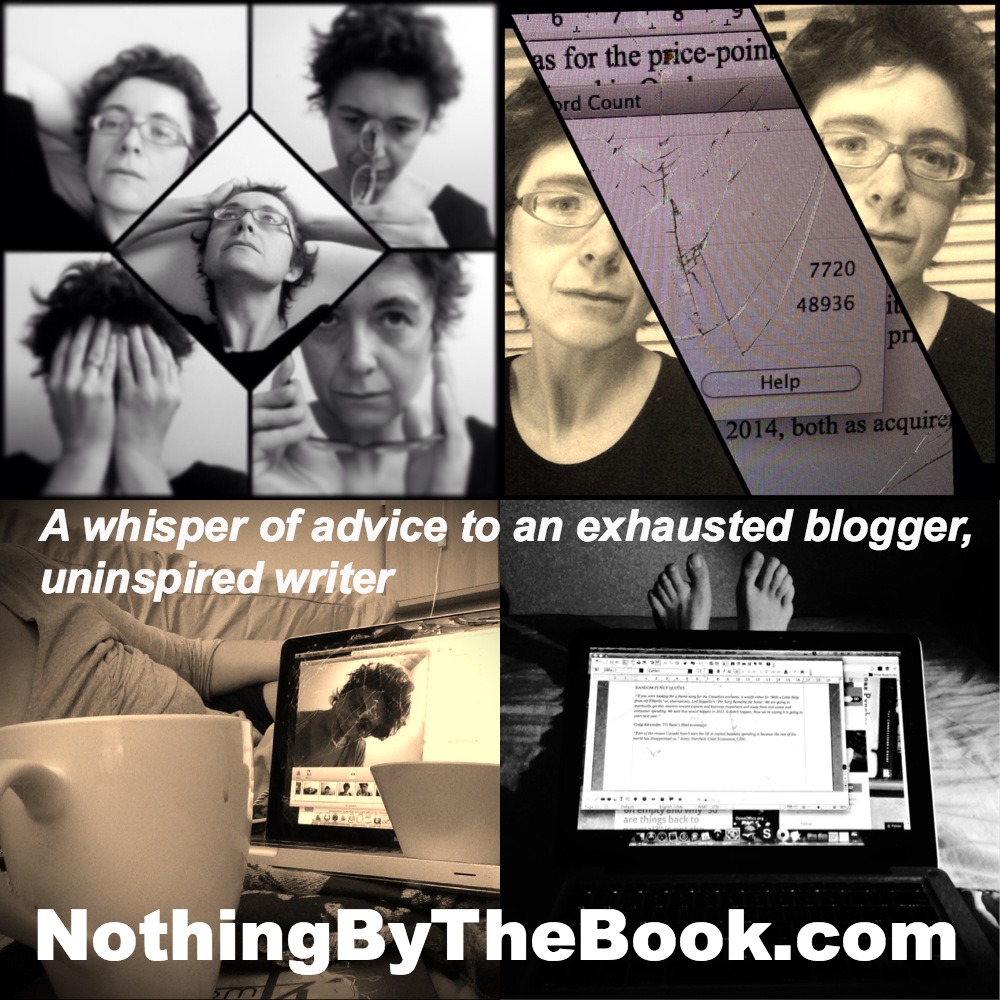
A whisper of advice to an exhausted blogger, uninspired writer

Play.

That’s all.

Forget about niching, target audience, stats.

Play.

Write three sentences about one of your kids’ curls. A pea smashed into the carpet.

Or: walk away from motherhood, parenthood, cooking, IT–whatever it is that your “niche” is. Write about something beautiful. Irrelevant. Important. Or not. Take a picture: and make a list of the adjectives it inspires in you.

Pull a quote from a book you’re reading. Do things to it. Let it do things to you.

Spend some time on Brain Pickings. Maybe start with Famous Advice on Writing. Or, no, no, read this, Susan Sontag on Sex:

“If only I could feel about sex as I do about writing! That I’m the vehicle, the medium, the instrument of some force beyond myself.”

… and see where that takes you.

Read Stephen King’s On Writing.

Here, in this space, your space, there are no rules but the ones you make.

Play.

Watch the Words, words, words playlist from Ted Talks: a collection of 12 fabulous talks for people who love words.

Write.

NBTB-Exhausted Blogger

xoxo

“Jane”

PS Unless you’re getting paid for it and you’re on deadline. Then suck it up, grit your teeth and get it done (hopefully not while crying). But here? Writing for you?

Play.

You’re welcome.