Manufactured Memories, for Suzie

I don’t want a pen pal, she doesn’t want a relationship, and we live 300 km apart, so really, we’re doomed, but we decide to play a game anyway, like Truth or Dare, without the dare part.

I set out the rules:

I ask a question. You answer it. Tell the truth, or lie—it doesn’t matter. How can I tell if you lied?

And then, you ask me. Only rule is, you can’t ask me the same question I ask you.

She agrees. But stipulates we shouldn’t lie. I shrug, although she can’t see it. What is truth, anyway?

She asks me to go first.

I ask, “What’s the worst thing you’ve ever done?”

And she tells me. It’s not so bad. But it’s honest and raw.

She asks, “Why do you hate Christmas?”

I give her the unvarnished truth; I suspect she wishes she hadn’t asked.

She asks, “Favourite childhood memory.”

I pause.

Think hard.

I’ve had, in many ways, an idyllic childhood. It’s only when I scratch and dig deep that I realize that much of it must have been hard. Displacement, poverty.

But I never felt, experienced the poverty. We were never hungry.

We always felt safe.

We always felt loved.

My parents really did create a cocoon around us. I make a mental note to thank them.

I search for a memory that makes a discrete story. I decide to go with a very early one.

It goes like this…

The taste of cherries

I’m on summer vacation in Poland from Libya, and it’s cherry season. We’ve spent the morning on my paternal grandparents “działka,’ essentially an urban community garden. Except in post war, Communist Poland, the działka provides, god, virtually all of the fresh produce for a city family, especially in the summer. If you didn’t have one, you made friends with someone who did.

I’m pretty little. Maybe six? I must be six, no more than seven, because my grandmother was dead by the time I was eight. And we come home from the działka, and we have so many cherries, and my grandmother and my great-grandmother, they are going to make cherry jam and preserves. But my brother and I, we just want to each the cherries. And they’re so ripe and juicy, every time we grab one, we stain our hands and faces and clothes.

So my grandmother, who is stern and particular, strips us down to nothing, and puts us in the bathtub… with a giant bowl of cherries.

And we eat them and eat them and eat them… our faces, hands, bellies are red from the juices. The tub is stained red. But oh-my-god, the taste of those cherries is still there on my tongue. I have never eaten something so delicious, before or since.

I don’t have a lot of memories of my grandmother—I was so little when we left, and she died soon after. Most of the stories I’ve heard about her—she was not a warm or loving or happy person. I don’t have any memories of her hugging me or kissing me or any gifts from her or anything.

Except this one. But this one is so delicious…

I treasure it.

Gorge myself on cherries every season. Often, they are sweet—they are never as sweet as in that memory.

I have a second favourite childhood memory. This one, I know is largely manufactured.

The donkeys

In Libya, we lived in a city, called El Marj. Most of the Eastern European foreign workers weren’t given free reign of the city—certainly the women and children weren’t. Most of us were housed in workers’ camps. Our camp was called the American camp, because it had originally been built for the Americans, I think. I can’t remember how many houses on it—it seemed huge to me back them. It was, after all, our entire world. There was one main road through it—barbed wire fence on three sides, and a stone wall on the fourth, separating us from one of the El Marj neighbourhoods.

Was there a gate? I don’t remember. Perhaps.

We kids were free to roam the entire grounds of the camp—we were discouraged from hanging out near the entrances or near the crack in the stone wall—that’s another story, we used to meet there for parlays with the Arab kids but neither our parents nor their parents liked for us to do that.

One day, in one of the corners of the camp, we found a mother donkey and her baby.

We=the assortment of camp kids. At any given time, there were six to twelve of us; I don’t remember who the other kids were at the time. Nor at any given time: we were interchangeable to each other, playmates of the moment. Anyone of us could be gone tomorrow. Polish kids, Bulgarian kids, a token Romanian—I remember we didn’t like him, he was the eldest, a bully, mean, until we put him in an old rusted barrel (they were all over the place) and rolled him all over the camp, beating the barrel with sticks.

(Um, Mom and Dad, if you’re reading—you didn’t read that part. IT NEVER HAPPENED.)

We had no idea how the donkeys got into the camp—maybe the mother could have jumped the fence, but her baby? Maybe the gate was open—or maybe there was no gate.

She was in pretty rough shape, lots of scars and wounds. The Libyans were pretty hard on their animals.

We cleaned her up, and took the ticks out of her eyes and where we could find them on her and the baby’s body (there were a lot of ticks, swollen with blood). And we got them food and water.

I can’t remember what we fed them. Most of our mothers grew vegetables and flowers while we had water, so we probably raided the gardens. Sometimes, we didn’t have water and had to drive hundreds of kilometres to get drinking water. Then, the gardens withered.

In my memory, we kept the donkeys hidden from the adults for weeks. But I expect it was only a few days. The big kids, we rode the mom. And we put the two little guys (my brother and the another little boy) on the baby. I remember this, distinctly.

When I say rode, I think I mean we got on the donkey’s backs and sat there and maybe the donkey walked around a little…

Memory is a funny thing. I don’t remember how this story ends and I refuse to ask. One day, the donkeys weren’t there. Did their owners come back? Did they escape? Did someone see them, and “steal” them? Did someone come to the adults, tell me, give us our damn donkeys back? Did our parents let them go, chase them out? I don’t know.

(Dad, if you know—don’t tell me. I don’t want to know.)

In my story, we keep them and take care of them forever, and everyone lives happily ever after.

She likes the story. A lot.

But now she wants her next question.

I ponder for a bit.

Then ask, “What’s the most creative lie you’ve ever told, and why?”

I hope it’s going to be a good story.

xoxo

“Jane”

If you want to save the world, fund libraries, use libraries, love libraries

It’s been a rough week, and I’m seeking solace in solitude… and the library.

My hometown boasts the second most used public library system in North America, and we’ve recently received what is probably the most beautiful public library in the world. Designed by American-Norwegian architecture firm Snøhetta and Canadian firm DIALOG after the two firms’ joint bid won a design competition in 2013, the new Calgary Central Public Library was recently named one of Time Magazine’s World’s Greatest Places to Visit in 2019.

Stroller Alley at Calgary Public

The building is so beautiful, the first time I walked through it, I burst into tears. It has quickly become the meeting place in Calgary. When I’m not sure where to meet someone, or what we should do, I almost invariably say, “Let’s meet at the library, and go from there.” And I’m not the only one—the library is teeming with people, always.

Books are dying, literacy is dying, culture is dying? Please. Not in Calgary, not at our library.

Questionarium, Calgary Public Library

When I visit the library on my own, as today, I have a series of rituals and routines I follow. First, I walk as high up the four floors as I can without taking the stairs or elevator, on a walk-through ramp that curls along the side of the library. I walk past the incredible children’s area and the cafe—at our library, you can make all the noise you like, kiddies, and also, you can eat and drink, and be merry. And I look at the curated book displays and games and everything, but I don’t handle any books, I don’t stop. I make my way to the very top, and to the reading room.

Curated children's book display, Calgary Public Library

The reading room is my favourite room in the library and the only “quiet” space: this is the place to come and work, not talk. So I set up my computer, and I write.

When I need a break, I pause, get up from my desk, and walk around the reading room, which showcases the librarians’ choices of books, arranged my topic. There’s usually a Wild West section (we do live in Cowtown after all). And Banned Books. And Graphic Novels. And, and, and…

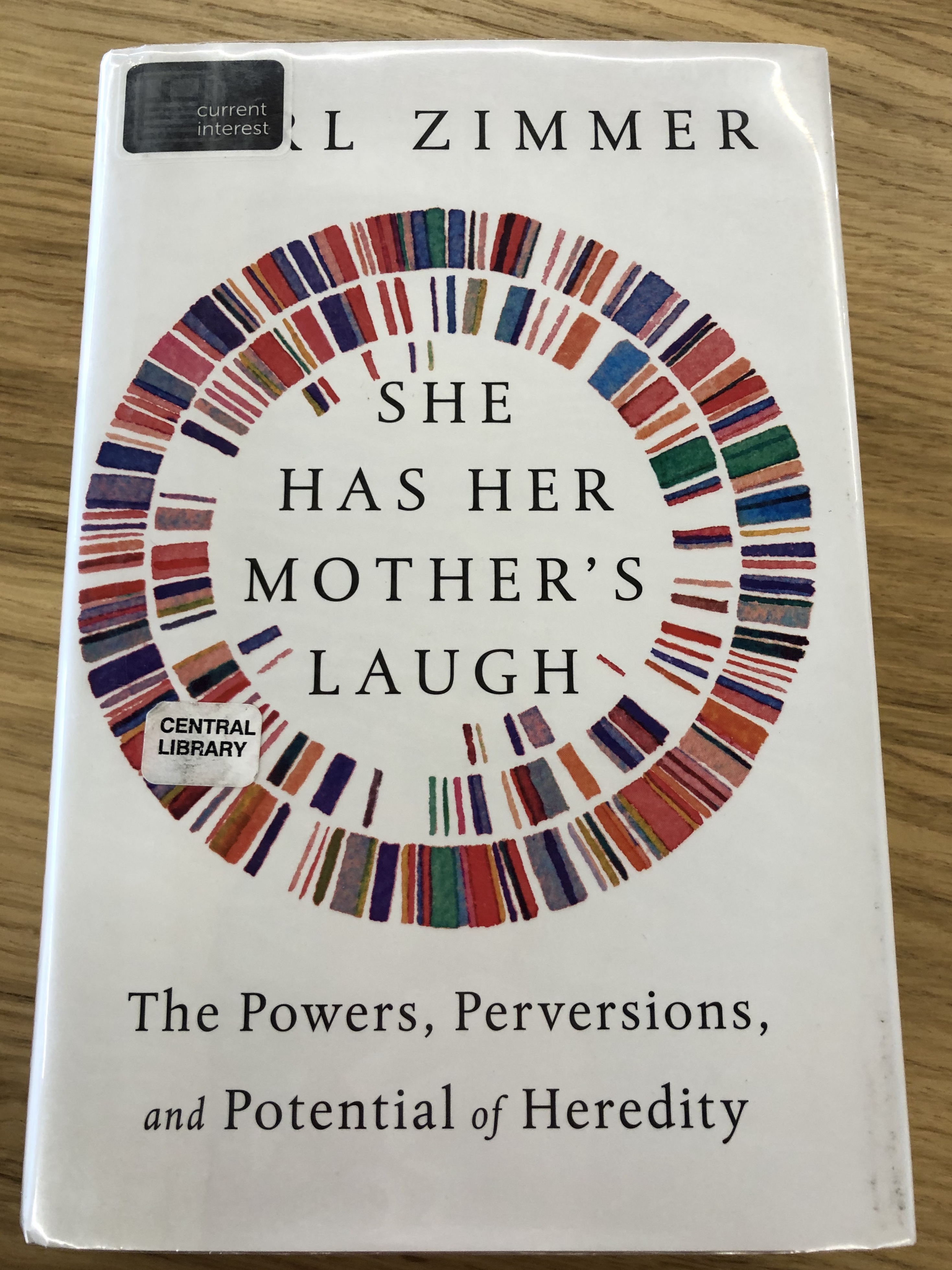
I let myself pick up a few books and leaf through them, and I might take a photo for future reference. I’m not allowed to read these books. Not yet. I’m still writing.

Book cover: I killed Adolf Hitler

I go back to my work space. Write. Pause. Browse. Write. Pause. Browse.

When I’m done writing (and I always stop just before I’m empty), I pack up, and start the slow walk down.

Now, I’m allowed to pick up books… and perhaps to take a few home.

Book Cover: Queen Victoria by Lucy Worlsey

Today, though, I’m walking and I don’t have a bag, just my small laptop briefcase. Today, I will not take out any books.

Among the many, many things I love about the library—among the many, many reasons why I think libraries will save the world—is… think about it, I can leave this place with a hundred books. For free.

Calgary Public Library cards are free, by the way. There used to be a nominal $10 application fee for adults. The library eliminated this a few years ago, because access, knowledge, freedom.

There are a dozen, perhaps more, meetings and programmes running in the library at any given time. The library offers free programming on—god, everything. Financial planning, coding, lego building, science, fashion—and, of course, literacy.

It has artists in residence and writers in residence.

And new art in its public space.

Today, I get to “meet” photographer Samuel Obadero, and his exhibit, “The Forgotten Ones.”

This slideshow requires JavaScript.

I also spend some time in the Create Space area, pondering some tough questions.

The Create Space is part of the library’s commitment to “Supporting brave conversations and generous gatherings that build understanding.”

Create Space, Calgary Public Library

You know. The conversations that will change the world.

Create Space, Agree or Disagree

I get sidetracked by books—thoughtfully curated by the librarians. This one catches my eye:

But it’s a brick. And I’m walking. And I am not getting any books today. I snap a picture to place a hold on it in the future.

I am not getting any books… Damn. Wait…

Well… but these are very light.

I get books.

I pass a group of citizens and tourists getting a tour of the library. It ranges in age from teenagers to octogenarians, and the enthusiasm with which they listen to the (ridiculously enthusiastic) tour guide makes my heart sing.

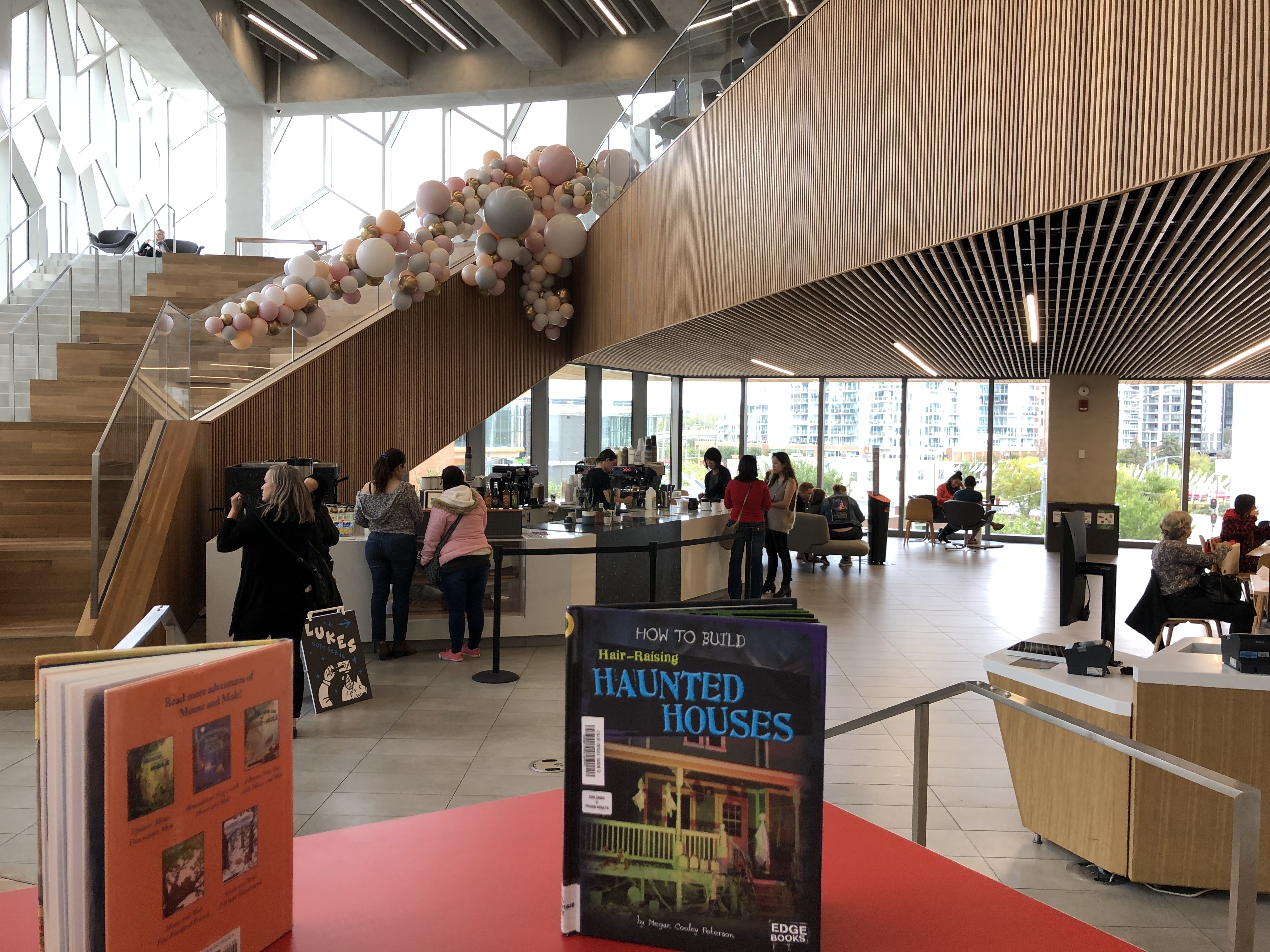
A family of five, Calgary locals, is visiting the library for the first time today. The father is trying to muster them along, because he wants to get to the reading room. But he’s lost the mother to a bookshelf, and the kids are staring, wide-eyed, at the balloon arch near the cafe.

I think about taking my books to the cafe. But not today. Not today. I still have to visit the drinking birds, massive sculptures by  Los Angeles-based artist and teacher Christian Moeller.

The birds make me happy and give me hope, in much the same way the library makes me happy and gives me hope.

As Sadie Trombetta writes in her March 20, 2017 article in Bustle, 7 Reasons Libraries Are Essential, now More Than Ever:

“…libraries have become centers for the movement that supports women, immigrants, people of color, the LGBTQ community, and those facing religious persecution. They are free public spaces that allow everyone to feel safe and to find opportunity.”

As I leave the library, hordes of people are coming in. Citizens, tourists. Young people, old people. White people, brown people. Queer people, straight people. Rich people, poor people.

Moeller’s Drinking Birds bop to welcome them.

[there really should be a Drinking Birds photo here, shouldn’t there? But I didn’t take one and I don’t steal images. So, imagine it… or Google “Calgary Public Library Drinking Bird Sculpture”]

I smile at strangers and they smile back.

In this moment, in this place and space, there is safety, peace, knowledge, potential… hope.

I am so happy, I almost cry.

xoxo

“Jane”

For some better photos of the library than mine, check out this fan-feature on the library in Avenue Magazine: https://www.avenuecalgary.com/city-life/inside-calgarys-new-central-library/

And, of course, the Time Magazine article: https://time.com/collection/worlds-greatest-places-2019/5654128/central-library-calgary-canada/


Two in high school, one at home equals… I don’t know, I’m really bad at math

Last week, I started drafting a post celebrating and documenting Calgary’s Pride 2019 and telling you why it is we march—and why if you don’t get that it’s political, that all the joy and dancing and laughter and singing around Pride is so political, then you shouldn’t come to our glitter party—but I couldn’t make it funny or even particularly convincing. So I shelved it.

The week before that, I wrote three very long essays about why I hate the family therapist that’s part of Flora’s medical team. Short-hand: She doesn’t understand. Me, Flora, our family. I don’t like her. I don’t respect her. I don’t want to listen to her, and I can’t hear her even when she gives me something of value, because I really need to be able to be angry at someone, hate someone, blame someone, and she’s the ideal candidate for the task. But I couldn’t make it empathetic or compassionate. It just sounded mean, and I didn’t want to come across as mean. Just… pissed and misunderstood.

We live here, how lucky is that?

Then, some good things happened, but I didn’t even try to write about those, because I didn’t want to jinx them. I jinxed some of them anyway. Alas.

And since Tuesday I’ve been trying to compose a “Back to School” post. My first-ever, because this is Cinder’s first “Back to School” year—my boy’s in grade 12, y’all. And it’s Flora’s first-ever “to school” year—she did it, we did it, she made it to regular school on day 1 just as she decided way back before BAM! Surprise! Curveball!

Flora’s first day of school; yes, that is her unicorn costume

And, Ender’s first year at home alone. I mean, with me, but you know what I mean. I don’t count, because I’m an adult. His first year at home alone without his siblings. He missed Cinder desperately when Cinder went to school last fall—I found this odd, because it seemed to me Cinder spent most of his time in his room anyway, playing computer games and punching holes in walls—but apparently just having him in the house was… nice.

I’m trying not to overplan and overpanic. He’ll be fine. He’s got buddies in the hood, and a homeschooled buddy just two doors over.

Cinder planning his semester (who is this kid??)

He’ll be fine. Me? Here’s the funny thing that most people don’t get. When Cinder went to school, I did not suddenly magically have more free, non-kid time. Because there were still two kids at home (and one of them was about to need 24/7 care but let’s not go there again, not now, not yet). And now, with both Flora and Cinder in high school—I do not magically have more kid-free time. Because, there is still… Ender. And an Ender who no longer has two older siblings to hang out with during the day, to distract, to bug, to annoy, to fight with.

And then there were three…

We survive our first week solo relatively well. Tuesday and Friday are a half-day, and on Wednesday, we have lots of errands, and Thursday is a beautiful day, so we spend a lot of time outside, and then, the weekend, and a sleepover with his cousins and all his friends on the Common.

And today is Monday, our first week of five full days of no Flora and no Cinder at home.

We’re gonna be ok.

I think.

Ender’s “not back to school” lunch

Our coping strategies are very similar. I decide to reorganize the homeschooling supplies and purge the stuff that we are definitely never ever going to use again. Ender reorganizes his Lego shelf—to make room for the new Lego sets he’s planning to receive for his birthday, my eternal optimist.

We read a book together, then I read alone.

I do laundry, because it’s Monday and it’s raining, and that’s what you do on rainy Mondays when you have a dryer and a large drying rack.

He sorts his Lego, then starts uploading Minecraft mods.

I scour the house for chocolate. For fuck’s sake, surely, there’s an untapped stash of chocolate somewhere?

(There isn’t. I eat a handful of chocolate chips instead.)

There aren’t very many chocolate chips left in the house, because Cinder was doing midnight baking…

He asks for three lunches.

I answer an email, then text, from a new homeschooler who wants some advice on learning plans and unschooling. I’m not sure if what I tell her will be helpful. Because in the end, my “proof of concept” is unique to me and my family.

I think a lot about my work. Write some new words. Delete a few. Write a bit more.

I ask him if he wants to go swimming. Or something?

He shrugs. “Maybe go for ice cream? Later? I’m busy now.”

I go back to my computer. Tickle the keys.

Write.

Invite the nervous new homeschooler over for coffee.

Write while I wait.

Happy rainy Monday.

The path less travelled

xoxo

“Jane”

Me and my “baby,” at the Passport Office