That’s my story, and I’m sticking to it… no, wait, actually, let me change it…

I believe, rather ardently, in the power of story. If your religion is Christianity, his Islam and hers Wicca—and theirs veganism—my religion is story.

Story is, perhaps, not everything—other things must exist, else there would be no ingredients for story, and no one to tell stories to—but it is all-powerful.

The stories we tell other people, the stories we tell ourselves, they shape our reality. They change the past, define the present, and create the future. That, loves, is power.

Sometimes, in our interactions with other people, our stories clash. There’s a fight. Perhaps one loses and the other wins. Perhaps both break into bits and they create a new story from the flotsam and jetsam of both. Sometimes, two conflicting stories manage to meld into a cohesive—but tense!—single one.

One of the amazing thing about story is its fluidity, adaptability. In oral traditions, the story changes a little bit in every telling. And this happens even in our more rigid, current product-focused traditions. Look at all the remakes of movies, retellings of classical literature. Story changes. That is its nature.

That is its power.

Our personal stories are among the most powerful stories. And these can change too—we can change them. At will, almost. But it’s hard, because stories don’t exist without an audience, and we are rarely the only audience for our story. Family and friends, even if they don’t really like our old story, are used to it. They redirect us to it, in every interaction. Even when we are telling them a new story—they act as though they are hearing the old one.

That’s hard. And discouraging.

I think that’s why, when we are working to change a story, we look for new people. We want a new audience for the new story we are creating. We don’t want the tried and true audience that says, “No, that’s not what happened—I know this story, the Prince woke the Princess up with a kiss and they lived happily ever after, that’s what happens in this story, why aren’t you telling it like that?”

Because I’m changing it, love.

If you can’t listen to the new story without trying to pull me into the old one—that’s okay. It’s natural. I understand. I’m going to tell the story to someone else, who hears it.

The greatest gift we can give our friends and loves, when they are changing their story… is to listen to the new one.

Her: Suppose the new story is all bull shit?

Jane: It’s their story. Their bullshit.

This is, by the way, very hard. Terribly hard. Exceedingly hard. The closer you are to a person and the more enmeshed in their old story, the harder it is to really hear—never mind support—their new story. I’ve failed at this, in the most significant relationships in my life, so I’m not preaching to you from a moral high horse. It’s hard. So hard. Sometimes, impossible. And then, the greatest gift you can give your loves is the opportunity, space, encouragement to find a new audience for their story.

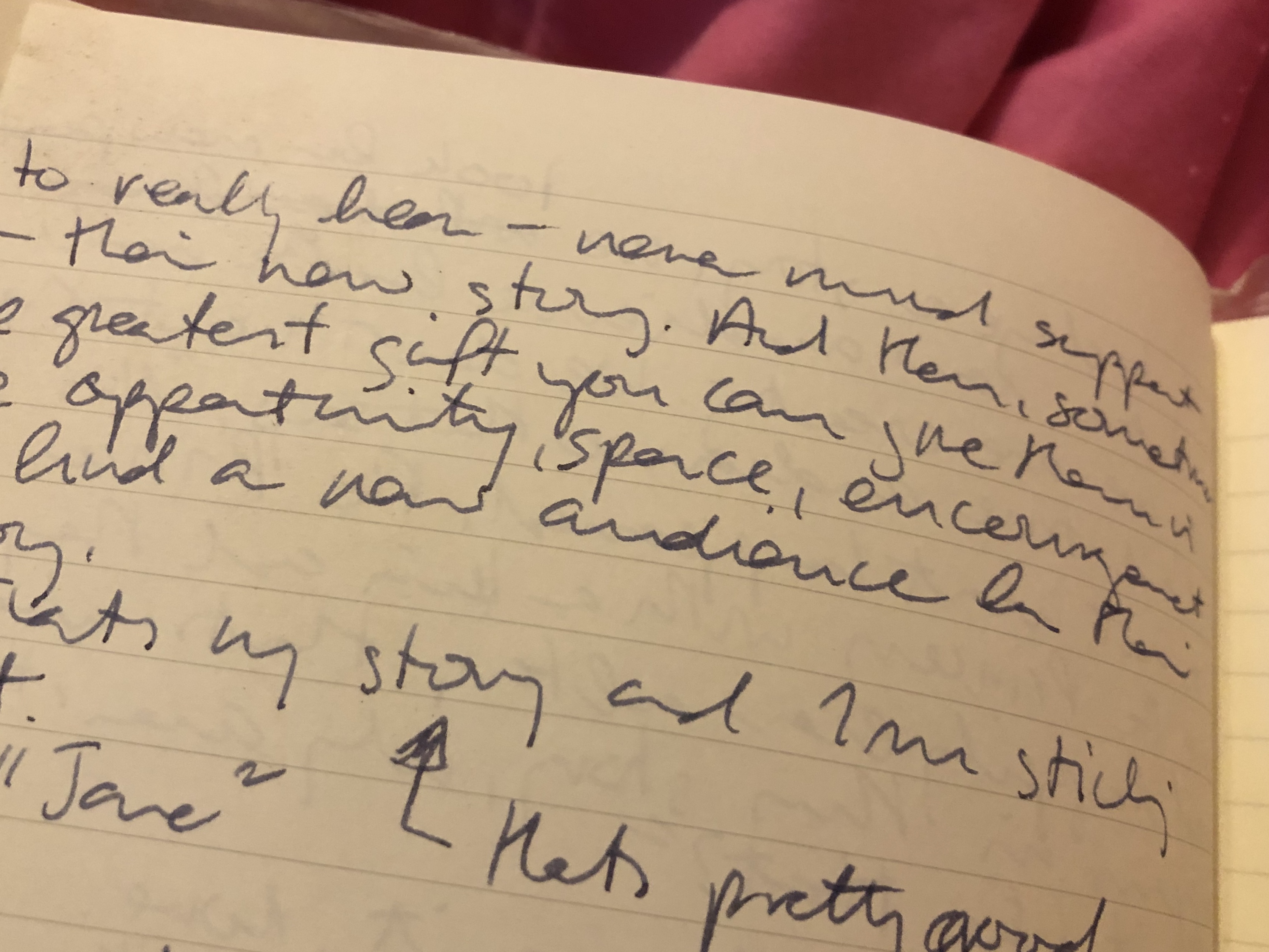
That’s my story and I’m sticking to it.

😉

“Jane”

Pandemic Diary: Of sentence fragments and their opposite, and also, parenthetically, purposeful procrastination

i

Me, in bed, much coffee, a bare foot sticking out from between tangled blankets, notebook, leaky fountain pen. Morning pages done but not yet quite ready to work—unfinished business? Sneezes—not COVID-19 and not a common cold—I think I’m allergic to my feather pillows, oh, but they are so comfortable!

Achoo.

Mentoring a writer and ripping her work to shreds in a big way. I mean—editing, but a new writer doesn’t understand the process and every correction hurts. Also—“But you use sentence fragments all the time!” True. But I do it on purpose, to achieve a certain tempo, feeling. You do it because you don’t understand grammar.

Ouch.

I need to learn how to deliver life lessons in a more gentle, supportive manner.

Except… successful, published writers need to learn how to survive criticism—even harsh, unjust criticism.

Just read the comments.

(Don’t read the comments.)

ii

I guess this is still a Pandemic Diary entry because the pandemic is still happening. But man-oh-man—boy-oh-boy—why do we not say girl-oh-girl, do you think we could make that a thing—it sometimes feels like it’s not, and I still don’t know if your grandma, your son, your immune-compromised system are worth all this—I wish you’d show me they were—but I suppose what all this is illustrating is that I am just not a very good, compassionate human being—I’m sorry (not-sorry), I fucking suck, aren’t you glad I’m not making policy decisions?

The above is an example of a run-on sentence that I can get away with in a blog post (but not in an article) and that Henry James could have kept on moving for pages and pages, but which you, beginning writer, need to chop into six simple declarative sentences.

You heard me. Six.

Maybe seven.

Chop.

Ouch.

iii

Achoo.

I’m sneezing again. Another cup of coffee. Almost ready to work. (<<<— Sentence fragment used to a purpose.) (<<<—Sentence fragment used to a purpose to illustrate the purpose of sentence fragments.) Yawn. Sneeze. Curl and stretch the toes of the foot peeking out from between the sheets. Sternly tell it that no, it does not get to crawl back under and snoozle.

It’s time to work.

Achoo.

Ouch.

More coffee?

“Jane”

Pandemic Diary: YYC Pride in Year One of the Pandemic

It’s sort of Pride Week in Calgary. Pre-2020, we had the best of all worlds, really: in June, while San Francisco, New York, Toronto, Montréal, Vancouver et al. celebrated Pride, some of us travelled there and some of us had micro events here, and meanwhile, we planned for the Labour Day Weekend, when Calgary has been celebrating Pride since 2009—because our June weather sucks, what with the rain and floods and what not. By mid-August, our Pride events were really in full swing and so the parade, held on Labour Day Weekend Sunday, and its after-party were really the end, rather than the beginning of a week—month—summer—long queer orgy.

Ah, the good old days.

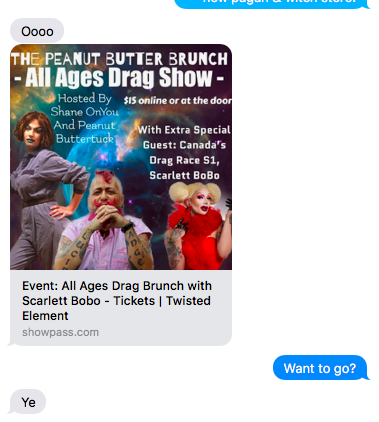
Of course, no parade this year. But, today, Flora and I are going to an All-Ages Drag Brunch at the Twisted Element, which has transformed itself from a nightclub in which nothing happens until after midnight to a pub with table services and a kitchen, with a couple of fellow queers—(parenthetically, I really love being the mother of teenagers—they are way more fun than toddlers). Because we’re doing that, we’re missing the Pride Park Takeover at Pearce Estates Park, hosted by Here and Queer Events –but, like, you should go. Calgary Pride is also, of course, offering an assortment of events all through the week, some on-line, some live, all queer as fuck.

So while it will be a shoestring Gay Christmas this year, Glittery St. Nick will still ride through town in his ass-less chaps and the lesbian angels will sing… on Zoom, occasionally live, six feet away from each other…

Better than nothing, right? But oh, I want to dance, I so want to dance—especially as I was supposed to dance at a wedding in Warsaw today (Congratulations, Łukasz and Magadelna!) but the only way that will happen will be if someone throws a somewhat illicit house party—about which none of us will tell anyone anything because, well, y’all are judgemental pricks and, in your own way, as rabid and dogmatic and uncompassionate as the anti-maskers… there. I’ve said.

Sorry-not-sorry—unloving thoughts on the eve of Calgary’s love is love celebrations. But. Seriously. Don’t understand why getting basic human rights for LGBTQ+ people has been such a slog and we’re still fighting for every single gain—or why the queer community is so fractured and rife with racism, transphobia, bi-erasure, femme erasure et al.? Look at how well we’re tolerating different risk assessments and responses to the pandemic.

The anti-maskers aren’t the only culprits. Think about it.

I digress, but not really, because all roads these days lead to COVID-19. I’ve got my rainbow mask, I’ve got my rainbow kid, and we’re going to take our rainbow hearts and go do something rainbow and fun—and sanitize our hands thoroughly after.

And then I will dream about a crowded dance floor while spinning in a circle, alone, in my living room.

Unless you’re hosting a dance party. In which case, text me.

“Jane”


Melting, working, waiting: an August vignette without a moral

We are melting.

The thermometer has hit 33 degrees centigrade today—for my American friends, that’s 91.4 Farenheit, or, as we say in Viking Hell, fucking hot. The air is hot and still, although a windstorm swept through the city and the prairie last night. But it did not bring a storm or rain, nor did it break the heat wave.

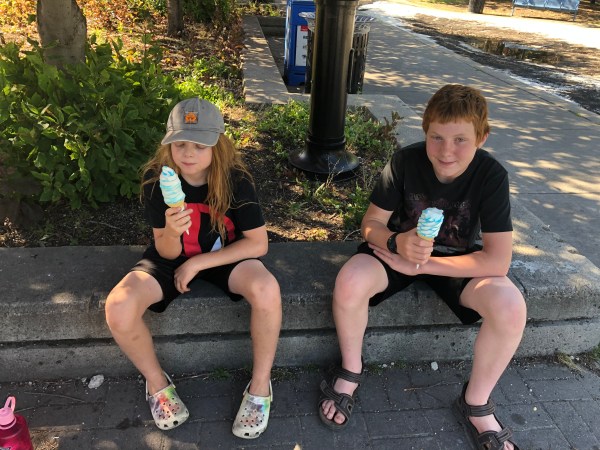
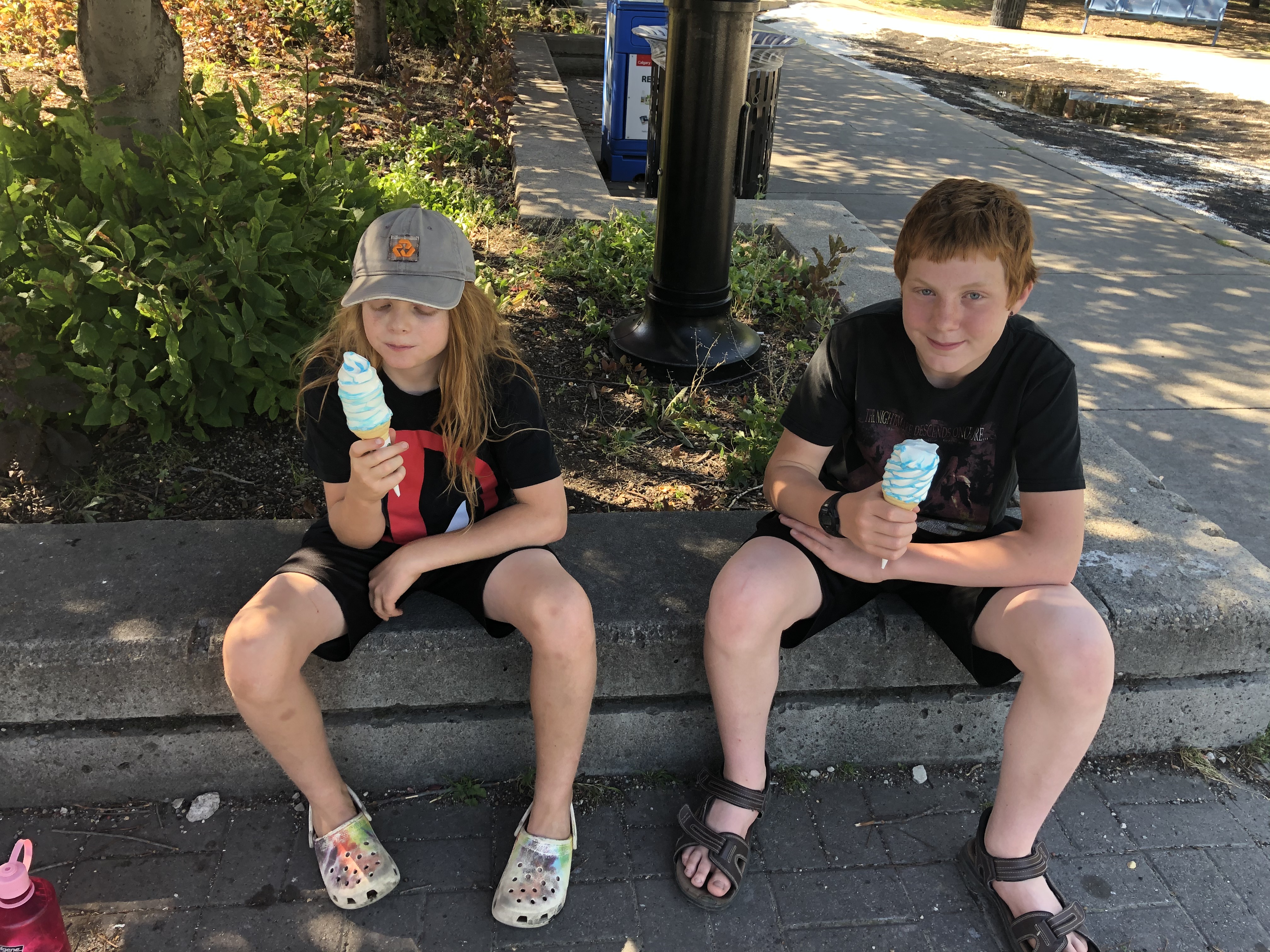
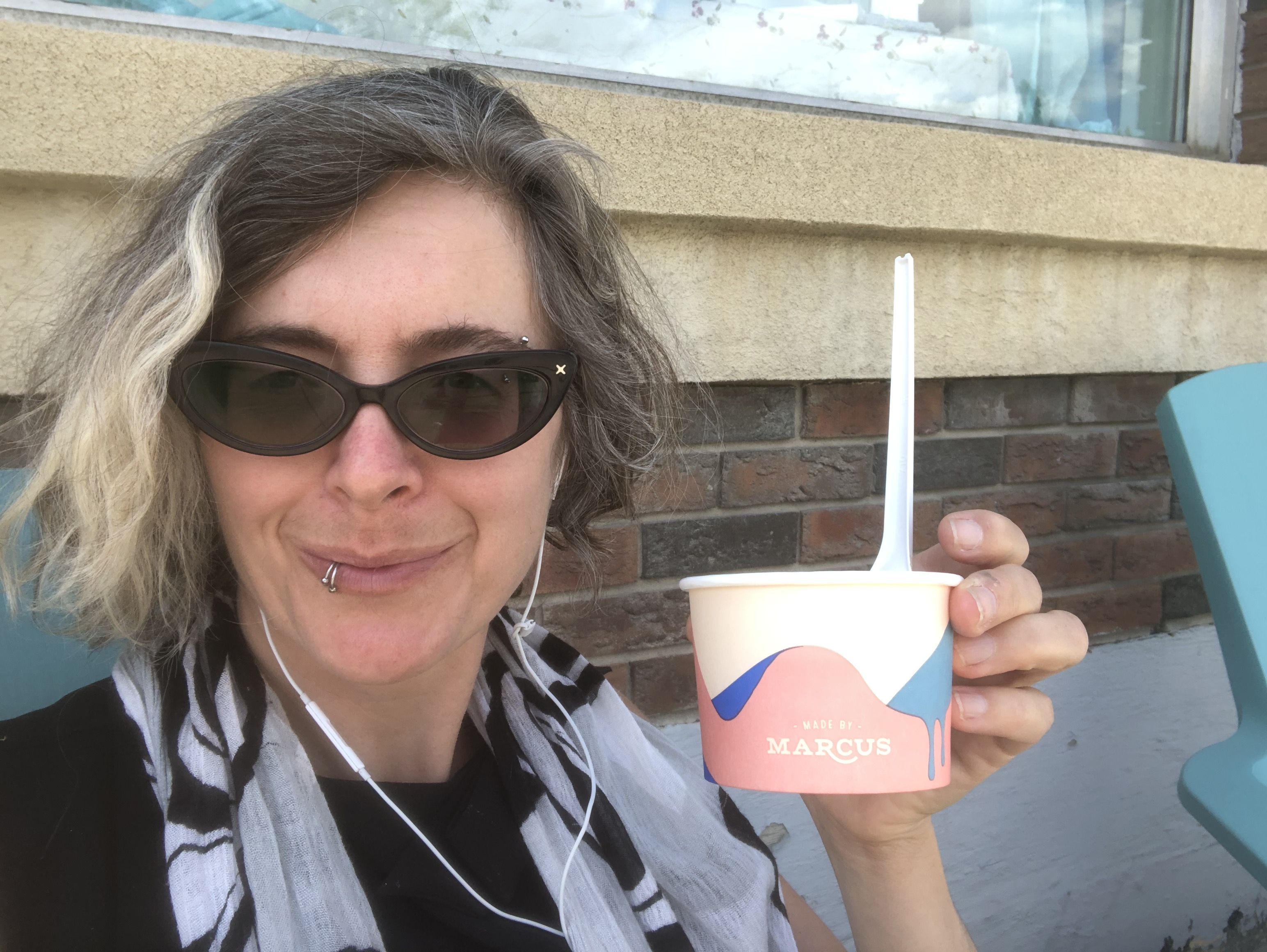
I rather love it, to be frank. I wrap a wet scarf around myself when I do have to walk, I stay in the shade and in my cool hobbit-cave of a house. I sit under a tree by the river and watch it swim by lazily. I take Ender rafting—and yes, son, we will go again on Thursday—and we bike, early in the morning before it gets too hot, to get ice cream. Ice cream—yes, this is the weather for eating ice cream—no, actually, it’s almost too hot, eat it quickly, lick as fast as you can before it melts, savour it after…

I am working.

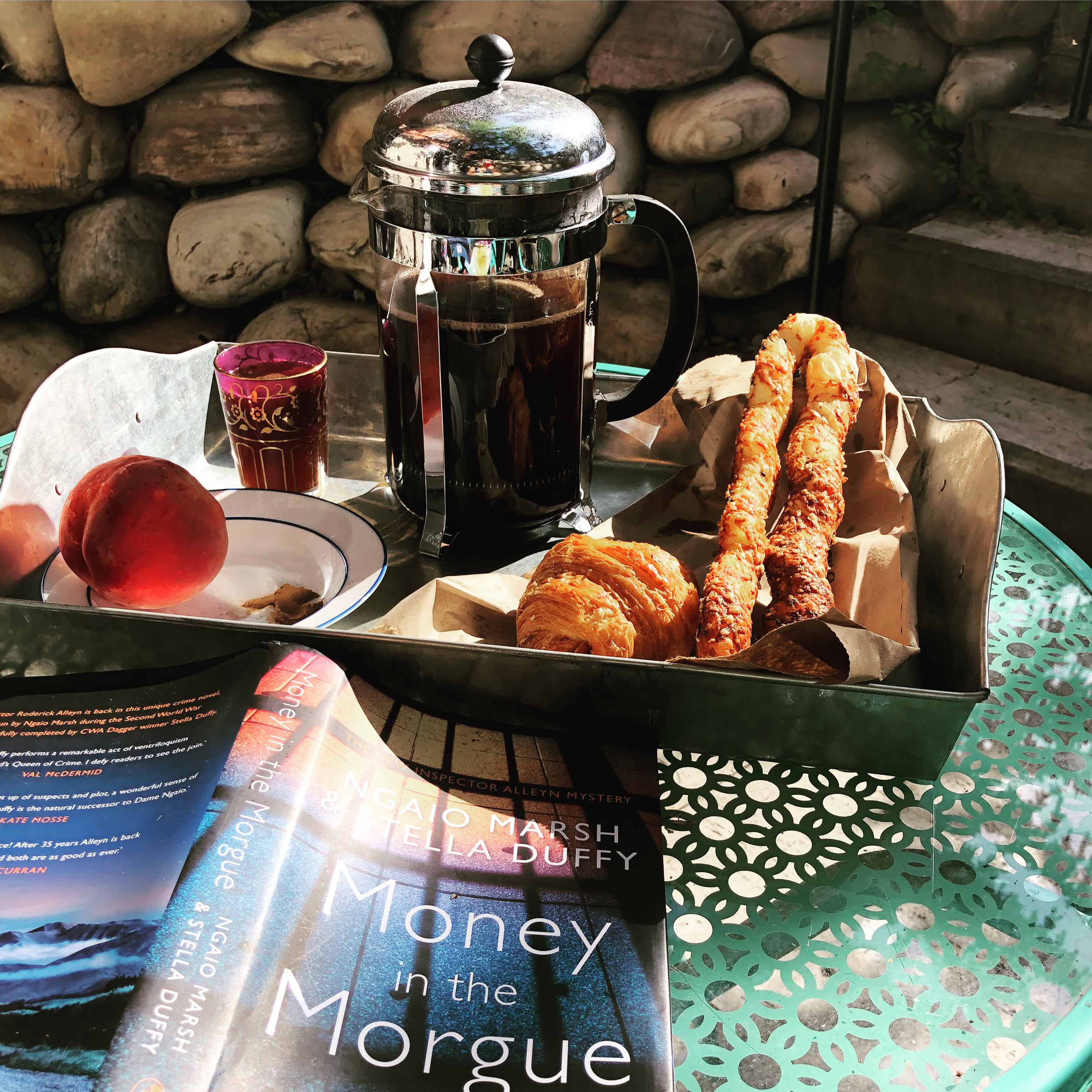
Deadline, and another one—and also this, that, and the other—and now I’m done, out of steam, it’s too hot, thirsty, sick of drinking water, cold tea? I stretch out in a makeshift chaisse lounge with a book, Stella Duffy’s continuation of Ngaio Marsh’s Money in the Morgue. It was not, from what I can gather, a great commercial success. But those of us who can’t get enough Ngaio buy it, read it—just as we devour third-rate Jane Austen retellings, Sherlock Holmes pastiches.

We all want more of what we love.

I am waiting.

I have done all the things, done my best, rolled the dice, stacked the deck, ran out of metaphors—hit send. Visualized, manifested—worked my ass off. Nothing left to do—nothing left to chance. But now, waiting. Waiting. I try to distract myself with ice cream and pleasure; fail.

I work.

I am working.

I am waiting.

We are melting.

“Jane”

Books in the Time of Corona: what’s on my shelves and what’s not, and the story it tells

First, an apology for the title slug. I know you’re all sick and tired of plays on A Love in the Time of Cholera. Still. There’s a reason we’re doing it.

Second… but really first:

i. A catalogue

I recently moved, and as part of the uprooting, I culled my physical books to the essentials. (Ok, I moved like 500 metres away, but hey, packing and thus purging was definitely involved.) Stress on the physical: thank gods for my e-readers, a library of thousands always in my pocket.

Still. I was pretty ruthless. Totally ruthless, actually. Goodbye, university textbooks. Goodbye, books from the “I was a teenage Wiccan” phase. Goodbye, big thick books that look good on my shelf and make me feel smart because I own them—but let’s be honest, I’m never going to read Infinite Jest. I tried. It’s unreadable. I read Gravity’s Rainbow—goodbye—and, frankly, wish I hadn’t, don’t remember what it’s about, and I’ll never get that time back.

Goodbye, all of Jeanette Winterson’s not Sexing the Cherry books. Goodbye, gifted books that missed the mark—goodbye, self-bought books that I read, don’t remember, will never read again. Goodbye, books I once loved but don’t anymore—that cull was the hardest.

What’s left was still heavy to move and comprises about ten shelf equivalents. But each of these books is loved. Important.

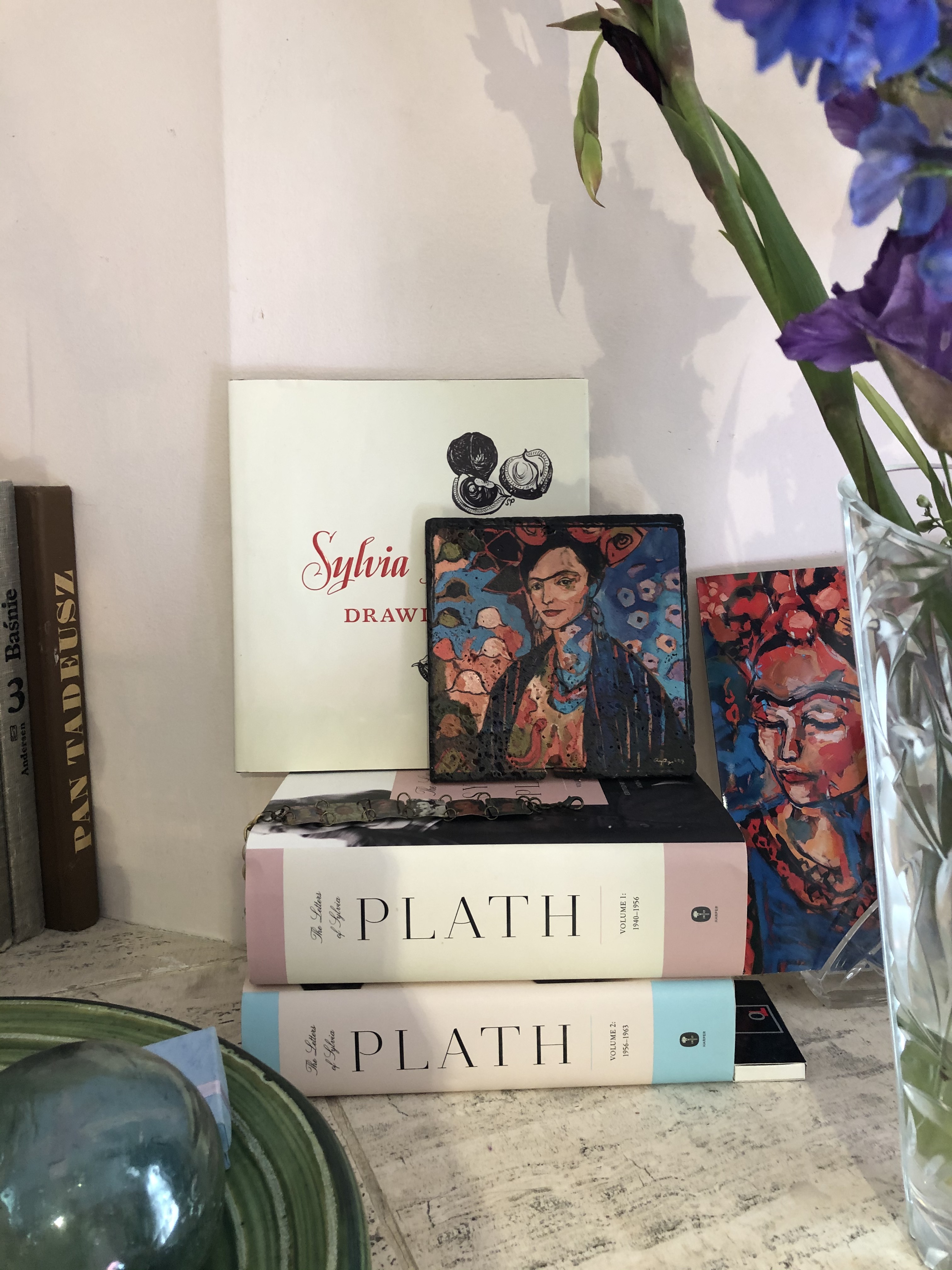
Like The Letters of Sylvia Plath and this little known book of the poet’s drawings:
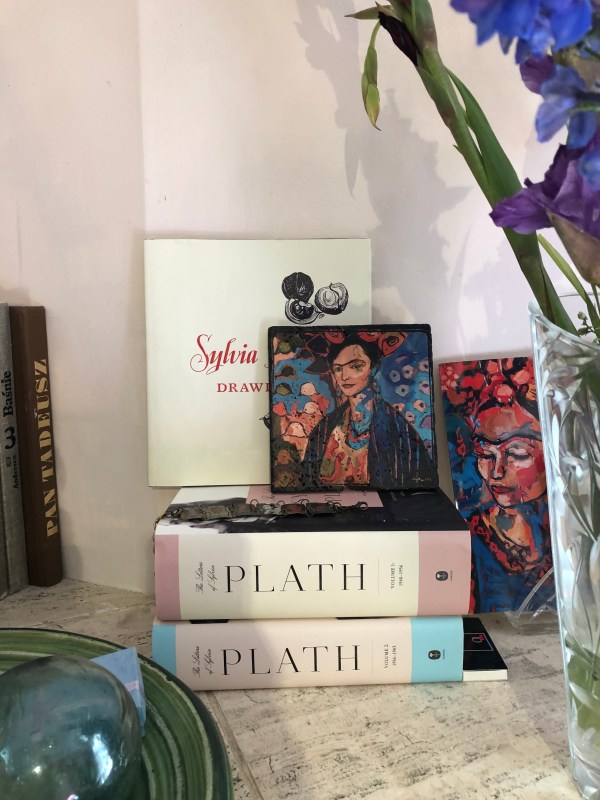
I don’t actually own Plath’s The Bell Jar or Ariel. How is this possible? Note to self: must buy. Response to self: this is how it beings, hoarding, pack-ratting expansion. Don’t do it. Response to response to self: Shut up. I want my Sylvia.

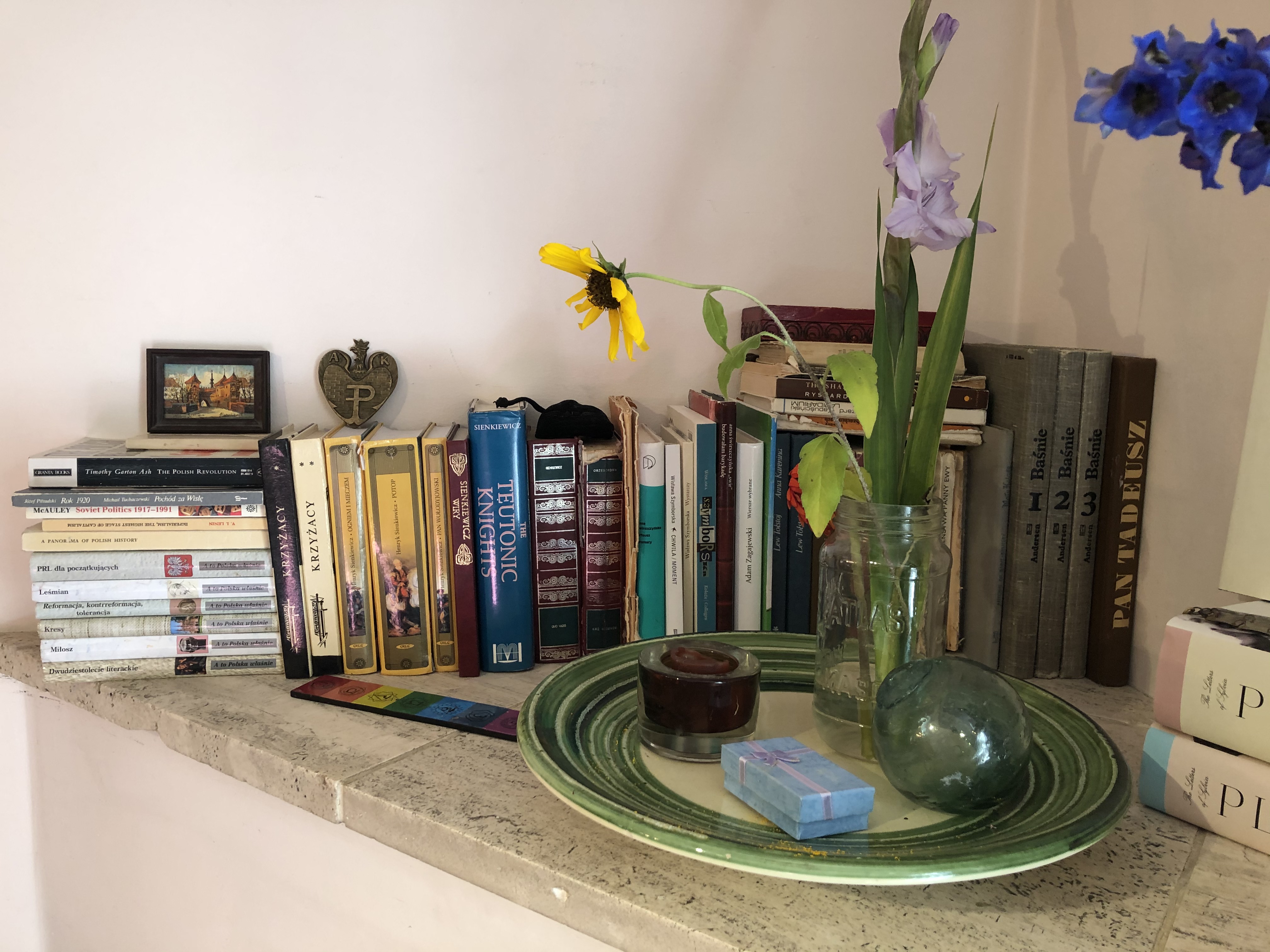
All of my Polish books:
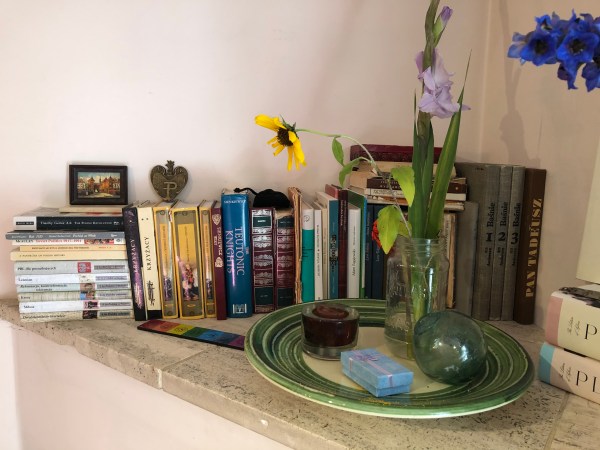
Some of these have travelled the world with my parents and me for almost forty years. The Polish translation of A.S. Lindgren’s Children from Bullerbyn (which used to belong to my dad’s sister, actually—she got it and read it the year I was born) and of Winnie The Pooh—the first “chapter” books I ever read. And, of course, Sienkiewicz, Mickiewicz, Orzeszkowa, Rodziewiczówna. Kapuścinski. The more modern poets: Zagajewski, Anna Świrszczyńska and Wisława Szymborska, not in translation.

This cultural heritage of mine, I have a very… fraught, complex relationship with. So much beauty, so much passion, so much suffering—so much stupidity, so much pain.

Governments do not define a national, a culture, or a people, I suppose. But in a democracy, they reflect the will and the hearts of the majority of the people, and, if the current government of Poland reflects the majority of the will and the hearts of the (voting) Polish people, they are repugnant to me and I want nothing to do with them. I am ashamed of them, of where I come from.

But I do come of them, from there, do I not?

Still. I keep the books. Including the one celebrating our first modern proto-fascist, Józef Piłsudski. History is complicated; ancestry not chosen.

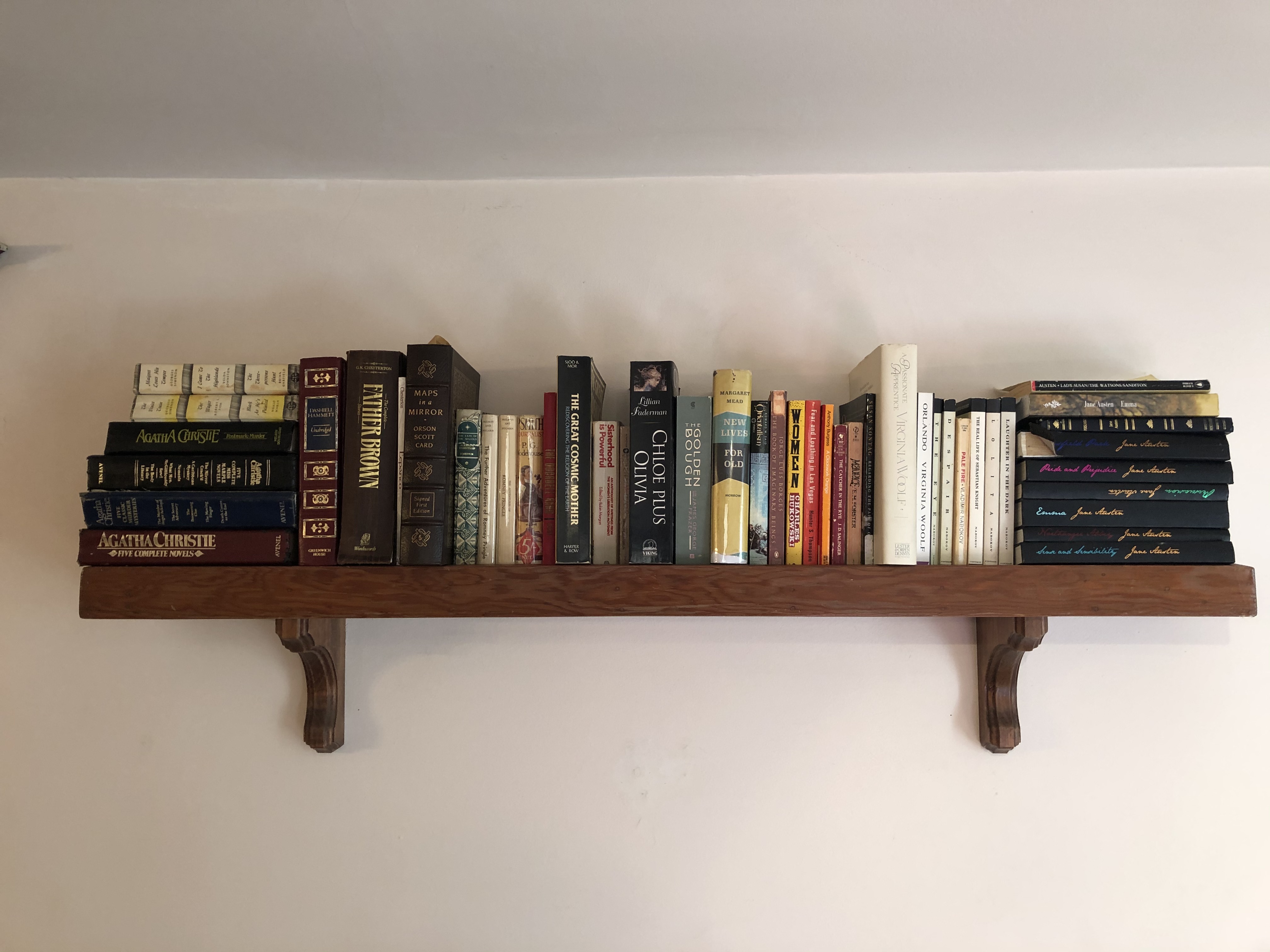
Next, a shelf of all of my favourites.
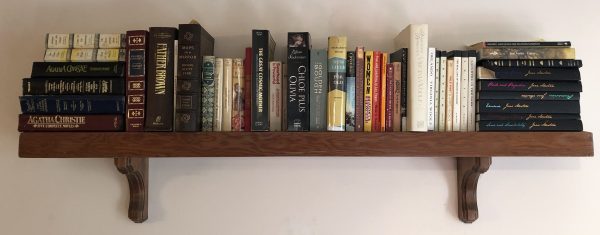
All of Jane Austen, of course. Most of Nabokov. Virginia Woolf, because, well, it’s complicated. Susan Sontag’s On The Suffering of Others, and E.M. Forester’s Maurice—I gave up Room With a View and the others. J.D. Salinger’s The Catcher in the Rye, not so much because I’ll ever read it again but because it was so important back then. Anthony Burgess’ A Clockwork Orange, because nothing like it has been written before or since. Hunter S. Thompson’s Fear and Loathing in Las Vegas—I mean. I had to keep it, hero of my misspent university youth. I put him right next to Charles Bukowski’s Women, which isn’t great, but which… well. It taught me a lot about writing. Then, Jorge Luis Borges’ The Book of Imaginary Beings, which always makes me cry because a) it exists and b) I will never write that well.

Edward Said’s Orientalism, the only book to survive my “why the fuck did I keep all of these outdated anthropology and sociology and history textbooks for 25 years” purge. Margaret Mead’s New Lives for Old, which wasn’t one of them, but a later acquisition, kept in honour of the woman who dared live her life, do her thing. She wasn’t the smartest, the brightest, the most original—but fuck, she dared. Fraser’s The Golden Bough and Lilian Faderman’s Chloe Plus Olivia, both acquired in my teens—the first gave me religion for a while, while I freed myself of the Polish Catholicism in which I grew up (“freed” is an aspirational word; I suspect the religions we are indoctrinated into in childhood stay in our bones forever—the best that we can do is be aware when that early programming tries to sabotage our critical thinking and emotional well-being), and the second showed me I wasn’t a freak, an aberration, alone.

Next, The First Ms. Reader and the Sisterhood is Powerful anthology—original 1970s paperbacks bought in a used bookstore in the 1990s when I was discovering feminism. Monica Sjöö and Barbara Mor’s The Great Cosmic Mother—I suppose another Wicca-feminism vestige. I will never read it again, but way back when, that book changed my life, so. Here it is, with me, still.

And now, back to fiction: The Doorbell Rang, my only Rex Stout hardcover, although without the dust jacket, and a hardcover, old, maybe even worth something, with protected dust jacket intact, of P.G. Wodehouse’s Psmith, Journalist. Next to them, The Adventures of Romney Pringle and The Further Adventures by Romney Pringle, the single collaboration between R. Austin Freeman and John J. Pitcairn under the pseudonym of Clifford Ashdown. Written in 1902 or so, both volumes are the first American edition. In mint condition. Like the P.G. Wodehouse—and The Letters of Sylvia Plath, and the unique, autographed, bound in leather made from the butts of sacrificed small children or something, Orson Scott Card Maps in the Mirror short story collection, which is next-but-one to them on the bookshelf—they were a gift from Sean.

A lot of the books on my shelves, here with me now, are a gift from Sean.

Between them, a hard cover Georges Simeon found at a garage sale, and then G.K. Chesterton—Lepanto, the poem about the 1571 naval battle between Ottoman forces and the Holy (that’s what they called themselves) League of Catholic Europe, which I will never read again, but which is associated with a specific time and event in my personal history, so I keep it. Next to it, The Collected Stories of Father Brown, in battered hardcover, which I re-read intermittently, and which are—well. Perfect, really. Then, all of Dashiell Hammett in one volume. Then, almost all the best Agatha Christie’s in four “five complete novels” hardcover collections, topped with two multi-author murder mystery medleys from the 1950s.

Looking at this shelf makes me very, very happy.

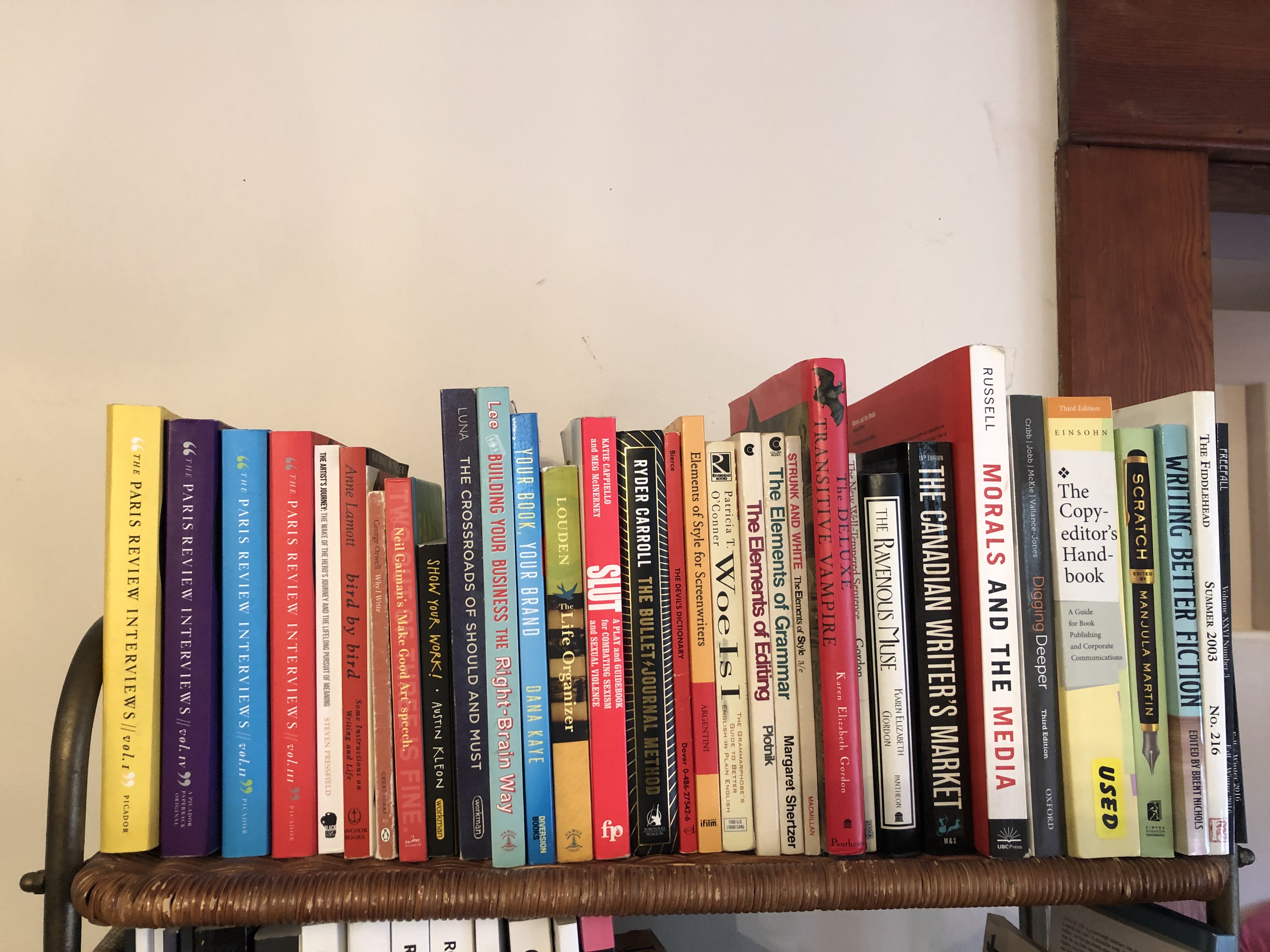
Next, the one fully preserved collection. Before the move, these books lived on a bookshelf perched on top of my desk. Now, they are here, their “natural” order slightly altered because of the uneven height of this case’ shelves. The top shelf is, I suppose, mostly reference and writing books:
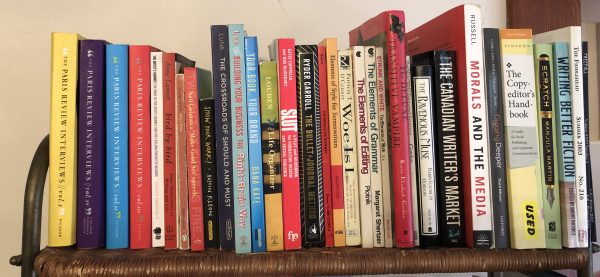
The Paris Review Interviews, Anne Lammott’s Bird by Bird, Neil Gaiman’s Make Good Art, Strunk and White’s The Elements of Style, and their ilk. At the end, a couple of publications in which I have a byline.

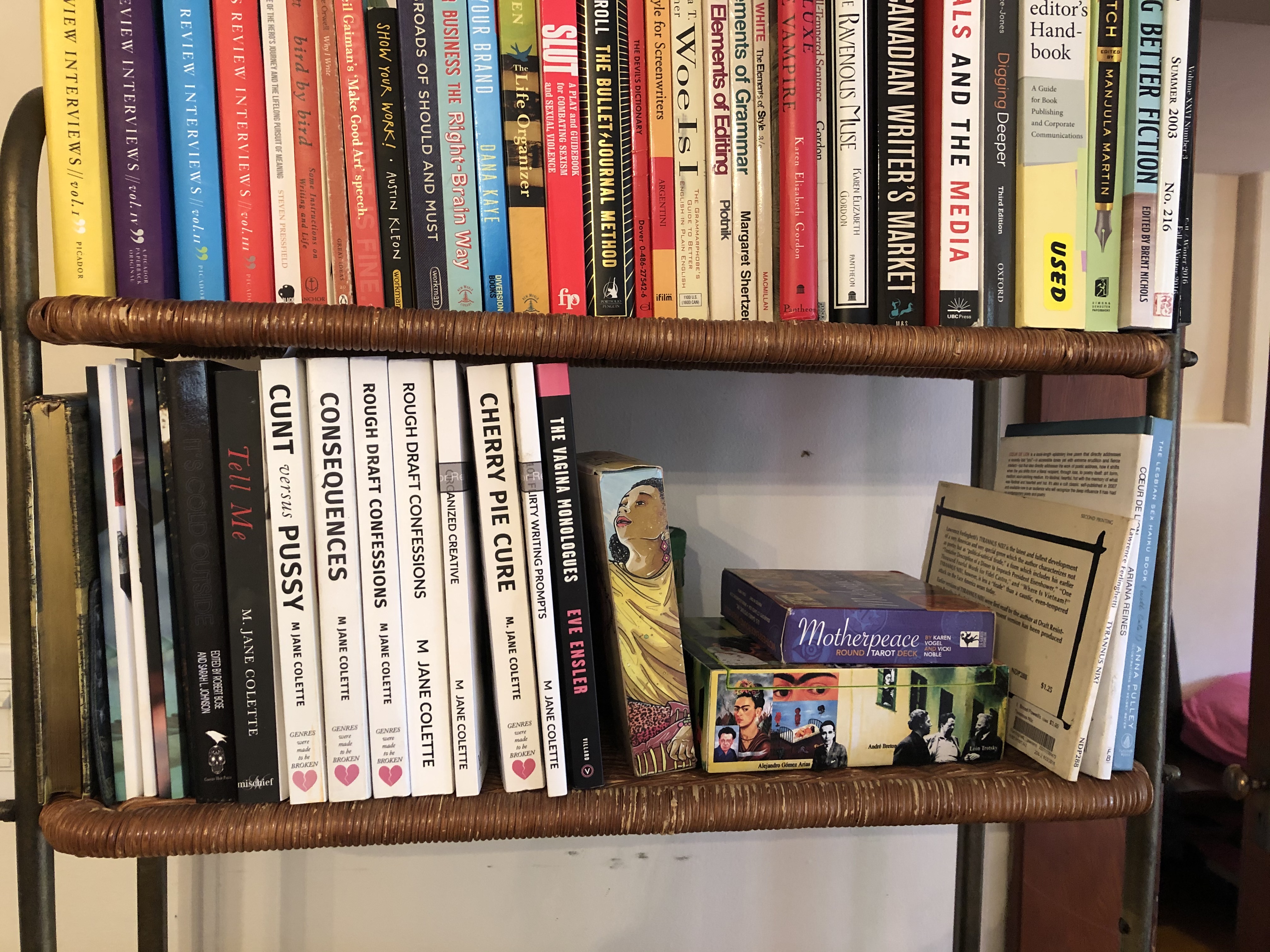
The next shelf, the smallest on the case, is a bit of a smorgasboard, but is very precious to me:

Do you see Frida and my Tarot cards? Also an Ariana Reines book that I really should give back to its owner…

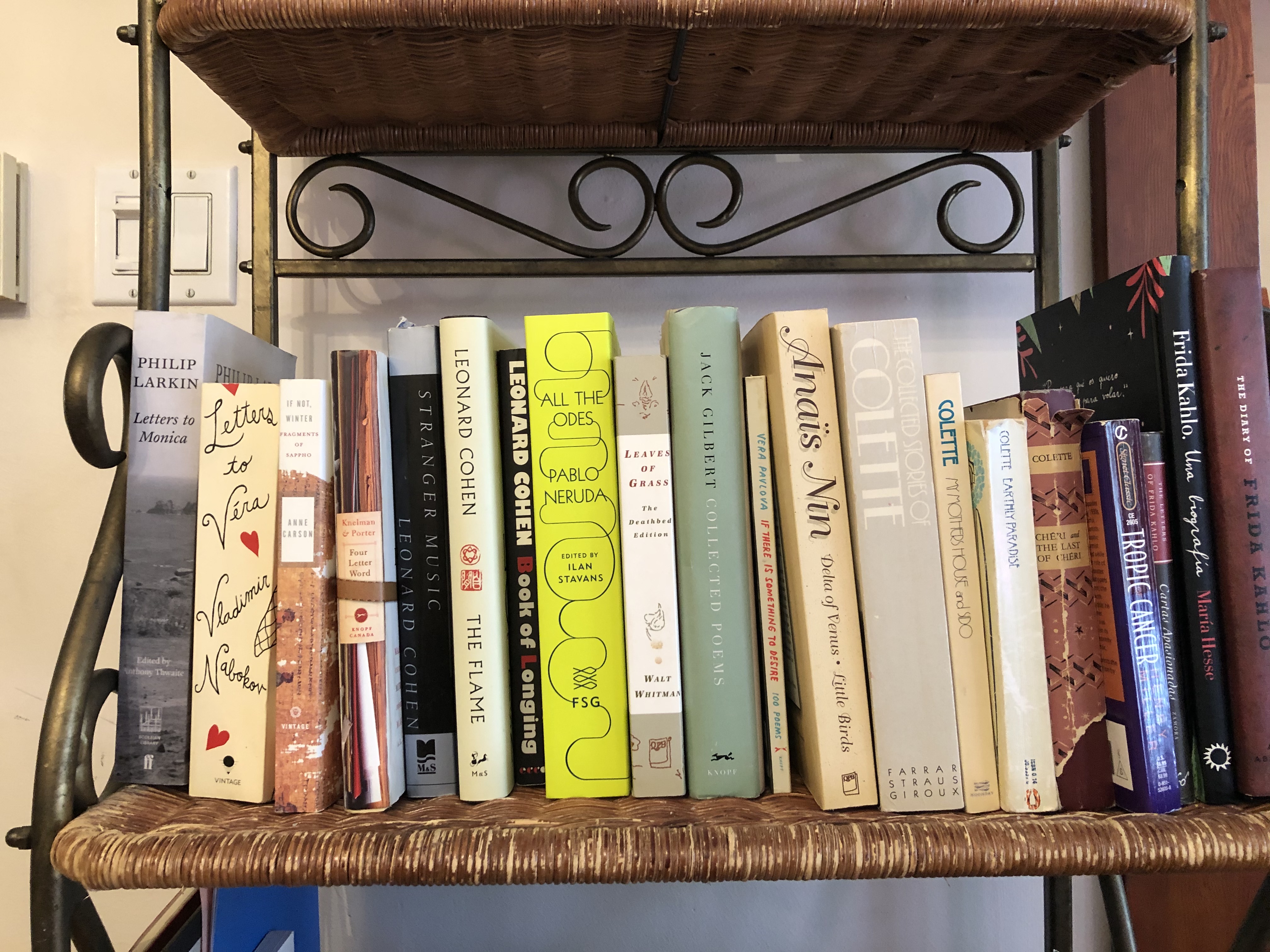
Next, my perhaps most precious books.

Philip Larkin’s Letters to Monica and Nabokov’s Letters to Vera. Anne Carson’s If Not Winter: Fragments of Sappho. Four Letter Word, a collection of “original love letters” (short stories, they mean, pretentious fucks) from an assortment of mega-stars, including Margaret Atwood, Leonard Cohen, Chimamanda Ngozi Adichie, Neil Gaiman, Ursula K. LeGuin… a strange assortment, really. But some lovely pieces in there. Some lame ones too—and I like that too. Even superstars misfire, every one in a while.

Then, Leonard Cohen, Pablo Neruda, Walt Whitman, Jack Gilbert, Vera Pavlova. Finally, Anaïs Nin’s Delta of Venus and Little Birds, and a bunch of battered Colettes. Henry Miller’s Tropic of Cancer right next to Colette, of course. Then, my Frida books.

The next shelf is full of aspirational delusions.
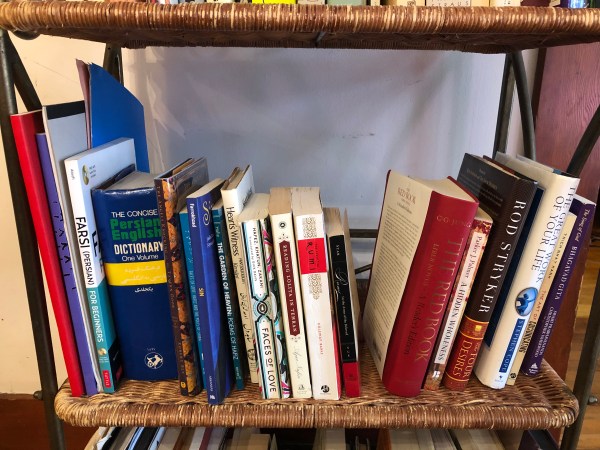
Farsi textbooks next to Hafez, Rumi and Forough Farrokzad translations. I will never be able to read Hafez in the original Persian. But maybe? Life is long. Maybe, one day, I will have time. Then, Jung’s Red Book, Parker J. Palmer’s A Hidden Wholeness, Rod Stryker’s The Four Desires, Stephen Cope’s The Great Work of Your Life, Thich Nhat Hahn’s The Art of Communicating (I failed), The Bhagavad Gita (still trying).

As I said, the shelf of delusions.

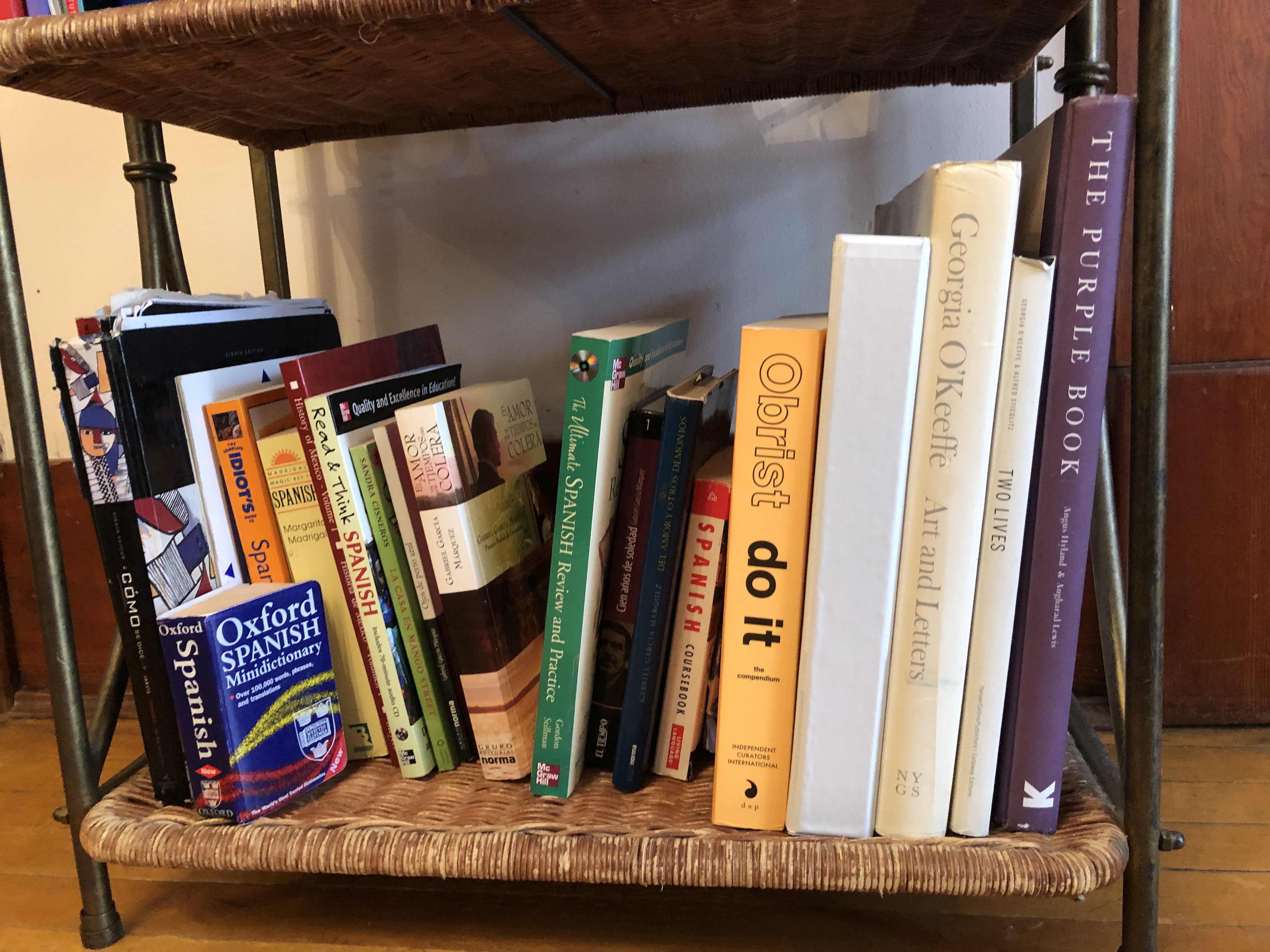
The bottom shelf is aspirational/inspirational, and also, very tall.
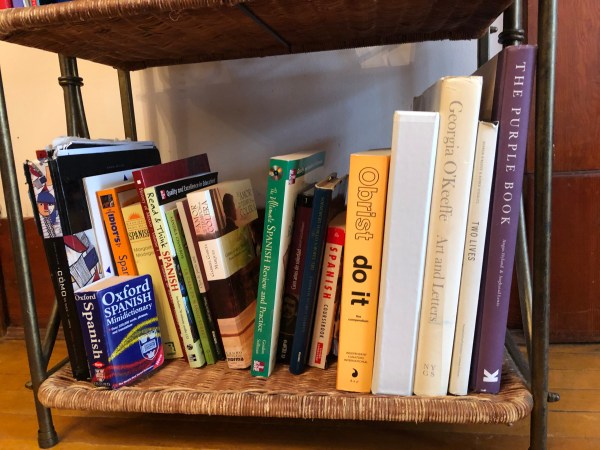
And so, that’s why my Georgia O’Keefe books are there, as well as The Purple Book, and Obrist’s do it manifesto. Perhaps there is room there for my leather-bound Master’s thesis, currently tucked away in the closet, right there, next to a course binder from SAIT? Then, all of my Spanish books, including Gabriel Garcia Marquez’s El Amor en los Tiempos del Cólera… which, also, one day, I will read in Spanish and actually understand. Life is long, right?

Next, not really a book shelf as such, but the top shelf of my secretary desk, where the reference and project books of the moment live.

The Canadian Press Stylebook has a permanent home here, of course. And I’ve got two copies of Canadian Copyright: A Citizen’s Guide there, one for me (unread, but I’ll get to it, I promise myself, again), one for a colleague. Both snagged from a Little Free Library, by the way.

Almost done.

In the bedroom, the books of vice.
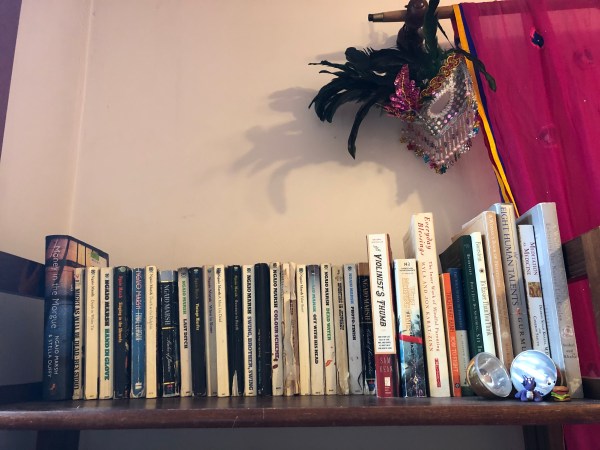
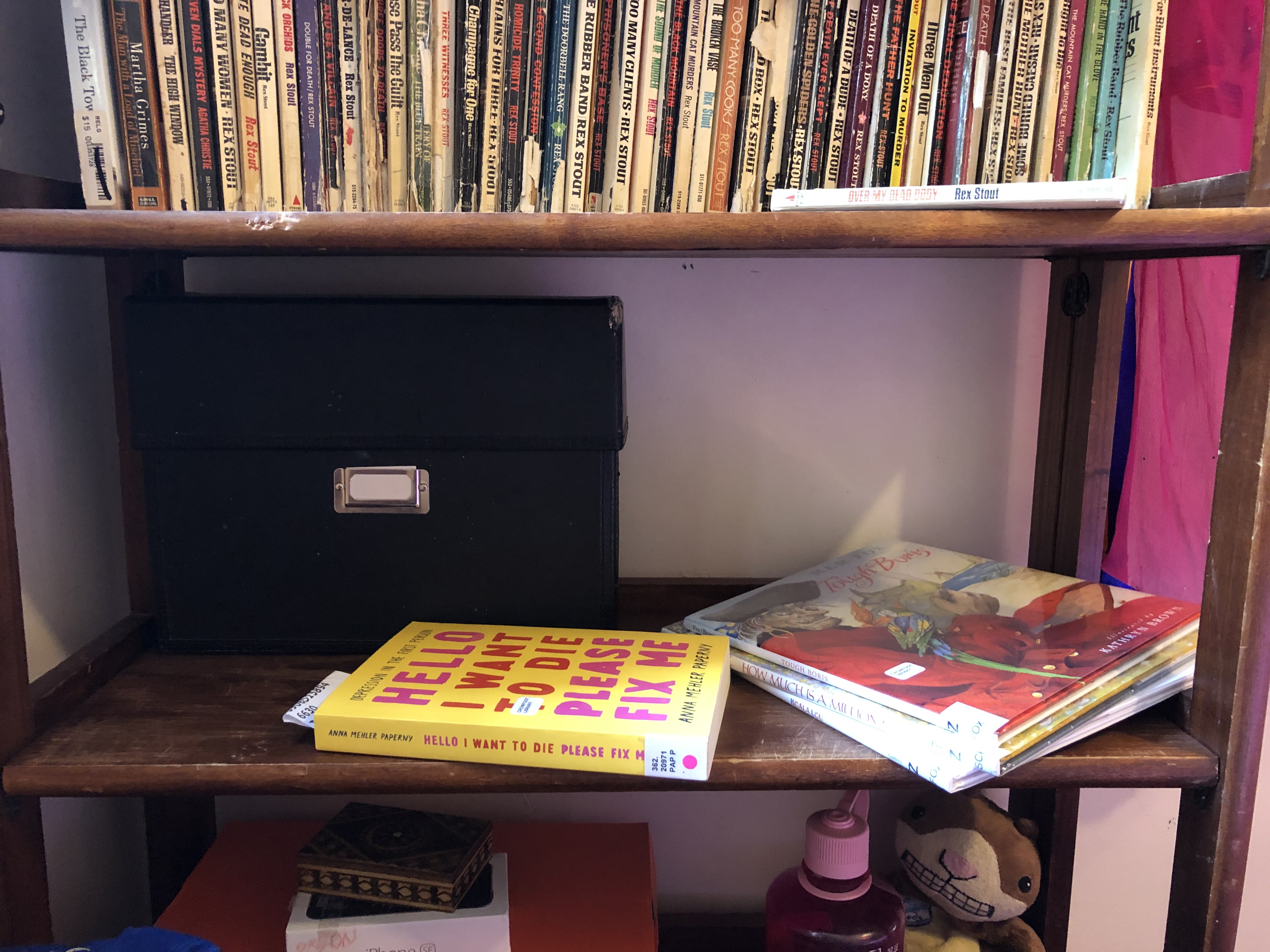
A shelf of battered Ngaio March paperbacks, tucked beside them some meditation and Kundalini yoga books that I’m not using right now, but, maybe, one day, I am not ready to give up on this part of myself yet.  Below, a shelf of even more battered Rex Stout paperbacks.
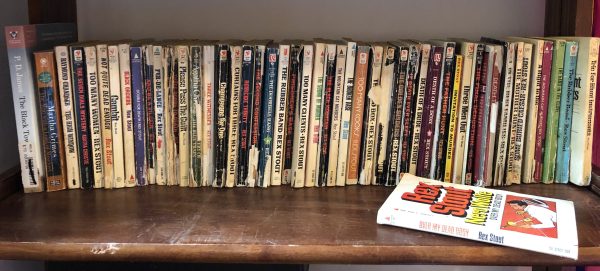
I read and re-read these books—as did their original owners—until they fall to pieces. They are my crack, my vice—also, my methadone, my soother.

Below them, space for library books, mine and Ender’s:

I am finding Anna Mehler Paperny’s Hello I want to Die Please Fix Me unreadable, by the way. I pick it up, put it away. Repeat.

Will likely return it to the library unread.

Currently not on display: books by friends. Some here with me, some on the shelves in the Co-op house. There are a lot of those. Can one be ruthless… with friends?

ii. A reflection

Books, for readers and writers, are the artifacts that define us. When I enter a reader’s home, I immediately gravitate to their bookshelves. What’s on them?

What’s not on them?

What I’ve chosen to let go of, to not bring with me here tells me… a lot.

What am I going to do with this information?

xoxo

“Jane”

Pandemic Diary: What is normal?

August 4

i

A few normal things from the past couple of weeks: I have an in-person interview, I meet a client face-to-face (well, across a room, but still); I go to a restaurant; I take an Uber; I shop at Canadian Tire; I take my kids out for lunch; Flora and I spend hours looking for the sketchbook that defines her as an artist in a local art store—and not online.

None of it feels normal, though. We wear masks in the stores, my hands burn from the sanitizer. The client and I do not shake hands. The entire time I’m in the Uber, I’m torn between

a) gratitude that this dude is working because I’m too drunk to drive,

b) guilt that I’m endangering his health by providing yet one more contact point of potential infection,

c) mild fear the previous passenger was a COVID carrier and so now, because I’m doing this normal thing, I might accidentally get the virus and infect and kill your grandma,

d) low key hate for your grandma and your auto-immune deficient cousin and also, your respiratory illness suffering son,

e) guilt at the hate, because what sort of monster is this selfish (me),

f) OMFG, it’s just an Uber ride—can you just relax and go with it already?

I don’t know. Maybe. Let me see. No.

Because none of it is normal.

Still.

It just is.

At some point, surely, this low grade stress will recede? Perhaps, even, disappear?

I don’t know. Maybe. Let me check. No. Still there.

ii

A few normal things from today: coffee. Morning pages. Lunch with Cinder and Flora. Nap. Work. The work feels like a slog and that’s the new normal too. But maybe the old normal as well. Was it ever easy?

I don’t know. Maybe. Let me check. No. Often a slog, often hard.

Sometimes, joy.

ii

A few moments of joy from today: coffee (it was exceptionally good). Lunch with kids. The discovery of James Runcie’s Sidney Chambers murder mysteries and their televised Grantchester version. A cool afternoon breeze. Cardamom in my afternoon tea. The flowers you brought me dropping their petals on the table.

Good things, normal things. Happy moments.

xoxo

“Jane”