A narcissist, a psychopath, and a hypocrite walk into a bar…

I.

Put in a position where I must act either like a social hypocrite or a ruthless bitch without feelings, I don’t even choose the latter—I am the latter because I can’t be the former—and by the way, this convention, this use of latter and former, is so fucking pretentious, I can’t believe I’m using it. Confession: when I encounter it when reading, I always have to scrunch up my forehead, and look carefully—ok, latter refers to… ok, got it… I think… or did I screw it up? Is former before? Former’s before, right? And latter is later? Why didn’t they just say first point, second point? Or parse the sentence differently?

Anyway. My point: I don’t choose to be the ruthless bitch without feelings. I just am one.

Except, of course I’m not. Well. I can be ruthless. But ruthlessness is a characteristic that’s rooted in pretty intense emotions. For me, anyway. And acting ruthless involves looking at the intensity of those emotions… and then cutting a straight ruthless path through them… to the right thing.

The right thing, being, of course, an entirely subjective thing, so let us qualify it as… the right thing for me, the right thing as perceived by me, the important thing in that moment.

The right thing, for short.
II.

Sometimes, I coach Flora on how to do the kind thing instead of the right thing. Because, you know, I want her to do better than me.

Flora: But don’t you think ruthless people are more efficient?

Fucking nailed it, baby. But I don’t think… efficiency… is the thing that’s supposed to make the world go round.

III.

I’m taking lessons in social hypocrisy from a psychopath.

No, seriously. He’s been tested. Not even a borderline psychopath. We’re talking, off-the-charts scores. But, he had a really good mother, who taught him how to… fake it.

Except he doesn’t call it that. He calls it analyzing a social situation and acting appropriately.

Jane: Ok, for the last time, I don’t have that gene.

Psychopath: Neither do I. It’s a socially learned behaviour. Let’s try again.

The lessons are not going well. I think, at least in part… because I’m proud of my INability to engage in that type of behaviour. You know?

Although I do know… white lies make the world go round.

IV.

Ender has that gene. In spades.

Cinder: He’s lying!

Ender: I’m not!

He is… except in his head, he’s just saying the thing everyone wants to hear. Well, not everyone. His parents.

Cinder: Stinking little liar!

Jane: He’s not lying, sweetie, he’s just…

What? Protecting himself? Protecting me. Something like that. It’s not a bad thing, you know. As someone who doesn’t have that ability, I do appreciate it in others.
V.

Except when I don’t.

Jane: And for fuck’s sake, next time? Just tell me—‘I don’t want to—I just really need to be alone.’ Don’t come up with excuses. False excuses have no place between friends.

Her: You’re telling me you wouldn’t have been mad if I had told you the real reason?

Jane: I would have been fucking livid. For five minutes. Then I would have moved on.

Her: You are very scary when you are livid.

Truth.

Jane: I would have been livid in the privacy of my head.

Her: …

Jane: I would have tried to be livid in the privacy of my head.

Her: …

Jane: Ok, I would have probably freaked out at you. For five minutes. Then I would have moved on, and apologized.

Her: …

Jane: What? I am really good at apologizing.

I’m just not that good at social lying.

Which is actually hilarious, because I’m really good at story telling. And you’d think the two would be related.

But they’re not.
VI.

Something else that’s ironic: the psychopath occasionally calls me a hypocrite.

Jane: What the hell? Seriously?

Psychopath: You have completely different expectations of other people than you have of yourself.

Jane: That’s not hypocrisy. That’s common sense. I’m not like other people, so of course I have different expectations of myself.

Psychopath: You might also be a narcissist.

Note to self: when a psychopath calls you a narcissist, it’s even odds whether he’s being casually analytical or coolly manipulative.

In either case, there’s only one right response.

Psychopath: OMFG, why are you crying?

Jane: Because you upset me!

See? I am not a ruthless bitch without feelings.

Just… ruthless.

xoxo

“Jane”
You: WTF?

Jane: I’m experimenting and practicing.

You: What? Incomprehensibility?

Jane: …

You: OMFG, why are you crying?

Jane: Because you just don’t understand me!

;P

PS New here? Catch up on the first three series of Postcards from Cuba. Or just browse.

Buddhists make bad artists or is it the other way around?

I.

Feeling out of sorts yet knowing what he should do, he texts me, partly to whine, partly to ask for advice he won’t take.

“I don’t do that anymore,” I tell him, and as I type the words, I decide it’s true. No more advice, gentle or forceful. No more suggestions. No more answers to questions either explicit or manifestly implied. Figure it out on your own.

Also, no more listening to anyone’s whining.

I make that explicit, too.

“In a mood?” he asks.

“Yes. And I like it. I hope it stays permanent.”

We end up talking about religions, gods, and faith—or lack thereof—will, mindfulness, and discipline—or lack thereof—and the relationship between art and suffering, also the connections between inner discipline, the ability to exist in a place of discomfort, and sex and its permutations.

Much better than him whining and me offering solutions and advice he doesn’t really want, won’t implement.

“So what happened?” he asks after a while. “Advice given gone horribly wrong?”

I’d tell you I shrugged, except we were texting, so, well, I couldn’t.

“I’m in a mood,” I say. Tell him a little more and we return to bigger, more interesting topics.

I won’t tell you what I told him about my mood because A. it’s a boring story and B. I’m done telling it now. Its summary and my take-away is that you can’t save people. I used to have a caveat on that—you can’t save people if they’re not willing to save themselves, but now I’ve struck it. You can’t save people. They have to save themselves.

The only help you (I) can offer… I suppose, really, it’s your (my) presence. I’ve quoted Thich Nhat Hanh’s Mantras of Loving Speech at you before, right? This is the most important one:

I’m here for you.

Except when I realize even that doesn’t help you—and it actually harms me—and then, I’m not.

I’m a terrible Buddhist.

It’s ok. I’m not trying to be a good one, or even an indifferent one.

“You’re a pagan,” he says.

I shake my head. (Well, we’re texting, so I actually write, “No, I don’t think so.”)

“I’m an artist,” I say.

Last week, I purposefully did not write about selfishness versus self-care (and, more importantly, versus self-actualization).

Today I will tell you this: a certain amount of selfishness is critical to physical survival and emotional stability… and to making art.

Not too much. An excess of selfishness makes your art meaningless and self-indulgent—unable to reach people, without resonance… and thus pointless.

Not enough selfishness makes your art… non-existent.

I told you, I’m a terrible Buddhist.

But I’m a practicing and producing artist.

II.

I’m still meditating, twice a day, and laying down in savasana most days.

I’m doing it wrong, because instead of infusing me with boundless compassion, it’s giving me cruel clarity.

And also ramping up my productivity… exponentially.

Like, holy fuck.

So… I don’t actually want to do it right, you know?

;P

xoxo

“Jane”

You might want to re-read this: Meditation for writers, “Mom! I need you!” and struggling to stay on that tightrope (but for fuck’s sake, don’t misconstrue it as advice)

Escape from the ashram (an entirely misleading title, but not really)

I.

This was last week:

This was two years ago:

This was seven years ago:

(And fourteen years ago, there was just one of them, and it was all harder, because it was new.)

You send me this:

and we laugh. But then I think… no. No, actually, that’s wrong. For me, anyway. See, without the children, I wouldn’t have written any of the work that really matters to me—the books, the best blog posts, the articles that captured the tension inherent in all aspects of business and life (especially for women, especially for mothers).

More—before children, I did not know how to love. I did not understand what suffering really was.

There’s a quote I’ve intermittently encountered (I haven’t been able to track it back to its source, my apologies) along the nasty lines that for a woman writer, every child is a lost book. It has always made me bridle, and today, I would like to officially say to that originator of the quote and everyone who has since repeated it, as an excuse it keep herself silent: So. Fucking. Wrong.

I do get why they say it, you know. Why they might even believe it. We live in a culture that hasn’t figured out how to value women, motherhood, or creativity—International Women’s Day, the still-enduring lip-service to the Victorian Cult of Motherhood, and adoration of WEALTHY and FAMOUS musicians, painters, and authors notwithstanding. Being a woman-mother-creator is much more difficult in a patriarchy (we’re still one) than being a man-father-creator. Our burden is bigger. And, we’re not supposed to—we’re terrified of being—selfish.

II.

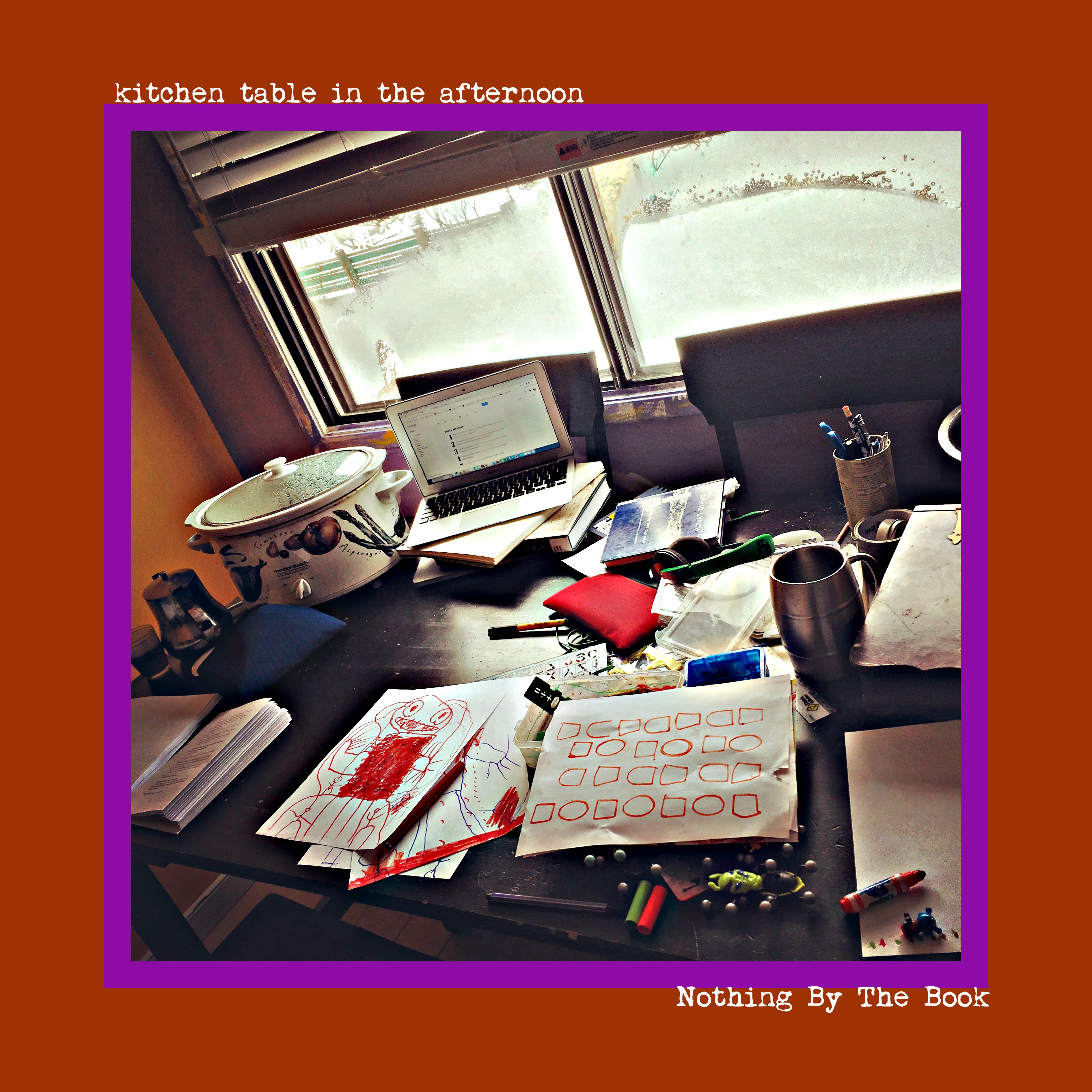
Ender is playing a Lego.com video game on Sean’s laptop at the kitchen table while I sit beside him and work on mine. Flora comes in, to the soundtrack of a Harry Potter audio book. Groggy-eyed, she asks for a kiss and French toast; I ask for fifteen more minutes.

When Cinder trundles down the stairs before noon—well, probably after—I will thank him for doing the dishes before going to bed at 3 a.m. And stand on my tiptoes to kiss his chin, because I can no longer reach his forehead unless he stoops.

And then I will tell him I’ve found a way for him to earn the $50 that’s his heart desire right now.

III.

I don’t actually want to write about the difference between selfishness and self-care (and, more importantly, self-actualization). A. Everyone else is doing it and B. It’s not a paradigm I’m going to shift in that particular way (I have another plan, but it’s a secret, sssshhhh). Instead, I want to tell you how important it is for me that my work be rooted in this messy, crazy, unpredictable, demanding FULL life. In this kitchen. In this family. In this community that throws an extra obligation at me just as I need to hit a critical deadline. In… reality.

Not in an ivory tower or the isolation of a writer’s retreat or an ashram.

Instead: in this child’s need to crawl into my lap at the precise moment that I need both hands to type and all my faculties focused on what it is I am trying to put into words.

Jane: Ender, I love you, but get out of my lap.

Ender: I love you more, and I need Mommy cuddles now.

On some level, I have been fighting this for the past three years. It was three—three-and-a-half, coming up on four!—years ago that I realized the nature of my work had to change. Before, it was enough to me that I was writing for a living. How lucky was I? Writing for a living, and able to be the primary caregiver for my children. Supporting my family, fulfilling my need to be a writer, and being the mother I needed, wanted to be. What more did I need?

Well, as it turns out… there was some stuff… but that’s probably a novel in itself, or even a hefty self-help book (that one of you can write; as I’ve said, I have other plans).

During that transitional time, I spent a lot of time dreaming of month-long writers’ retreats and week-long conferences and government-funded residencies… I substituted them with occasional weekends alone in hotel rooms (or friends’ apartments) and self-created 12-hour writing marathons in cafes and sheesha lounges. I was chasing “the time and space” to really do my work, to give to it the attention and care it deserved—to give it the sort of focused attention I like to give my family… without, of course, short-changing my family…

…but there was only so much time to go around, right?

And so… a fight…

In the last few weeks, something has shifted.

I have long been able to see the value in this tension between the demands of my kids and the demands of my work. Before 2013, though, the demands of my work were mostly externally created. You know? Editor. Client. Magazine deadline. For the past three years—they have been increasingly, and now almost completely, internal. The drive to create, to make, to write this stuff—it’s all mine. It’s nobody else’s fault, demand, responsibility. I want to—I need to do this.

And now I see the tension between my desires and my life’s demands is not just valuable—it’s also critical. Necessary. Essential—it’s who I am, it’s the reason I write what I write.

And what I want to do going forward is not to alleviate this tension, but to continue to grow how my work comes from my life—how I perform it in the middle of life.

Now—this does not mean that I will not make focused time and space for it. I need that 12-hour marathon at least twice a month. That occasional weekend away is part of an equation that then lets me work in hour-long, 15-minute increments the rest of the time. And the week-long writers’ conference—it’s a gift I will continue to give myself whenever I can.

But it’s what I do on the ordinary days, full of mess and chaos and conflicting demands and dentists’ appointments and children fighting and supper burning and “fuck, we’re out of groceries again, am I a bad mother if they eat cereal for supper? Wait—they can’t even do that, because there is no milk” that determines what I make, how I create it… why I write it… and who I am.

This is a good feeling.

I hope it lasts.

III.

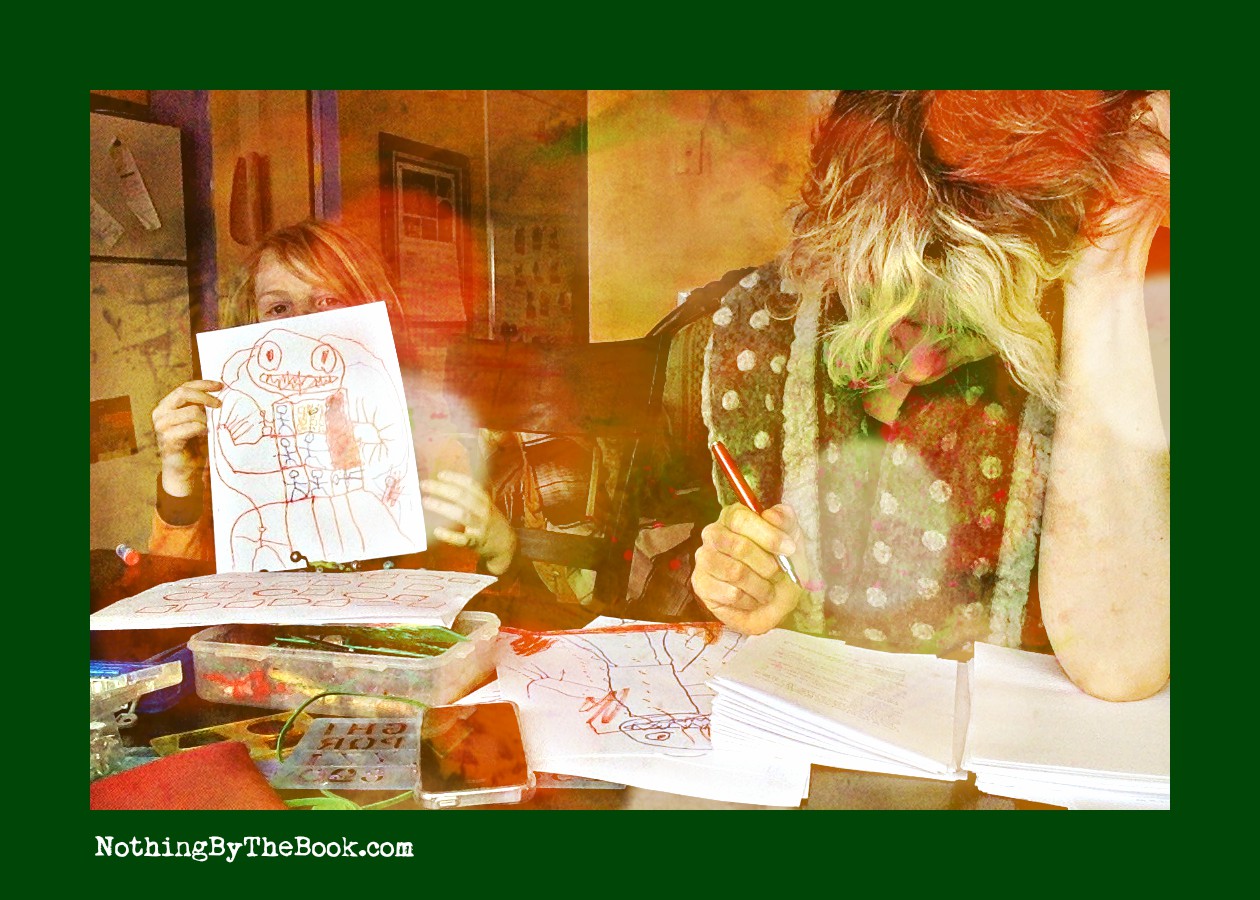
This is today:

xoxo

“Jane”

PS This is a disclaimer to mothers of babies and toddlers: My children are aged fourteen, twelve, and seven. They can get their own breakfast. And lunch. The elder two routinely make supper. Everyone’s old enough to do their own laundry, run a vacuum cleaner, take out the garbage and the recycling. There are no little people sucking on my nipples or needing me to change their poopy diapers. The amount of time that I have to give to my work now compared with what I had seven years ago is exponentially bigger.

Like… I can’t even express how much bigger. When they were little, real work only occurred when another adult could tend to their needs, or when they were asleep.

And they so very rarely all slept at the same time.

But all that time—it was like compost, fertilizer, seeds. This time, this current place of—I don’t even know how to express where I am, because it’s not a place of tranquility at all… it’s a place of explosive creativity and drive and celebration of tension, it is so many things, but tranquil, yeah, not so much—this current place-space I’m in has been created by journeying through the demands and exhaustion and challenges of the baby years and the toddler years and all those “I thought it was supposed to get easier, when the fuck is that going to happen” years.

I am still, to be honest, not sure that it gets easier. Parenting, I mean. It’s gets… different. And we get… better (or, in some cases, worse, but that’s also another story).

PS2 POSTCARDS IN CUBA, the final leg, you won’t get to see until the fall or so. Because this final leg of the postcards is very, very different… and I want to deliver it properly. And that takes time. This, incidentally, another shift: I have all the time I need—and I refuse to give myself Internet/social-media induced FOMO/YOLO/DO IT RIGHT NOW! psychosis.

Because… priorities, baby.

PS3 Sometimes, I think Maria Popova and I share a brain: Hermann Hesse on Little Joys, Breaking the Trance of Busyness, and the Most Important Habit for Living with Presence