Think-not-think: A tip for burnt out creatives

1

I hit Friday fried. By my last two meetings on Thursday, I can’t language. You know? I open my mouth and my tongue struggles to form the syllables that need to become the words that will give voice to the thoughts I want to express. I’m crossing into the zone where I’m about to start making stupid mistakes because I have no bandwidth left for thought.

The cure, for me, is pretty simple. I need, first, some down time and then some thinking time.

I start the downtime with some manual labour. I sweep and vacuum. I gather up the leaves. I do a load of laundry, start to finish. Get the body a little tired, get the mind focused on the body. Then I take a very long bath, with neither book nor show to distract me from the water, the bubbles, the dark.

I do nothing, I am nothing.

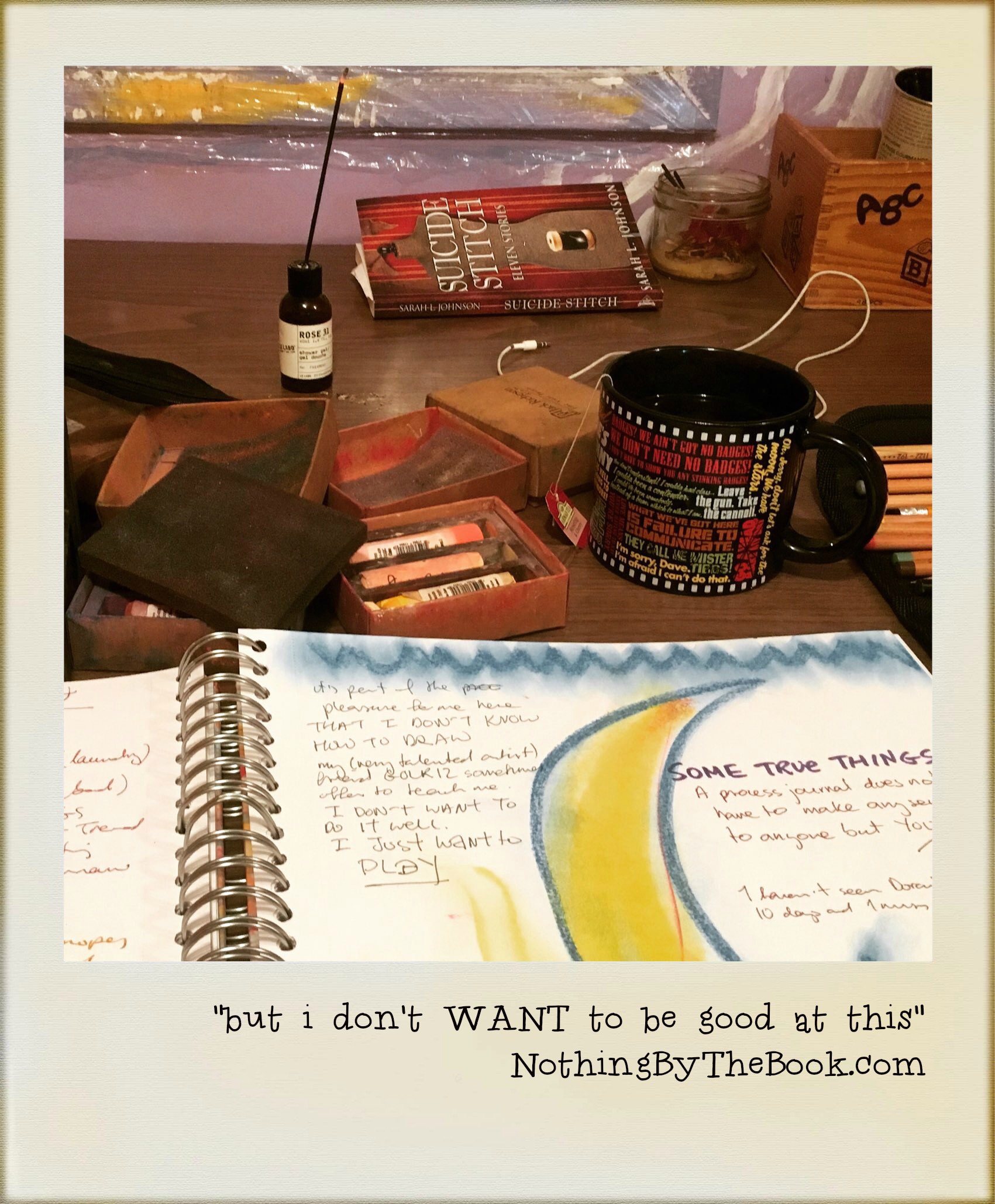
Then, I turn to the page. As writers, I think we’re so lucky that we can rest while writing. Not on the current WIP — now is not the time to torture the novel, speech or article. It’s time to play. Write a bad poem. Play with the cadence of a pretty, useless sentence. Journal — but not about the things that cause you pain. Find an interesting, warm memory. Take that weird overheard phrase — “But what would I do with a gallon of Cool Whip?” — and give it silly, imagined context.

Create that space within yourself.

Play.

Play is rest.

2

Successfully, sustainably creative people know how to play and rest. And, with practice, we learn how to do it before we burn out. We recognize the signs and course-correct before we crash.

Unsustainably creative people burn out. Frequently.

When I’m living my life right — and yes, there is a right way, of course there is 🙂  — I don’t get to the fried stage. I take that pause when I start to feel fatigue. That’s how I (used to) write a full first draft of a novel in three to six weeks: Stop when you still have juice. Recharge before that battery dies.

Work, deadlines and contracts sometimes make this difficult, sure. But it’s possible, attainable, practicable.

Do it.

Do it yourself, for yourself.

Nobody else will — or can — do it for you.

They’ll just tsk tsk when you crash and burn.

3

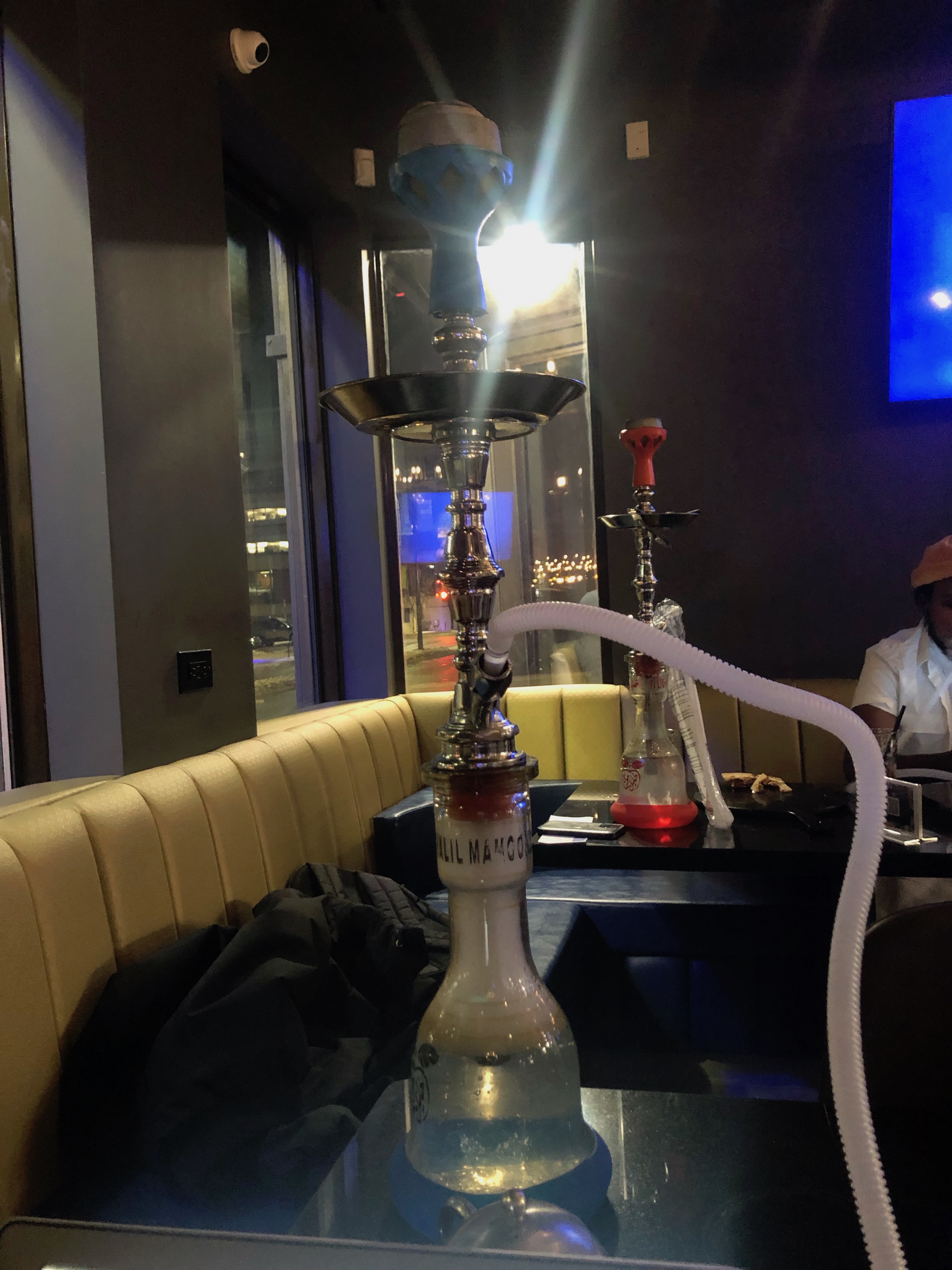
Rejuvenating rest and play look differently for each of us. Sometimes, I can reset in the arms of someone I love. Most of the time, I need silence and solitude. My notebook. The self-permission to play with the things I work with. Sheesha. A trashy novel. A pile of cookbooks full of recipes I’ll never attempt because seriously, four hours of active kitchen to time to put something on the table?

I’d rather write, sleep or, you know. Reset in your arms.

But looking at the pretty photographs makes me feel good.

4

After I write-play, I stretch out of my purple sofa and think-not-think. I look at my animals, the lazy cat, the dog who really wants another walk but knows she’s not getting one for a while. My bare toes.

I think-not-think about the WIPs now. The “not” is the most important part of this: I’m not actively rolling anything over. I’m not reflecting. I’m actually not thinking about work at all. Except that it exists and it’s inside me. And when I not-think about it, I think about it in that magical way that will let me think about it happily a few hours, days later.

Breathe in, breathe out. Watch the smoke. Listen to the breath. Look at the cat. 

Don’t think, but let the thoughts come.

5

We call ourselves knowledge workers or creatives now and they claim to value us… but neither they nor we give ourselves sufficient time, the permission even to do the thing that makes us sustainably creative:

Think-not-think.

Play and rest.

6

My homework for myself on that Thursday night is to play and rest, think-not-think.

My homework for what would be an unproductive, frustrating, burnt-out Friday: think-not-think. Lay on the floor. Stare at the ceiling. Feel the space inside. Delay responding to that non-urgent email. Reschedule the important, requires thought meeting.

It sets the stage for a fantastic Monday, fulfilling Tuesday. I’ll have words, thoughts.

But first, this: rest and play. Think-not-think.

xoxo

“Jane”

How to craft meaning in a cloud of smoke

i

I began the year with three and a half exhilarating weeks at work, followed by a massive setback/roadblock/slam into a brick wall that had me screaming, not just into a pillow, but into my headset on a Teams call—my director slid off their headphones so as not to puncture their eardrums—and plunged me into severe existential angst. Ever have days like that, months like that?

No, I figured not, just me. 😉

I’m working through the existential angst the way I always do—by walking for miles, writing down all the unsayable things, re-reading risque romance novels (K.J. Charles, thank you, from the bottom of my aching heart, for all your books, especially the Sins of the Cities series), smoking sheesha, arguing with Julia Cameron and reminding myself of my responsibilities to my children and other important people in my life… and also daydreaming about running away to Cuba and being Ernest Hemingway—but hey, he didn’t end so well, so perhaps he is not the role model I should be looking at right now, or ever.

(But, man, could Papa ever craft the world’s most perfect sentences.)

My bouts of existential angst always boil down to the very simple question of “Why am I here?” … and “to craft a collection of perfect sentences” seems like a pretty inadequate life purpose.

Maybe I’m confusing skill with purpose, talent with meaning.

ii

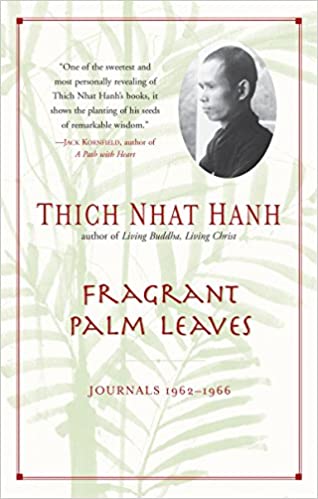
Because the human brain is wired to look for patterns (and stories) in the randomness thrown at us by our senses, The Marginalian’s Maria Popova chooses this moment to pop into my inbox with Thich Nhat Hahn’s epiphanic loss of self—and discovery of his true nature:

Yet every time we survive such a storm, we grow a little. Without storms like these, I would not be who I am today. … when such a frenzied hurricane strikes, nothing outside can help. I am battered and torn apart, and I am also saved.

I, too, will soon disappear.

Some life dilemmas cannot be solved by study or rational thought. We just live with them, struggle with them, and become one with them… To live, we must die every instant. We must perish again and again in the storms that make life possible.

Thich Nhat Hahn, Fragrant Palm Leaves

Ok, Maria, not helpful. I don’t want to just live with my dilemmas, dammit. I want to solve them.

iii

The thing about creative work is that while you’re engaged in it, you can’t think too much—at all?—about reception. The inner critic is hard enough to silence; if you let the outer critic shape the work as you’re drafting, you will never finish anything worth sharing.

And once you share it, when the outer critics start second-guessing you… while you’re listening to them—and you have to listen to them, because critical feedback is, you know, critical—it’s very difficult to shut them, and the inner critic, out on the work you haven’t yet shared.

But I digress. I’m just chasing thoughts where they want to go.

I’m going to give them free reign for a few more hours.

Then, I will shape them.

iv

The thing about creative work that “aspiring” (I hate that adjective) writers and artists don’t understand is the amount of discipline it requires.

Moving out of existential angst requires a similar type of discipline.

Iron will.

I’m trying to find mine in a cloud of smoke.

v

Discipine, and that exercise of will, requires a clear sense of purpose. What I have learned over my decades (when did I get this old) of battling existential angst is that it doesn’t have to be the purpose.

It just has to be a purpose.

Sometimes, that purpose just needs to be—I need to get through this day, this hour, this minute.

But it helps if it’s a little bigger, more constructive than that.

vi

Constructive is a good word.

vii

We construct meaning. Purpose. We create our stories and our narratives before we live them.

Well, I suppose we can live them without construction, but I’ve never been capable of that kind of in-the-moment existence. Have you?

I chase clouds of smoke, looking for a way to shape the narrative.

viii

The nice thing about my existential angst is that it has been my fairly constant companion since age four, and the nice thing about being a storyteller is that I have a lot of experience in shaping its narrative. Bending it to my purpose.

I’ll do it again.

In the meantime, I’m going to read some K.J. Charles and meander through another cloud of smoke.

See you on the other side.

xoxo

“Jane”

Sitting on the couch and eating bonbons

My inner artist is very lazy these days, and much as I know that the only way to want to work is to start to work—desire comes from action—my default mode is still inertia and exhaustion. Don’t get me wrong—I’m not just sitting on my couch eating bonbons. I doing all the things that bring me a guaranteed revenue stream. The rent is paid.

But, instead of performing my labours of love, I am sitting on the couch—laying, really—eating bonbons.

Hey, at least I’m not drinking wine—day 11 of no alcohol here, dry January, kittens. It’s not hard exactly, it’s just that tea is an insipid beverage and water is so boring.

By the way, a friend one told me, “Tea is my poison,” and I almost had to terminate the relationship. Tea is nobody’s poison, nobody’s vice. IT’s the liquid equivalent of saying you eat too much kale, especially if you take it black. (Green?)

So, Day 11, no alcohol. I have not replaced it with weed, cigarettes or cocaine, so, you know, kudos to me all around.

Hey, it’s not cocaine.

All that as belaboured exposition to say—as I sit on the couch, not drinking wine and not doing my work, I’m waiting for boredom to set it. I mean, not doing anything is boring. I’m a driven, ambitious person with a high need for stimulation. Surely, any moment now, my inner artist will become so bored, she’ll get off the couch and create?

Problem is… I’m not bored. Not yet. The not doing doesn’t feel bad. It feels awesome. The couch, wine-free though it is (full disclosure, there is always chocolate within reach), is a great place to chill right now.

This may all be part of the process.

Or, I’m totally spent as an artist and I’ve become a regular Monday-to-Friday, nine-to-fiver working schmuck.

Where is that wine?

Part of the process. It’s part of the process.

Right?

😬

“Jane”

POSTCARDS FROM CUBA: outtakes from the journal

For Helen. Just because you’ve been on my mind lately.

You asked, “So is this how you wrote all of them? In your journals?”

No. Not exactly. The journals were full of content like this:

Listen (for a just a minute):

& read:

One can’t really write a good /original/ poem about longing. It’s all been done before, said before, cannot really be improved upon, because nothing has changed…

Today, I wrote a piece about exploring Havana as a ghost… which morphed into a meditation on freedom-choice… and then, “fidelismo”… What has happened to this country is so tragic and yet… they are so fucking lucky, and they don’t know it. At all. They don’t see it—they don’t see the other turns their history could have taken, and that as far as suffering goes… there are significantly worse repressions. But…it is too easy to pontificate as an outsider.

So I won’t.

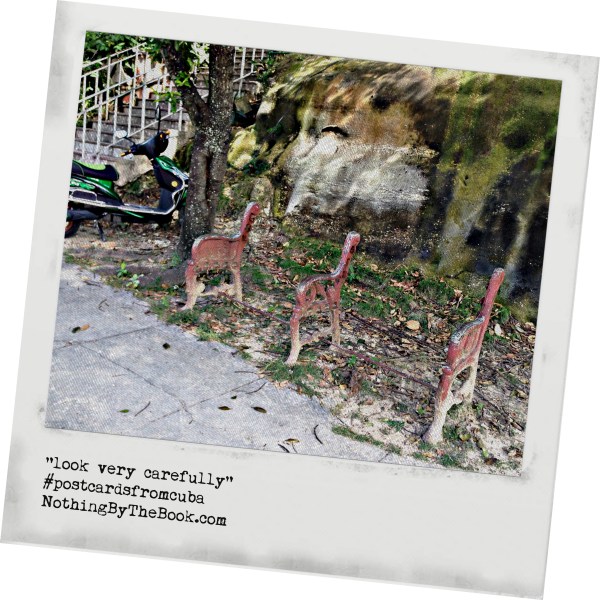
2-6a-benchwithnobench

*

Today’s postcardette is all a teaser for the next feature: GHOST. Stay tuned.

*

Want to make my day? Be my patron and support Postcards from Cuba and Nothing By The Book. A $5 donation makes a difference:

PayPal - The safer, easier way to pay online!

& no, you don’t have to have a PayPal account to use the button. Thank you!

“Jane”

2-6a-flowersbehindfence