But you don’t understand–I really am feeling stupid, or Arguing with the therapist and non-problem solving strategies

I have a new therapist. I make an appointment to see her after a particularly exhausting appointment at Flora’s clinic, a yet another excruciating debrief with yet another new member of Flora’s medical team. She—the new addition to the team—is actually quite wonderful. She clicks with my girl very quickly. Seems to recognize and value her intelligence and her quirks. And gets the severity of this particular manifestation of a non-textbook illness: she doesn’t offer us short-term promises or solutions. Things go really well, except for some of the completely inconsistent with reality (but perhaps consistent with being a teenager) things Flora says about her home life. Her throwaway comments (home life is stressful, she doesn’t really like her parents, and she never does anything fun with her family) plunge me into such despair I drive home in a rainstorm of tears in my eyes and barely get supper on the table. Then go to bed at 6:30 p.m., so that can be well-rested and at least semi-functional before facing the illness-related bedtime chores.

I decide to call the therapist after I try to debrief with Sean and, instead of getting support and acknowledgement and the strong, clear message that I’m a good mom, I’m doing my best, and all my sacrifices are worth it, I plunge him into my despair, and then perhaps lower. Fucking empaths, fucking mirror neurons.

Fucking genes.

I don’t blame him. He’s as empty as I am—how can he hold me up? I can’t hold him up either.

So. Therapist.

The clinic has a family therapist who is supposed to support us through this. She has, I am sure, a good heart, and apparently an education; there are framed degrees on her office walls. But no insight, at least not into me. And no tools that help—me. Frankly, when I do go to see her, I feel that I am helping her feel that she’s doing her job. So, I feel that I’m supporting her, not so much the other way around.

I don’t have super high hopes for the new therapist, but I know I desperately need to talk to someone, and it can’t be you, because, frankly, you’re as useless as the family therapist, and I fucking can’t handle your despair and fears. And tears. You don’t know how to help me, and I don’t have the energy to find feel-good jobs for you to do or to find feel-good words with which to thank you for your concern or to reassure you that yes, I’ll be ok, because, well, I don’t know. Maybe I won’t be, and now I have to worry that my not being ok is making you not be ok, and OMFG, this is why I don’t talk to people.

And now I’ve hurt your feelings just by writing this, and there you go, crying in the corner—for fuck’s sake, do you think something, anything could be about me for a change?

Um. Sorry.

Internal dialogue.

But do you see why I need to see a therapist?

So. New therapist.

I try to set her up for success.

I tell her about my struggle with the family therapist. “I need help coping and I’m here because I know I need help coping,” I tell the new one. “But if you tell me to have a bubble bath, get some fresh air, or practice self-care, I’m leaving.”

I don’t add, “After thoroughly trashing your office.” But I think it.

“Well, so long as we know who is boss here,” she says.

She might be able to help me, I think. Is she going to challenge me, push back? Force me to think about shit in a new way?

Yes, and no.

The appointment is interesting. We have very different perceptions of what the problem is. She thinks I’m being too hard on myself. Which is very sweet and all but I suspect it’s another way of telling me to take bubble baths. I think the problem is that I hate and resent my daughter because her illness is wrecking havoc on my work and my life, and I need to stop having those feelings because it’s fucking hard to act out of love when you’re seething with resentment. More importantly, it’s fucking hard to work when you’re seething with resentment, because all those feelings are exhausting and I’m so tired of feeling exhausted, and I just want to be able to sink into my work and enjoy it—I just had a taste of it when I was at the residency in Banff, and I want more, I need more, like a fucking drug, my heroin, my flow, my respite…

She thinks I need to bring more balance to my sense of identity. I think I need to work more. At all. Specifically, to figure out how to maximize the time that I do have. Because right now, I’m pissing it away, unable to focus, recovering from morning routines, anticipating afternoon and evening routines, all of which revolve around Flora’s illness, waiting to be interrupted, and so not really starting, doing anything…

“This concerns me” she says. But she doesn’t seem to hear what really concerns me. And she talks about balance and identity some more until I cut her off.

“I don’t want balance.” I am emphatic, clear, unequivocal. “I have never had balance or wanted balance. I have had passion and drive and flow and those are the things that bring me joy. And it’s not far, this thing I need. I had it in Banff: I wrote, I existed. I need that now, here.”

She latches onto my language. “Did you hear what you said?”

“What?”

“I write. I exist.”

Duh. Well, of course. Beavers built dams, songbirds sings, moose—I have no idea what moose do, stomp through swamps stripping lichens off bark? Whatever. Writers write. I write.

She seems to think this is a problem and starts to give me a lecture about work and identity and the dangers of over-identifying with your job. I tell her that we need to accept that if this is a problem, it’s not something I want fixed. What I need is to feel less resentful, less exhausted so that I can, um, you know. Work, write more.

She says, to lower the bar. Change my expectations.

I start to worry this appointment is a waste of time.

“I don’t think you really understand how I’m wired.”

I try again.

So does she.

It’s interesting.

I recognize that she’s trying to figure out how to give me what I say I need. I decide the process is sort of helpful… I did need to talk to someone, and to tell someone how angry and resentful I was, and why.

But what I really need is to stop feeling angry and resentful—and exhausted—so that I can work. And the thing that will make me stop feeling angry and resentful is being able to work.

“Wait.” The therapist wants to be clear. “So you’re not writing at all?

“I’m… practicing. And I’m writing… well, short things. And crap.” Like this. “I’m too stupid to hold space for any of my big, important projects.”

She latches onto the word “stupid.” Tells me I’ve used it a lot.

I shrug. It’s apt. In Banff, my brain woke up, felt sharp for the first time in months. I could think all the things, see all the connections. The Big Picture. Cause and effect and missing pieces, and how to find them.

My mind was sharp as a razor’s edge. I knew it, myself, again.

Back  in the demands of real life, I feel, again—stupid. Foggy.

“This is a problem.” Quoth the therapist.

“Yeah, well, I’m not here because everything is just awesome, you know.”

We again experience cognitive dissonance on what, precisely, the problem is. She thinks the problem is that I think I’m stupid. I think the problem is that I actually can’t think, perform at anything approximating the level that defines normal for me. My non-functionality isn’t all in my head and it’s not the result of poor self-esteem blah blah blah. Trust me. I be an ego-ful, arrogant bitch. If I’m telling you my brain feels stupid, that I can’t perform, this is a real thing that needs a real solution and not a lecture on negative self-talk.

“The problem is that you’re beating yourself up for it,” the therapist says.

I sigh. I feel, again, we’re talking at cross-roads. I redirect her. This is my brain running on nine months-plus of trauma and emotional exhaustion, and I suppose, physical exhaustion too. This is my brain shoulder-checking and, by the time it’s looking forward, not remembering what it saw over the left shoulder. Also, why is it in the car? Where was it driving, exactly? And why? This is my brain screaming, “Write this idea down NOW because I will not be able to hold it during the chaos that is about to ensue!” and this is me screaming at it “Write it down where, how? When? And to what purpose?”—and everyone just deciding to not do anything instead, because, what’s the point? Let’s just seethe and hate and resent instead. We know how to do that, and we can do that in this foggy state, we can do that in-between interruptions. Sure, it feels awful, but by now, it feels familiar…

We need to break that thing. I need to break that state, that habit, that default mode—I need to smash it. I need tools, I need strategies, I need help. What has she got? What can she give me? Cause I’m fucking empty—I’m too stupid to solve this myself.

She does not appreciate the irony in my choice of words.

Whatever.

She gives me homework. She suggests that I try to stop working in the morning—that is, that I stop trying to work in the morning, thus eliminating the feeling bad when it doesn’t happen thing. And perhaps look for other potentially productive windows later in the day. This is so obvious I feel stupid that I haven’t thought to it myself—and she latches onto my words again.

For fuck’s sake.

“Well, it is obvious,” I counter. “And also, an illustration of how non-functional, by my usual standard, I am, that it didn’t occur to me to just… you know. Stop sticking to a non-functioning routine.”

She jots something else on her notepad. I expect it might be “usual standard.”

I don’t really know that we’ve solved anything, really. I leave the office feeling pretty shitty. Emotionally exhausted—not that I was sparkling fresh when I walked in. But, with a bit of a plan.

The next day, I don’t try to work in the morning. It’s a Sunday, so I feed Ender, putter around the kitchen, and leave the house as soon as Sean is up and about. Flora is still in bed.

Go to the library. Don’t really work here—I transcribe. Something unimportant, short, not very good.

I read. Something completely unrelated to any of my projects. Research turquoise mining in Khosan, I don’t fucking know why.

Spend a big block of time, in the midst of real life, not engaging with Flora’s illness. With my obligations as a mother.

So. That’s something.

“Jane”

PS Can we be clear, darling—I’m not asking you for tools or strategies or help. You are here to bear witness, that’s all. And make mewling supportive sounds. Perhaps bring me chocolate. (I was just reading somewhere that among the many proven health benefits of dark chocolate is protection from the sun. I didn’t read the article very carefully, so I’m not sure if this is achieved via ingestion or via smearing melted dark chocolate on your skin, but I’m not sure I really care. I could totally get into smearing chocolate on my skin.)

PS2 Two weeks, two more therapy appointments. The therapist thinks I’m evading dealing with the problem. I don’t care what she thinks. I’m writing.

Deep Texting Conversation with My Teenager

You don’t hear a lot about Cinder these days, I realize, so I thought I’d catch you up with what’s going on in his world via our text exchanges.

Jane: This is your boarding pass. Have a good trip.

Two weeks later:

Cinder: Landed.

Jane: Here.

Cinder: K.

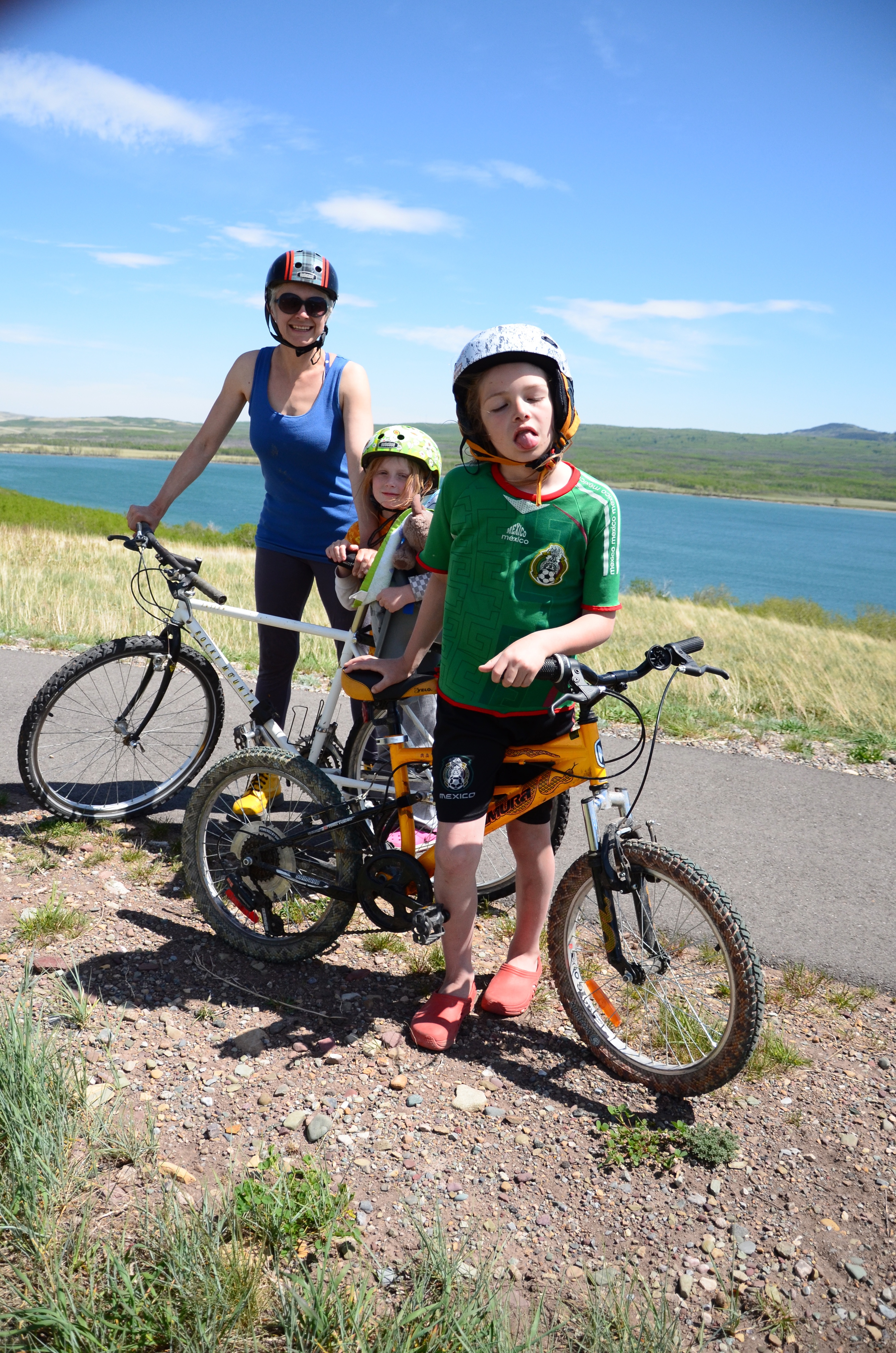
Biking in Waterton Lakes National Park

2012

Next day:

Cinder: My course schedule is all fucked up.

Jane: You’ll have to see your counsellor, I guess.

Cinder: I guess.

Next day:

Jane: Supper’s ready.

Later that night:

Jane: Where are you?

Cinder: Home soon.

Next day:

Jane: Food. Caesar dressing or oil and vinegar?

Cinder: Caesar.

A few days later:

Cinder: Math 30-1 has a special textbook that’s $20.

Jane: Ok.

A few days later:

Cinder: Can I drop English 30 and take it online?

Jane: K.

Later that day:

Jane: Supper.

Next day:

Jane: Food.

Next day:

Jane: Food.

A few days later:

Jane: This is your Alberta Health Care number.

Cinder: Why are you sending this to me?

Jane: You’ll get a phone call. You’ll need it.

A few days later:

Cinder: Can you get toilet paper on the way home.

Jane: There is a shitload of toilet paper in the furnace room.

Cinder: Not a good place for toilet paper.

Jane: Alternative storage suggestions welcome.

Next day:

Cinder: Where are the bandaids?

Jane: What happened?

Cinder: Nothing. Where are the bandaids?

Jane: Bathroom, top cabinet.

Cinder: No.

Jane: Then we’re out.

Cinder: Can you buy bandaids.

Jane: Do I need to hurry home?

Jane: Are you bleeding to death? Is Flora? Is Ender? Is there a dead body in the house?

Cinder: Buy bandaids.

Cinder: And cookies.

A few days later:

Jane: Are you dead?

Cinder: No.

Jane: Coming home?

Cinder: Eventually.

Jane: Can I have an ETA? I’m stuck in the stairwell under Flora’s desk and I need help to move it.

Jane: Cinder? Hello? I’m really stuck!

Later:

Jane: Supper.

Next day:

Jane: Food.

Next day:

Cinder: There’s no food in the house.

Jane: Basement. Ramen, Annie’s. Cans of beans. Knock yourself out. There might still be a frozen pizza in the fridge.

Cinder: K.


Next day:

Jane: Mashed potatoes or garlic bread?

Cinder: Both?

A few days later:

Cinder: What’s my CBE password?

Jane: How the fuck should I know?

Cinder: Didn’t you write it down somewhere for when I forgot?

Jane: No. Reset it.

Cinder: What’s my CBE email?

Jane: Seriously?

Next day:

Jane: Supper.

Next day:

Cinder: Where are you?

Jane: Out. Why?

Cinder: There’s no food.

Jane: Pizza.

Cinder: There’s no fruit or salad things in the house.

Jane: Who are you?

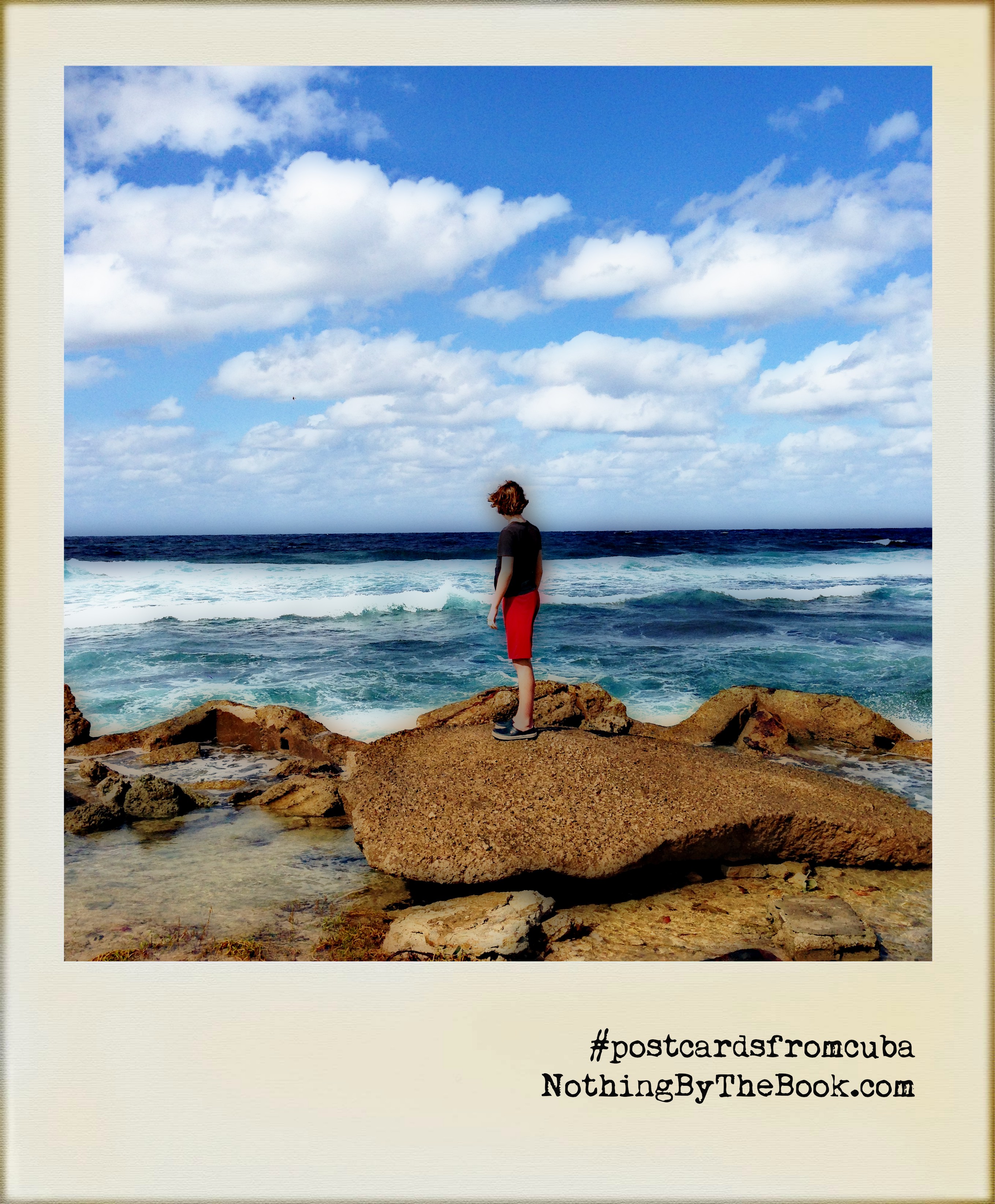
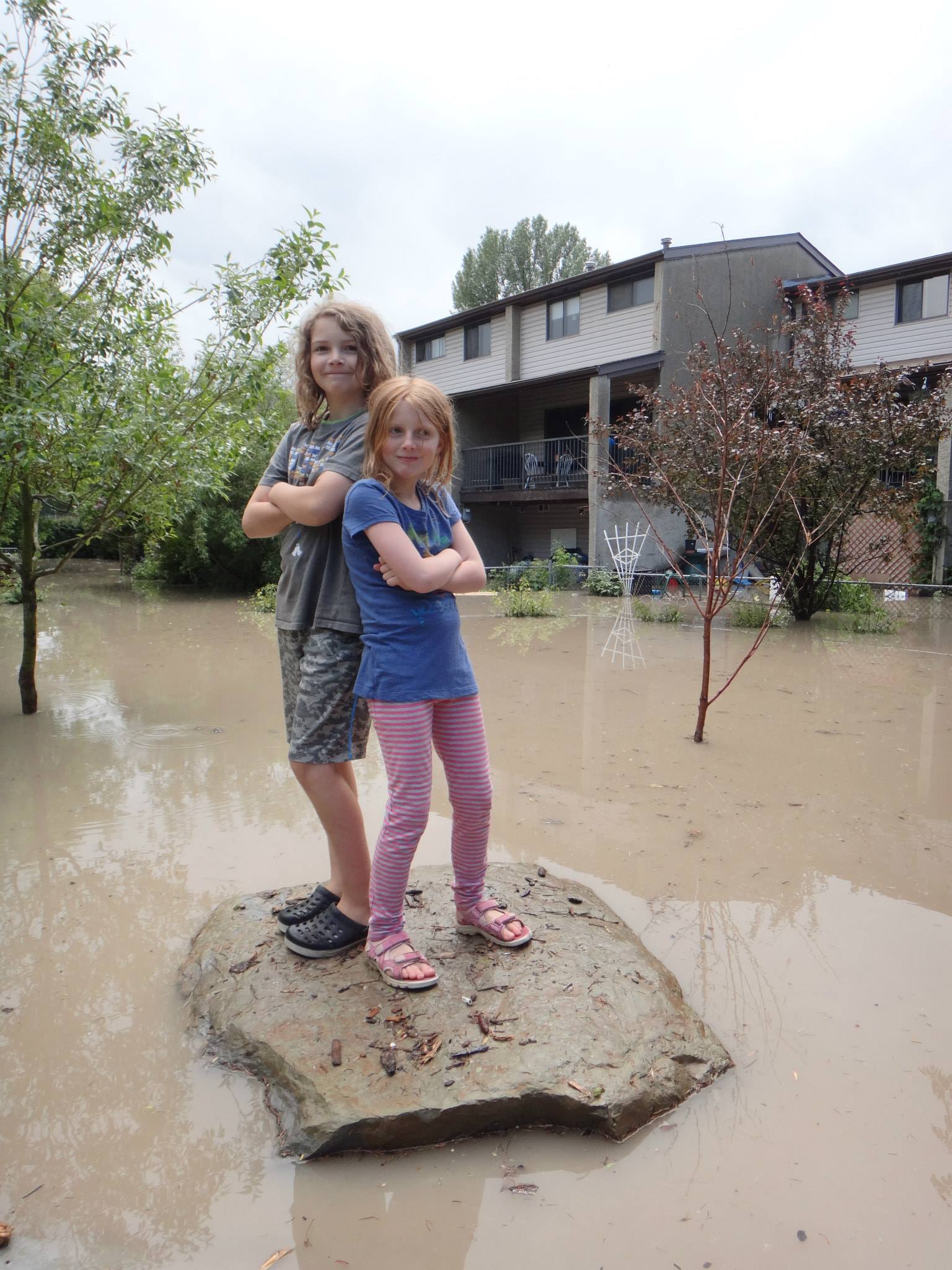
Cinder and Flora on the one unsubmerged rock on our Common.

Next day:

Jane: Supper.

Next day:

Cinder: Can I have $20?

Jane: Cash?

Cinder: Yes.

Jane: Today?

Cinder: Yes.

Jane: Only if all the change in the change jar in front of the Buddha adds up to $20.

Cinder: Are we broke?

Jane: Experiencing cash flow difficulties.

A few days later:

Cinder: Can you proof my resume?

Next day:

Jane: Food.

Cinder: Not home.

Jane: Where are you?

Cinder: Out.

Jane: K. I’m gonna eat your steak.

Cinder: Coming home.

God, I love this 6 foot 3 baby of mine

xoxo

“Jane”

So, yeah, I met Julia Cameron (in the flesh!): The power of story, dialectics and the creation of god

I’ve left paradise and I’m in a crowded parking lot. It’s tucked between the Ukrainian Catholic Church that, I guess, presumes to be a conduit to paradise for its worshippers, and the cultural centre it runs as both a community service and a modest revenue stream.

Even churches need to keep the lights on, somehow.

The Church is St. Basil’s, an unusual and beautiful name that always makes me think of both Sherlock Holmes and John Cleese (and OMG, people, John Cleese playing Sherlock Holmes, why has that not been a thing?).

(Excuse me—I’m googling “Has John Cleese ever played Sherlock Holmes?”)

(OMG, people, John Cleese played Arthur Sherlock Holmes, the grandson of the great detective, in a 1977 British film called The Strange Case of the End of Civilization as We Know It, and you can watch it for free on Open Culture.)

(Back to regularly scheduled programming…)

I’m here because in 2015, then-Conservative MLA for Edmonton-Decore, Janice Sarich, lost her job.

Follow me for a while; I’ll explain.

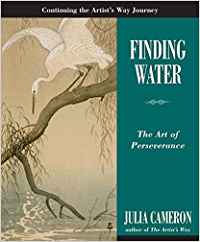
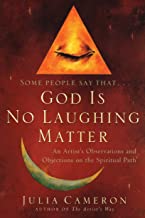
I’m actually here for Julia Cameron’s first Canadian appearance in more than 20 years. Julia Cameron is the author of The Artist’s Way—and more than 40 other books, several musicals, plays, screenplays, etc. She’s also the director of an art film, the creation of which is a study in synchronicity, serendipity, and also, perseverance past the point of reason.

Julia has been my writing teacher and creativity coach for five years. Today is the first day we are to meet. And when I say meet, I mean, I will be in a church hall with 300 other people while she talks. It’s not going to be a particularly intimate experience. But still. We will be in the same room, I will have seen her, truly, “live,” and this brings me much anticipatory happiness.

Back in 2014, when I was drowning (metaphorically, although the flood was real enough), The Artist’s Way threw me a lifeline and turned Cameron into my first real teacher, and the one I keep on going back to, again and again and again.

And again.

I don’t like her.

Let’s make this clear right away, so that you are not expecting a hagiography. We are not friends, Julia and I. I do not have a rose-coloured schoolgirl’s crush on her. I am neither the Peter nor Paul to her Jesus, nor the Mardana to her Guru Nanak.*

* You can google Mardana and Guru Nanak. Or, you can read The Singing Guru, a marvellous novel by Kamla K. Kaur (also author of Ganesha Goes to Lunch and Rumi’s Tales from the Silk Road), about the life of the founder of the Sikh religion—that’d be Guru Nanak—and his faithful companion, Mardana.

If we were closer in geography and fame, we would not be friends, meeting for a coffee and a chat. I don’t accept Julia’s tools and wisdom uncritically, as gospel. Frankly, I argue with her, fight her every step of the way. I call her names—throw her struggle with alcoholism and co-dependent romantic relationships in her face (repeatedly and unkindly). Tell her that if she spent less time gazing out her window and writing Morning Pages and more time perfecting the craft and refining technique, maybe she’d be famous for her poetry or her musicals. Or her novels would be, like, good, and they’d sell.

I am mean to her, so mean to her.

I hate her.

She is my most beloved teacher.

My refusal to be an uncritical acolyte notwithstanding, I’m here to pay homage. I’m quite aware of this, long before I get into my hic-cuping (Please don’t die!) 2007 Nissan Versa (grey) (I’m telling you this because Julia likes specificity, just as much as Writing Down the Bones author Natalie Goldberg does) at 5:30 a.m. that morning to drive the 300 km that will take me to St. Basil’s Cultural Centre in Edmonton.

I know I am here to give gratitude and pay homage long before Julia Cameron enters the hall and I leap to my feet, giving her a standing ovation before she utters a word, because, fuck, Julia, there you are, after all these years, in the flesh, you’re real, would I be where I am, who I am, right now if you hadn’t been thrust upon me back in 2014?

Julia Cameron is 71 now, and an old 71, a frail 71. My mother is 68 and a) she looks much younger and prettier and b) she could easily take Julia in a fight. Janice Sarich—the organizer—warns us before the Godmother of Art, the Midwife of Creation enters the hall that Ms Cameron has health issues, and because of them, there are some rules we need to follow. We are not to badger her, approach her, crowd her—there’s a red velvet rope strung as a barrier to separate us from the lectern and we are not to cross it. There will be no book signings or requests for selfies. We are here to get what she is willing to give us—and to demand no more.

I know from her books that Cameron is a highly introverted, very sensitive and anxious—neurotic really—and has suffered at least two nervous breakdowns.

Those are all the things about her that annoy me when I read her (Could you be a little less neurotic, Julia?), those are all the things that make her such a sensational teacher.

If I am a doubting Thomas and a pre-conversion St. Augustine—maybe even a Rene Descartes, who, had he lived half a century earlier may well have been burnt at the stake—the woman who brought Cameron to Edmonton—to me—is a less critical disciple. Former MLA Sarich is in the honeymoon phase of the student-teacher relationship, you know, when Socrates can do no wrong in the eyes of Plato, when Jung nods his head enthusiastically at every word Freud utters… even though, if he lets himself think, he’ll see that actually, um, ah, I dunno, maybe the old man got it just a little wrong?

I’ve never had that phase with Cameron. I’ve never had that with anyone. Hero-worship, goddess worship—I envy it when I see it.

Sarich lost her job at the Alberta Provincial Legislature when my socialist, progressive, feminist, “Damn straight I will dance at the Pride Parade!” premier unseated the oligarchy that had been lording it over the province for 44 years. So as soon as Sarich introduces herself and her story, I know some pretty core philosophical differences separate us. In 2015, I celebrated with abandon—if not precisely her loss, then my premier’s win. When the Conservatives returned to power in 2019 under a reprehensible platform that offended virtually all of my values as well as my reason, I mourned.

But when I talk to Sarich, all I feel is gratitude and admiration. Because she turned her tragedy and trauma—and job loss is traumatic, no matter how common in the modern economy—into this opportunity, not just for herself, but for me and for 300 other people. To meet Julia, to work with Julia.

For an emotionally exhausting eight hours.

At 4:30 p.m. that day, I revise my estimation of Julia as old and frail. Fuck, the woman might be 71 and battered by life, but she’s also tough and committed. She might have health problems. She may pause at the lectern for a long, long while here and there, to catch her breath or to recall her train of thought. But she gives us her all for the entire day, shepherding her energy carefully, resting in-between when we break off into our mini-clusters—but, at the end of the day, still giving it all, as fully engaged, as fully present as she was at its beginning.

I bow my head and come the closest to hero-worship, goddess worship I will ever feel.

There are several points during the day when I wish I hadn’t come. The first happens early in the day, during one of our first break-off clusters. The workshop for 300 of Julia’s biggest fans is surprising intimate, because Julia (clearly, she’s done this before) speaks for a little bit, gives us a written exercise, then has us break off into clusters of three, four or two. Each time, we are to connect with new people; each time, we are to share ourselves with strangers.

I fucking hate this. There is immense creative power in being vulnerable, open, exposed. I know—I’ve just come off a 10-day stint in Paradise in which I gave myself like that, completely. And I am still so very vulnerable and leaking tears and love. But these people, here? I don’t know these people at all.

And this is a fact, not an opinion: being vulnerable and open with people you don’t know and trust is stupid.

This is also a fact, not an opinion: The Artist’s Way exercises Julia is leading us through are useless unless one is stupid and open. I mean, vulnerable. Ugh.

I hate her. I wish I hadn’t come. Fine, Julia. I’m here. For you. My stupid list… numbered one to five. Things people in my family thought about Art. Imaginary lives. Things I’d do if I knew I didn’t have to do them perfectly. U-turns…

My first two clusters are marvelous. The women—the audience is 90 percent female, and also, 95, 99 per cent white, and this is sadly relevant—are all also open and vulnerable and loving. And so they set me up for what happens next.

Fine. No blame. I set myself up. I relax into the vulnerability. I start to feel safe.

Bam!

Julia says, she’s going to dictate some questions for us, and we are to answer them in our best Obi Wan Kenobi impersonation. I’m not a Star Wars fan, and while I know the difference between Obi Wan Kenobi and Yoda (Yoda’s the green one, right?), I’m not sure which one of them it is who says, “There is no try. There is only do.” But I think that’s what she’s asking for. Right? Anyway. Jedi master advice to the Padawan. This much I know. Jedi, wise.

She dictates.

What do I need to do?

I write:

Write and build.

She says:

What do I need to try?

I write:

Rejuvenate, recharge, restart.

(I actually think, “I need to let go,” BUT I AM NOT LETTING GO OF ANYTHING, analyze that!)

Number three, says Julia:

What do I need to accept?

Motherhood is forever.

Corners of my eyes tingle, sting.

Number four:

What do I need to grieve?

I don’t want to do this fucking exercise.

But I write:

Loss of freedom. And time.

Tears stream down my face, hot and sticky.

Last one.

What do I need to celebrate?

This one’s hard. But I find the words.

Love. And my talent. I’m fucking amazing and I’m still here.

My face is wet, soaked when we break off into the clusters. Fuck you, Julia, I wasn’t quite ready for that. Fuck honesty. Sometimes, a little bit of distance and delusion is good. And now, in this state, I need to be with people? Why would you do this to me?

We’re a  group of four, a young stay-at-home mom, a woman who could either be my age or be a decade my senior, hard to tell, and a post-menopausal matriarch. And, me.

I want to stay to stay open, so I tell them the exercise really triggered me and I was crying and I pretty much can’t stop. They make supportive noises. We share our lists, without details, context, backstory. Then, the matriarch starts asking questions. Who, what, why. She likes to be in charge. The young stay-at-home mom says something about motherhood, challenges, sacrifices. “You will never regret this time,” the matriarch says authoritatively. “There is so much time to do everything you want after…” And she launches into the story her of her perfectly sequenced life.

I can’t bear it. Because sometimes there’s no time, there’s no more time. Sometimes, just as you think there’s more freedom, more time, everything comes crumbling down, and then what? Is it still worth it?

Right now, to be perfectly, brutally honest, I don’t know. I don’t know if it was worth it. Maybe I should have been more selfish, more focused on what I needed back then. I’ve lost so much time, I’m losing so much time now, I’m wasting the time I do have…

What happens when you find out there will not be more time, more freedom? And you will never get back what you lost, and you have to figure out how to work with what you have?

And what is it with this crap of telling women—sacrifice everything you are, everything you want now, because sometime in the future, when nobody needs you anymore, you can do the things that you…

Fuck that shit.

My tears come again. Hot.

What do I need to accept?

Motherhood is forever.

What do I need to grieve?

Loss of freedom. And time.

I don’t want to out Flora, her story, her struggle to strangers.

But they are looking at me, confused, but, I think, also, compassionate.

“I have a sick child,” I say by way of an inadequate explanation. “I don’t have more time, now, that she’s older. My challenge is to figure out how to work with the time I have.”

I don’t add that I’m having a really hard time making use of what time I do have. That I spent most of it exhausted, non-functional.

The matriarch looks at me. I don’t really expect words of wisdom. Just, what? Acknowledgment? That it’s hard.

“I know this couple,” she says. “Married thirty-two years. Never a cross word between.”

There’s no more to her story, although her mouth keeps on moving and she’s making words. I excuse myself and go cry in the washroom for a while.

I’m not angry. Just unsupported. And reminded that it is stupid to be vulnerable in front of strangers.

I recover sufficiently to be present and to listen to Julia. But I know that even though I carry out the exercises, between myself and the page, fairly honestly, I will not be naked to strangers again today.

This is not unfortunate. It’s smart, safe, necessary. Just as necessary as, when walking home late at night, choosing the well-lit paths or opting to call an Uber instead of taking a shortcut through the dark alley or ambush-point filled urban park.

The next point of pain comes during the Q&A on Morning Pages. The Morning Pages, if you’re not an Artist’s Way acolyte, are the primary tool Julia gives us for creative recovery—and perseverance. Three pages, written in longhand, first thing in the morning. Other than those guidelines, anything goes.

In my Morning Pages, I often tell Julia she’s an idiot and this is a stupid exercise, and surely there’s a more productive, creative, enjoyable way with which to start my mornings?

But it’s been more than five years now and I’ve missed perhaps five days. The Morning Pages have given me three novels. Renegotiated most of my existing relationships, opened me to new ones. They are saving me, keeping me anchored to life and why I want to live it during this latest, shittiest chapter of my life.

They work.

They work, very very well, for writers.

Julia prescribes them for everyone.

The question, asked by a woman I don’t really see, but the top of whose head suggests she might have African roots, is this:

“The Morning Page tool is so powerful. But it’s all about writing. Is there way for people or cultures without writing traditions, to use it?

Julia answers it like a 71-year-old white woman.

The first part of her answer is ok. She says that she’s a writer and she comes at this process from that lens and she doesn’t have any experience elsewhere.

Would that she just stopped there, it would be ok.

But she doesn’t. Her next sentiment, communicated as much by tone as actual words, comes across as, “I’m not interested in making my tools work for non-writing cultures.”

Bang. Ouch. Wah.

I can’t tell if the woman asking the question is African or indigenous—she’s far, the room is crowded, I’m blind (I meet her later, she’s a Canadian with Jamaican parentage), but OMFG, Julia, how could you?

Well.

She’s no goddess, she’s no hero, she’s blinded by her class and her privilege, and she’s a product of her time.

She’s also a product of her culture, which has over-privileged writing as a cultural and communication form almost since it invented it.

And it’s so weird, really if you think about it at all.

This urge to write shit down. Not even important shit. Just… anything that happens to you. Or crosses your mind. Imagined shit. Stories about robots and unicorns and alternate universes. Murders that didn’t happen. Love affairs that go right or wrong—but that don’t actually exist.

How weird is that?

Nothing natural, inevitable about any of it, right?

What would all we writers be doing if we were born into a pre-literate age?

We would be… story tellers. Song makers. Poem reciters.

Writing is a tool, a technology, a cultural invention we use to express, communicate both the very mundane (“Sold three sheep for two wheat barrels”; “Pick up toilet paper and eggs on your way home, will you love?”) and the absolutely divine…

“The minute I heard my first love story,
I started looking for you, not knowing
how blind that was.
Lovers don’t finally meet somewhere.
They’re in each other all along.”

― Rumi (Coleman Barks translation)

The Morning Pages are magical for writers. My non-writing son finds a similar peace and cleansing when he runs. His father finds it in meditation (which Cameron near-dismisses during the workshop, wilfully misunderstanding what it is that happens in meditation—“You meditate until you push the problem away,” she says—as most failed meditators and non-meditators do).

My great-grandmother found it in prayer or the rosary.

I find it in the Morning Pages.

But that doesn’t mean everyone will, everyone should.

Julia. You too old to be open-minded?

Sigh.

My last moment of pain comes when Julia wants to talk about God. She’s a highly spiritual person and this, and her highly personal relationship with an anthropomorphic God the Creator, God the Artist permeates all her work. It is another point of contention between us. I’ve had to “get over” Julia’s god thing to work through her books. Don’t laugh. It’s possible. You can read both the New Testament and the Q’ran for life lessons and reject the existence of both Jesus’s God the Father and Muhammad’s Allah. Ditto the Vedas and the Upanishads. You can learn from the Bhagavad Ghita without praying to Krishna, you know?

Siddhartha Gautama, the “first” Buddha, figured it out—he also realized the average person needs God and I don’t expect he’s surprised either by his own deification or the veneration of Boddhisatvas and statues that make some schools of Buddhism look as theatrical as Roman Catholicism. But I digress, yet again. Point: Julia loves God and trusts that he’s running the show.

I think it’s… well, now, occasionally, I think it’s nice. Why not? Whatever gets you through the days and keeps you sober. But I can’t join her there. Not even because, Syrian civil war, genocide in Rwanda, the Jewish Holocaust, and also, the disease my daughter is battling. Just because… it seems so infantile.

Fake.

In the workshop, we first deconstruct, as a group, the idea of god we grew up with. I’m silent. I’ve put the pedophiliac “You are born in sin and you will die in sin” anthropomorphic, misogynist God the Father of my childhood religion away a long time ago. So I think, anyway. Many of the people in the group though had a similar experience. They share it. I don’t understand why anyone would worship, deify, believe in such an entity past the age of reason. Well. I do. Children are impressionable, life is uncertain.

Worship is seductive.


Next, Julia wants us to construct a joyous God the Creator, God the Artist. “What sort of God do you, as an artist, want?” she asks. “Let’s make him!” The room enters into the exercise enthusiastically. I’m silent again. I think making art to celebrate a thing that doesn’t exist is, while not as evil as making war in the name of a thing that doesn’t exist (“She was a virgin mother!” “No, she wasn’t!” “He was the son of God!” “No, he was just a prophet of God!”) is just as pointless.

But because I’m not busy building false deity, I am looking inward, and when I look inward, the “Why? to what purpose?” question inevitably looms large.

And because “it’s god’s plan” is not an answer available to me, I must find the answer myself, in myself.

This is hard to do when one is empty…

Julia ends the section, and the workshop, by asking us to first, write a letter from ourselves to this god we create, and then a response from him. (Yes, it’s a him. Of course, no gender neutral pronouns for Julia. We don’t get into it. But I feel we would fight about that too. Anyway, I don’t think she’s thought about it very deeply. Her god has a definite, also material penis. Or so I think as I seethe at her. I told you. I don’t like her. This is not a hagiography.)

At the beginning of the workshop, she introduces us to two characters who will accompany us on the journey, the Tyrant and the Rebel.

The Tyrant is also, I think, the Inner Critic. My Aunt Augusta. “Your list of five imaginary lives is so stupid.” “See, you couldn’t come up with 25 things that you love. I knew you wouldn’t be able to do it, because you suck. You’re stupid.”

The Rebel says, “The teacher is so stupid. Why is she making us do this shit?”

My Rebel is rising, but as I have done since I’ve first started working with Julia five years ago, I acknowledge that she, the Rebel, is absolutely right—but we’re going to do this stupid exercise anyway.

I write:

Dear Creativity God,

You don’t exist because, well, you don’t. I don’t believe in you, or ghosts. But Julia Cameron exists—she is very real, right here, and I believe in her. And in myself. And I believe—most of the time—that my urge to create, to write, to put all these stories down on paper is a worthwhile one. It’s important to bear witness. To document.

Look at that. This is how Jesus and the Buddha became gods.

Julia calls time. Now, it’s time for the Creativity God to write back.

Jesus.

For three minutes, I need to write in the voice of something I don’t believe in, that doesn’t exist. Fun.

Fine.

When I commit to doing something, I do it.

I write.

Yes, M., you’re absolutely right. It’s important to bear witness, to document, to interpret, even. How did you put it in that love letter to your crew? To make sense of the world and share it with other people. Not everyone can see either the whole, or the unique angle with which you can illuminate the most ordinary experience. And so, yes. Believe in your urge and in yourself and in its value. Believing in me is not necessary. Unlike Neil Gaiman’s American Gods, I exist whether you believe in me or not.

Well, fuck what the hell is this?

I hate Julia Cameron.

I love Julia Cameron.

Both statements are true. That’s dialectics, that’s where all the best ideas happen.

(Note to self: re-read American Gods soon. I love Neil Gaiman. But it’s his wife Amanda Palmer who is, occasionally, my teacher.)

We give Julia Cameron a standing ovation to close the day and then, I end up at dinner with three other fascinating attendees, including the woman who asked the question about non-literate people and cultures. (She’s brilliant, Julia, working on a doctorate on how we can use art to heal trauma—you really should have paid more attention to what was behind her question).

We de-brief, dissect. I am very pleased to find myself talking with critical thinkers, not mindless acolytes.

I love Julia, I hate Julia—I think the reason my work with The Artist’s Way has been so fruitful for me is because I fight with Julia, argue with her almost every step of the way. Resist and then surrender, for a little while. Fight some more, grow some more.

She is my most beloved Teacher.

Thank you, Janice Sarich, for giving me this time with her.

xoxo

“Jane”

PS In case you forgot where we started: John Cleese + Sherlock Holmes = The Strange Case of the End of Civilization as We Know It (1977). Give it at least 13 minutes before giving up. The 1970s were a different time: people still expected/accepted awkward foreplay in their books and films.

Heaven Hangover, or, thoroughly non-journalistic reflections on the Investigative Journalism Intensive, Banff Centre 2019

for Small medium larch

A Golden Larch

I am trying to not think of an audience.  I am trying to not think of a reader—the reader. I am trying to not think that you will read this. I am trying to think—note that the “not” disappears, more accurately, relocates—that you will not read this.

This is, of course, ass-backwards. We almost always write for an audience, a reader—even in the privacy of journals that we claim we write for ourselves but of course keep to appraise posterity of our brilliance, significance, intellectual insight, and emotional depth (What? No? Your journals are truly, completely private? Do you burn them, destroy them, after you write in them? No? Then, beloved hypocrite, you are just as vain and ego-fuelled and delusional as I am). Good work, effective work posits a reader. It is created with an audience, a reader in mind. Otherwise, it’s either therapy or narcissistic indulgence, not art.

Certainly not journalism.

But that’s another story.

This story is about heartbreak. And to write a true story about heartbreak, you need to write without thinking of the reader.

I want to tell you a story about my 12 days in Heaven, and I want it to be a truly true story. You know most of my stories aren’t really true—each is a performance, an exercise, a game. But today, I want to give you a true story. To give it, I need to not think of the audience (especially not you), a reader, the reader (the specific reader).

I am thinking, writing in circles.

It’s because I am sober for the first time in 10 days; hungover from Heaven.

View from the Banff Centre Library

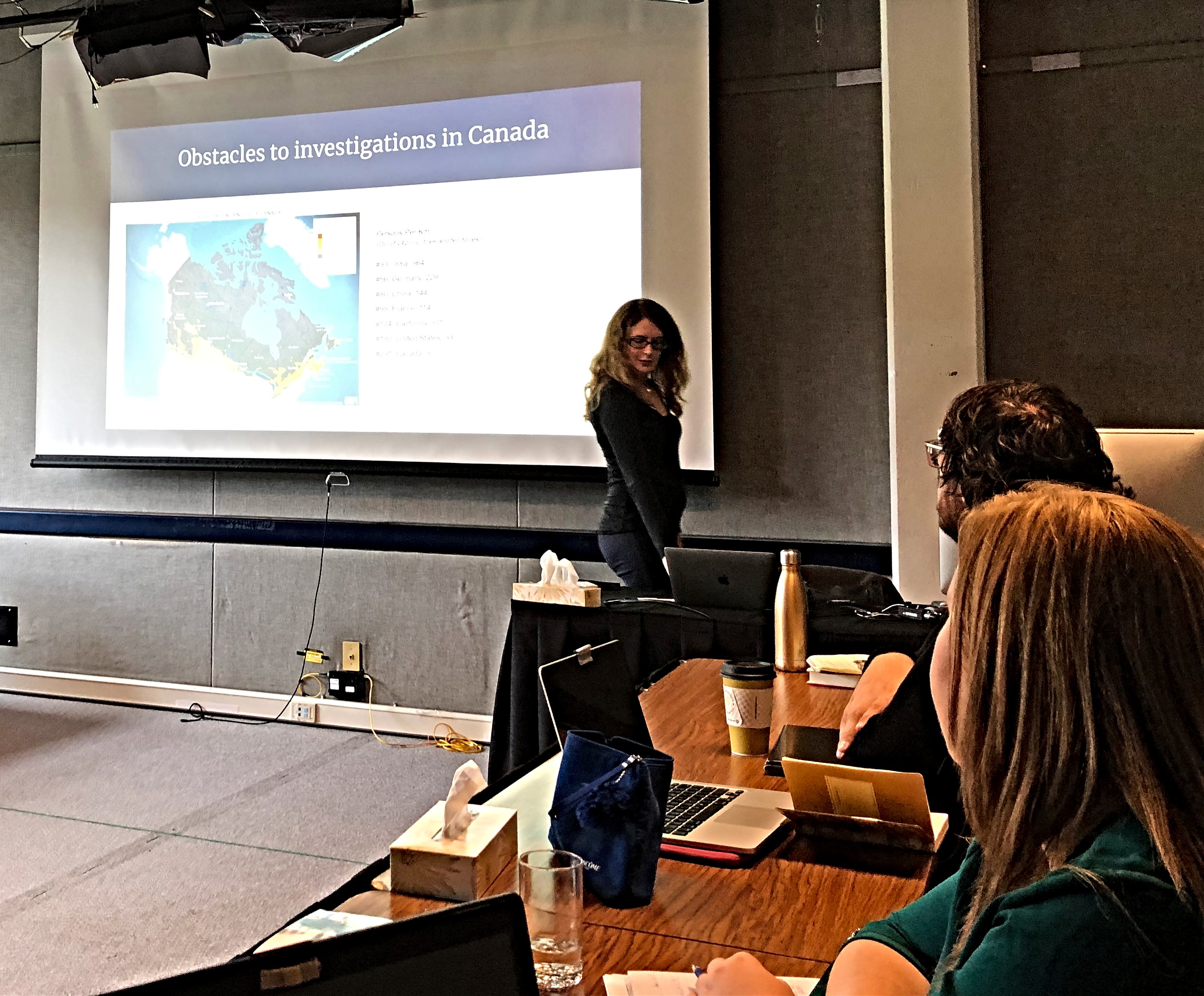
Heaven is partly a place, mostly people. I’ve just come back from 10 days—12, if you count the shoulder travel days, and I do—at the Banff Centre for Arts and Creativity, where I was privileged to be part of the Centre’s third annual Investigative Journalism Intensive.

Background for the uninitiated: The Banff Centre is, I believe, North America’s largest non-parchment granting arts institution. Its official messaging describes it as “a learning organization built upon an extraordinary legacy of excellence in artistic and creative development… the global organization leading in arts, culture, and creativity across dozens of disciplines… [which] aims to inspire everyone who attends our campus—artists, leaders, and thinkers—to unleash their creative potential.”

Words, words, words—what it is, it’s heaven on earth for artists, creators. And because it’s located in Alberta and at the mercy of the economic and political machinations of a boom-bust economy and governments that do not believe in nourishing art, culture, and artists, it’s an arts organization that’s an entrepreneurial leader. It provides a womb for artists from across Canada and the world, and it funds this womb in large part through hard-nosed business operations. Yeah, it’s an arts institution that has revenue streams independent of the government and student fees. And we’re not just talking generous donations from philanthropists (while we’re talking philanthropy, though, to the many individual and corporate donors who made the Investigative Journalism Intensive possible, thank you!).
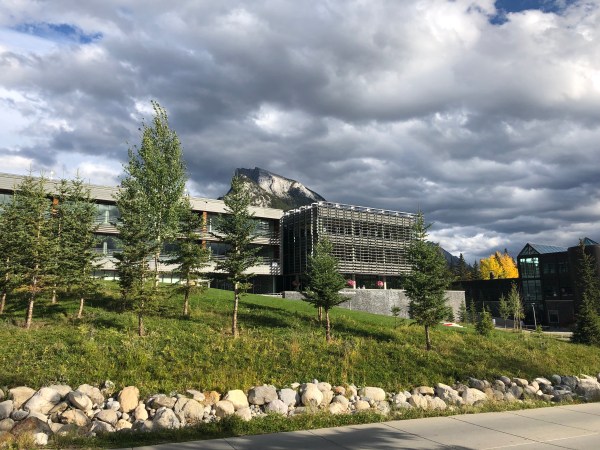
Banff Centre Campus, God’s light

But that also is another story. This is not a hard-nosed business story, although I just completed a hard-nosed investigative journalism intensive. This is a story about Heaven.

And also, not thinking about the reader.

So. I’m in Heaven. This is, I think, not a metaphor. The Banff Centre is in the heart of the obscenely beautiful Banff National Park, nestled into the side of the sacred Sleeping Buffalo Mountain (Tunnel Mountain to the colonizers), with views of Sulphur Mountain, Cascade Mountain and others enclosing it in a fairytale-like setting. God’s country for atheists, hedonists, naturalists, artists.

Elk on campus

Elk and deer wander the 42-acre campus; the occasional bear visits too. Birds sing. Little mammals scurry. Trees rustle, the wind whispers.

Artists dream.

More importantly, they work.

I arrive exhausted and beyond depleted. Soon, I will meet my cohort and later, we will share with each other our hopes, expectations, and fears—so many fears. People are intimidated, uncertain, worried—we are, technically, the most promising-passionate-something-or-other journalists around (ha! who the hell told them that? how did we ever fool them into letting us into this programme?) and we are all suffering from Impostor Syndrome. Everyone’s worried that at check-in—or check-out—or any point in-between, someone will lean over our shoulder and say, “Um, sorry, we made a mistake, you don’t belong here.”
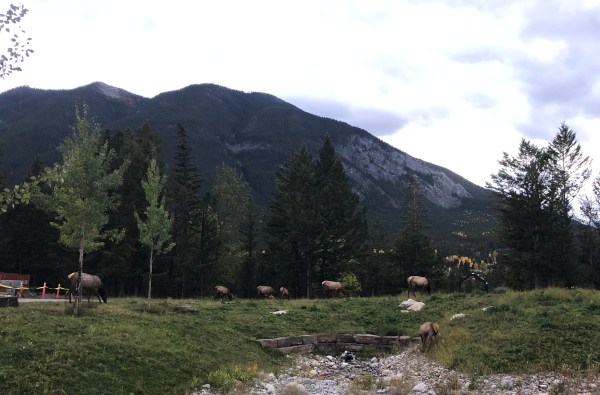
Elk harem on campus

What I’m most worried about, though, is not Impostor Syndrome. Over the years, I’ve come to accept Impostor Syndrome as, if not a friend, exactly, then as a constant presence, whose poisonous whispers I acknowledge, hear, but don’t listen to. “You don’t belong here,” the demon—I call her Aunt Augusta—whispers. “You’re so out-classed.” “You’re so right,” I answer back. “And yet, here I am. I’m so lucky. Now screw off and let me take advantage of this opportunity I don’t deserve.”

What I’m most worried about is that I am arriving so exhausted, so depleted, I will piss the opportunity away. I check in at 3:45 p.m.—and I’m on the gorgeous king-sized bed, linens white and fresh, and falling asleep by 4 p.m. I’m going to sleep the entire time that I’m here and what Alberta tax payers, conference attendees, and generous Banff Centre donors will have paid for by providing me with this opportunity is… dreams. Nothing but dreams.

And not metaphoric dreams, either, but literal dreams, in the pre-2013 definition of the word.

I sleep for 30 minutes, and then I do what I always do when I don’t have the energy to move or live. I go for a walk.

To a cemetery.

The Old Banff Cemetery is also nestled into the side of Sleeping Buffalo Mountain, just below the Banff Centre. I visit it often when I’m in Banff. Death affirms life. Later, as my stint in Heaven is ending, I will talk about beautiful melancholy with a positive-but-melancholy musician, and I will tell a fellow journalist that I hope he finds beauty in his sadness.

This is what I find in the cemetery.

This slideshow requires JavaScript.


But this is also not part of this story in which I’m trying to not thinking about the reader. (But do you see how, because I’m trying to not think about the reader, you are only able to follow because you love me and you think I love you, and you hope that, perhaps, I’m writing for you, trying to not think of you? Good. That’s the point, at last part of it.)

That night, I sleep for 12 interrupted hours, waking to the sounds of rutting elk, and also, to the sound of deep silence. Once, my screaming, a nightmare.

The next day, I meet my people.

On top of Sleeping Buffalo (Tunnel) Mountain

I don’t know it yet, of course. When I meet them—when we meet, we are strangers. We spend that day, I think, sussing each other out. Posing, positioning? Impostor syndrome is strong. Intimidation rising.

Me, I don’t make deep connections easily and rarely do I feel that I belong, anywhere, with anyone.

(But when I teach, and I ask students the question, “What do all people want?” the answer I give them is this: “To be loved, to be understood—to belong.)

That first night, I run away from the possibility of connection. I leave as soon as it’s offered, actually. Exhausted, depleted, I sleep another 12 hours…

Later, on the last night in Heaven, I tell the santur player who turns sadness into beauty (you haven’t met him yet, nor have I, wait, it’s coming) that for people like me, intimacy is a conscious choice. Love, connection, trust—none of it just happens. It is safer to be distant—it is more comfortable to be on the periphery. It is easier to be a journalist than an artist: it is easier to walk through a room glibly, smiling and laughing, but not investing. Observing but not risking.

With love, with connection, with trust comes the possibility of loss and pain.

Tears, heartbreak.
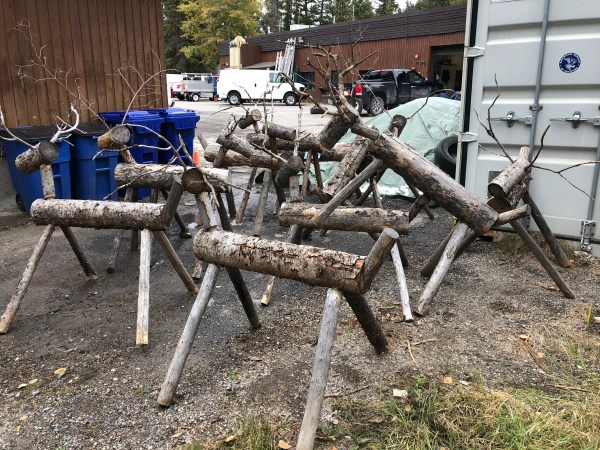
No comment

In North American culture, we mostly talk about erotic, romantic love. And we misunderstand it, pervert it—that’s also another story.

Non-romantic love can also cause heartbreak, tear you apart. That’s part of this story.

I will tell you, the reader of whom I am trying so hard not to think, this: the day I arrive, I am so afraid I am too exhausted, too depleted to risk, learn, love. On the day I meet my people—except that I don’t know that they are my people yet—I realize that, the bone-deep exhaustion notwithstanding, I can, I must make a choice. And on the next day, on top of Sleeping Buffalo Mountain, the cold wind whipping my face at the same time as the sun warms it, I make the choice to love them. Fully, unabashedly, no constraints, no barriers, nothing held back.

In the wind

Here’s the magical thing, here is what happens in Heaven: every other person in the cohort makes the same decision.

Not at the same moment, not that day, not on that mountaintop. A few of us are a slower burn than even me—it takes them longer. (And yet others have fewer intimacy issues—they decide to roll the dice, take the risk, and love us all on day one.)

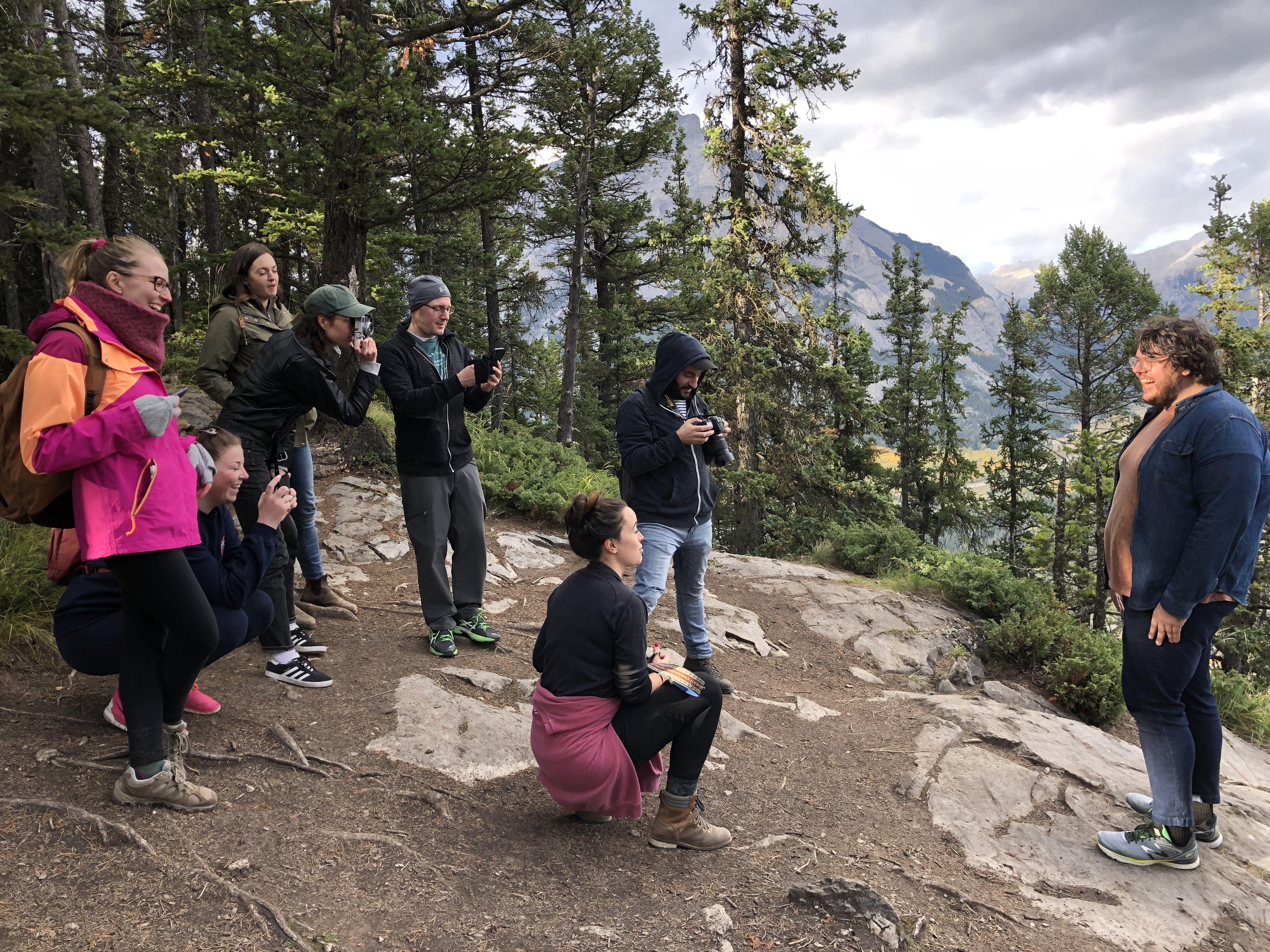
Photographing the photographers; context deleted

I explain all this to the melancholy musician on the last night. And I cry.

He plays beautiful music to soothe my heart, and I cry some more.

I’ve jumped ahead and you can’t follow.

Rewind.

So. I am in Heaven—aka the Banff Centre for Arts and Creativity—on a 10-day Investigative Journalism Intensive. My debriefing, description, depiction of it violates every “this is journalism” rule, I know. I am not a journalist right now. I am a broken, open heart.

And it’s a journalist’s fault.

Robert Cribb, the star investigative journalist from The Toronto Star (see what I did there), who is our main guide on this journey, sets the sappy tone in the first hour of the intensive.

(Patti Sonntag, former managing editor in The New York Times’ news service division and now director of the Institute for Investigative Journalism at the University of Concordia is the other; we also get some time with the brilliant Aron Pilhofer, the James B. Steele Chair in Journalism Innovation at Temple University—holy cow, loves, mind utterly blown, I drink each word from him as if it is vintage wine or the blood of Christ itself).

But it’s Cribb who is the main midwife of what happens in Heaven. And this is weird casting. Really weird. If you’ve read Cribb in the Star—if you’ve read Digging Deeper: A Canadian Reporter’s Research Guide, the textbook for people like us that he co-authored with Dean Jobb, David McKie, and Fred Vallance-Jones and which forms the text for our intensive—you form a certain image. Expectation. At least, I did, and it was the kinda image often depicted in movies. You know. The seasoned, cynical, hard-boiled journalist (or, actually, homicide detective) with a bottle of whisky in the bottom drawer of his desk.

And when you see Cribb in the flesh, he rather fits that image. Maybe better dressed than the typical Silver Screen depiction. But tough, tough. And hard as nails.

Heart of gold inside? I dunno, maybe, not really, more like a heart of steel, or an uber-fast analyzing computer.

Hard-core, not soft-boiled. Clearly.

Not.

“This is love, here is love,” the hard-core Cribb tells us on day one, in hour one. I don’t believe him.

I’m wrong.

This is love.

I have no idea if he knows how he’s doing what he’s doing. How much of it is on purpose, by design. How much of it is intuition. But we fall in love, with each other, with each other’s work, passion, experience, vulnerability, frustration, fear, hope, ambition, humility… fear. Did I mention fear?

We are journalists working in the era of free content, death of newspapers, evisceration of news desks. And the rise of alternative facts and fake news.
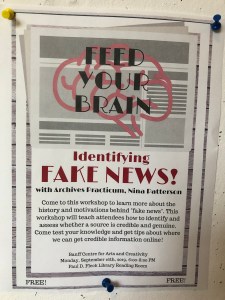
We are all probably (not just a little) mad.

I am mad, I am in Heaven, and while here, I am working on three things:

  • The narrative journalism-this-is-not-really-an-investigation-but-it-has-elements-of-one-I-hope story I want to create around this thing that’s happening in Alberta that I’m not going to tell you anything more about, because it’s my story and while not really a secret, still, containment is the first rule of magic
    (Ok, I’m not really working on that story. Unless thinking is working. I’m thinking. A lot. Document state of mind, where is it written down, where can I find what I need to answer my questions? I make lists. Identify agencies, names. Think, think, think. A lot.)

meme by David

  • The novel that I was supposed to have finished in February, but, you know, sick child, life
    (I plot it out completely, and hit about 6-7,000 new words on it before the intensive ends; also, flesh out some other parts on its sister pieces—I am happy, productive, accomplished.)

  • A painfully introspective “what do I want to do with the rest of my life, or at least the next five years” journaling exercise
    (I do not arrive at an answer—except that I do not wish to work for an established Canadian media company in any way, shape or form, I want to be part of a revolution, except that I don’t think I’ve got quite enough fire to lead the revolution—what I want is someone else to start the revolution and tell me how to help execute it, what do you mean, I have to figure it out all myself?—and that, my love, is a taste of what my journal pages look like, minus the expletives, doodles, and digressions.)
This is not a newspaper; this is not journalism

I am not working on the story I pitched to get into the programme. Because I don’t have the emotional bandwidth to write it right now. And that’s—well, that’s also another story. Also, I’m not sure who will pay me for it (which is in some ways the most important story). But it’s ok. I don’t have to write that story, right now. Maybe someone else can do it better. And if they can’t, life is long—maybe I will get to it one day.

Maybe not.

In Heaven, for me, my story is not what matters. My people matter.

I have a people. Do you understand how intoxicating this is for me?

We are an interesting mix of people, from across Canada and around the world. The prairie provinces are well-represented, and the East Coast (hello, New Brunswick!) over-represented. Toronto and Vancouver are notable by their absence—why is that? But we’ve got Montreal (although he’s really Boston). And London, Kingston, and Hamilton. There are journalists from New York and New Orleans, a Pole working in Cambodia and an Australian based in Liberia—and the Brit was most recently working in New York. A First Nations journalist from Northwestern Ontario—what a beat she has, what a heart pounds within her—how does it not break, daily?

Perhaps it does.
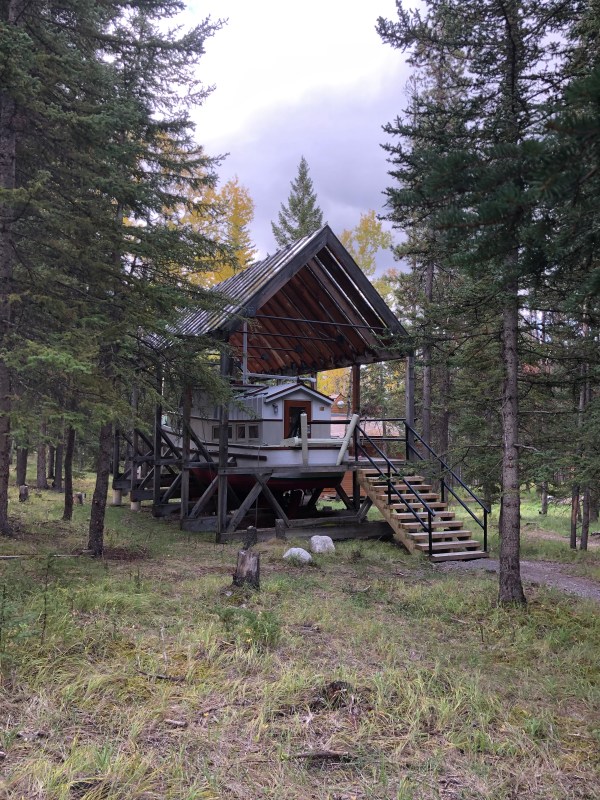
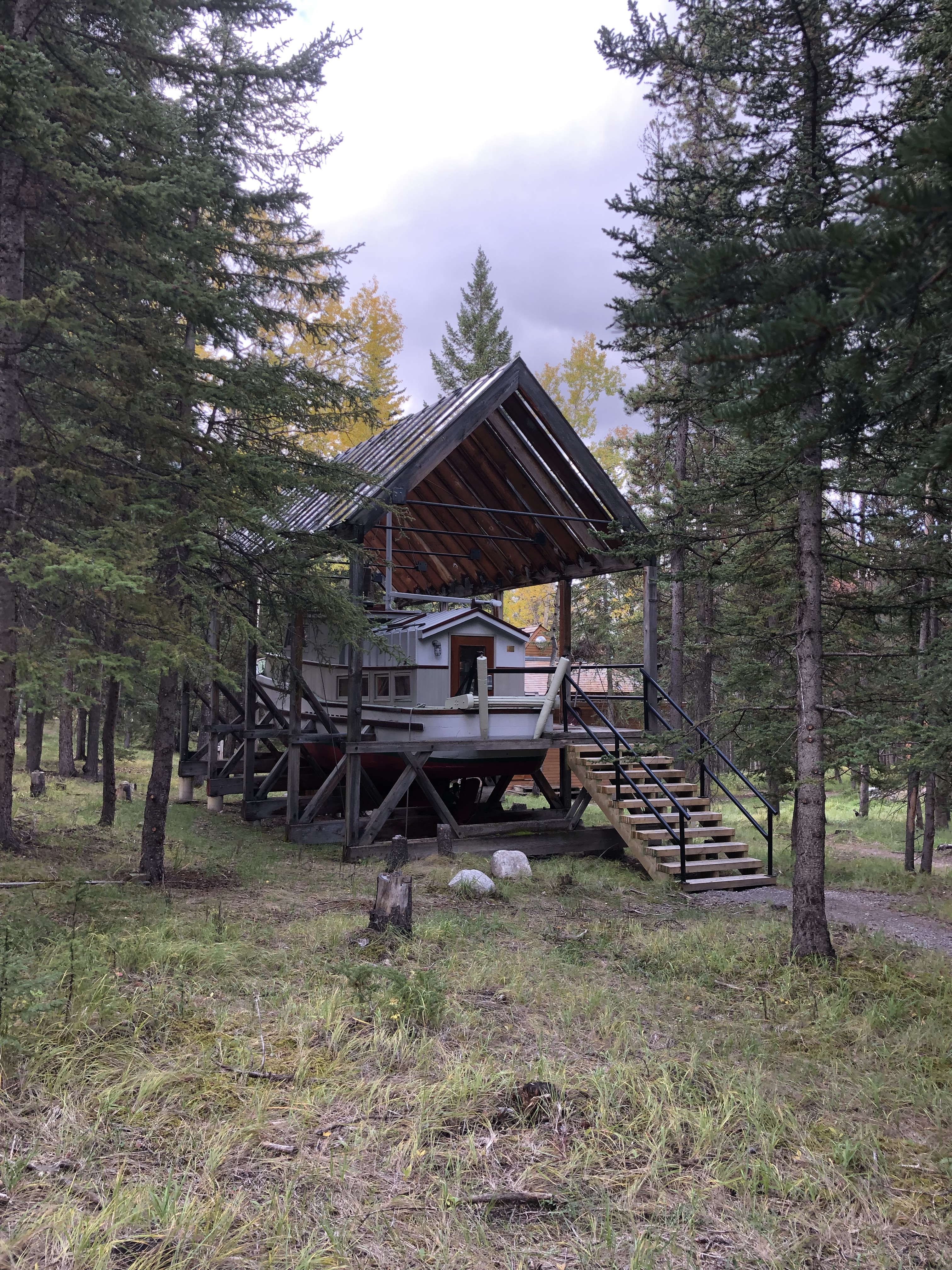
Boat in the woods

Exhausted, depleted when I come, I request complete radio silence on behalf of real life while I’m in Heaven. “Unless one of the children is in the hospital and needs a blood transfusion from me, don’t text me,” I tell the family. I issue the same directive to my friends and loves. “Don’t text me, I won’t text you”—I want to be here, away, completely.

I break it twice. Once, when the high school calls me—they never call me, what’s wrong, panic—texts—it’s fine, everything is fine.
The second time, it’s after Heaven becomes interdisciplinary—we the journalists go to hear the musicians in residence perform a concert, and I don’t know exactly what happens—it’s like the secret sauce. Journalists (writers in general, except perhaps the poets) don’t usually think of ourselves as artists. A number of us in the intensive are recipients of artists’ grants, and Impostor Syndrome prompts us to laugh at the label. Artists, us? What are we doing here, really, in this arts sanctuary?

Do we belong?

The answer, I think, is this: Yes, we belong. We’re all here, musicians, photographers, painters, poets, novelists, journalists, because we make things in order to make sense of the world. Right? Isn’t that what we do, at the core? And hearing the musicians make sense of the world in a language in which we journalists, writers are rarely fluent—I certainly am not—shakes us.

Shakes me, anyway, to the core.

Dancing in the Streets, photo by Kathleen

Cello, bass, violins, viola, guitar—flute, gods, the flute, what is that? how does she do that?—voices as instrument, body as instrument, drum and paper, a hundred-stringed Persian santur, piano and bass—is that a Zappa song? And that string quartet, do they share a hive mind and what have they done to my insides, they are no longer my own—they’re cosmic dust, and I don’t exist.

(And yet, it turns out later in the night, non-existent, I can still dance…)

The night of the concert, I don’t really sleep; in the morning, unsettled, vibrating, I break radio silence with an email. I write about the santur player (I’ve met him now, and so have you—but this is all the introduction you get), and the flutist, and the folk singer, and the string quartet from Vienna, and the bass player who loves Frank Zappa, and the dancer who speaks with her body, oh-my-god, but mostly, I write this:

My work is not really moving forward in a significant way—well, I did plot out the next [Series Title Deleted] novel, and I’ve got some words down on that, I should not downplay that—but most importantly, my brain feels like it’s waking up, I am drinking art and I am surrounded by people loving and making art and music and poetry and making words sing, and I am so alive even when I am almost too exhausted to move.

Last night, after an intense day of work work work, and then the concert, and then the party, we danced in one of the hotel rooms until we literally collapsed on the floor—I have not felt such freedom and abandon in an eternity.

And I am grateful, and that’s a good feeling—I have had a very hard time feeling grateful.

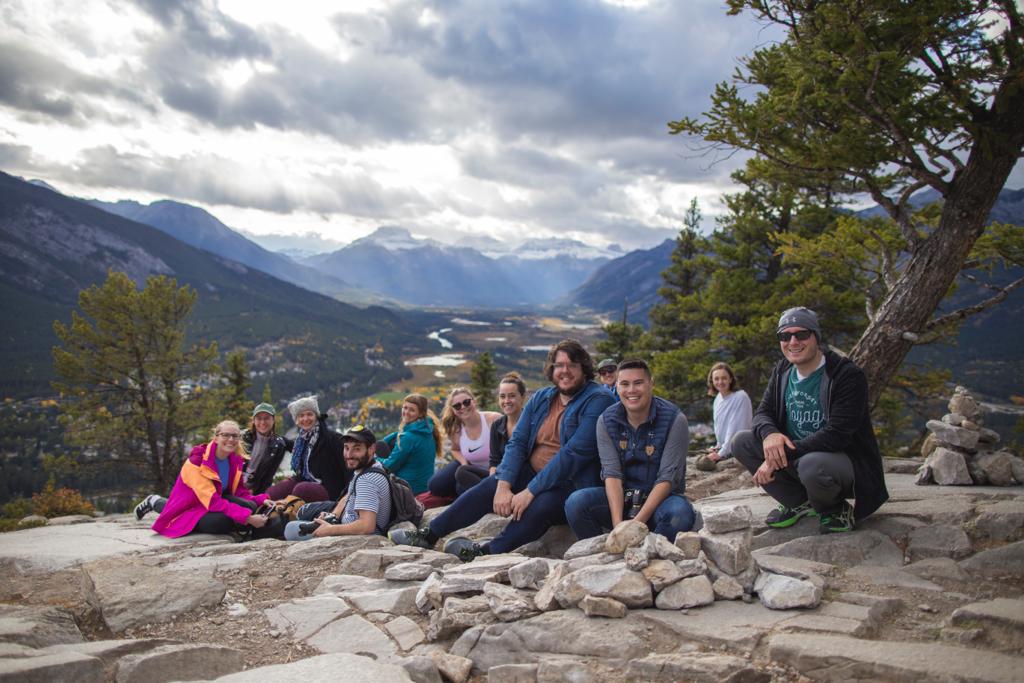
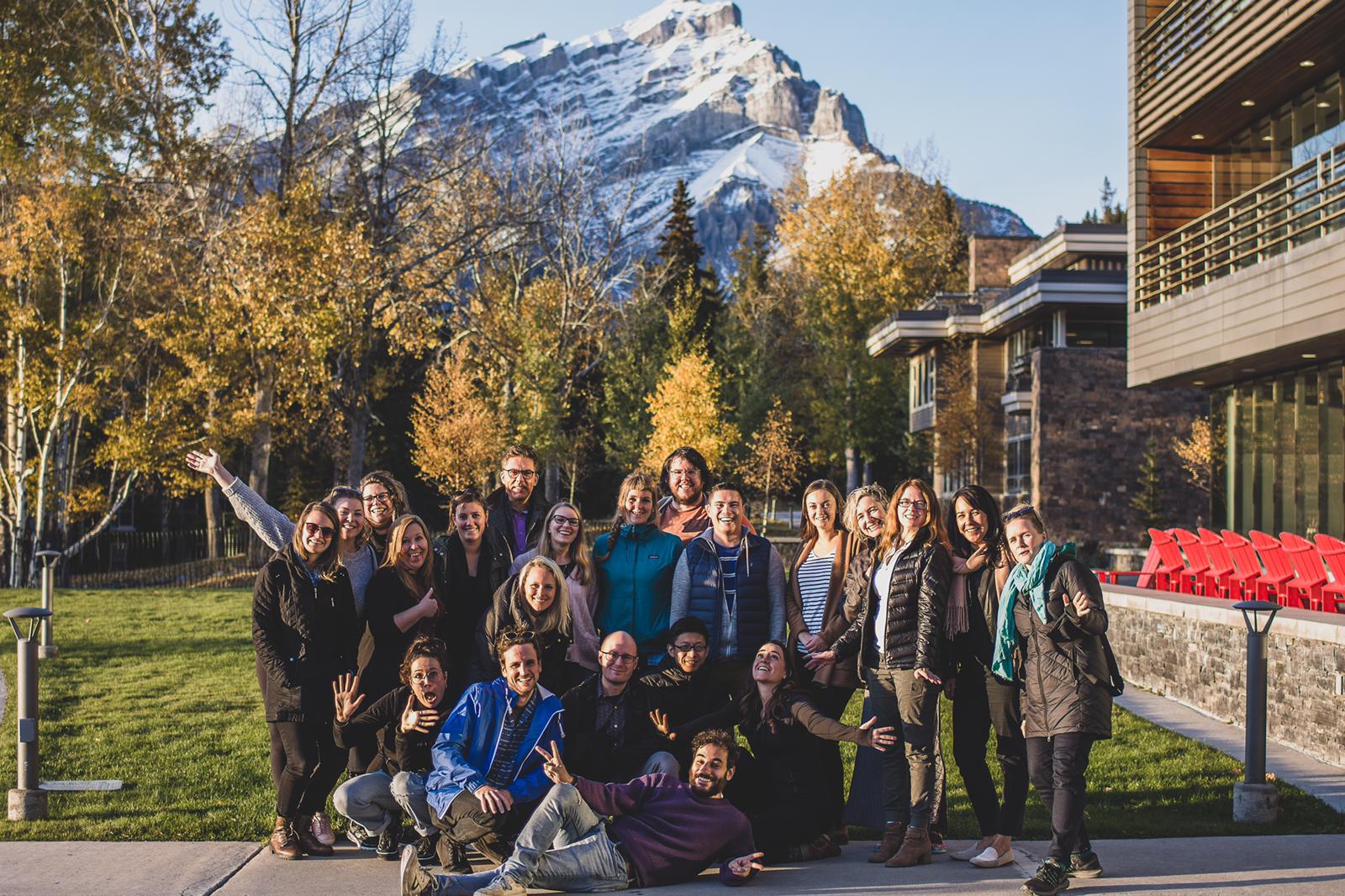
Here’s a picture of my crew.

Did I mention that I am so happy? My heart threatens to break out of my ribcage.

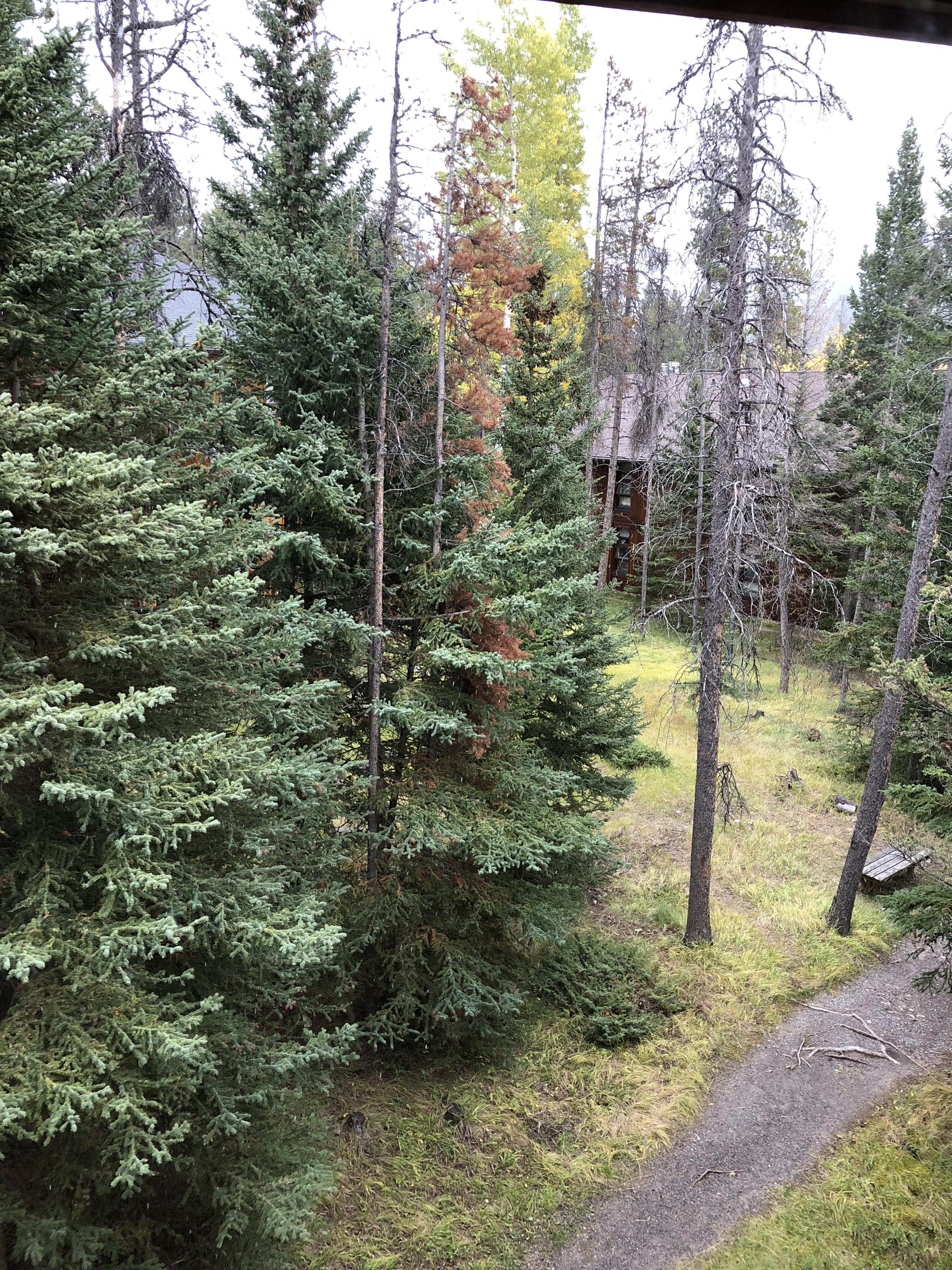
View from my room

We work, we learn, we work, we hike, we work, we dance—we talk, argue, share, fall silent. Repeat.

I feel the hangover coming before it hits. It all ends, we are to leave Thursday morning. Tuesday, we fill out programme evaluations, have our closing reception… which morphs into a closing party and karaoke (and there is also a mechanical bull, don’t ask, it’s Alberta)… and then a long walk from Banff townsite to the Banff Centre, the longest way possible, not on the direct path, but all the way around the mountain. With lots of stops.

“No. We’re not turning there—if we turn there, we’re going to be back at the Centre, and then this night is over, no.”

Not my words, but my sentiment.

We lay down for a while at the Surprise Corner look-out point and look at the stars.

It’s two, three in the morning? Too late. Too much. Too little. It’s almost all over.

Melancholy.

“I don’t want this to be over.”

I have the conversation that begins with this sentence a dozen times, with a dozen different people, none of whom I would have met in the ordinary course of my creative or professional career; these 10 days are extraordinary.

We are hungry for each other, we fit each other, we stimulate, challenge, push each other. This is Heaven.

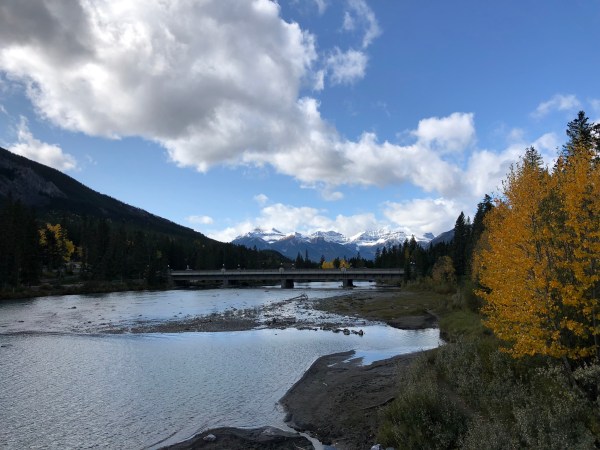
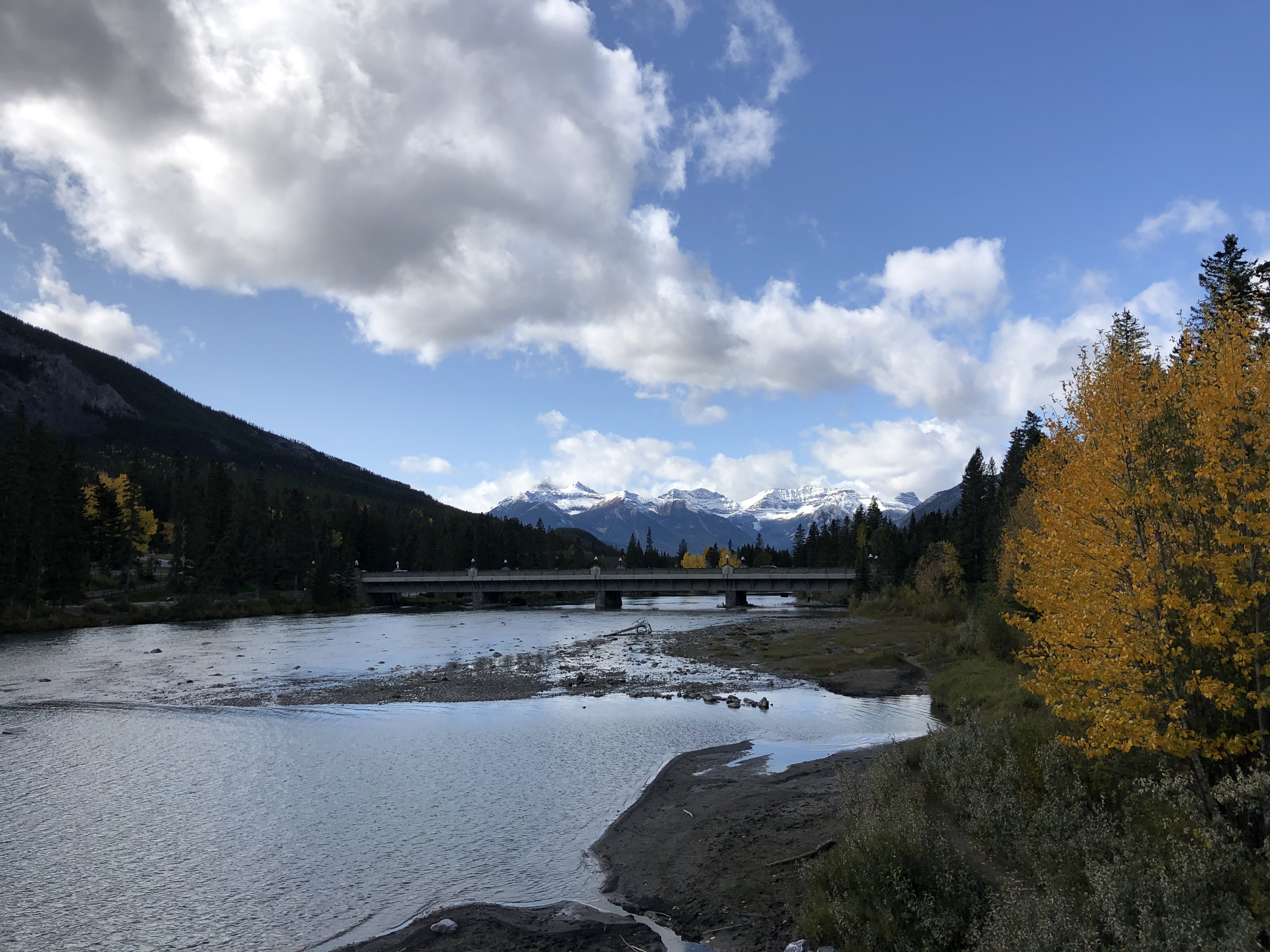
Bridge over troubled (they only look calm) waters

The santur player—you’ve met him now, remember?—is Persian, and in our encounters we talk poetry, of course. The Persian sufi poets excel at metaphor, at using the language of sexual desire to represent divine love, at using the prosaic and the ordinary to represent that which cannot rightly be put into words.

I wish I had the talent of Hafez of Shiraz to put my longing into words. I do my inadequate best—my people understand, because we all feel it. Many of us freelance, which means we are almost always alone, working with cyber-editors and ever-new sources. Colleagues, friends, collaborators, soulmates? What is that?

Even the people in the newsrooms—they often feel alone, isolated. Also, under stress, fire, threat.

Embattled.

Being an artist has never been easy; there has never been a worse time, in the “free” world anyway, to be a journalist at a traditional media outlet.

And yet, here we are.

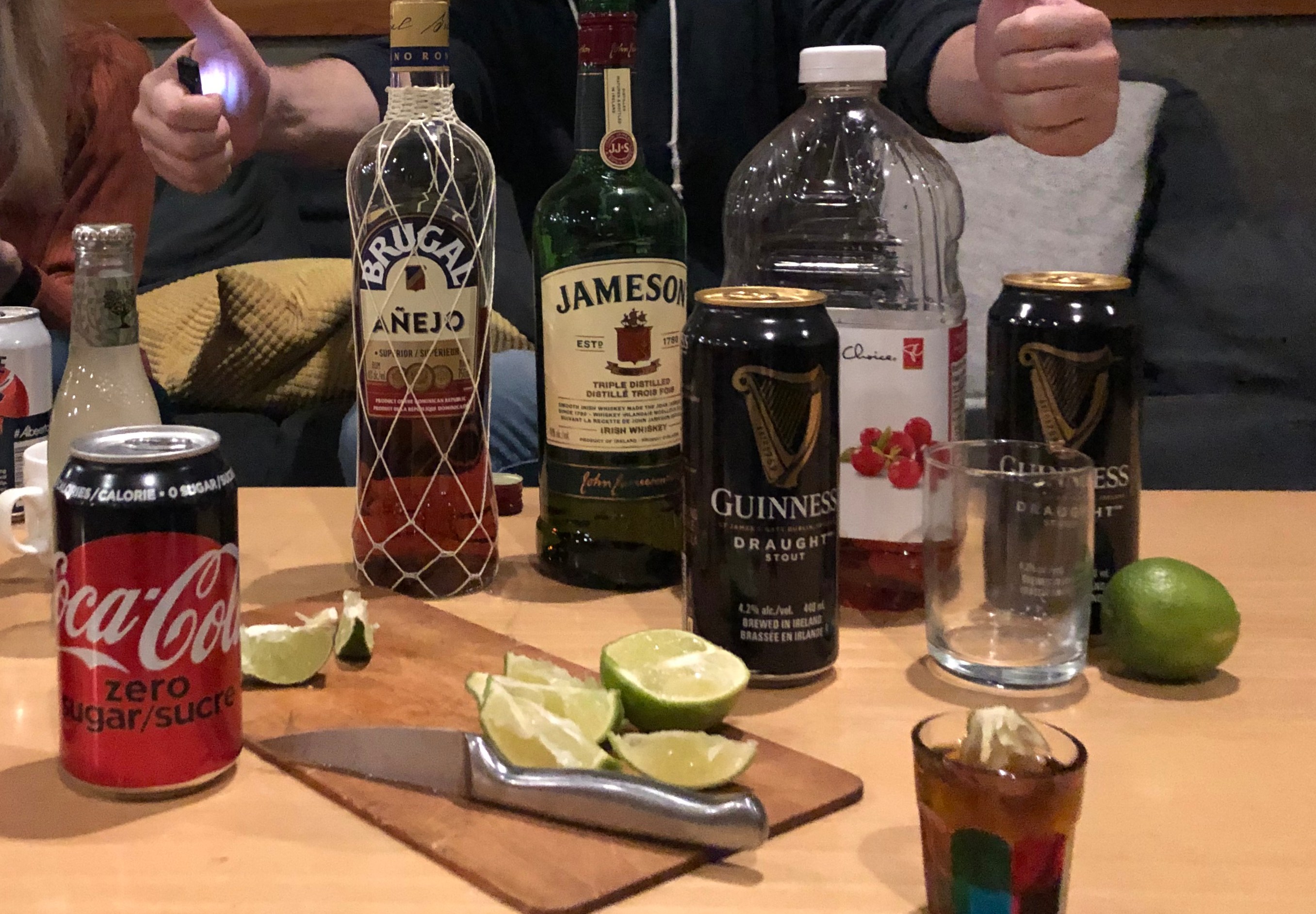
“Are we stupid?” I ask this question as the level in the whisky bottle—not the first one—drops. “I mean, I know we’re brilliant, we’re all high on how brilliant we all are. But are we really stupid? Aren’t the smart ones in public relations, communications, marketing, in-house at the corporations, out-earning us, out-spinning us, killing us?”

All the industry stereotypes

Maybe.

“So why do we keep on doing this?”

The question answers itself when I talk with the melancholy-but-happy (that’s a thing) santur player, who makes the hundred-string Persian instrument weep to bring peace to tormented hearts. He can’t remember not playing the santur. He can’t remember not making music. He can’t remember at what age he made his first attempts at composition—his father first recorded him “improvising” when he was ten years old.

Music is in his bones, in his DNA.

It is who he is, as much as it is what he does.

I ask him questions, so many questions, intrusive questions, ignorant questions—I am not fluent in the language of music.

But there’s a question I don’t ask, don’t have to ask.

I’ve heard its variant often.

“What would you be doing if you weren’t writing?”

(What would you be doing if you weren’t making music? If you weren’t making art?)

And I don’t understand the question.

I stare.

I smile awkwardly.

I shuffle away.
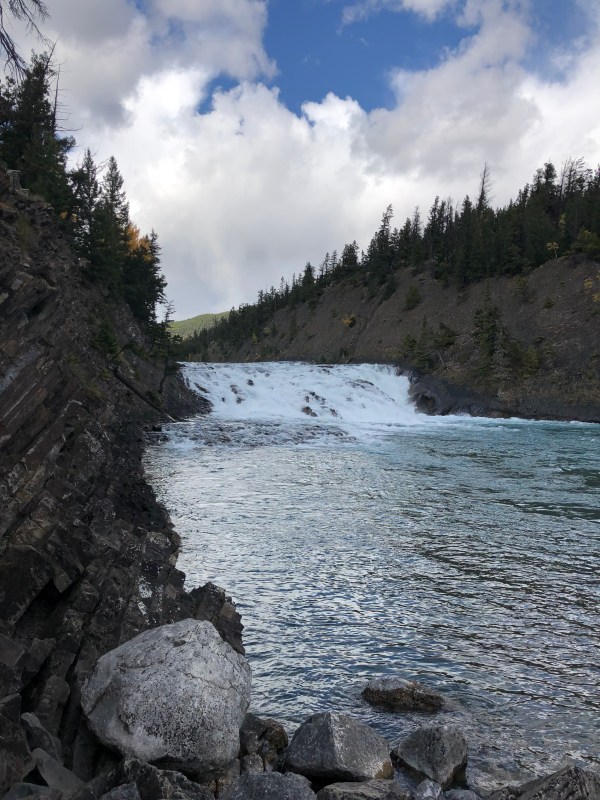
Bow Falls

We here, this intrepid group now enjoying 10 days in Heaven, we are the people who have to tell the stories. We need to document them, chase them, share them.

Beavers build dams.

We see the “Who, what, when, where” and then ask, “Why? How?”

And keep on asking…

Then write down the answers, send them into the world, so that you know too.

This used to be a valued, precious skill and gift. Lately, not so much.

Except here.

Heaven.

See what happened? A bunch of journalists and the Banff Centre made me believe in God. Or maybe it was the Persian santur. Goddamn Sufis. Where’s my whisky and my heart of steel?

It’s time to say goodbye.

I don’t want to. I break radio silence, again.

Today my heart hurts because I will be leaving them. I am stupidly hiding from them because I don’t want to say goodbye.

As I write the email, I realize I am being stupid.

I close my eyes. And enter into the pain.

I am going to stop being stupid & go love them a little more, a little longer.

Photo by Alex

We spend that last evening outside. Around an open fire.

When I leave them, I am an open wound.

The santur player has a song called “One Last Time”:

I don’t even try not to cry when he plays it.

“This is how I feel about my crew,” I tell him. “Precisely, exactly, completely, this.”

We will never see each other again—not like this, not all of us—and the reality of this hurts, hurts, hurts. We now know each other—and we know we are not alone, and we know we are loved and valued. That is something, that is everything.

We connect—Facebook, Twitter, Instagram. LinkedIn. Slack.

Sorry. That is meaningless. It doesn’t matter, it doesn’t compare to this face-to-face time, any more than an email “interview” compares to a face-to-face one—any more than watching porn compares to having sex with someone you are mad about.

(You know I was going to go there.)

So. Goodbye.

Photo by kind stranger from Willow’s camera under Willow’s direction

Heartbreak.

When your heart breaks, you have, I think, two choices.

(You almost always have at least two choices, right?)

You can sow it up and harden.

Or you can leave it open. And make art.

I’m making art—I’m writing—and I am trying to not think of an audience.  I am trying to not think of a reader—the reader. I am trying to not think that you will read this, even though, of course, I am writing it for you, only for you.

Document state of mind forever.

xoxo

“Jane”

Photo by Kathleen

PS All you need to know about The Banff Centre: https://www.banffcentre.ca/

PS2 All you need to know about the Institute for Investigative Journalism at Concordia https://www.concordia.ca/artsci/journalism/research/investigative-journalism.html

PS3 (The Most Important One) The Banff Centre Musicians in Residence perform most Friday evenings this fall, in Rolston Hall. If you’re within driving distance (Calgary, I’m talking to you), you should go hear them. Because. Amazing. (Also, free.)

PS4 I know that part of the intoxicating intensity of our love affair comes from its brevity and its enforced, prescribed ending. Were we all to, suddenly, form a single, cohesive full-time newsroom, were we to work together five, six—in this world, seven—days a week for 52 weeks—hell, even a few months—there would be less infatuation and more frustration, the professional equivalent of seeing a lover’s dirty socks on the living room floor, repeatedly, for goddsake, what’s wrong with her, does she not know what the laundry basket is for? I know all this. Vacation romance, fairy tale love affair. I don’t care. It’s not any less real, any less precious because it’s ephemeral and must end. All things end. We are lucky, so lucky, that we drowned in it as fully as we did, among the mountains, the elk, the true evergreens and the mysterious golden larches.

Michael on deadline (he made it)

PS5 Ok, I realize, you–the reader I’m trying not to think of–you’re going to go here:

You: OMG, woman, did you actually do any journalism?

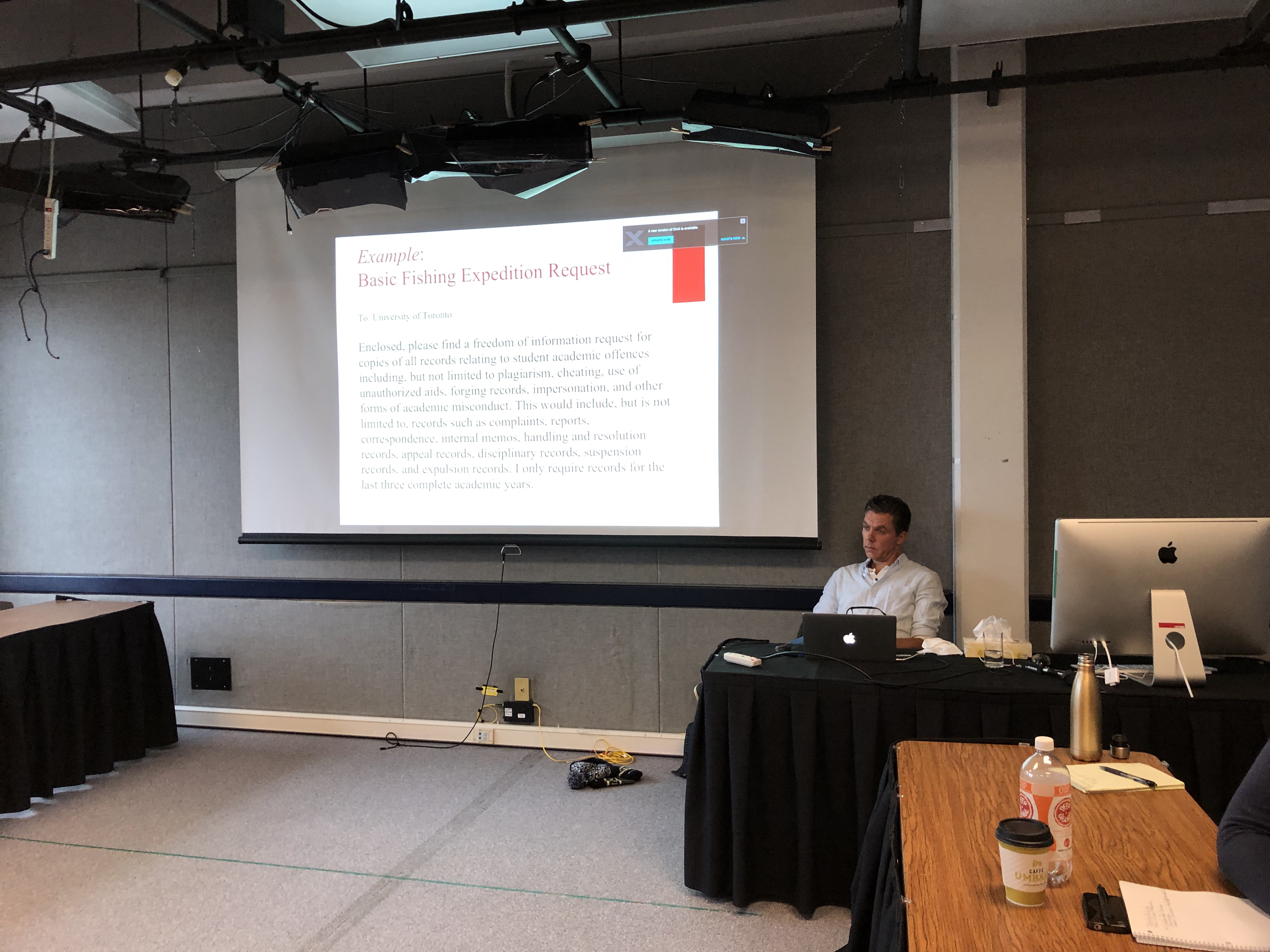
Jame: OMG, we did EVERYTHING. We drilled into the elements of investigative reporting and what separates original investigative work from derivative reporting—and also, how it’s possible to write an original, revealing investigative piece purely from data already out in the public records that nobody had bothered to connect together before. DOCUMENT STATE OF MIND. We pitched out story ideas and refined them—and refined them some more—being part of this process was probably the most useful part of the entire intensive, except that all of it was useful. We talked about focus and moral and purpose. “What’s the point of this story? What’s the moral of this story? Why are you writing this story?” (We’re writing to change the world. Short answer.) We talked about testing ideas and getting started, organizing documents, identifying (and chasing down) sources. DOCUMENT STATE OF MIND. Collaborative (like hundreds of journalists working together) investigations. Sharing data, interviews, and insights. Preparing for cooperative publications and broadcast. Public records and freedom of information requests. DOCUMENT STATE OF MIND. Pay-walls, love as business model, memberships and subscribers, the future of our industry. Doing the work, loving the work–paying attention to the reader. Piggy-backing on past FOIP requests. How data tells a story. Turning data into narrative. DOCUMENT STATE OF MIND. Sequencing interviews, preparing for adversarial interviews, dealing with spin and reluctance. Turning “off the record” sources into “on the record” ones. Libel-proofing stories. Role-playing adversarial interviews. Surviving being scooped. DOCUMENT STATE OF MIND. Solutions journalism (sort of). Data. More data. DOCUMENT STATE OF MIND.
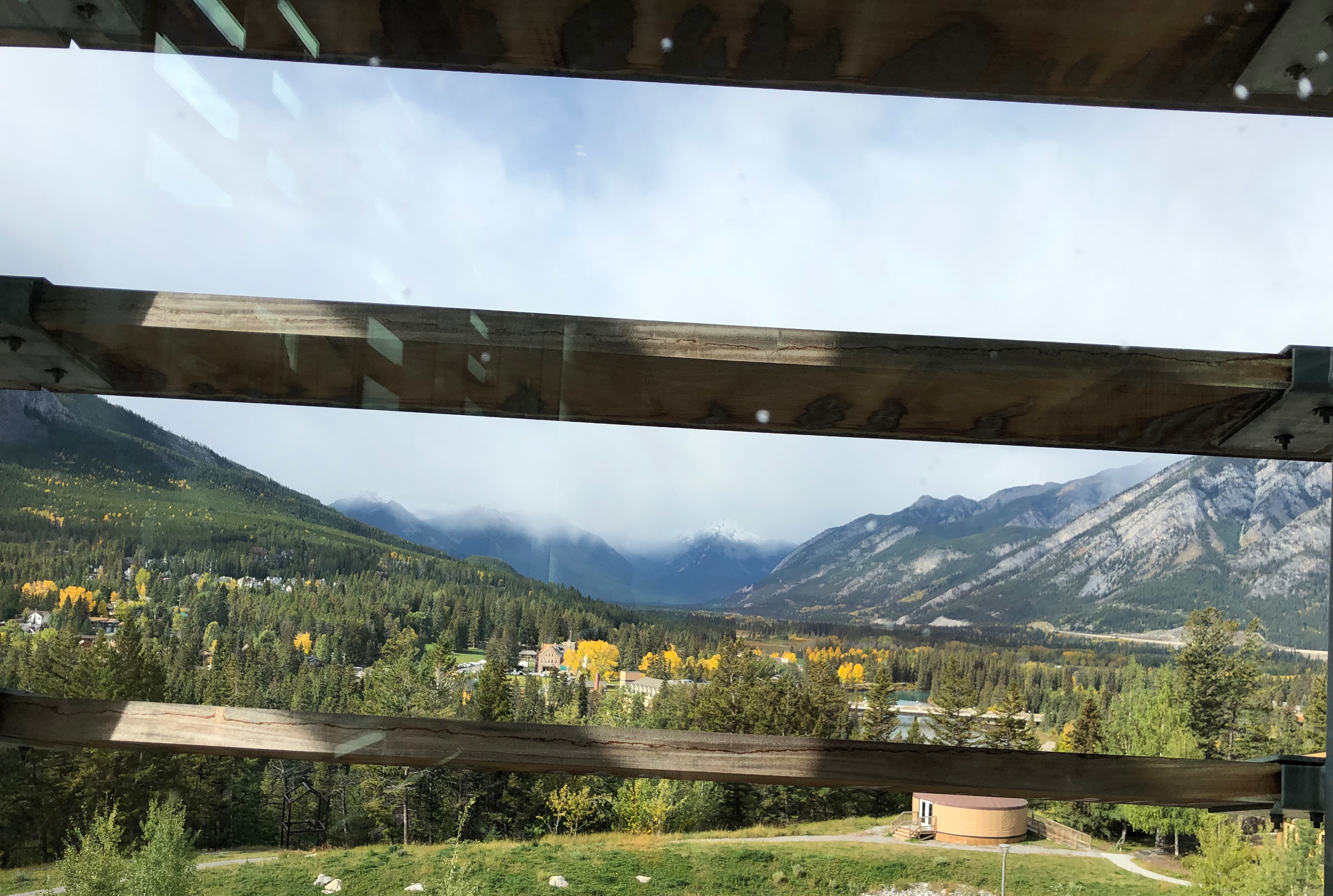
You: I don’t understand any of this.

Jane: You had to be there. Here, have some more whisky, and then I’ll play you some modern Persian music, and we can both cry.