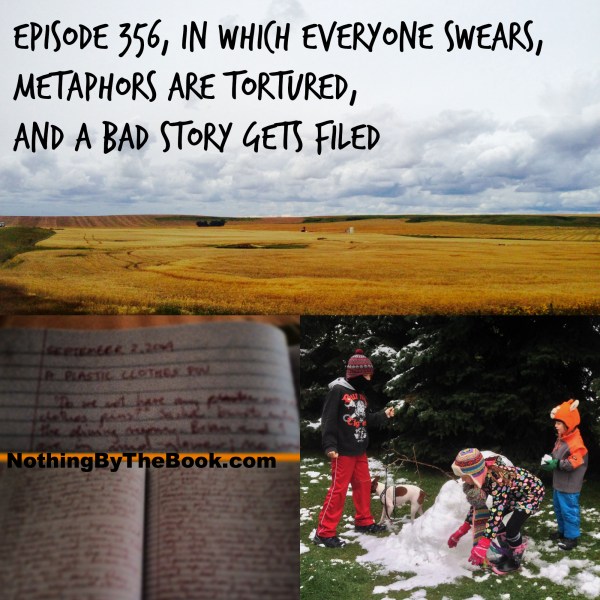
Episode 356, in which everyone swears, metaphors are tortured, and a bad story gets filed

subtitled, why my children swear… and why I’m not going to stop…

I.

Ender: Mom? You know what the difference between you and me is? You swear at people. I just swear for fun.

Go ahead. No, please, go ahead, indulge the judge within. There are so many things WRONG with that statement, I don’t even know where to start.

It’s only partially true.

I don’t really swear AT people. More at the THINGS they do.

More often yet: at my self. My brain. The things it refuses to do when I really need it to perform…

Still. I hereby resolve to swear less. In front of the sponge-like four-year-old, anyway.

II.

I have this deeply insightful point to make and I’m just trying to find the right way to lead up to it, and then…

Flora: Mom? Do we have any of that delicious bean mush left?

Jane: What? That? Yeah?

Flora: Can I have that for breakfast?

Yes, of course, but I have to help her heat it up—because it’s been left overnight in the pan and so requires some, um, resuscitation shall we say—and then, ok, a tortilla or two to go with it, and then by the time I come back to the laptop, I can’t remember where I was going, what I was thinking…

Yeah, gone. Forever. Here. Read this instead:

III.

Jane: Stupid, stupid, stupid, stupid, why is this piece so fucking bad? It’s easy. It’s simple. A goddamn chimpanzee at a typewriter could write it, so why… Jeezus—Keerist, why. Am. I. So. Fucking. Brain. Dead. Today? … hey, Cinder? I’m going to walk over to Vendome to get a coffee with whipped cream in it and clear my head, wanna come with?

Cinder: That depends. Are you going to talk to yourself and make weird hand gestures and roll your eyes and stop suddenly and shout, “YES!” or “Fuck, no, that won’t work,” because you’re stuck on that story?

Jane: Um… maybe…

Cinder: Then no. But can you bring back some of that good focaccia bread? And don’t eat it all on the way home!

OK, this stopping swearing in front of my children thing probably isn’t going to happen.

And also: seriously, a goddamn chimpanzee with a typewriter could have written it better than I had in that first draft form. Your writing tip for the day, boys and girls: an amateur despairs and gives up. A professional despairs, goes for a walk, downs a triple mocha, and redrafts.

IV.

The thing is, though, I’m feeling kind of lonely and really do want company.

Jane: Flora? Wanna go to Vendome with me?

Flora: Are you going to talk to me as we walk, or ignore me and just mumble to yourself and do that creepy thing with your eyes?

Jane: Um. I don’t know. Maybe?

Flora: Can I make a video of you and put it on Youtube?

Jane: No!

Flora: Can I make a video of you and show it to all my friends?

Jane: Why do you hate me?

Flora: We don’t hate you, Mom. We just like to mock you.

Awesome. I go for my walk alone.

IV.

I redraft. It still sucks. Woe is I. Or rather, woe is my editor, who will have to fix it.

Point: “Filed.” I’ve told you before, have I not? An amateur thinks it has to be good. A professional knows it just has to be done.

V.

This is the moment where I try to adapt the good/done, amateur/professional metaphor to parenting. It’s rather torturous, but it goes like this. The amateur/theoretical parent—i.e., your childless friend who is so full of theory and advice and knows exactly how he will raise his kids or even any first-time, first-year mom at that stage of the journey (do you remember that stage? I find it’s fading for me, too fast, thank goodness I write so I have proof of how insufferably arrogant and “right” I was)—thinks it has to be perfect. That it can be perfect. The professional parent—that is, anyone who’s done it in the real world for more than a year—knows it just has to… be. It just… is.

It gets done, every day.

Right?

xoxo

“Jane”

NBTB-Everyone Swears

An unhappy childhood

I.

I know you all worry about fucking up your children. You wouldn’t be a thinking parent if you didn’t. I’ve got great news for you. We* had a meeting the other day, and we decided that:

1. All of our kids will need therapy anyway.

2. “Successful” parenting means they’ll need therapy for different things than WE need therapy for.

Right? We can’t get everything right, of course not. How can we? So long as we avoid/minimize doing what we know is wrong—what we know first hand is wrong… we’re doing ok.

So chill. But also, add a “saving for Joey’s therapy” line to the family budget…

II.

Proof that, on the whole, we get it right:

Flora: Mom? What does that say?

Jane: It’s an excerpt from an Ernest Hemingway book. Someone asks, “What is the best early training for a writer?” And the answer is, “An unhappy childhood.”

Flora: Well, I’m screwed then. Good thing I’d rather be an artist or a veterinarian, anyway.

Neurotic parenting for the win!

III.

Sean: What are you doing?

Jane: Wallowing in existential angst.

Sean: Again?

Jane: I put it in calendar as a regular thing. Every Monday, 8:30-8:45. Then I drink coffee. Then I function.

Flora: Dad? Is Mom crazy?

Sean: Yes. But she’s ours, and we take care of her. Now, go let the dog out while I grind her coffee beans.

Flora: You’d better give her some chocolate too.

Ender: On it!

I love them buttsacks of mine.

xoxo

“Jane”

NBTB-Unhappy childhood

PS Looking for me? Find me here.

 * “We” = select members of a select club I belong to called Elitist Bitches Who Don’t Like to Make New Friends, thinking mothers with issues all. No, you can’t join, but you could secretly start your own chapter. Except now that I’ve told you about it, the other bitches will probably blacklist me. Ooops. My bad…

xo

PS2 “This is a very short post, and sort of short on insight, Jane. What’s up?”

“What? Nothing. Why? What have you heard? Not true. Ssssh. I’ll be long-winded next week. Maybe. Deadlines…”

On writing, reading about writing (just don’t), mothering and raging

I’m curled up in bed with Ernest Hemingway, Stephen King, and Pierre Berton, and they’re pissing me off.

I decided to do this thing tonight, this ridiculous thing, to give my time this night to reading about writing instead of… writing. I’ve been feeling restless, unfocused—my deadline-and-paycheque-tied work is getting done, as it always gets done, but my creative-passion work is kind of flailing, directionless, and I’m not sure what it needs at this precise moment, a restart button perhaps, a Eureka moment of inspiration, something? Or maybe just a different routine, a novel approach, I don’t know…

So instead of writing, I take Ernest, Stephen and Pierre to bed. I’ve been with them all before, with their fiction, anyway, word-slut that I am. And I’ve devoured Stephen King’s On Writing when it first came out—it was the first, sometimes I think only, useful piece of writing about writing I’ve ever read.

But today, all three of them are pissing me off. Especially Pierre.

And it’s because they’re men.

Well, to be more specific: it’s because they’re NOT mothers.

Writes Pierre:

“The Make-Believe Writer doesn’t really want to write; he simply wants the Aura. The real writer writes because he must.

He writes even when it is torture for him. He writes in despair, knowing how damnably difficult it is, feeling his own self-confidence drain away, realizing the goals he strives for can never be attained and yet he writes because he cannot stop. He will forsake the company of his friends to write. He will ostracize his wife or mistress, disregard his offispring, abandon his social relationships, neglect his meals and his bed, cancel all his engagements. But he will write.”

And I want to smack him. Because… guess who’s bringing him up his meals and feeding his children and making sure all the other shit that needs to get done gets done while he’s indulging in the self-torture of writing in despair because he must?

Sean: What are you doing?

Jane: I’m writing about how you’re a terrible wife.

It’s a little unfair. He tries. And I’ve got half-a-dozen, more, “wives” in the wings—my mother, my coven, all my women, the elitist crazy bitches I love who watch my back. I am not alone, I am never unsupported.

But “ostracizing” and “disregarding” my family, my “offspring” … not an option.

And so I think… Pierre. You selfish, selfish fucker.

And I think… this is why women-writers, mother-writers should never take advice from men. Or childless women.

And I think… I never, ever want to resent my children, think of them as a reason that I didn’t do something I really, really wanted to, needed to do.

So what do I do about that?

Sean: I will try, very hard, my love, to be a better wife.

Except, he can’t. I mean—he can’t be all that I need that mythical, all-supportive wife to be. Because he needs to chase his own dreams and aspirations too: I would not love him as I do if he did not, just as he would not love me as he does if I were Mrs. Pierre Berton.

Virginia Woolf had no children and she longed for, praised the necessity of a room of her own (and, a private income!). I am surrounded, beloved, buried in children, their needs, noises, demands, lives. This is true for most of the women I know who write. They write on ironing boards, in corners, on beds, on stairs. In cars. Park benches. Coffee shops. Room of our own? Ha.

Disregard our offspring? Ha. They are always there, always first. (And the world is always there, ready to censure “mommy bloggers” for the fact that they find fulfillment in creating words and worlds on the screen and don’t find utter fulfillment in changing diapers, baking chocolate chip cookies, and cooing over their off-springs’ every burp, fart, and smile. You know what, world? Fuck you. I coo. I love. I change diapers. And I also Need. To. Write. So take your judgement and expectations and shove them up Pierre and Steve’s…)

Ender: Read books to me, Mama?

Jane: I can’t. I’m swearing at Pierre Berton. Give me 10 more minutes.

Sean: I’ll read to you.

Ender: No. I want Mama.

Jane: Then you have to wait. I’m still raging.

The almost-five year old curls up beside me with a stack of Magic School Bus and Dr. Seuss books. His dad sits on his other side, and picks up a book, starts reading. I breathe. Moan. I’m spent by swearing at Pierre. I’m thinking that Tabitha King is also a writer, completely eclipsed, of course, by the output and fame of her husband. Because he had more talent? Or because she had no wife? And why am I in this whiny mood today?

Ernie, help me.

“He always worked best when Helen was unwell. Just that much discontent and friction. Then there were times when you had to write. Not conscience. Just peristaltic action. Then you felt sometimes like you could never write but after a while you knew sooner or later you would write another good story.

It was really more fun than anything. That was really why you did it. He had never realized that before. It wasn’t conscience. It was simply that it was the greatest pleasure. It had more bite to it than anything else.” (Hemingway, The Nick Adams Stories)

I always write best when I’m… a little overwhelmed. Frustrated. Angry. Creation never seems to stem from happiness. Happiness makes me languid, lazy. When I am tranquil and grounded, I’m probably a good mother, friend, lover, wife… but I’m a dull, dull, unproductive writer. When I have time, I am lazy. When there are no other demands on me, but those of my “passion-love” creative work… I don’t carve out the time to really do it.

Ender is asleep and drooling on my pillow.

Sean: Wine? Chocolate? Coffee? Laptop cord?

Jane: No. Sex. Conversation. Then maybe more sex. And you need to make supper every day next week, because I’m going to write from 5 til 9 until I go fallow again.

Sean: I can totally do all those things. Especially the sex.

Jane: And, don’t forget, more sex.

(I know how to sell anything. Please, feel free to take notes.)

Tomorrow, before 5 p.m., Ernest, Stephen and Pierre are all going back to the library. And I’m going to write, not read about writing.

Wait. I’m going to keep Ernest. Because…

“Tell me first what are the things, the actual, concrete things that harm a writer?”…

“Politics, women, drink, money, ambition. And the lack of politics, women, drink, money and ambition,” I said profoundly. (Ernest Hemingway, Green Hills of Africa)

and

“When you first start writing stories in the first person if the stories are made so real that people believe them the people reading them nearly always think the stories really happened to you. That is natural because while you were making them up you had to make them happen to the person who was telling them. If you do this successfully enough you make the person who is reading them believe that the things happened to him too. If you can do this you are beginning to get what you are trying for which is to make the story so real beyond any reality that it will become a part of the reader’s experience and a part of his memory.”

Yes. That. Thank you, Papa H.

Xoxo

“Jane”

NBTB-On writing and reading about writing

PS I was reading Stephen King’s On Writing, Pierre Berton’s The Joy of Writing: A Guide for Writers Disguised as a Literary Memoir, and Ernest Hemingway on Writing, edited by Larry W. Phillips.

PPS Looking for me? Find me here.

I want to know. Everything. Anything. How about you?

I.

I’m north and west of the middle of nowhere, and there’s a fire burning, and I’m drinking gin and being baited by a Wise Wild Man of the Woods.

Wise Wild Man of the Woods: Humans screw everything up by wanting to know. You know? Taking the mystery out of everything. Why is the sky blue? It just is. Can’t we just accept that, enjoy it?

It’s tempting, isn’t it? So is religion. Certainty. Any dogma offers comfort… But, see…

Jane: No. No, we can’t. Because asking, questioning, wondering, learning—that’s the most human part of us. That’s the sapiens in Homo sapiens. Once we stop asking… we become these horrible, static, smug, dogmatic, unbearable creatures. Do you know any people who’ve “figured it all out” whom you actually like? I bet you don’t… The thing is, though, every answer we find should lead to another question. Right? That’s the process; that’s the journey.

Wise, eh? There was something in the air.

And in the company.

II.

But what this story is really about is this:

Flora: What does IRL stand for?

Jane: In-Real-Life. As in IRL friend—in-real-life friend—versus Facebook friend.

Sean: How did you know that?

Ender: Because Mommy knows everything!

Ha. If only… Mommy knows nothing.

III.

That’s not true, of course. Mommy knows some stuff. And, because she’s older than he is, she knows more than the four-year-old who is finding out and learning everything for the first time. But in the most basic way, the four-year-old knows he knows more than I do. I’m not talking about innate, natural wisdom here… I’m talking about certainty. When he knows something, he knows it. No ifs-buts-maybes. His life is all about certainty and black and white; there are no fuzzy edges. Bananas are delicious and hot sauce is yuck. Cars have four wheels. Boats float, planes fly. Dogs bark because they’re dogs. Mommy knows everything, Daddy can fix everything, Dziadzia’s the strongest man in the world. Exceptions are irrelevant; grey areas do not exist.

It’s an enviable place to be in. Do you remember it? Just knowing things, and being sure something is true, just because?

My nine-year-old is in the midst of losing that certainty and she’s fighting it tooth and nail. She wants to know. She wants absolutes. I thwart this desire of hers, inadvertently, in every conversation.

“Mom? It’s important to always tell the truth?”

“Well… what do you mean by truth?” her mother responds, because she knows that the question stems from someone at the playground saying something nasty and cruel and defending that statement as “true.”

“Mom? Cars are bad for the environment and everyone should drive less, right?”

“Right. But you’re asking me this question in a car, as we’re driving to a store to get groceries…. Which arrived at that store in trucks and cars and maybe planes… So it’s a much bigger, much more complicated…”

“Mom! Can’t you ever just say ‘Yes’ or ‘No’?”

Apparently not…

She wants to think I know everything. And that she knows—or can know —everything. And she’s so angry when she sees I don’t… she doesn’t… she can’t…

IV.

My 12-year-old is on the cusp of that life stage when he will question everything. I am so very excited. Do you remember your teen years? This is what happens: you lose faith. Utterly. In everything. Your parents become fallible, so fallible. They know nothing. They’ve fucked everything up—their lives, the world, you. They understand nothing. Society sucks. Everything’s wrong with it, nothing works. And so, you question, search, rebel. Reinvent the wheel: lust to change the world.

If it weren’t for this click in our brains, this period of chaos… nothing would ever change, there would be no progress.

We would not be sapiens.

V.

As they move from 13 to 17+, teenagers become dogmatic, peer-oriented, convention-bound because a state of chaos-not-knowing-always-questioning is exhausting, and certainty—of something, anything—is seductive. Soothing.

I get it. The idea of embracing uncertainty as a constant, not-knowing as THE thing… terrifying.

But I do like this concept: every answer leads to a new question.

Even though constant questioning is exhausting…

VI.

Flora frowns. “I don’t know,” she says. “When I say ‘I don’t know,” when I feel, ‘I don’t know,’ that’s pretty much the worst feeling ever.”

Yeah…

VII.

You, you’ve embraced this pain, fear of not knowing. We’re walking down the street and down Memory Lane, talking about who we were 15 years ago, 20 years ago, and you say, “I still don’t know. I think I’m still as lost. I’ve just made some choices, walked some paths. But do I know where I’m going? Or why? I don’t know. But I think the difference is I’m ok with not knowing.”

You are wiser, further on the path than I am. I’m not ok with not knowing. But I’m working on it.

VII.

No, I’m not ok with it, not at all. It totally sucks. I really want to know SOMETHING with utter certainty. ANYTHING.

I sit down on the floor with the four-year-old. Cars have four wheels, and boats have none. Rocks fall when you throw them. Feathers float on the air for a bit, because they are lighter than rocks. Dogs bark because they are dogs.

“I love you so much.”

“I love you more.”

“Impossible. I love you more.”

Of this, I am certain.

photo (14)

xoxo

“Jane”